
Soul and Monad
We have already noted more than once that one of the most radical positions separating the Magical Tradition from religious and quasi-spiritual currents is the denial of the “immortality of the soul”. Yet to deny immortality is not to deny the soul’s very existence. The soul is understood here as a collection of the structured experience of each incarnation.
At the same time, the Tradition categorically rejects the idea that the entire psychic pattern available to us — the habitual image of “oneself,” with all tastes, fears, attachments, and other traits — is eternal. What is mortal, first and foremost, is the personality itself: a temporary configuration the mind assumes under specific conditions.
To clarify these notions, we must separate several concepts that everyday speech habitually compresses into a single word:
· the soul as personality (ruach),
· the soul as the energy of experience (neshama),
· the soul as a “seed atom” (akh, yechida), and
· the soul as the potential of individuality (monad, netzotz, ניצוץ).
Most often, everyday speech uses “soul” to mean precisely the bearer of personality (ruach, the “psyche”). No special teaching is required to see that such a “soul” is entirely relative, dependent on the body, and mortal.
In a stricter sense, “soul” is the repository — or “sublimate” — of accumulated experience. It includes two components: the capacity to accumulate experience (the vessel, kli) and the act of imprinting (chotem). The capacity to accumulate experience (that is, awareness) is a basic property of any manifested being (and in this sense one may say that everything in the world is “ensouled”); in its “pure” form it is a manifestation of primordial attractivity. Imprinted experience — the “light” of neshama, or pnimi (אור פנימי) — is an energy that, depending on the degree of its “wholeness,” can either be transmitted into the inner repository — the “soul of the soul,” the seed atom — or be “discharged” back into vital force in the depths of the World Vortex.
Moreover, not every lived moment generates chotemoth, just as not every impression rises to the level of neshama. Most of what a person endures — affects that never reach full awareness, mechanical reactions, drives and whims, emotional outbursts, random fears — falls apart almost immediately. For experience to be truly imprinted, it must not merely “happen”; it must be lived through, comprehended, and felt. Chotemoth are created not from events as such, but from events processed by the mind. This is why the difference between a “strong impression” and a “gain of the soul” is immense. The former may be stormy, traumatic, vivid, and still remain a temporary energetic surge. The latter can be outwardly unremarkable, yet it is precisely what can cross the Abyss, because within it the inner synthesis has already occurred — the synthesis that makes an impression into real experience. What passes into the seed atom is not the raw material of life, but its “dry residue,” hardened into inner knowledge.
It is obvious that when the Tradition speaks of the “absence of a soul” among the Fair Folk or angels, it does not refer to the levels listed above: both the Fair Folk and angels undoubtedly possess personal traits and the capacity to accumulate experience. The difference begins with the “fate” of experience — with the light of neshama.
In this sense, the human differs from the Fair Folk, angels, and similar beings in that human experience can, under certain conditions, crystallize and pass into the seed atom. The Fair Folk possess deep self-identity and an enormous capacity for feeling, yet their experience remains fluid; it does not “deposit” into a final residue. Angels, by contrast, are too one-sidedly driven by the Current of Dinur: inseparable from functions, they carry light and impulse, but they do not gather an inner residue. Demons exist in the tension of the ascending flow and are cut off from the higher conditions under which experience could be brought to full imprinting. An intermediate — and therefore especially tragic — position is occupied by the Grigori, who, lacking the original human capacity for imprinting, were forced to build external conditions for artificial stability: in effect, to assemble an analogue of a soul through prolonged self-retention in the material worlds.
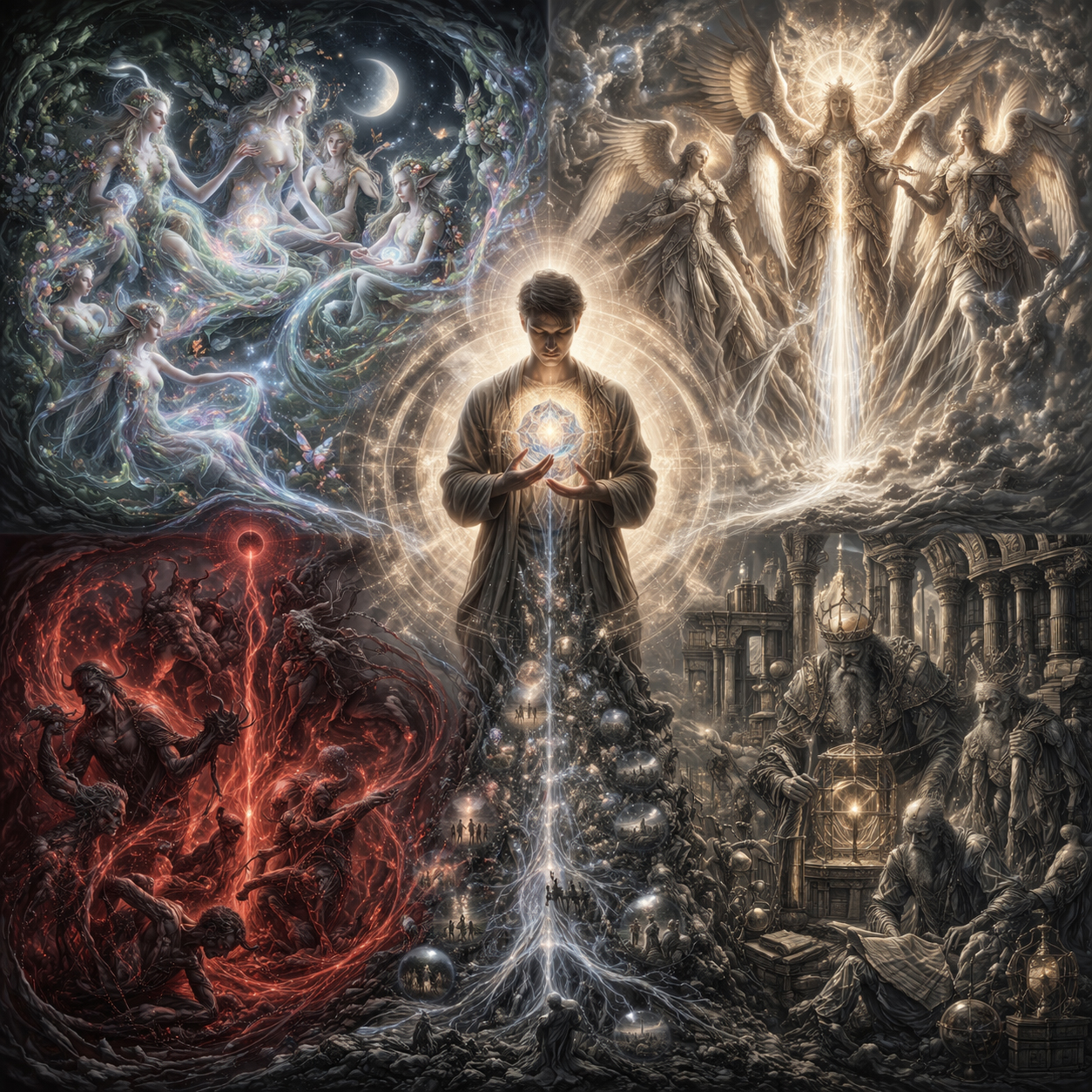
To grasp what is meant here, recall that between neshama (associated with the sefirah Daath) and yechida (which can be correlated with Chokhmah or even Keter) lies the “second half of the Abyss,” which must still be crossed for the final imprinting of experience — and then the “Great Sea”: Binah, the principle of Universal life. We have already said that Binah is the summit of the mind of the Fair Folk; they proceed from profound unity rather than from individual disclosure, as humans do.
We also discussed that angels are born from the “Flow of creative fire” — Dinur, the energy of aspiration of the Middle Pillar, descending from Keter into Malkuth; in fact, mezla, the descending light of Daath. The nature of angels runs counter to the direction in which experience is assimilated; therefore they also do not accomplish final imprinting. Demons, by contrast, form the basis of the ascending flow, are cut off from the higher lights, and likewise cannot create chotemoth.
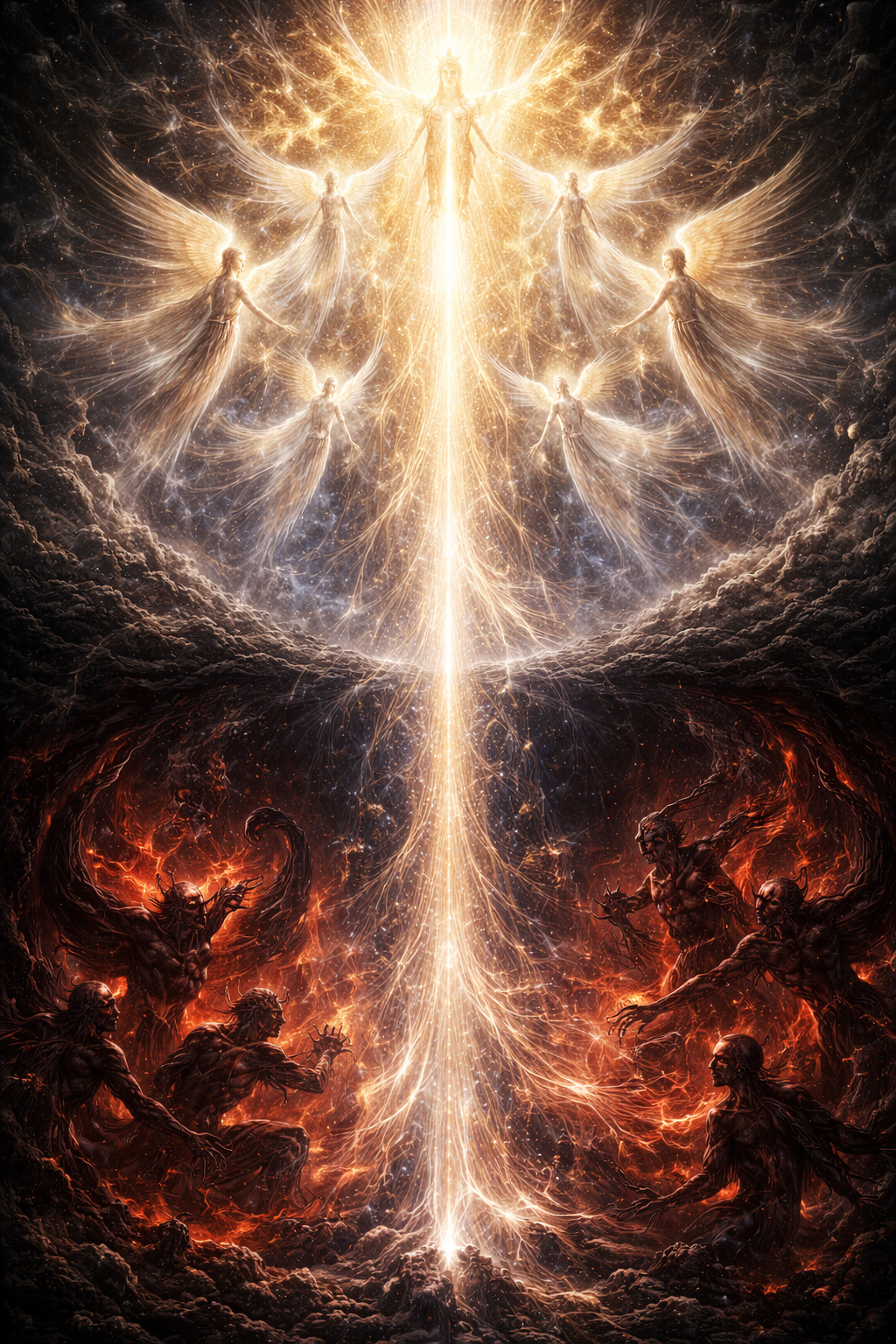
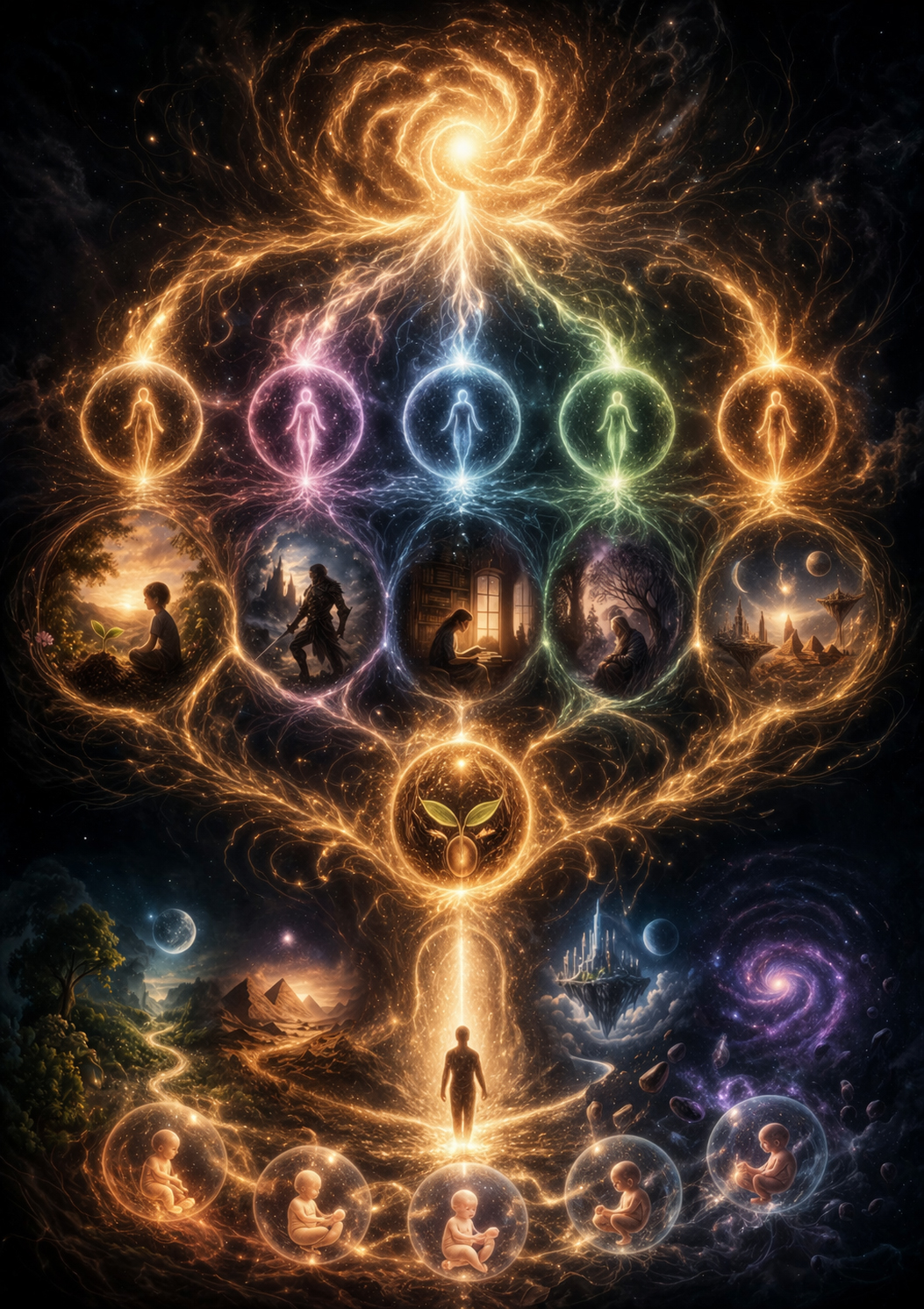
Finally, by monad (or “divine spark”) the Tradition means the potential beginning of individuality: the fundamental mode of subjectivity that localizes the one mind within a differential flow. Monads are not things that “exist,” not objects; they are a property, a capacity of the one mind to manifest in multiplicity. Monadness expresses the mind’s capacity to know, just as energies express being’s capacity to be knowable. It is therefore incorrect to say that beings possess monads; it is more accurate to say that certain currents of mind have a monadic nature— they arise from the mind’s inner striving to know, to reflect, to be a subject.
The monad is the very possibility that a Way will be traversed as someone’s own. The seed atom, by contrast, is the outcome of gathered experience: its irreducible residue, what has held within the fabric of the current of mind. The monad is the principle of subjectivity; the seed atom is what this subject managed to carry through the repeated destruction of temporary shells. The first concerns the mode by which mind localizes; the second concerns the content of that localization.
Accordingly, for beings originally deprived of a connection to the source of such stable subjectivity, forming that connection — that is, the acquisition of a “soul”, or more precisely, monadness — is possible in two ways:
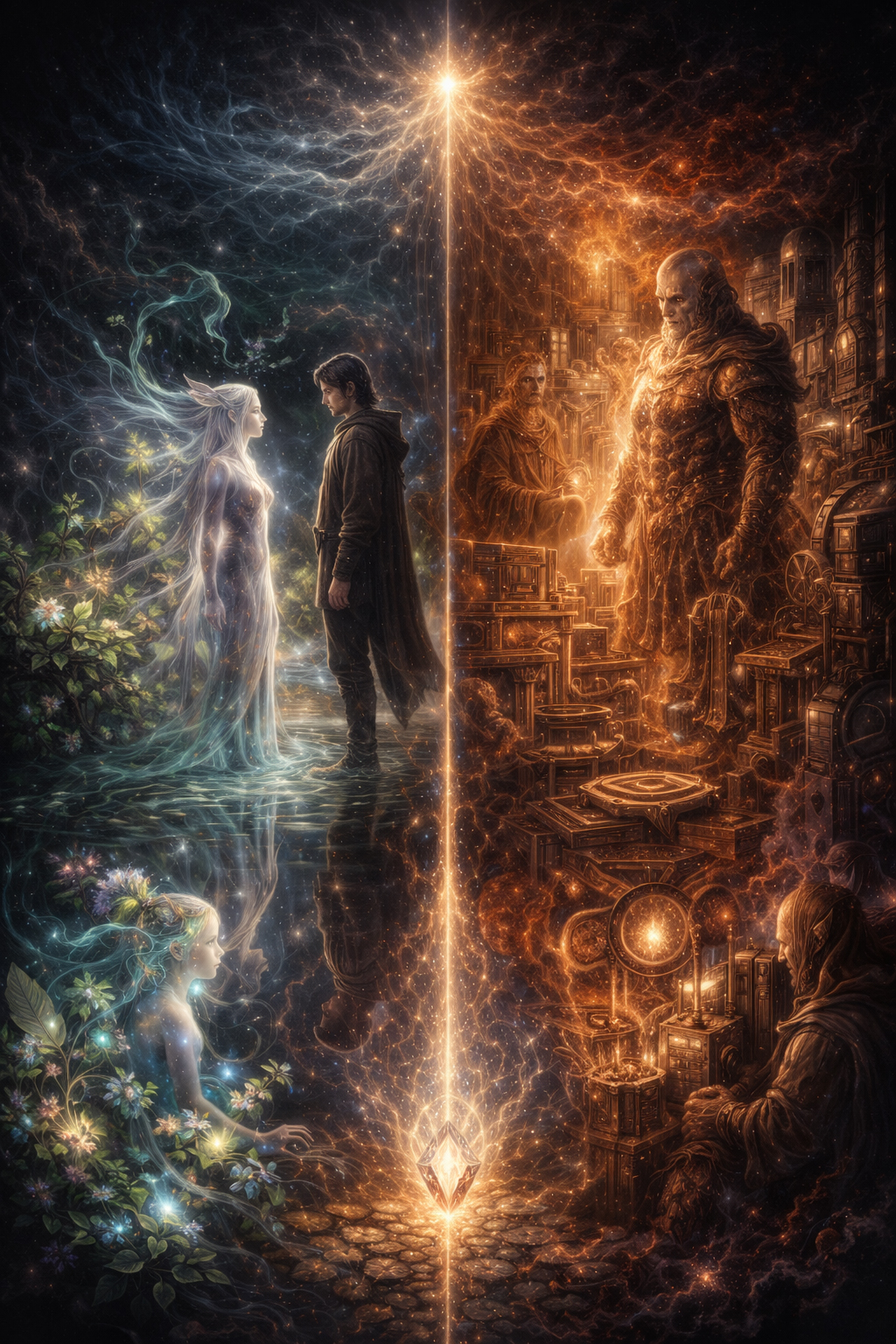
1) by establishing a bond between flowing and individual nature — becoming aware of oneself not only as an element of the whole, but as a self-determining unit. This is what happens to the Fair Folk when they, for example, fall in love with mortals: love is a different kind of unity, one that demands the fullest manifestation of individual qualities and their mutual reflection. As we have already discussed, half-bloods born from unions of the Fair Folk and humans also possess a monadic nature, though it remains under strong influence of the Faery flow.
2) by “constructing” a system for producing imprints that relies on external carriers. This is what the Grigori did: they acquired stable individuality, no longer dependent on functions, through the condensation of vortex structures into dense bodies.
While the Grigori were seraphic vortices, they participated in the world’s movement, kindled will, sustained the tension of forms — yet they had nothing that could be called a destiny of their own. A ministering being has a function, but no inner residue, no sense of individual value. This became the Grigori’s principal limit. It was not enough for them to conduct impersonal will and return to Dinur. They wanted not only to act, but to hold the consequences of action within themselves — to be not as a process, but as a definite “I.” For this they required a soul: a support, an “organ” of duration. Only through the light of neshama do personal memory, inner continuity, responsibility for what has been lived, and the relative immortality not of a function but of individuality become possible. The soul was necessary to them as a bulwark against dissolution. Without it they would have remained eternal, but not self-possessed. Having built this support of selfhood, they became themselves — but at the price of dependence on the stage, on the world, on form. Their entire Descent was an attempt to purchase inner continuity at the price of the world.
Thus, one may say that the Grigori created an “external prosthesis” of the soul: a system for holding subjectivity, rooted in prolonged fixation in density, in the memory of forms, and in the extension of embodied presence. Their individuality is real, their personal history is real, their suffering and will are real — yet the basis of this stability remains secondary and conditional. Therefore their individuality is always more strained, more dependent, and more fragile than the human one. A human bears the possibility of imprinting in the very structure of the psyche; the Grigori must maintain continuity as a complex construction. This is why their position is tragic: they are no longer pure ministering powers, yet they are still not beings for whom inner imprinting of experience is naturally born from the depth of monadic nature. Their “soul” endures only as long as they themselves remain stable, whereas for a human, at least in possibility, life itself should be the material for the growth of the seed atom.
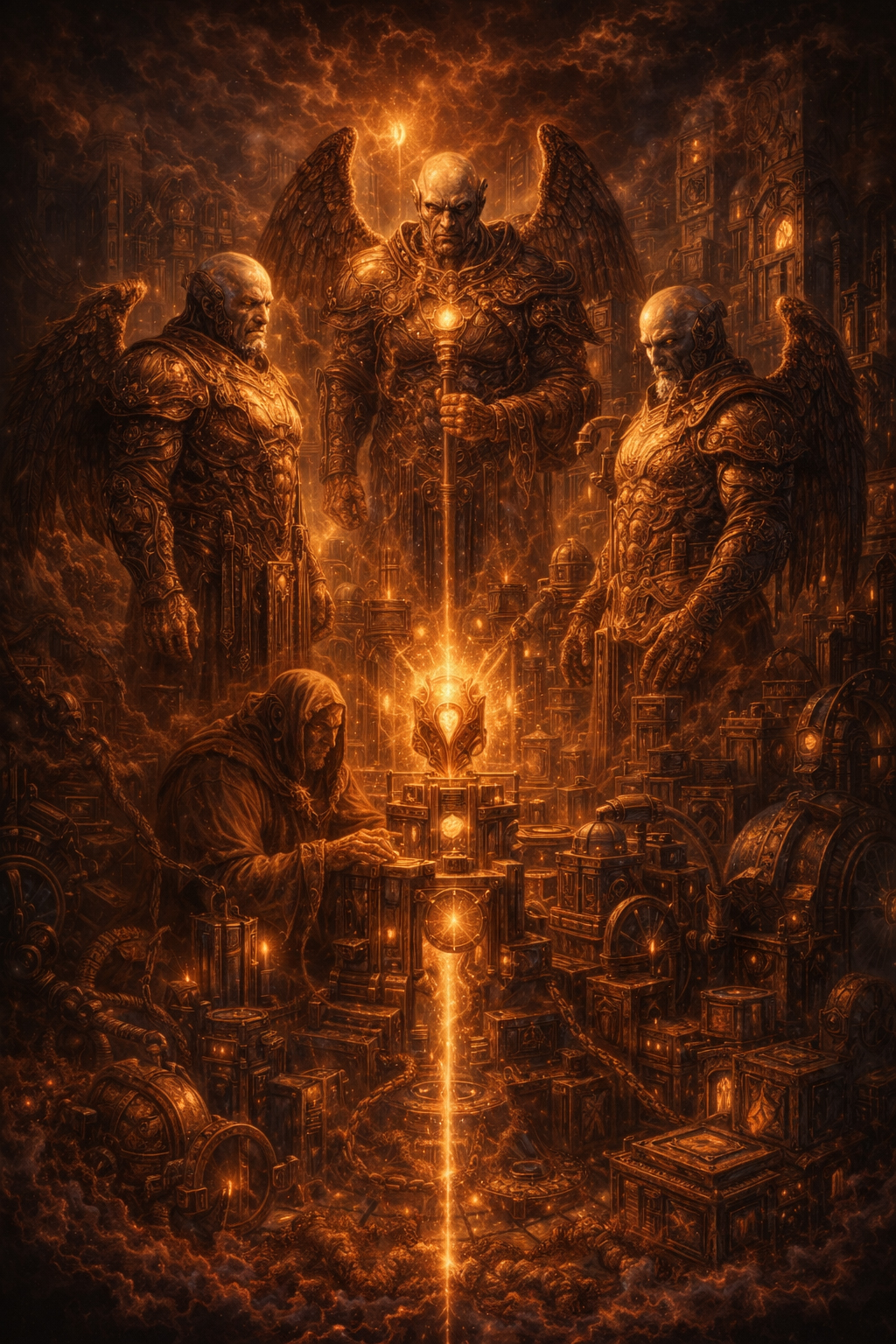
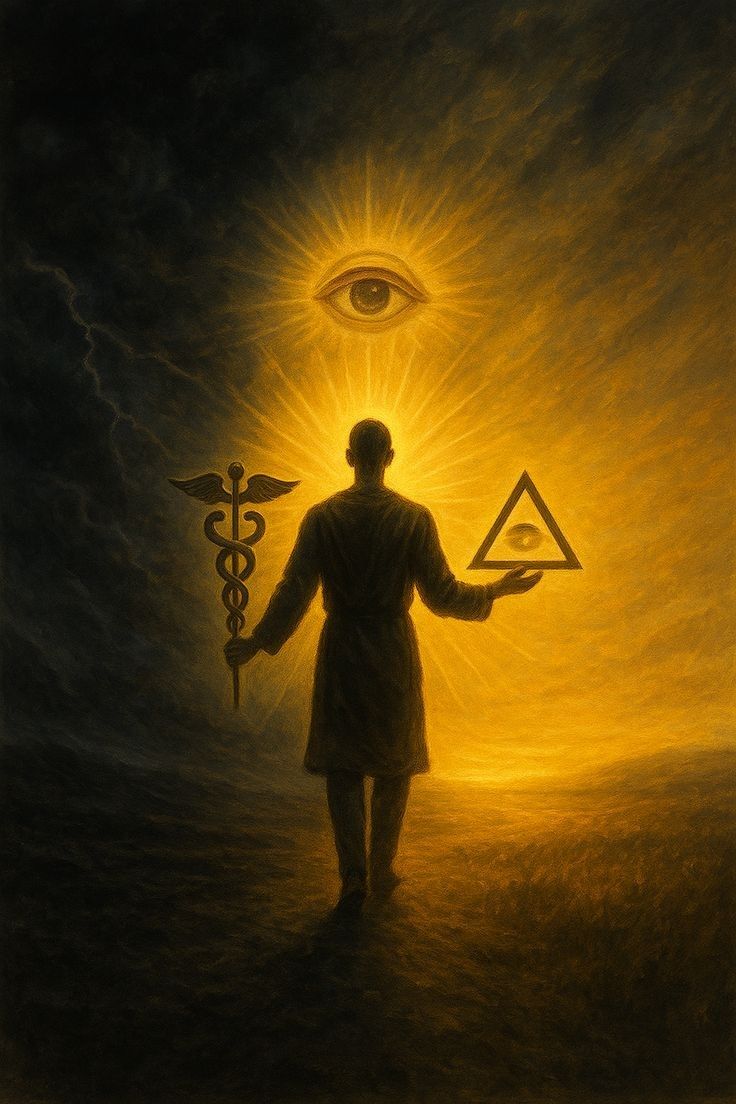
This makes it possible to see that the Magus’s Way is not aimed at the religious “salvation of the soul,” not at its “training,” and not at comforting oneself with the dream of posthumous preservation of the familiar “I.” Its task is to gather accumulated, lived-through experience into a form that will not fall apart with psyche and body. The Magus is concerned not with the continuation of the present personality, but with ensuring that something passes through it that can become an inner imprint. Not every life yields a soul; not every suffering deepens; not every experience becomes an inner acquisition. To live mechanically is to return what has been lived straight back into the world vortex. To live with awareness is to turn impressions into experience, experience into knowledge, and knowledge into an imprint upon the very fabric of mind — something that can be carried through a succession of incarnations. Therefore, for the Magus the main thing is not to “have a soul,” but to refuse to squander life’s possibilities and to make one’s temporary form a true instrument of imprinting. This is why, in the Tradition, the question of the soul always becomes first and foremost a question of the discipline of mind, the quality of lived experience, and the ability not merely to live, but to live fully — and to imprint what has been lived.



Thank you so much for your wisdom!
Thanks for the article!
As I understand it, “khotemot” isn’t identical to the concept of “samskara”? Khotemot is assimilated experience, while samskara is more like encapsulated archives.
You write that unprocessed experience falls apart almost immediately. And yet during the so‑called Great Work, we constantly run into countless of these not-fully-lived-through samskara-impressions, including, apparently, ones connected to past incarnations. What do you mean when you say they “fall apart almost immediately”?
It’s important to distinguish between two kinds of imprints: reshimot (imprints in the environment) and hotemot (imprints in consciousness). The environment is absolutely passive, and therefore carries “memory” of every single event without exception; it can’t “erase” anything from itself. Consciousness, on the other hand, is active, so only what truly changes the nature or structure of its flow gets “imprinted” in it. So we’re always surrounded by reshimot and filled with hotemot; however, actions or events that may be subjectively important but are still “not fully lived through” or “not fully recognized” remain only as reshimot, and their energy dissipates (and is usually consumed by various consumers). So when people talk about the “shadow” or other “layers,” they mean precisely these kinds of “memories of beginnings” that never got an ending—births of impulses that weren’t carried through to a full and adequate realization.
What does the model of interaction between subjective consciousness and the imprints of reshimot look like?
There are, for example, certain world events—an oil tanker spill, or some Tatar-Mongol invasion—that get imprinted in every consciousness. What keeps them in consciousness until they’re lived through—some kind of collective responsibility agreement? Is it theoretically possible to work through this collective shadow of humanity, or won’t the intensity of the processes allow it?
It’s noticeable that these imprints show up as various psychosomatic disturbances and illnesses. And I have a suspicion that from century to century this burden only grows, with no reverse process—except for a few individual magicians who do this work on themselves. Is their contribution significant, or is it just a drop in the ocean?
Sorry for the messy wording—it’s hard to grasp this topic, and I don’t feel I have enough concreteness in me.
In my view, the soul is something else, and everything described here about the soul is actually about the spirit. The soul is a derivative of those structures that are called Heaven in Christian mythology. Prav.
Reshimot aren’t located in consciousness; they exist in the informational aspect—the Synezis (https://www.enmerkar.com/mezhmire/biblioteka-sinezisa-i-hranenie-informaczii). Consciousness gains access to those of them for which it has “keys,” and such a “key” can be either the consciousness’s own state—the processes it’s going through right now—or special “access codes.” In other words, consciousness “reads” the reshimot that, for one reason or another, are connected to it at the present moment. And it’s clear that reshimot generated by the being itself have an affinity with it, and therefore are more easily accessible than “someone else’s.” They’re exactly what creates that “broth” of energetically rich memories, which in turn forms either the channels of outflow or the paths of development.
Thank you so much!
A wonderful article — once again I’m convinced of your talent for looking at the subject you’re exploring from two sides, or in multiple layers.
In my own experience, I’ve seen how imprints play out an entire storyline, and your classification of the soul really does hold up. What’s especially interesting is that right now I seem to be tapping into the awareness of the “seed atom.” It feels like whatever left the imprint is trying to “reconnect,” and as a result grow into a different kind of intelligence.