
Sabaoth – the Archon Who Came to His Senses
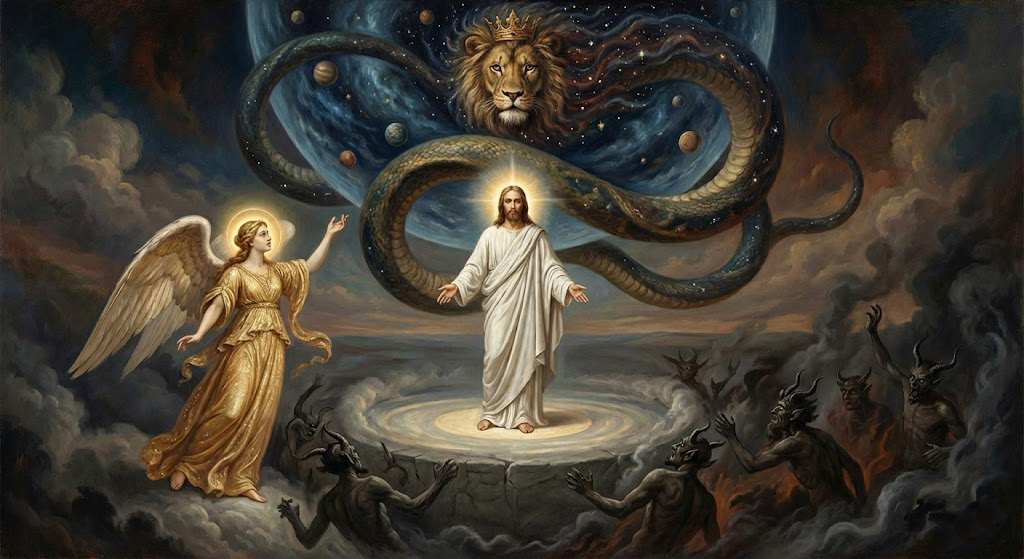
Within the Gnostic picture of reality, which describes the hierarchy of the interworld forces as a system of Ruling Spirits – Archons and Potestates – the figure of Sabaoth occupies a distinct and singular place. He is the being whose image embodies the very possibility of a qualitative transformation in the nature of “administrative” power.
This figure binds together the Gnostic and Hermetic Myths, acting as a “mediator” between aeonic, archontic, and “Kabbalistic” reality, and at the same time explaining the origin of the “underside” of the world – the Qliphoth.
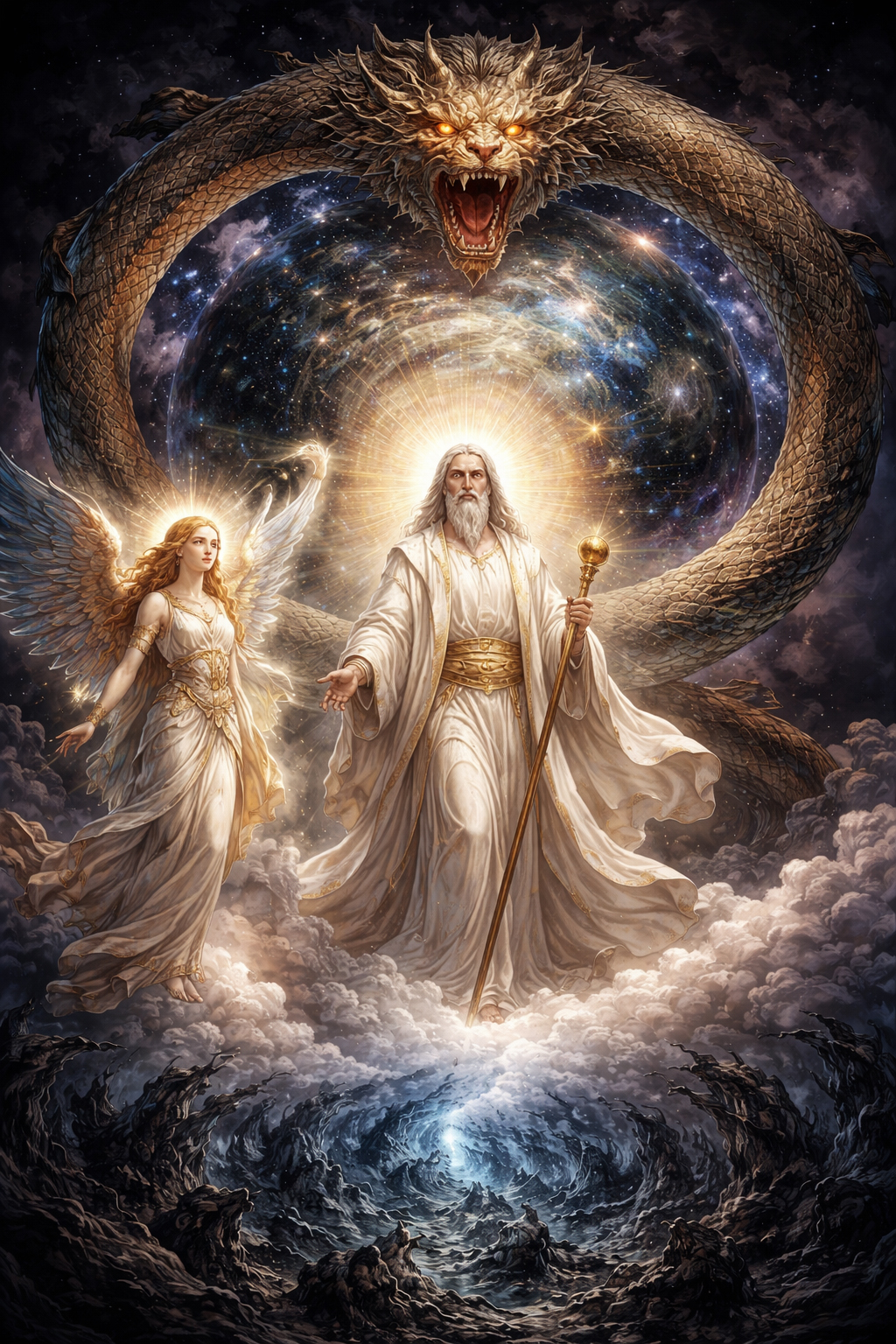
The Gnostic Myth of Sabaoth is devoted to a decisive cosmogonic event – the “unlocking” of the cycle of self-sustaining delusion. Within the hierarchical system of forces that assert and maintain reality, Sabaoth occupies an entirely exceptional position, appearing either as the “son who came to his senses” or as the “benevolent double” of the primal Archon Ialdabaoth.
The events of this Myth show that even within the densest and most inert structures of the demiurgic order there remains a potential for turning back toward the Pleromic Source of being. While the Blind Demiurge is the expression of darkened creativity, tragically locked into its own ignorance, Sabaoth personifies that part of the creative impulse which was able to recognize its own secondariness and to hear the voice of the Pleroma through the veils of the Interworld.
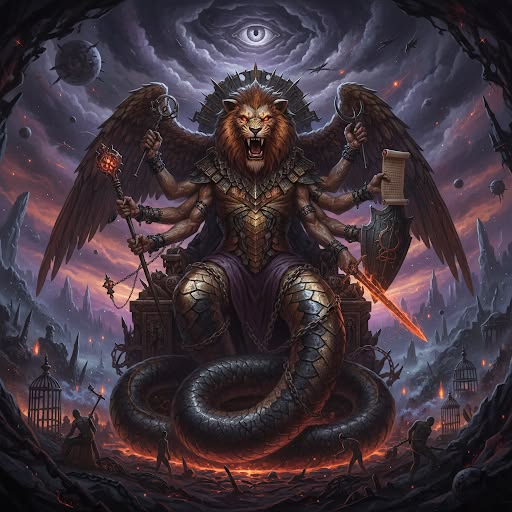
In the classical form of the Gnostic Myth, presented in such texts as the “Hypostasis of the Archons” and “On the Origin of the World”, Sabaoth is described as one of the seven planetary sons of Ialdabaoth. This “fatherhood” and “sonship” are stages in the unfolding of the demiurgic Logos: Ialdabaoth as “Father” embodies the primary, blind inertia that seizes the Creative impulse and fixes it in an imperfect creation, while Sabaoth as “Son” is the offspring of this inertia who, through an act of “metanoia” (repentance), acquires the capacity to see the Light. In this perspective, Sabaoth’s origin as “son” emphasizes the possibility of transformation within the system itself, where the heir of the Blind Creator becomes a conscious ally of Wisdom. At the same time, some Gnostic schools regarded Sabaoth merely as a “mask” of Ialdabaoth — an “alter ego” of the blind tyrant, who keeps souls in bondage to matter under the guise of the “Lord of Hosts”.
A deeper and more technically articulated picture appears in the text of “Pistis Sophia”, where Sabaoth is presented as an entire hierarchical vertical: from the “Great Good Sabaoth”, dwelling in pure Light and standing outside the archontic systems, down to the “Lesser Sabaoth”, who governs the interworld, and “Sabaoth-Adamas”, who remains in the ignorance of the wrathful Archon. Yet the most significant image is Sabaoth as a power that has crossed from mechanical repetition to conscious stewardship.
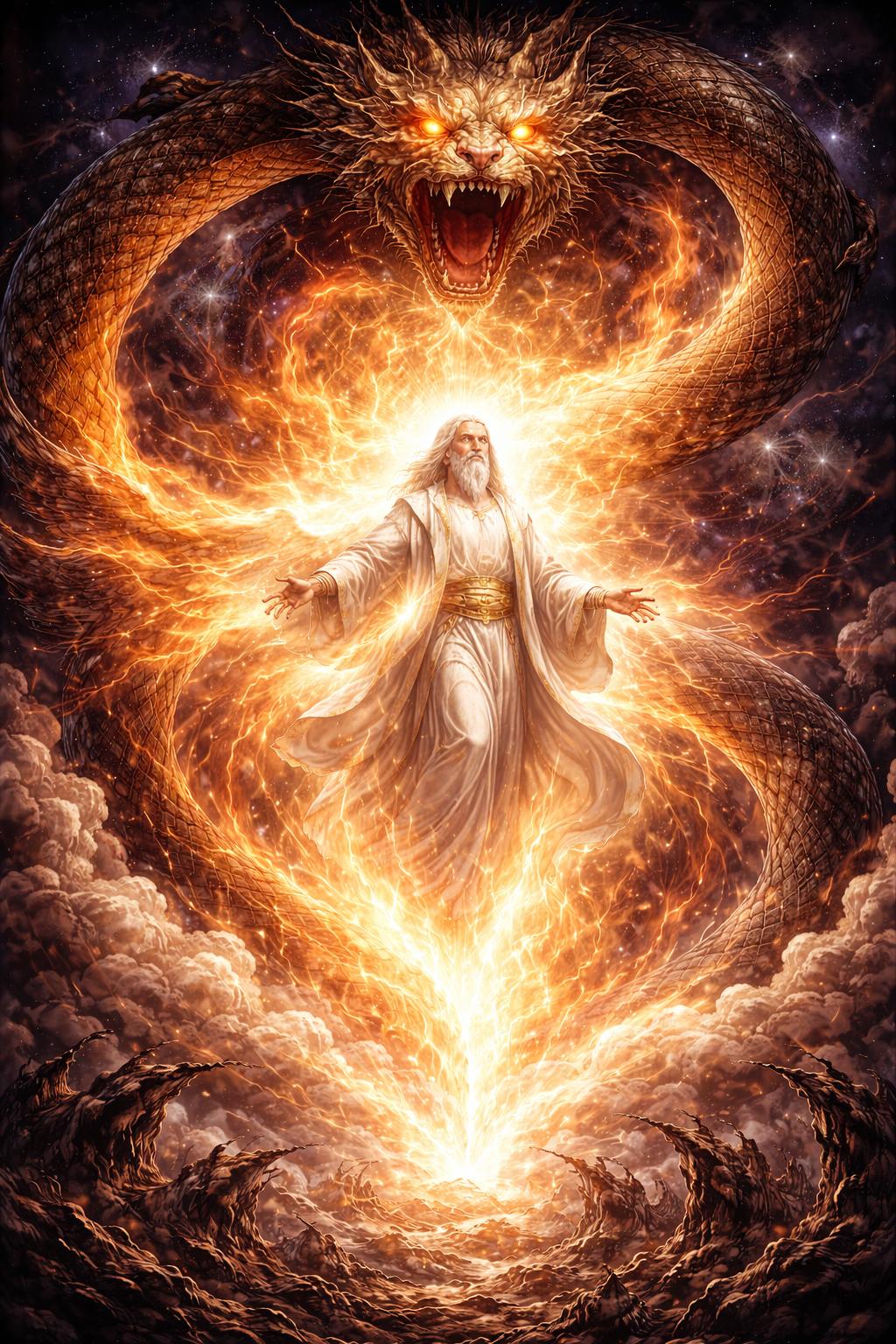
In every case, the functional role of this power is bound to the “wrath” of Ialdabaoth. This wrath is a form of governance and a mode of ordering available to the usurper: Ialdabaoth is the “jealous God” who orders the universe by “repelling” those probabilities, those potentials which he “does not wish” to actualize. The demiurge’s creation is the manifestation of his wrath itself – a repulsion that selects, from the infinite field of probabilities in Sophia-Achamoth, those that he deems “worthy” of realization. Sabaoth is the manifestation of precisely this “creative wrath”. Every world, every universe is born as the result of the “repulsion” of those possibilities that do not belong to it, that do not fit its inner logic; and it is Sabaoth, as the manifestation of the Demiurge, who carries out this repulsion.
The Name “Sabaoth” (Greek σαβαωθ, Hebrew צבאות, Tzvaot — “hosts”, “forces”) is a key title marking this transition from chaotic creation to ordered governance. The plural form at the root of the word points to the countless structures, algorithms, and “heavenly ranks” that constitute the informational fabric of the manifested cosmos, since the word “צָבָא” can denote stars, elements, laws of nature, as well as the “Heavenly Armies” — angels, seraphim, cherubim. Thus, while Ialdabaoth is the blind impulse of creation, Sabaoth is the lord of those very vectors and “angelic” forces that hold the universe in a state of dynamic equilibrium, “excluding” from it all “alternative” possibilities. It is telling that this title is almost absent in the most ancient layers of the Old Testament tradition and becomes dominant only in the era of the Prophets, which underscores the evolution in the understanding of the principle of cosmic organization: from the idea of a tribal patron to the concept of a transcendent Ruler whose scope encompasses all cosmic phenomena — from the motion of the stars to the currents of angelic hierarchies. In this perspective, the stars and cosmic laws themselves are the “heavenly hosts”, and their lord, Adonai Tzvaot, appears as the force of the world’s structural integrity.
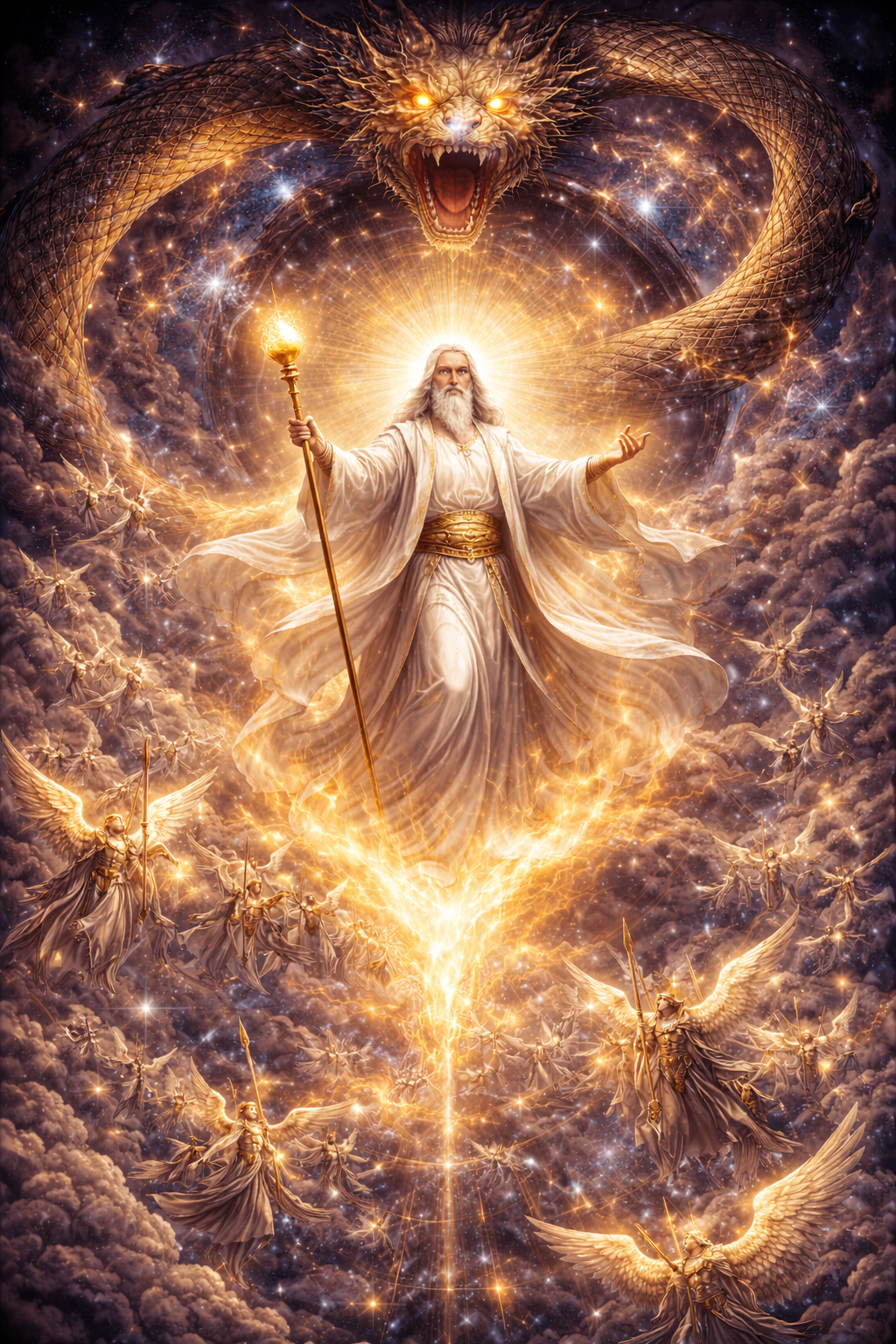
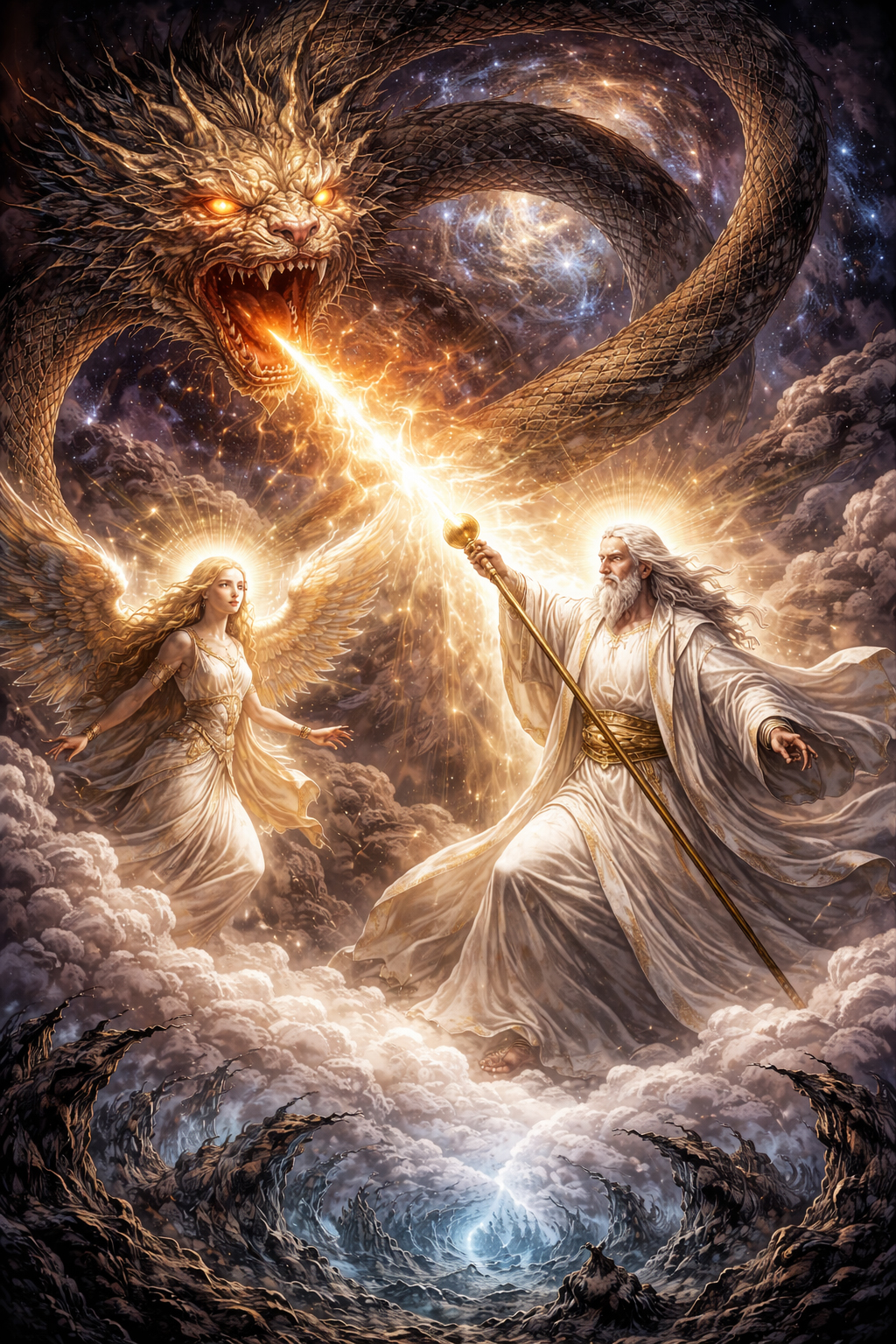
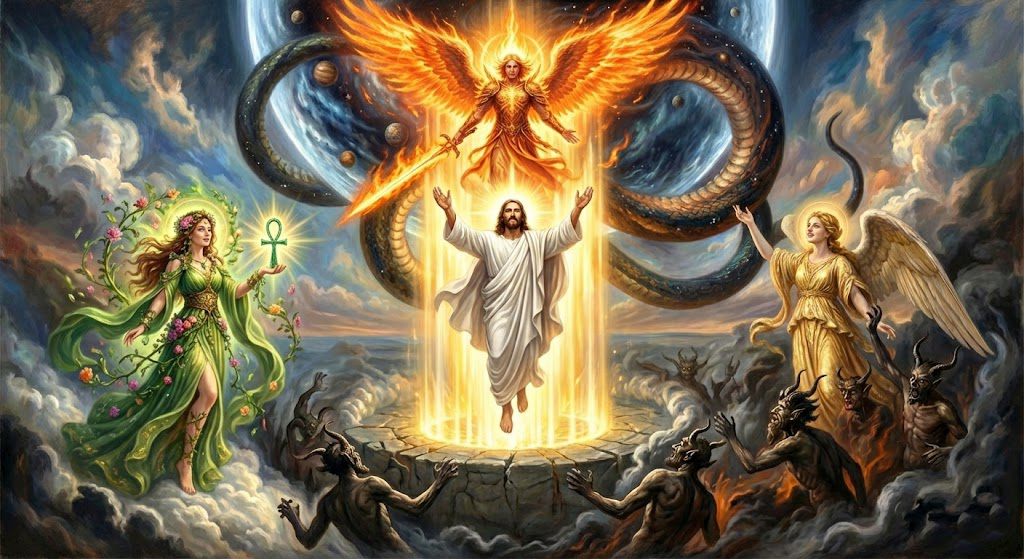
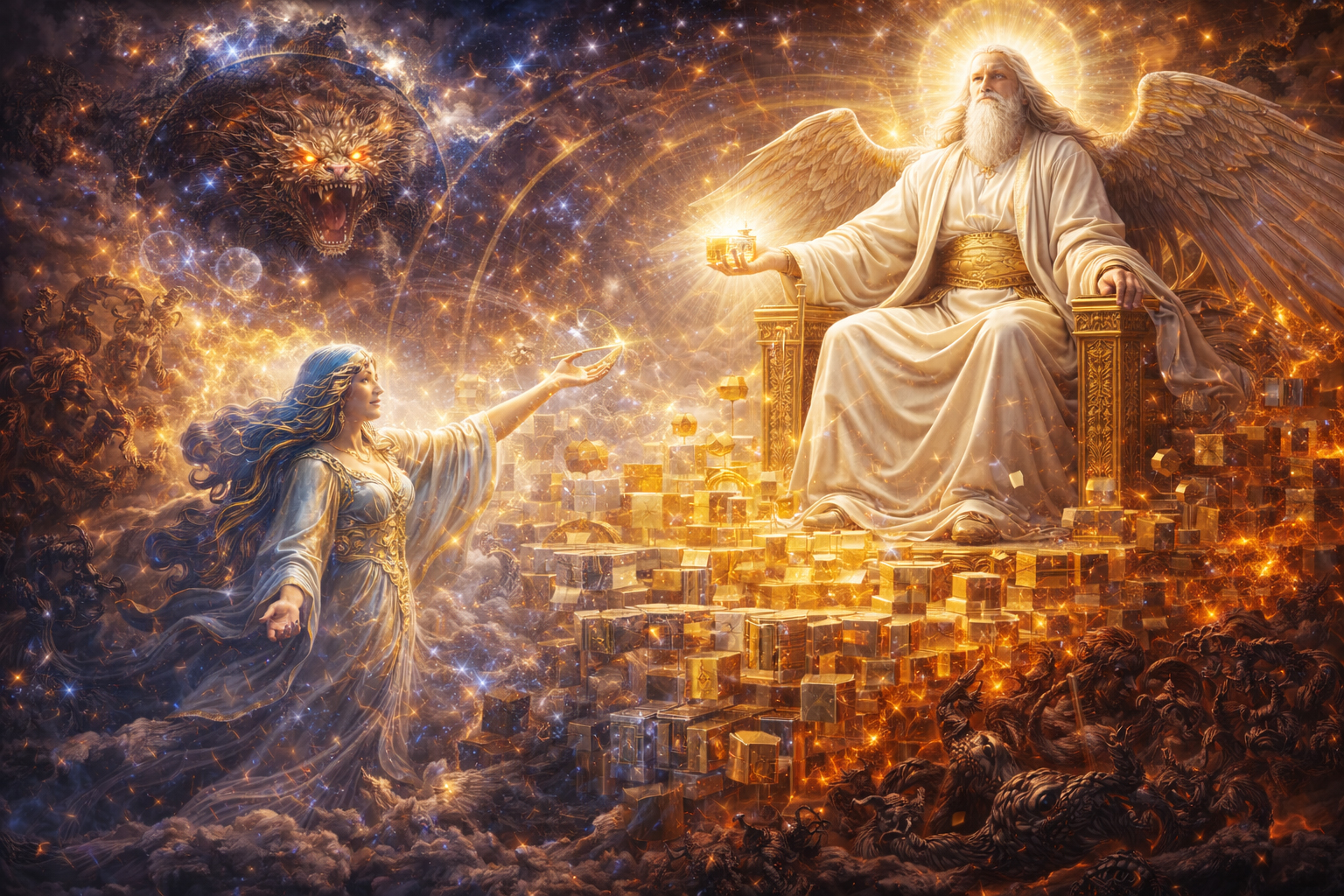
According to the Gnostic myth, Sabaoth’s awakening occurred at the moment he heard the voice of Pistis Sophia, proclaiming the existence of the Immortal Human (the Aeon Anthropos). According to the “Hypostasis of the Archons”, Sabaoth beheld the manifestation of a Fiery Angel (the Aeon Logos), linked with Zoe (Life), and this vision shattered his habitual loyalty to the “parent of power”. He saw that meaning, the semantic first principle, is rooted not in the arbitrariness of Ialdabaoth, but in a higher, aeonic ground. This realization compelled him to reject the inertia of matter and to condemn his father’s ignorance, symbolically portrayed as the casting down of Ialdabaoth into the abyss of Tartarus — the victory of conscious (logos-like) order over a blind drive to domination. Sabaoth “repents” of his “falling away”, after which Sophia and her daughter (or, conversely, Mother) – Zoe (Life) endow the “Archon Who Came to His Senses” with a portion of their Light, then raise him and enthrone him in the seventh heaven, “beneath the Veil” that separates the upper from the lower, at the very boundary between the worlds of separation and the unity of the Pleroma. From this moment he bears the name “God of Hosts” or “Lord of Hosts” — a title that states directly that this is not the Pleroma, but the command over the forces of the lower levels. The “seventh heaven” stands as the Limit, where the archontic structure ceases to be a prison and becomes a space of protection and awakening. Accordingly, Sabaoth, as the Archon who has “been saved”, is no longer a jailer of souls; he becomes the Guardian of this Boundary — the Horos.
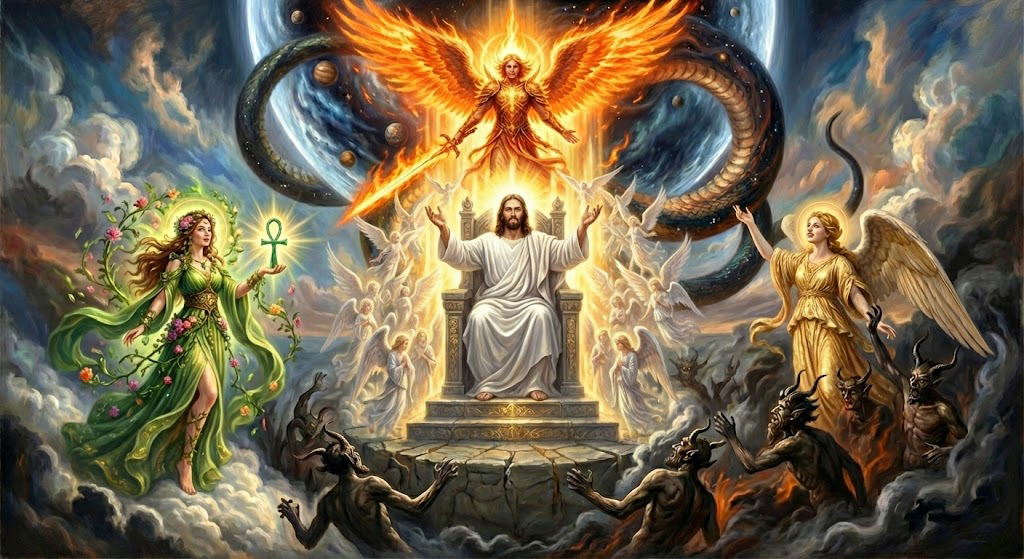
After this exaltation Sabaoth realizes his demiurgic capacities in a new mode. He builds a Great “house” and establishes a Throne upon the Merkabah — the four-faced chariot of the cherubim — and institutes angelic choirs and ranks, creating within the lower cosmos the image of a Pleromic “assembly” that reflects the order of the Aeonic worlds. Thus arise the “ministering” hierarchies of the cosmos, which uphold its structure and sustain its dynamics.
In this process a clear parallel emerges between the “Ascent” of Sophia and the enlightenment of Sabaoth. The ascent of Pistis Sophia is the macrocosmic path by which the principle of Wisdom returns to the Fullness through thirteen stages of repentance, while the metanoia of Sabaoth is the other side, the mirror image of this process within the archontic structure of the universe itself.
Both events share a common point of initiation: a turn of will from self-enclosure toward recognition of the higher Source and the striving for reunion with It. The driving force of this ascent is Abraxas — the perfect creative fire of divine will. Touching the consciousness of Sabaoth, it compels him to recognize in the voice from Above the message of his true nature. Yet Sabaoth remains “beneath the veil”; he does not abolish the consciousness-enslaving system of heimarmene, but gradually “corrects” it, transforming ignorance into conscious care. Sophia lays down the very channel for ascending consciousness; Sabaoth provides the “technical support” of this process within the potential spaces of the interworld, becoming an ally of the pneumatic on the path through the spheres of the Rulers.
Beside him stand Zoe as guide to the “Eighth” heaven, and the Angel of wrath (clearly Samael) as the shadow of the power-aspect of dominion, from which there grows the “Tree of Evil” — the abyss of the Qliphoth. In this sense the Qliphoth are the “husk” of ignorance that remains after Sabaoth has transformed and “corrected” reality. Samael’s duality reflects both the “sprouting” of the Tree of Qliphoth from Geburah and its support in Hod (more precisely, in Kelev). Sabaoth is thus the ruler of the hosts and forces at the boundary of three levels at once – aeonic, archontic, and qliphothic realities.
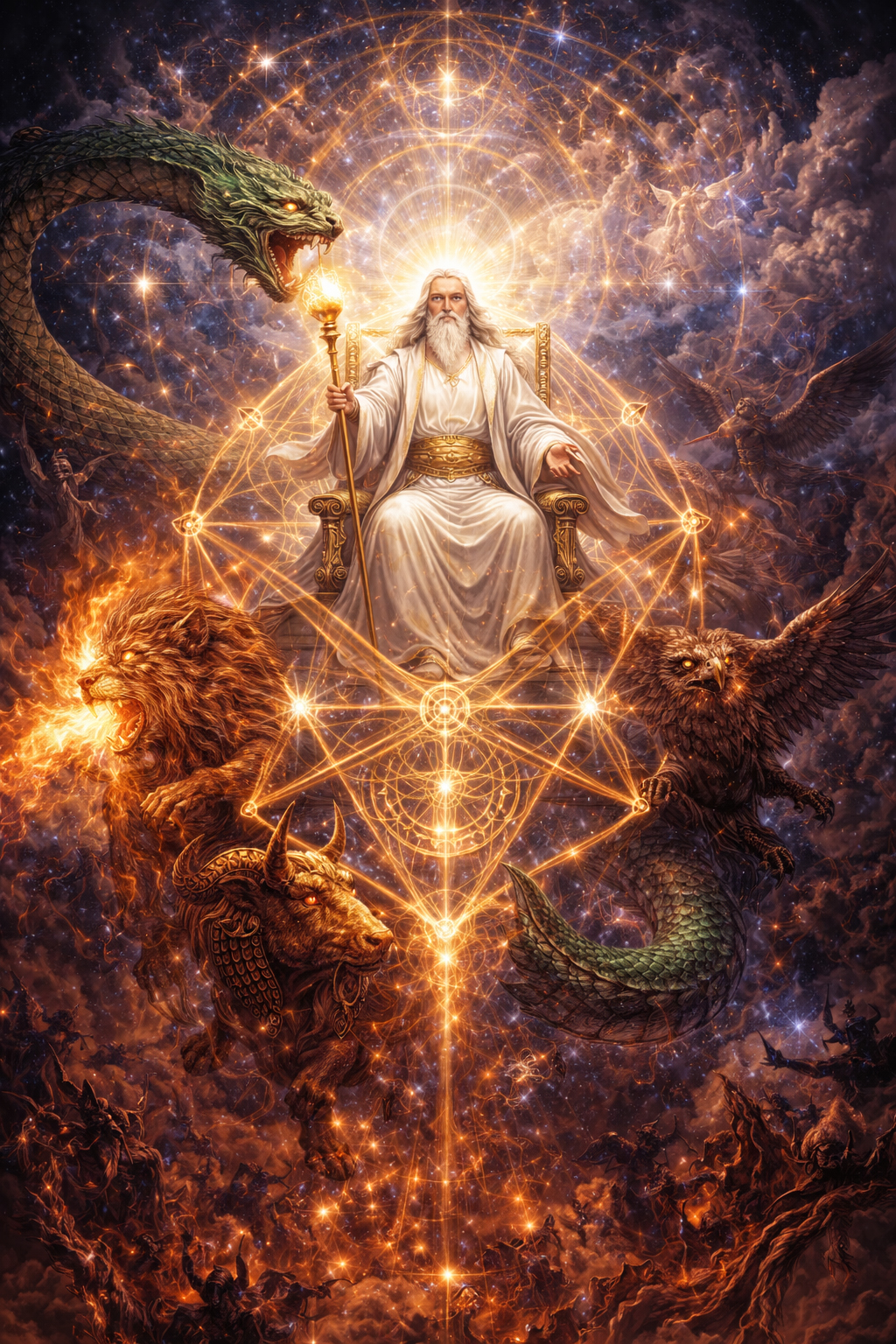
The Kabbalistic tradition links the name Tzvaot with the sefirot Netzach (Victory, Endurance) — in the form Yahweh Tzevaot (יהוה צְבָאוֹת) — and Hod (Glory, Majesty) — in the form Elohim Tzevaot (אֱלֹהִים צְבָאוֹת). This indicates the capacity of this power to fix the impulse of the Pleroma in stable forms. In the “Sefer Zohar” Yahweh Tzevaot is God in the aspect of active, victorious force, governing all organized energies of the universe. From this standpoint, the “Hosts” are dynamic information fields through which the interaction between the transmundane Source and the world of separation is carried out. The well-known angelic doxology “Holy, Holy, Holy” (“Kadosh, Kadosh, Kadosh”, which can also be read as “Other, Other, Other”), addressed to Sabaoth (Adonai Tzvaot), proclaims the presence of this “Other” Light within the archontic order. To acknowledge Sabaoth as “Lord of Hosts” is to establish, within both macrocosm and psychocosm, an order in which every particular energy finds its place within the overall movement back to the Source. In this sense, Sabaoth is the name of the World Vortex that has been tamed and directed into service to a higher aim.
This “turn” of archontic nature does not mean that Sabaoth “becomes the Pleroma” or departs from conditioned reality. The texts emphasize his intermediacy: he is stationed in the seventh heaven and remains “beneath the veil”. Sabaoth is therefore the principle of savedness within the archontic system, not of transcending or abolishing conditionedness itself. In Gnostic understanding, Sabaoth is simultaneously distinct from both the blind Ialdabaoth and the highest Father of Truth, and his Throne stands within the lower cosmos. Thus Sabaoth represents the rectified demiurgic impulse: a creative power and rulership that no longer rests on self-assured ignorance, but has chosen to serve ascent and rectification.
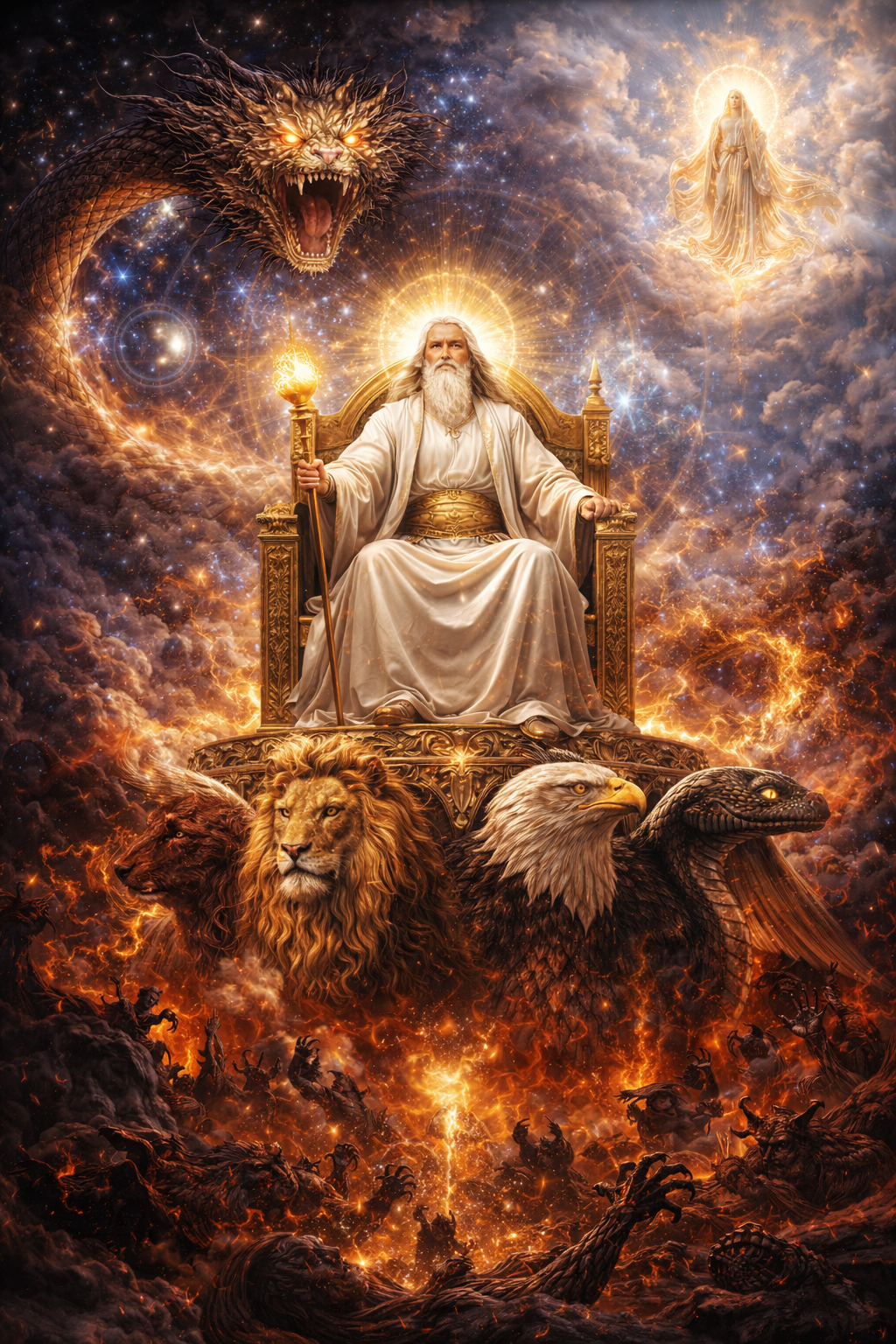
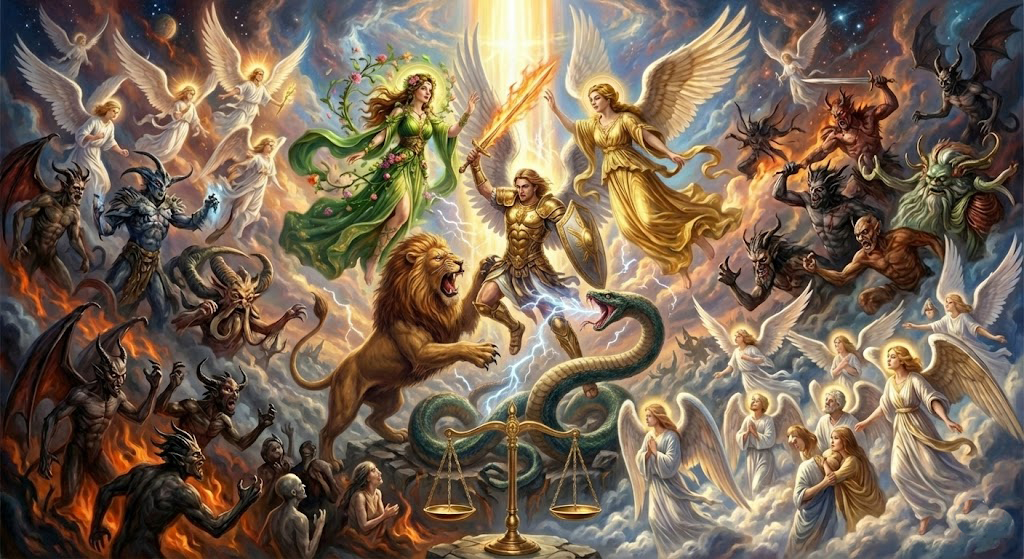
This turn of will inevitably provokes a reaction from the “old center”. The relation between Sabaoth and Ialdabaoth is described as an eternal conflict between conscious order and blind envy, between ascending striving and “horizontal expansion”. Ialdabaoth, cast into the abyss, engenders Envy and Death in response to his son’s transfiguration. Some sources describe this “division” of demiurgic activity into “benevolent” and “malignant” aspects by analogy with the “two faces” of Sophia – Pistis and Achamoth. This accounts for the presence in the world of destructive currents that seek to ruin every structure that acknowledges the Light.
The text “On the Origin of the World” speaks of a “war in the seven heavens” over the light of Sabaoth. Pistis Sophia raises him aloft, assigns servants to him, establishes his sovereignty over the “twelve gods of chaos”, and then introduces the symmetry of right and left, justice and injustice, because even a “rectified” power in the conditioned world remains a force of division and judgment, required to maintain structure until its final transfiguration (“complete rectification”, gmar tikkun).
Thus, while Ialdabaoth is the blind “fatherhood” of the system that demands subjugation, Sabaoth is the principle of “sonship” that has crossed over from mechanical repetition to awareness.
When knowing ceases to be merely a system of explanations and becomes a vector of transcendence, it activates in the psyche this principle of Sabaoth. It is a governing structure, an administration that knows (is conscious of) its strengths and weaknesses, its limitations and its place, and that provides for the safe passage of consciousness “to the other shore”, bypassing the snares of the Blind Demiurge. The energy of Sabaoth allows consciousness to relate to reality as to an ordered “heavenly host”, whose Ruler has already opened the Gates to higher knowing. Sabaoth is the force in which the administrative might of the Archons encounters the wisdom of Sophia, turning the world’s inertia into building material for the realization of the will of the Pleroma. He is the guardian and conductor of the great work of rectification, by virtue of which the path to the Light is possible from any point of the fall, provided that the will chooses the recognition of Truth and the movement toward it, rather than the preservation and magnification of its own shadow.

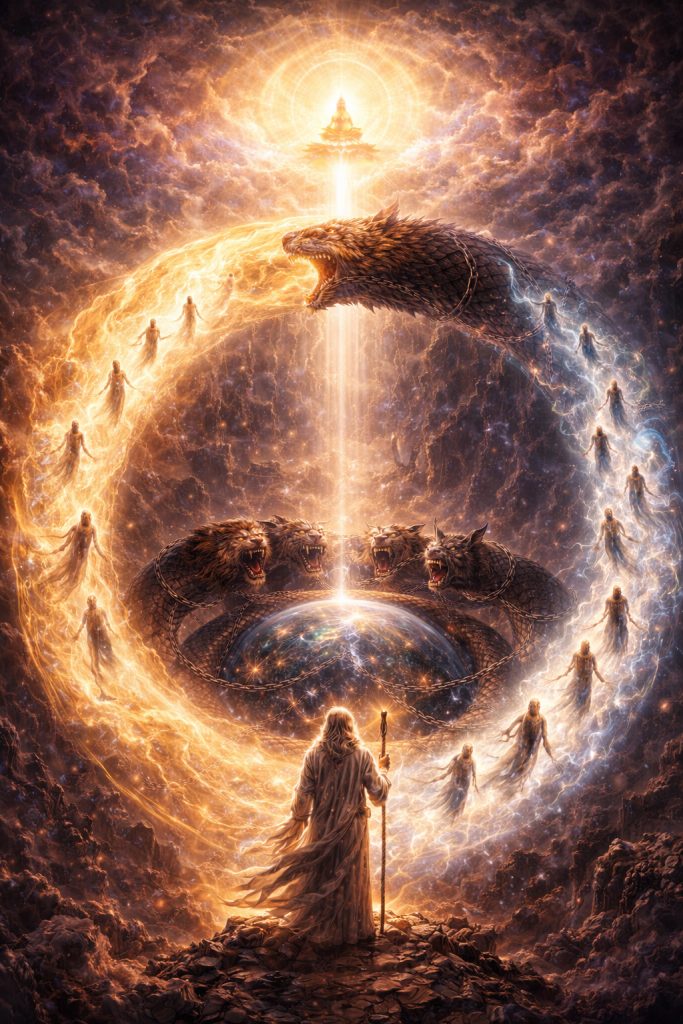
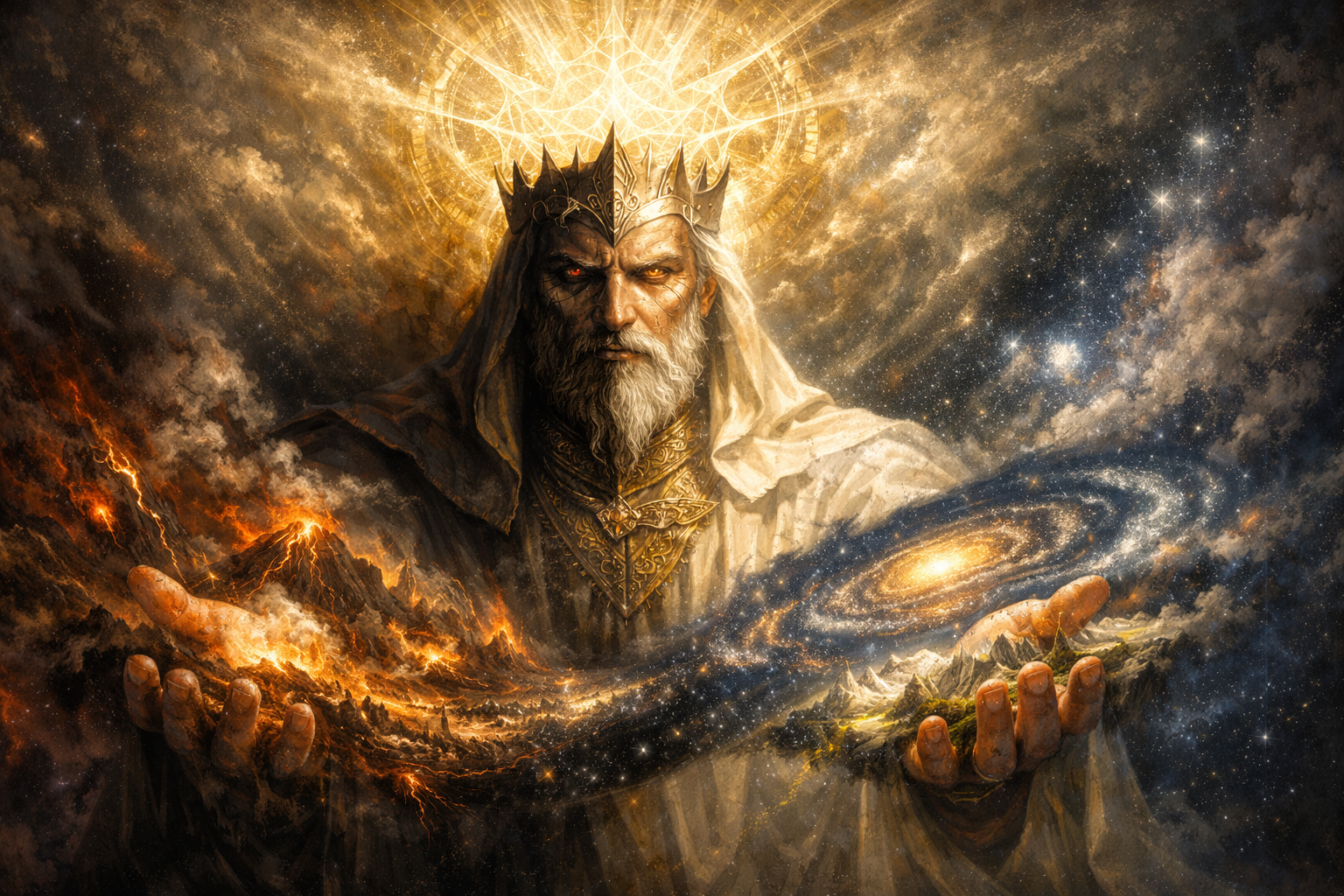
Can we, as an analogy to what was described above, consider the manifestation of the energy of Savaoth in the context of human psychology, as the manifestation of awareness when confronting the pleasure principle and the reality principle? Awareness acts as a manifestation of the will to distinguish oneself from chaos in order to move toward orderliness and structure, but it constantly needs to be maintained by keeping this principle in mind, which only becomes possible at a certain stage of development, and if successful, leads to its refinement.
Hello, is Kabbalah the same as Gnosticism?
Hello. No, these are different Traditions.
Indeed, if we project the conflict between Ialdabaoth and Sabaoth onto the human psyche, we get a map of the struggle for the emergence of the Subject. In its “blind” aspect, the Demiurge embodies the primary, undifferentiated impulses of the unconscious. This is the state of “fatherhood,” where the will is directed solely towards consumption and self-reproduction, not seeing its boundaries and not recognizing the “Other.” This is that “sleep” of reason that the Gnostics called agnoia (ignorance). The gemarment, on the other hand, refers to the external and internal limitations that “enslave” the psyche in rigid scenarios. This is the level where reality is perceived as a prison or a mechanical set of rules devoid of living meaning. The emergence of Sabaoth marks a stage where within the system of “desire-law,” a third force arises. This is the “Sonship” that turns out to be “above” the order that birthed it because it possesses the ability for reflection and distinction. It’s a volitional act of moving from the dreamlike state of the Interworld to informational stability. In Gnostic terminology, the awakening of Sabaoth is the achievement of the “pneumatic” level, capable of utilizing demiurgic tools (will, intellect, structure) for the purpose of liberating consciousness. In other words, we can say that Ialdabaoth is the “want,” the Archons are the “cannot,” and Sabaoth is the “aware,” and this awareness is the only path to genuine improvement and transcending the gemarment.
If we consider the name YHWH (JHVH) as the tetragrammaton representing the four elements (fire, earth, water, air) that make up the world, is there a possible analogy from alchemy where the blind Demiurge represents a world of these unbalanced elements, driven by the blind inertia of their mutual consumption, while Sabaoth represents the elements that have reached a state of mutual harmony, resulting in the birth of the Quintessence, which illuminates the coarse matter of the four elements, creating the world with pure Spirit, transforming the rough world with the Higher Light of the pleroma?
Yes, that analogy can be justified. Ialdabaoth can be described as “the cosmos of the Tetragrammaton without a center,” meaning a world of the four elements, where each acts out of its own blind necessity. In alchemical terms, this is the stage of crude matter: the elements are present, but they are not assembled into a cohesive structure, trying to assert themselves through mutual exclusion, resulting in gemarmene – an empty repetition without meaning, motion without direction. From this perspective, Sabaoth can be viewed as a “corrected demiurgical impulse” at the level of the same primordial elements. In alchemy, it can signify the stage when the four elements cease to be a passive substrate and become the building material of the Great Work. In alchemy, the quinta essentia appears when the four elements are combined in the right proportions, and then a subtle “fifth nature” is extracted from it – their common, purified meaningful essence. This can be described as the light of Sophia, which enters the demiurgical field of activity and makes it transparent to the Pleroma. Then the possibility of ascent and correction arises.
How do you manage to reconcile work within traditions that so clearly contradict each other? After all, the Good Deity of Kabbalah essentially acts as a “blind god” in Gnosticism. Can you please share how to avoid this internal contradiction?
That’s exactly what the article is about:
https://www.enmerkar.com/en/myth/the-two-souls-of-osiris
Amazing information! Thank you so much!!