The Mortal Soul
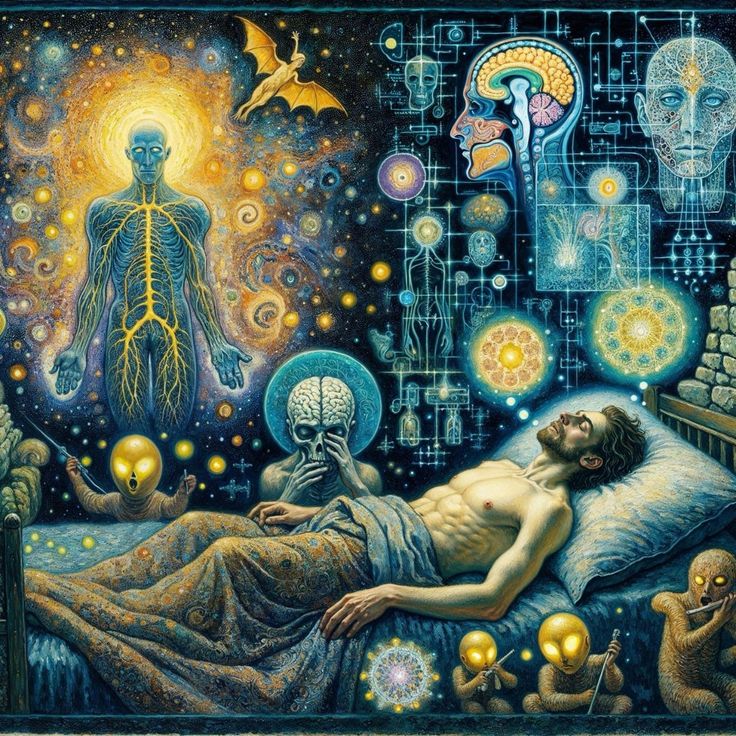
As we have discussed more than once, Traditional views of the so‑called “soul” — the immaterial seat of the psyche — differ substantially from both religious and materialist positions. Religious consciousness is usually comforted by the idea of the soul’s immortality; materialism, on the contrary, regards the soul as a byproduct of the brain’s functioning and denies it any independent existence. The Traditional view stands between these poles and, in a certain sense, is more pessimistic than either. In particular, from this perspective consciousness has a source more fundamental than the body, yet far from everything ordinarily called the “soul” is immortal. Moreover, a significant part of what a person considers themselves is destined to die, leaving almost no trace in the higher core of the being.
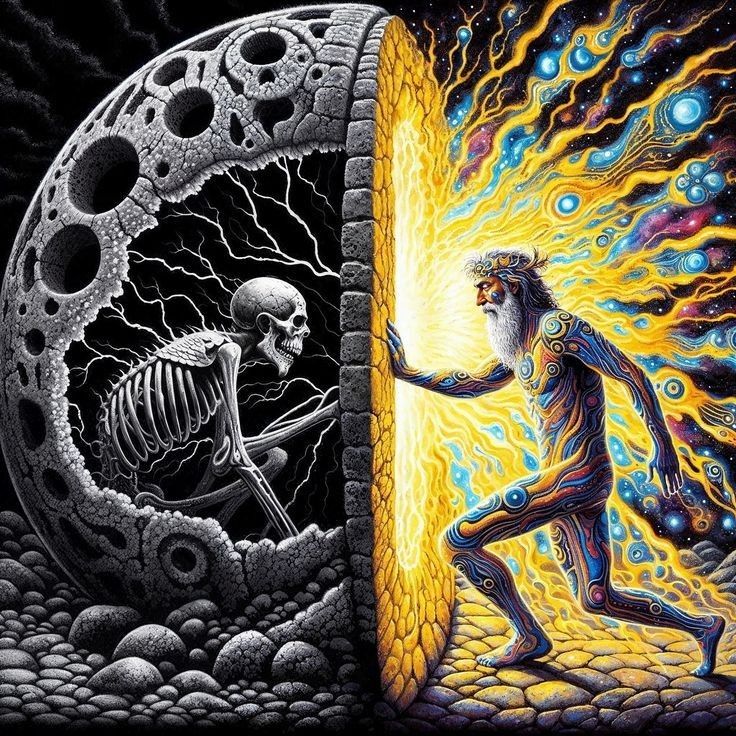
Let us recall that the Myth under consideration speaks of an embodied being as a multi-layered manifestation of localized consciousness, and among these layers one can distinguish two groups — “supporting” and “causal,” that is, those which provide consciousness with the very ability to localize, and those in which impulses, aspirations, and drives arise, guiding the process of incarnation. These two groups are usually called “body” and “psyche.” In turn, the “driving” basis of the psychocosmos is an ensemble of “energies” or “lights,” which is summed up in the concept of the “soul.”
And within this ensemble there are also manifestations of two levels — those related to this incarnation, and those related to the chain of incarnations of a given stream of consciousness. The first group includes the energies known as nefesh (Egypt. ka) and ruach (Egypt. ba), the second — chayah and yechidah (Egypt. akh), and the conjunction between the levels is mediated by the energy neshamah (Egypt. ren), which is usually understood as the “soul” in a narrower sense. The level “soul of souls” (neshamah le neshamah, נשמה לנשמה) is the integrated experience (khotemot) of all incarnated personalities, the common vessel of the monad’s actualization.
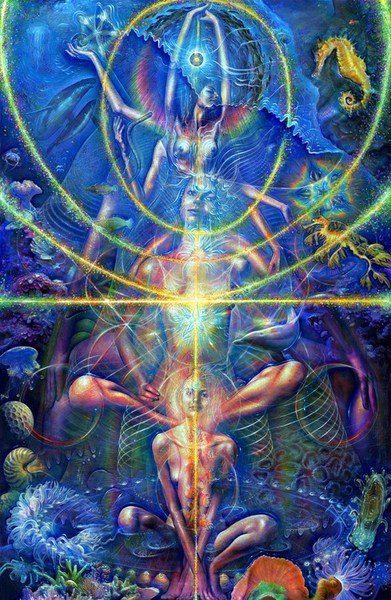
Thus, the soul is a “cauldron of experience,” the substance of awareness, possessing both qualitative and quantitative characteristics. We have already said that it can be cultivated, diminished, or lost. At the same time, the loss of a private soul is precisely this incarnation’s falling out of the monad’s stream of ruachot, when it leaves almost no trace of meaningful experience in the “soul of souls.”
In other words, for the purposes of our conversation we can say that only the monad/seed atom (yechidah) is absolutely immortal; conditionally immortal is the “soul of souls” as the accumulated experience; while the personal soul of an individual person is decidedly mortal.
As long as the mind has not identified with its center, it “revolves around the Black Sun” — reincarnating, gathering, making sense of, and losing experience. When consciousness returns to its center it attains its unborn, ideal nature (or, as the Egyptians said, ka and ba integrate into the Divine akh). However, the immortality of the “seed atom” in no way implies the immortality of the personality. On the contrary, it upholds only the continuity of the stream of awareness and the karmic coherence of incarnations.
The personal soul — as a configuration of experience — can either be integrated into the “soul of souls,” or partially dissolve, or even dissociate into fragments ( shadow and elemental forms), and in that sense “die,” even if something of it continues to drift in the interworld for a long time. And normally, the purified neshamah — the soul as the dry residue of experience — is incorporated into the monad.
The normal scenario of disincarnation includes several stages and begins when life force is expended to the limit. In this case, the remaining energy is devoured by gallu and other recyclers, while accumulated awareness-ruachot is “eaten” by Baphomet — as the force that discharges consciousness.
And normally, the purified neshamah, the soul (the dry residue of experience), is included in the monad.
This is the “healthy” mortality of the private soul: the personality dies, but its “grain of experience” is embedded into the higher whole.
However, if disincarnation does not conclude properly, part of the psychic structures can become stuck and turn into utukku — a semi‑conscious predatory being attempting to secure a nefesh for itself through ibbur, murder, and the like. At the same time, neither elementers nor utukku are a true “immortal soul”; they are, in essence, long‑lived fragments that do not develop, do not integrate into the monad, and live only at another’s expense, and sooner or later will be destroyed. Recall that one deceased may spawn an entire “ensemble” of such pseudo‑immortal entities, prolonging each of their unbalanced tendencies and thereby only complicating the posthumous fate of the mind.
That is, the attempt of the personality “to avoid dying at all costs” leads only to dubious forms of pseudo-immortality — parasitic existence, which ultimately ends in violent discharge.
Ba and ruach likewise tend to “stick” in experiences and states instead of flowing freely. This is a distorted memory of unity (the light of chayah) turned into attachment and the desire to possess. If consciousness does not know how to let go, it accumulates unintegrated, frozen experience and thus creates the conditions for the build‑up of shadow formations and predatory elementers after death, which prevents the “proper death” of soul‑forms. The chief enemy of a proper death of the soul is precisely this stickiness — the inability to release what is complete. It manifests as an obsessive return to the same events, an unwillingness to part with a role, a status, identifications, or self‑images even after they have lost relevance. Each such act of clinging becomes an anchor that holds shadows and restless dead.
In other words, there is a risk that, instead of integrating experience into the “soul of souls,” the personal soul will either simply dissolve, leaving no trace, or get stuck in “viscous” forms (shadows, utukku), and then will still be torn apart and eaten.
Thus, while a person lives in the “default” mode, all their energies are automatically absorbed into the horizontal scheme of the “farm of worlds.” In that mode, indeed, something of the soul‑structure may be retained for a long time, but more as a convenient battery — stored energy — than as an independent entity. What is immortal in such a mode is not the soul but the system that recycles its energies. A person who does not develop awareness is therefore likely to have their personal souls either dissolve “without a trace” or be used to feed external entities.
Accordingly, Magic also offers another way out — “verticalization” of the structure of the psychocosmos, conscious recognition of levels, ordering of desires, the search for and assimilation of logoi so that energies rise to the Source as much as possible, rather than going into chains of consumption. In doing so, ideas about the “mortality of the soul” become a stimulus rather than a “bogeyman”: some manifestations and complexes die consciously, in order to free and gather what can be immortal.
The Magus learns to die many times, without waiting for the biological end: old patterns of the world die off, old contracts, old masks. And in the process of this dying, the process yields — understanding, power, freedom. With each such small “dying,” something of the temporary rises into the eternal, while something else is expended and no longer claims immortality. And the more such transformations a person manages to undergo, the fewer viscous fragments they will have left, suitable for turning into restless dead; and the more processed content there will be, which the monad will be able to assimilate. What is immortal is not the soul that we habitually pity and protect, but that part of a human being that is able to imprint experiences, extract meaning from them, and at the same time preserve freedom. And from this point of view, the question is no longer whether a person “has an immortal soul,” but whether there is enough in them of what will be worthy of preservation when the time comes to die.


Good day. Is it possible to change the nature of one’s being and thereby acquire some form of immortality (to repeatedly extend one’s life)?
Let’s say, transition into the wave of Frey or as Castaneda described, transition into an inorganic form (passing by the Eagle)?
Hello! Yes, of course, there are many ways to prolong life, however this is not immortality, and most often – not development.
https://www.enmerkar.com/en/way/fixation-of-souls-flight-from-gilgul
https://www.enmerkar.com/en/observations/pathologies-of-the-afterlife
If, as you describe, the personal soul is mortal in most cases, and only a small imprint of experience enters the ‘soul of souls’, then what happens to the energies of emotions, love, pain, memory, and connections between people? Are they food for the ‘farm of worlds’, or do they still have their own, non-energetic status that makes them worthy of preservation? Otherwise, it seems that the overwhelming majority of what a person considers the most important in their life is doomed to complete disappearance, and then what is the justice or meaning of such a world order?
Yes, in the way a person usually lives their life, much of what is ‘most important’ for their soul will not survive death. But this does not mean that all this was in vain. It is important to understand what dies in attachments, pain, and memory, and what may and should be preserved.
In any experience, one can distinguish three levels: 1) energy: charge of feelings, passions, pain, desires. 2) eidos: information, faces, scenes, stories. 3) logos: qualities and meanings underlying manifestations.
After death, energy almost entirely goes into disposal, into the general ‘farm of worlds’. The world is a coexistence of energy consumers, which lives through the cycle of forces. Images — personal stories, dramas, models, and neutral memories are mainly low-energy and therefore dissipate; only the most energy-intensive imprint and from them shadows and restless souls are born. However, logos, if they were truly found and experienced, are imprinted as part of the eternal structure of the monad.
The universe is not structured like accounting, where every receipt must be preserved for eternity, but more like a laboratory or workshop. The woods around a house under construction are not preserved; the house itself is preserved.
So, a huge part of what we consider important is doomed to disappear. But what will disappear is precisely what was important only for vanity and the fear of emptiness. What turned out to be truly authentic in life — vision, responsibility, the ability to love, weaved into the fabric of consciousness.
Good day.
What does it mean that ‘accumulated awareness-ruakhot “eats”’?
What exactly is ‘eaten’?
Experience? Personality? Essence?
How can it take it away, devour it?
For example, demons consume emissions of ‘negative’ emotions and sometimes can even directly eat lifeforce.
Archons some ‘radiation’ which gives willpower.
How can ‘awareness’ be consumed? What is it in its subtle material manifestation?
As I understand it, it is impossible to take away the experience of a being. It may disappear if the ‘carrier’ is destroyed. For instance, if the soul becomes too ‘black’, but for some reasons predators do not gain it in their possession.
Then it can be ‘cleansed’ by the same ‘ghallu’ or decay from lack of energy.
However, if it was ‘sold’ out of foolishness, that is the end of everything, interruption of the chain of incarnations, since through it the predator gains access to the source of energy that animates it. And when it devours it utterly, the ‘seed of spirit’, having completely lost experience, personality, essence, will most likely either reintegrate or enter a new chain of incarnations…
Hello.
The energy of awareness is a quite definable and clear energy; it is not experience itself but its energetic imprints – hotemot, which can be ‘eaten’, i.e., ‘discharged’ back into life energy. The experience extracted from them as an imprint remains in the structure of yehida, but this experience no longer possesses energetic potential and is preserved only within the structure of the stream of consciousness itself.
More details:
https://www.enmerkar.com/en/myth/energy-and-its-consumers
https://www.enmerkar.com/en/myth/the-gloom-of-the-heavens
Are there any historical or contemporary examples of individuals who achieved the ‘verticalization’ of the psychocosmos through magic, and how did this impact their lives or legacy? How can one distinguish true progress from illusion?
Yes, there are people who could be said to have partially achieved ‘verticalization’ of consciousness through magic/theurgy, as a probable conclusion from their lives, texts, and influence. Among them, specifically, Iamblichus, Proclus, the theurgists of late antiquity for whom magic was identical to theurgy, and rituals were viewed as ways to elevate the psyche to the gods rather than compel the gods to fulfill wishes.
For them, ‘verticalization’ emphasized the purification of the soul, asceticism, ethics, and the refusal to reduce the gods to ‘energies for ritual’, as well as their lives in which philosophy, cult, and everyday life do not diverge.
In later epochs, among such figures one can mention Renaissance actors – Marsilio Ficino, Pico della Mirandola, who worked with astromagic, ceremonial magic, Platonism. For them, magic was ‘elevating the soul to the stars’ and the Divine, a constant dialogue between reason, faith, and practice.
Jacob Boehme, a Christian theosopher, though not strictly a magician, was essentially a mystic-alchemist. His verticalization manifested as passing through his own darkness (‘the dark center of the Divinity’) without fleeing into sweet visions, and, as a result – the birth of a holistic image of God/cosmos from personal experience.
None of them left memories of themselves as flawless saints. All had limitations, mistakes, strange actions. But for all of them, Magic was primarily a means of ordering one’s own nature under something higher than personal comfort. They did not hide their own aggression, sexuality, greed, did not mask it ‘under spirituality’, but tried to learn to see and transform it.
Thank you very much for your work.
Good day! Please tell me how to deal with various spiritists (E. Barker, E. Randall, etc.), regressionists (D. Cannon, M. Newton, etc.), behind whom stand not just well-written books, but literally thousands of examined individuals? They describe transitions into the Interspace and staying there in a softly, to put it mildly, different way.
Hello.
I think the situation is similar to that of different religions – they also describe life and death in completely different ways, but this does not mean there are ‘more’ or ‘less’ true ones; it simply speaks of descriptions from different perspectives, much like the fable about the elephant and the blind sages. Each describes reality as it appears to them, and each follows the description that resonates with them most. Ultimately, the only criterion of truth is its ability to make a person more loving and compassionate, as there is no wisdom without love.
Thank you for the response, but these possibilities are so diverse that it’s easier to perceive the situation as ‘neither one nor the other’ rather than ‘both’, although, of course, this is a personal choice of each dual mind.
I believe for a ‘dualist mind’, the correct position would be ‘either one OR the other’, implying that the other can also be right. Just as Buddhists easily explain the concept of Brahman in terms of shunyata, and Hindus explain tathagatagarbha in terms of Brahman, I am sure I could easily explain the experiences of other visionaries within my worldview, just as they could explain my experience from their positions. This only means that we are approaching the same reality from different angles, which fundamentally surpasses our cognitive abilities. Nevertheless, for each specific traveler, it is more effective to adhere to one system – the one that suits them best for various reasons. To achieve something, both ‘total acceptance’ and ‘total rejection’ are equally unproductive, and at each relative level, it is more successful to use one specific system.