Logoi and Energies
The problem of the emergence of manifested reality from a potential state is central both to fundamental physics and to traditional ontology. In the contemporary scientific picture, this process is described through notions of quantum fields, vacuum fluctuations, and decoherence, whereas traditional Hermeticism operates with the categories of the Medium, logoi and eidōs. Yet despite the difference in terminological apparatus, serious analysis reveals an essential unity between these descriptions: the arising of the manifested world is understood as the result of the superimposition of structuring information upon an infinite energetic potential.
At the foundation of the cosmos, according to both modes of description, lies an unmanifest, unified, and in itself qualityless Medium. From the standpoint of physics, it correlates with the notion of a quantum field in the vacuum state. It is a “boiling ocean” of potential states, possessing a colossal density of energy, yet yielding zero informational output. In the Medium, all probabilities exist in a state of superposition: all are equally possible, yet none is actualized. This is the region of pure potential, devoid of differentiation, time, and space in any objectual sense. For a particular stable world to be manifested from this homogeneous Medium, an external or immanent influence is necessary — one that introduces into the system division and structure. This influence is information, which in its highest aspect manifests as a hierarchy of Logoi.
We have already discussed that logoi are structuring principles, laws, or “algorithms” that select, from the infinite spectrum of possibilities of the Medium, a particular trajectory of development. In the informational sense, a logos is a mode or form of limiting a system. If the Medium is absolute freedom bordering on chaos, then the logos is the measure that narrows this freedom to a definite state.
The superimposition of the system of logoi upon the Medium proceeds by the principle of resonance, whereby one definite frequency is singled out from the background noise of potential oscillations. In quantum mechanics, this corresponds to the appearance, in a particle, of definite quantum numbers — mass, charge, and spin. These parameters are precisely the information that prescribes to the field how, exactly it must vibrate in a given local region. Thus, the primary act of creating an object is always an act of informational determination.
The further transition from an abstract law to a concrete form is realized through the totality of eidōs. We have discussed that whereas the logos is a general law or “word,” the eidōs is a discrete “blueprint” or matrix of an object. This conception accords well with the phenomenon of quantization described in physics. The quantum nature of reality implies that the world is not continuous; it consists of definite, indivisible portions — quanta of energy. In the ontological sense, this means that information is superimposed upon the Medium not chaotically, but in the form of integral semantic units — eidōs. Thus, the eidōs of an object is its informational limit, beyond which the object loses its identity. One cannot transmit “half” a quantum of light, just as one cannot realize “half” an eidōs: the form is either actualized as a whole, or else remains in the domain of probabilities. Quantization, therefore, is the mechanism that ensures the stability and distinctness of objects in the manifested world.
Yet information (logos) and form (eidōs) would remain static without the participation of energy. Energy in any system functions as a dynamic mediator, “animating” informational structures. In physical terminology, the excitation energy of the field turns a virtual possibility into a real particle. In Hermetic cosmogony, energy (Shekhinah, śakti) is regarded as the force that “installs” logoi into the Medium, compelling it to assume the form of eidōs. It is important to understand that energy does not precede structure, but manifests simultaneously with it. Objectification is the process in which the logos directs the flow of energy so as to crystallize form out of the amorphous substrate of the Medium. This process unfolds according to a hierarchy: more complex logoi govern enormous energetic masses, creating complex macroscopic systems, whereas simpler Logoi operate at the level of elementary particles.
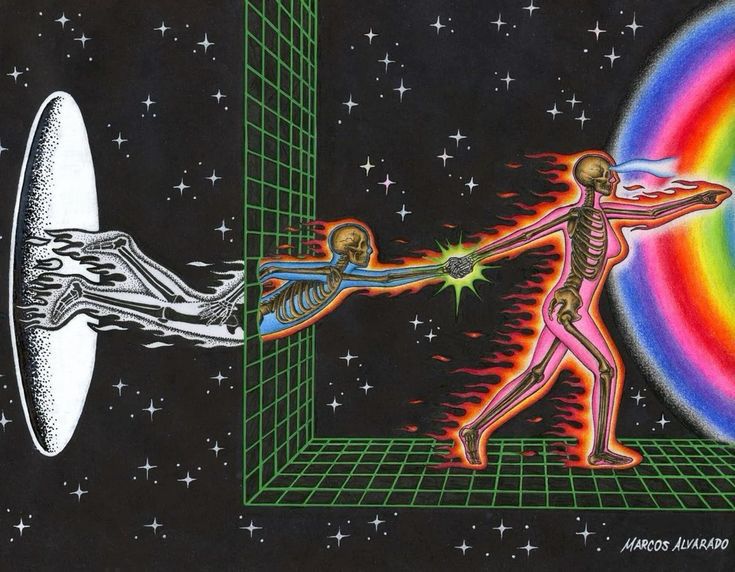
We have already discussed that in the physical sense “energy” (in the singular) is understood as a scalar measure of the interaction of matter — its capacity to perform work or alter the state of a system. It is a thermodynamic magnitude, the “currency” of physical processes, conserved in accordance with the laws of time symmetry. Traditional Hermeticism and Eastern metaphysics, however, also use the term “energies” (Gk. ἐνέργεια or Skt. dharmas) to denote “elementary qualities” or primary units of “objectness.” In this context, energies are not a measure of work but primary modes of difference through which the formless potency of the Medium acquires the possibility of description. If the Medium is an infinite field of probabilities, then energies are those discrete “points” — those qualitative minima — from which the perceiving mind assembles a picture of the world. From the perspective of fundamental physics, it would be more accurate to correlate such “energies” not with the energy balance but with the notion of “action.” In classical and quantum mechanics, action is a physical quantity with the dimension “energy multiplied by time” (J·s). It is precisely the quantization of action via Planck’s constant (h) that sets that “discrete threshold” below which a physical event cannot be fixed. Thus, “energies” are elementary quanta of action, the tiniest informational transactions out of which the fabric of being is woven. And each such “energy” bears within itself a specific quality of the logos which, when superimposed upon the Medium, limits it — turning pure potential into a concrete element of the objectual world.
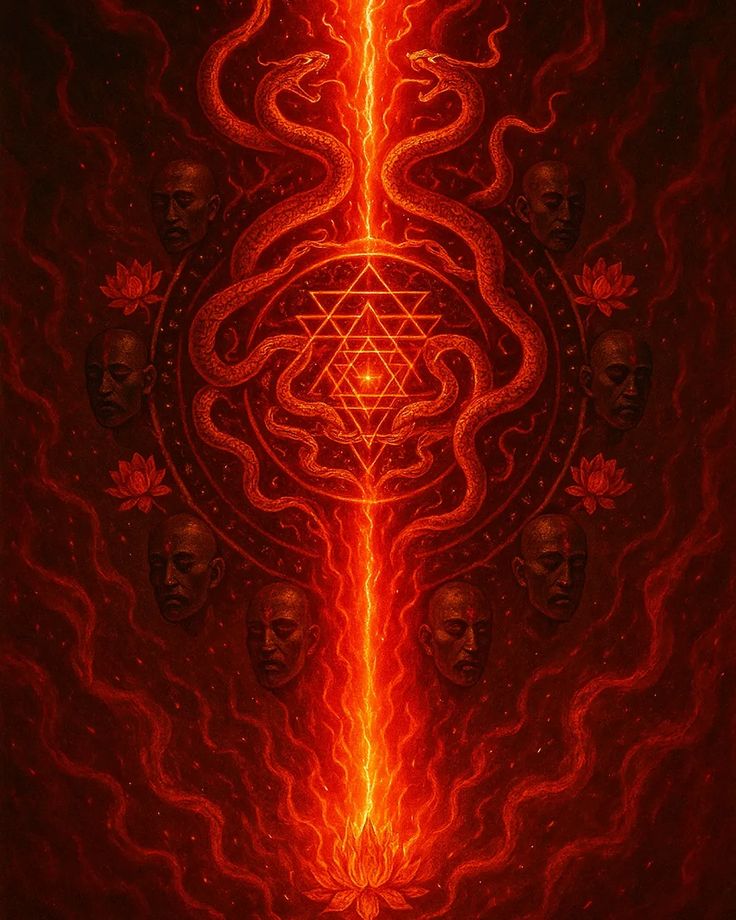
In the Myth we are considering, reality is not an autonomous mechanism; it is born in the perceiving mind as a result of the “assembly” of these elementary qualities. In other words, the birth of the objectual world is inseparably bound up with the process of fixation, “observation,” or “enumeration.” Indeed, in the quantum world a particle remains a wave of probability until the moment of interaction with another system, as a result of which decoherence occurs. This may be described as a process in which the local information of an object becomes the property of the entire surrounding environment. When an object’s logos enters into resonance with the logoi of other objects, a stable network of relations arises. This network is what the observer perceives as “objective reality.” Objects confirm one another’s existence through the continuous exchange of informational signals. The interaction of two objects is, in this sense, the contact of two informational hierarchies, where electromagnetic repulsion (the physical aspect) and the Pauli exclusion principle (the informational aspect) create a stable sensation of boundary and solidity.
The birth of reality, therefore, appears as a hierarchically organized process. At the base lies the Medium — the region of zero information and infinite potential. Upon it is superimposed a hierarchy of logoi — structuring laws that determine which energies (modes of difference) will be actualized. The superimposition of logoi upon energies generates eidōs — stable informational forms, the matrices of objects. Finally, the total interaction of these forms is described by physical energy as the measure of their influence upon one another.

It should be noted that “energies” (“actions”) are not separate from the mind. We have already understood that any object is the result of resonance between an external informational signal and the internal assembling mechanism of the perceiving subject. The mind acts as a “decoder” that performs the “rendering of reality”: it interprets the chaotic noise of the quantum fluctuations of the Interspace/Medium, extracting from it discrete energies and uniting them into stable images. Without the act of perception, the world remains a set of unconnected “strings,” or potential logoi, and only through the observer do these energies acquire the status of one or another objectual reality, one or another timeline.
Thus, the transition from “energies” to “energy” is the transition from the qualitative composition of the world to its quantitative description. The cosmos may be described as an intricately layered informational text, where each letter is a discrete energy (a quantum of action), each word is the eidōs of an object, and physical energy is the syntax ensuring the cohesion and movement of that text.
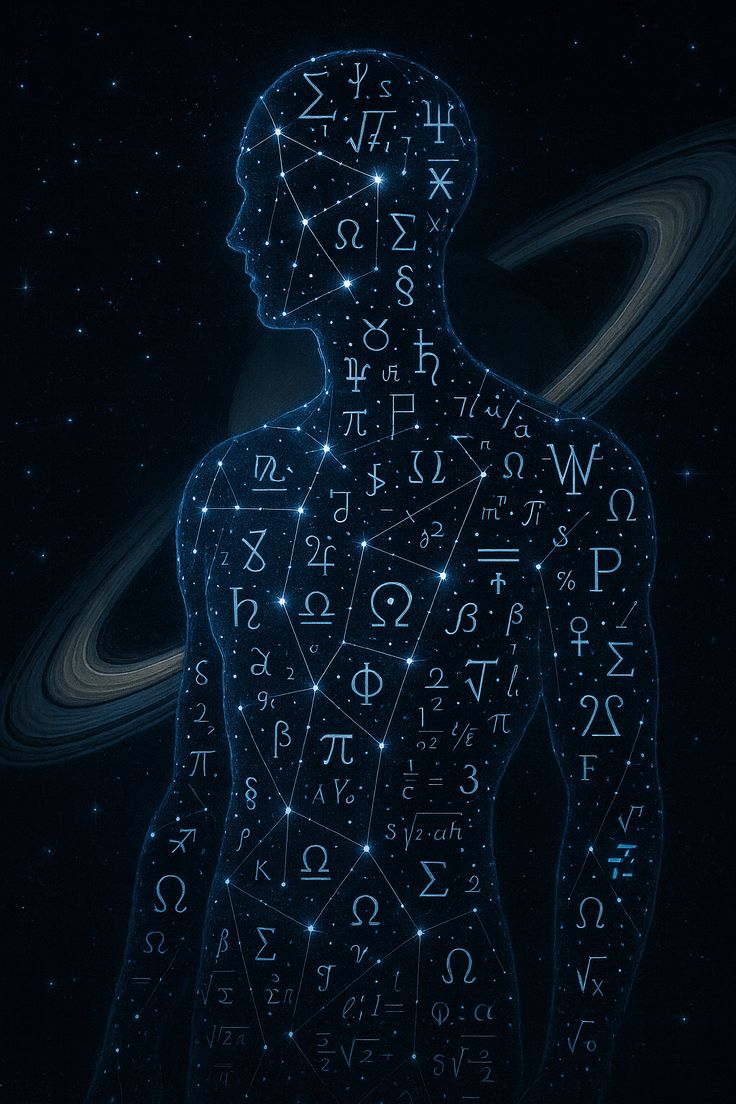
And yet, while the Medium is absolute potential and the logoi are the ways of structuring it, the totality of all possible realizations of these logoi forms the structure of the Multiverse. What the individual observer perceives as a single dense “objective reality” is only one of countless branches of actualization, stabilized by a specific set of informational filters.
We have already said that such a region of coherent superposition of all possible world-lines is traditionally called the Interspace. It is hyperspace, where reality appears as a multidimensional network of semantic nodes, and each such node is a point of choice among different “energies” (modes of existence).
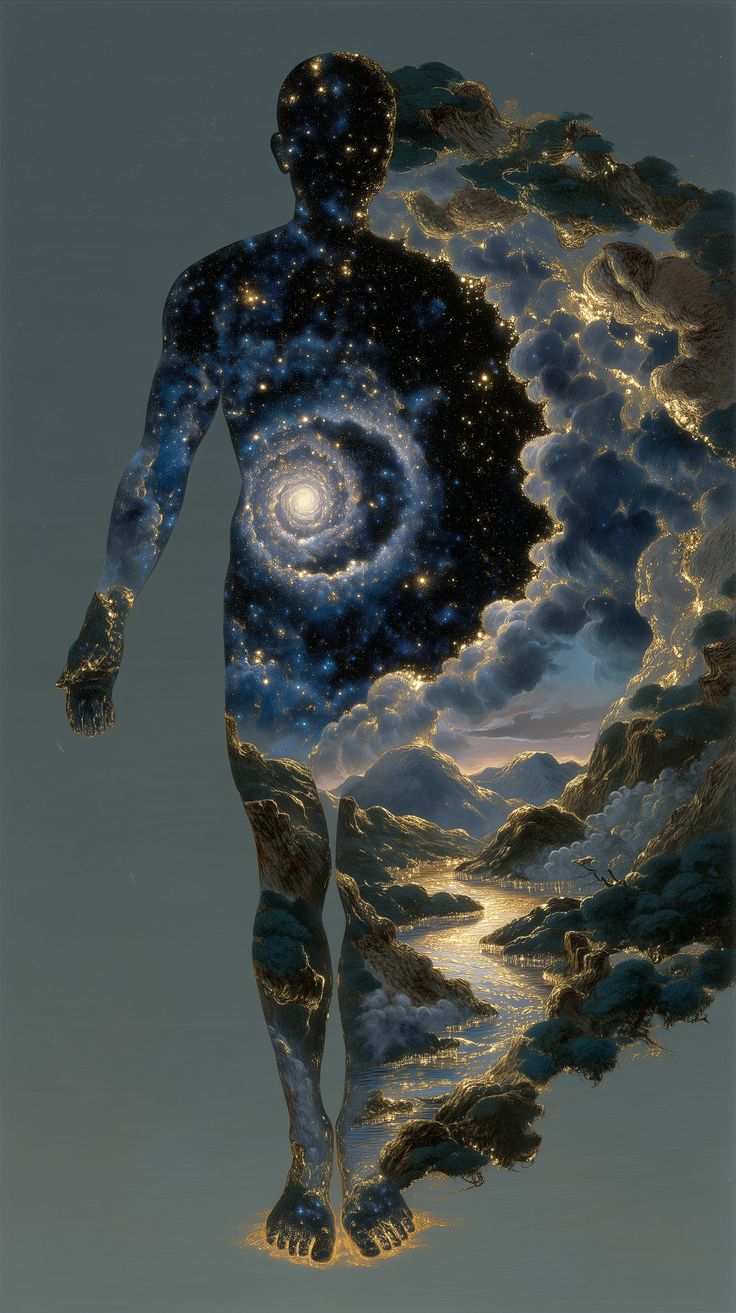
The passage from the Interspace to a concrete manifested objectual world is accomplished through the mechanism of semantic resonance, where the “choice” of a particular branch of reality is conditioned by the correspondence between the internal structure of the perceiving mind and a particular architecture of logoi. The observer’s mind singles out from the Interspace those chains of events that accord with its own informational capacity and volitional impulse. Thus, “the objective world” turns out to be the result of induction, whereby the mind “extracts” from the Interspace a definite set of energies, fixing them into a stable structure.
Such a description explains the phenomenon of macroworld stability: billions of individual observers, being in informational interaction, form a “consensus reality” — a common “block” of actualized energies, which is exceedingly difficult to alter by an individual act of will. Nevertheless, whenever the informational definiteness of a system declines (for example, at the quantum level or in moments of crisis of meaning), reality once again approaches the state of the Interspace, opening access to alternative branches of logoi — that is, to the emergence of new timelines.
Thus, the superimposition of information upon the Medium is a continuous process of navigation within the Multiverse. The mind constantly “traces” its reality through the ocean of energies of the Interspace. Therefore, any objectual world is a concrete, stabilized “projection” of one among infinite possibilities, sustained by attention and by the regularities of informational exchange. From this perspective, the laws of physics may be regarded as protocols that ensure the coherence of the chosen branch.
Hence it becomes clear that in any limited world a crucial role is played by fundamental laws and constants, which in traditional texts are described as Heimarmene or the “Archontic order.” These are the ultimate parameters of the Universe’s informational system, such as the speed of light or Planck’s constant. It is precisely they that, on the physical level, determine the “rules of grammar” by which logoi may combine with one another. On the one hand, these constants keep reality from spontaneously collapsing back into the Medium, imposing a rigid architecture of interactions; on the other hand, they also limit the possibilities of the mind’s development.
In the course of the Universe’s evolution, total quantum information, according to the principle of unitarity, is conserved; however, its distribution changes. Entropy steadily increases, which means the gradual “entangling” of information — the transfer of it from an explicit, structured state into a hidden, microscopic one. At the same time, in local regions of the Universe — where energy flows are most intense — there arise islands of negentropy: spheromats, complex organisms, intelligent bearers of mind, and collective structures. These are the objects in which logoi reach the highest degree of manifestation, creating the most detailed eidōs.
Thus, from both the physical and the Hermetic standpoint, the objectual world is not a collection of “material things,” but rather a dynamic stream of informational events. What is customarily called matter is only a mode of perceiving highly concentrated energy, delimited by particular logoi. The cosmos is born from the Medium as a continuous “enumeration” of reality, where each interaction is an act of confirmation of form. Physical reality proves secondary to the informational code, and an understanding of the mechanisms by which information is superimposed upon the Medium opens the Way to a conscious interaction with the very foundations of being.

Thank you.
Thank you so much for the article! Is it possible to establish a hierarchy of languages or symbolic systems based on their ability to directly influence the governing logoi of a given world? Surely, there must be symbolic systems capable of directly changing the settings of a given reality through their impact on the logoi that structure that reality. These linguistic systems are likely to be secret and accessible only to the highest “programmers” of the reality in question, and not available to ordinary users. For instance, Latin, which is used for many incantations in exorcism, or the use of spells in so-called “barbaric” languages—forgotten and incomprehensible to contemporaries, yet which must be reproduced exactly as they have been preserved. Is it possible that such phrases could be fragments of a higher hierarchical level of logoi, granting “admin” access to modifying the given reality? You once mentioned that one of the systems capable of directly impacting the structuring logoi of reality is runes (at least the part known to people), but there must surely be other, more powerful systems completely hidden from humans. For example, something like the Enochian language.
Yes, we have already discussed these topics:
https://www.enmerkar.com/en/magic/the-sacred-alphabets
https://www.enmerkar.com/en/observations/letters-and-the-logoi
https://www.enmerkar.com/en/myth/letters-and-vortices
Dear Enmerkar, here: https://www.enmerkar.com/en/myth/life-and-awareness/ you mentioned that the prospects for a convergence of scientific and magical worldviews are absent, yet this article presents such a convergence. What prompted you to change your mind?
Absolutely right, but worldview is not the same as world description. In terms of how the picture of the world is viewed, Magic doesn’t usually contradict science; rather, it expands and complements it. But the most important aspect is not the picture itself, but the attitude towards it. And this is where the fundamental difference lies: science focuses on the question “how?”, while Magic considers “why?”. This leads to completely different emphases and approaches. Even the very images of the world take on a completely different color. For example, although at its core the scientific concept of “quantum field” and the magical idea of “ether” refer to the same thing, in terms of values—and therefore technically—they can’t be considered fully analogous: ether implies personal contribution and personal responsibility. The same goes for many other concepts, where different teleologies essentially result in different ontologies.
Where do these logos come from, which are the principles of the universe? And can we say that the “boiling vacuum,” i.e., the medium, represents the horizontal, while the logos represent the vertical? So schematically, it could be depicted as a center and a circle, hence the symbol of the yoni-lingam? The vertical and horizontal always go together, meaning there’s no scenario where one existed before the other, right? But then they must have a common foundation from which they emerged (logically).
Logoi are not “taken” or arise by themselves; they are a different, informational (or, more precisely, semantic) pole of the same reality, the plastic aspect of which is represented by the Environment. We have noted more than once that the very “division” of reality, the emergence of dynamics and “poles” within it, is just one of the possibilities, one of the potentials of the Great Spirit, Who is One and undivided in other potentials, or is actual and fully realized. What we call “ourselves” is simply a perspective from this dynamic, from an aspect of becoming that is not the only one. And in this aspect of possibility, the Spirit achieves self-knowledge by highlighting a conditional duality within Itself (which doesn’t lead to His change or division) – the objective and subjective “poles,” the environment and consciousness. Logoi represent the possibility of the Environment being known (or, which is the same, the possibility of consciousness knowing itself through reflection in the Environment).
Thank you for your response! You clarified that this is one reality, but for some reason, I got really stuck on the idea of two different ontological topologies. At the end, you mentioned knowledge – could you elaborate on that concept in this context? To know means to make something certain, permanent, stable, and then one can relate it to oneself (in the context of logos/consciousness), right? It turns out that the matrix of logos overlays the immanent (in the sense of a changing multiplicity, a boiling vacuum of probabilities) and somehow casts stable “patterns,” images, or eidos? I like this image: like light hitting the surface of an abyss, illuminating and structuring stable patterns in that boiling potential. But of course, not all possibilities can be structured. This analogy falters because light comes from above—that is, a distinction is needed, a gap, for the light to be able to FOCUS. Otherwise, it seems like light and darkness merge into one. This then becomes radiance, i.e., EIN SOF.
“And in the aspect of this possibility, the Spirit realizes self-knowledge by distinguishing within Itself a conditional duality (which does not lead to Its change or division)—the object and subject ‘poles’, the medium and consciousness.”
I just realized that to achieve knowledge, reflection is needed, and for that to be possible, a conditional “duality” is required. Now, I’m wondering: how does the medium differ from consciousness, from logos?
With the medium, the material seems more or less clear; it’s the boiling singularity, the quantum shift of overlapping planes of probabilities. To put it simply, one could say that this is the clay from which we shape patterns. But how can we metaphorically describe logos/consciousness/spirit?
It would also be helpful to logically describe it, to provide a formula. For example, the medium is pure immanent and is well-described by the symbolism of the ouroboros. The immanent is that which is inside, residing in itself, THIS, or if we simplify it, it’s just “itself” or even more simply “IN ITSELF.” For this to happen, self-equivalence must be fulfilled. Equivalence and Identity are not the same thing.
Identity is the removal of all distinctions without exception. Total coincidence. In equivalence, the distinctions are not completely removed; for example, one can relate A’”” and A’””””” because they share a common basis A. Identity is strictly A = A, or you can have A’’ = A’’.
For the ideal, the spirit fulfills self-identity. For the medium, it’s self-equivalence.
Logos are like principles, one could say they are standard states where the principle of self-identity is fulfilled. Identity involves the removal of any distinctions. This is related to oneself. One might say that a logos is like a slice of the ideal. A close analogy might be a mathematical formula that fundamentally expresses a principle, or a simpler formula, like one that builds the fractal plane of Mandelbrot. But I think that might be more of an Eidos. What I’m trying to get at is that perceiving logos directly is unrealistic for a person; one can interact with it indirectly only through eidos (essentially a pattern, or, better yet, a form in mathematical terms). The unfolding fractal itself is a manifestation of Eidos. Why am I saying all this? We have an aeonic reality, the dwelling place of the aeons, and as you mentioned, there’s the reality of the sephirot, where logos come into play. Is that correct? Or is it also appropriate to use logos in the context of the Pleroma?
If we develop the gnostic ideas about the Eons, then, as we’ve already discussed, the sephirotic system “fits into” the “second sonship” of the Eons, and the Eons of this Sonship act as “proto-sephiroth.” As for the hierarchy of logoi, it unfolds from the same Eonic reality, with the third syzygy of the First Octave having the Eon Logos (as the principle of semantics) as its “fatherly” pole. It is this syzygy that gives rise to the “proto-sephirotic” sonship, meaning the very possibility of establishing the laws by which reality will develop. In other words, it can be said that just as “Silence” (Sige) ultimately generates the Medium, “Fullness” (or Depth, Bitos) through “Consciousness” (Nous) gives birth to Meaning (Logos).
It’s hard! But so interesting!!! Deep work! Thank you