Fragmentation of Mind
A persistent tendency of the mind to consider itself a single, indestructible system does not withstand logical analysis or empirical testing.
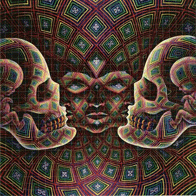
We have discussed that the Magical myth denies the “immortality of the soul” not from malice or crude atheism, but as the result of direct experience that shows the instability of all those conglomerates that people customarily call “personalities” and regard as the bearers of their ‘I’ or selfhood.
On close inspection we see that neither the soul, nor personality, nor selfhood usually serve as a complete, stable support and expression of individuality. On the other hand, Monadic nature, as the source of manifested existence, has no actual existence and is only the meaning-forming axis of the chain of incarnations, manifesting itself only as an impersonal “presence” on the horizon of the mind.
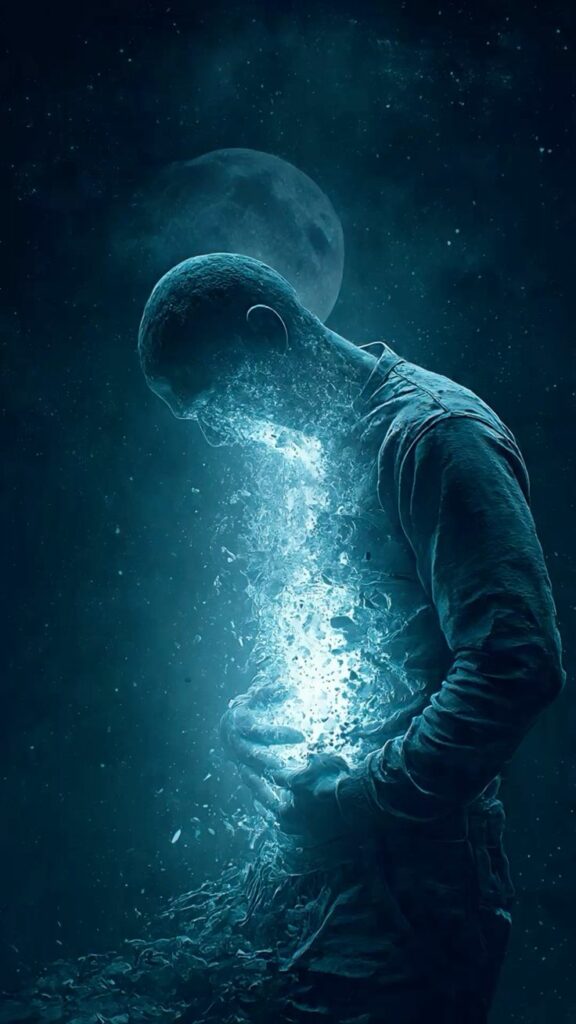
The chief illusion, the source of all problems, sources of destruction and obscuration, is precisely the notion of the “real” existence of the “I” as a self-subsisting unit. The psychocosm presents itself as a monarchy in which there is a “reigning” personality and elements “subordinate” to it. At the same time, it is entirely obvious that, in most cases, each such personality is merely a “caliph for an hour” — a temporary usurper leading the whole system of the mind toward fulfilling its limited goals, whims and caprices. One state replaces another, one subpersonality yields to the next, one drive gives way to another, and often the link between these successive states is tenuous and fragile, held together only by selfhood — that is, the initial notion of a division into “I” and “not-I”.
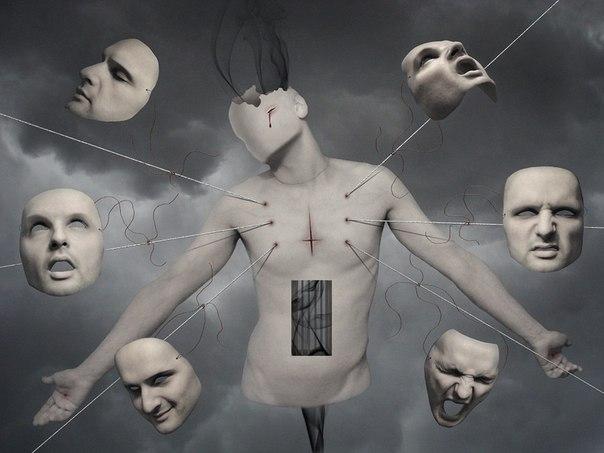
The degree of fragmentation of the mind is inversely proportional to its development, since, in fact, by the “development” of the mind we mean an increase in its wholeness, integration.
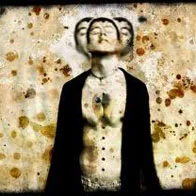
The greater the number of mutually opposing impulses, desires and intentions that make up the mind’s system, the more subpersonalities succeed one another in the circulation of that system, the lower the effectiveness of the mind as a system; and consequently the lower the success of that incarnation as a ground for self-knowledge, and the greater the number of unconnected Reshimoth — souls — that it leaves behind.
In other words, Magical conceptions of both reincarnation and of the causal links between incarnations exclude the existence of any “transmigrating substratum”, anything that reliably passes from life to life. Monadic nature as the source of individuality and the “Seed atom” as a constant basis, the germ of crystallization in the chain of births, are not bearers of the “I”, and cannot give the personality hope for “eternal life”. Let us repeat once more: according to Magical conceptions, there is no foundation, no one who could say, “I will live forever” — neither in the sense of “soul immortality”, nor in the sense of reincarnation or transmigration. The system that carries the “I” is the product of the current incarnation; it is formed within it and is destroyed with its destruction.
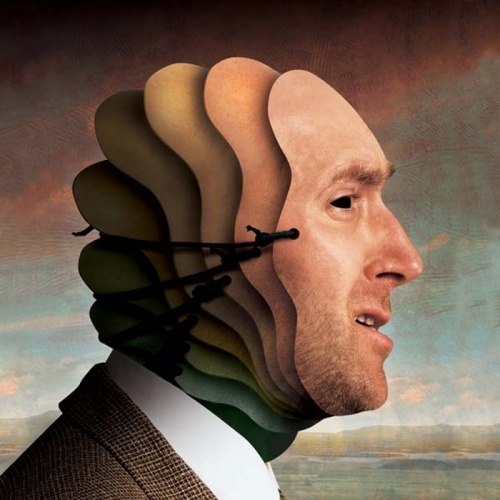
Nevertheless, what has been said has nothing to do with the vulgar materialists’ notions of the transitory nature of mind.
Denying the substantiality of personalities and selfhood, and the indivisibility of mind, Magic nonetheless affirms the eternity of mind as a phenomenon. Moreover, being a strictly practical system, it also lays out ways to change the existing state of affairs. The point is that, although it is impossible to preserve personality, it is nevertheless possible (and therefore ought to be) to make it as true an expression of individuality as possible, and to bring the psychocosm itself as fully as possible to a state of wholeness and harmony.
So long as the mind’s system is fragmented, so long as it is merely heaps of loosely connected thoughts, emotions, tendencies, inclinations, etc. (Buddhists call them “skandhas”, which, strictly speaking, means “heaps”), it begins at birth and ends at death. In other words, a person is typically not the “incarnation” of the soul of some single person who existed before him, but a conglomerate of psychic elements created by a great number of people; he enacts impulses generated by different beings, and he, in turn, is a source of components for various other minds, and the impulses he generates will continue not in one being but will become the causes of a whole series of tendencies across a number of newly arisen minds.
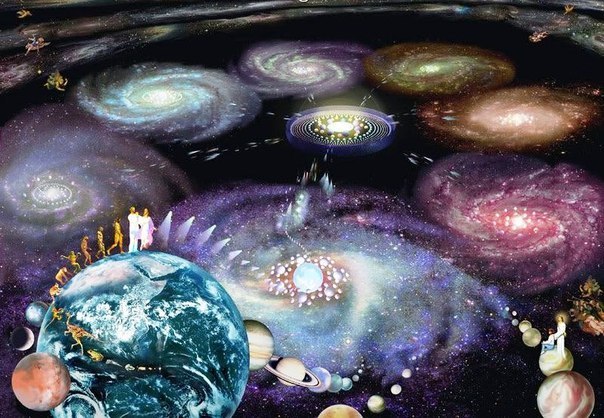
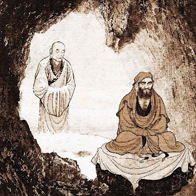
One of the Magus’s important tasks is to attain a state of “indestructibility” of his mind. The Magus makes his mind whole, unified, integrated, and therefore strong and unbreakable. Instead of being a chaotic accumulation of separate elements, the Magus’s mind is made cosmic and ordered, and this, on the one hand, makes it a more effective system of self-knowledge and self-actualization, and on the other hand reduces the fragmentation of his existence. The more realized a being is, the fewer new systems take in its impulses after its destruction, and only highly realized beings attain that “conscious reincarnation” considered the common lot. Ultimately, when personality becomes a full and perfect reflection of individuality, and mind a perfect instrument of self-knowledge and actualization, the psychocosm merges with the macrocosm, and mind attains non-duality and liberation.
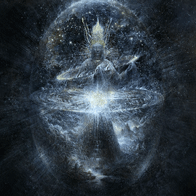
We said that the most common motive for beginning the mind’s development is the desire to avoid death. The Magus’s task, however, is not the pursuit of the “immortality of the I”, for the “I” that sets out on the Way of Magic is usually inherently destructive and disharmonious and has no chance of survival; rather, the task is the “killing” of that “I”, the overcoming of the opposition of self to “not-self”, and the attainment of the state in which the Magus sees himself not as an isolated unit but as the whole, in his individual aspect. So long as a being identifies with temporary “heaps” of affects, or even with the “superego” of his life’s logos — it is doomed to destruction. Only when the mind identifies with the Great Spirit itself in one of its infinite individual aspects does it identify with its Monadic nature and go beyond both forms and their absence, both being and non-being, and — either dissolve into the ocean of nirvana (as the essential aspect of Infinity), or — enter the fullness of the Pleroma (the active aspect of Infinity), which in essence are likewise one and indivisible.
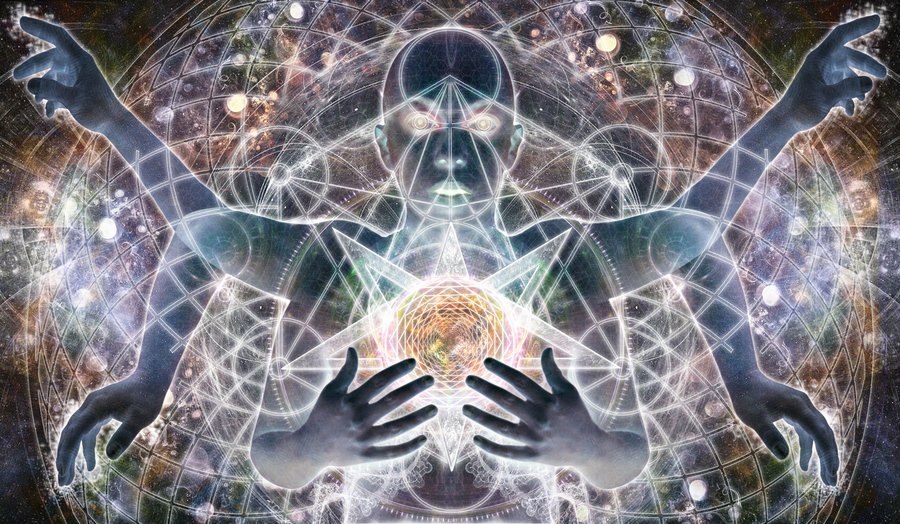


A certain state of self can be called identification with the Great Spirit (when perceived through the right hemisphere, a merging with ‘not-I’ is felt) But where is the guarantee and who confirms that it is not a play of imagination?)
Very interesting, your article resonates with Jungianism and many myths and religions of the world, the only thing I disagree with is that magicians chase after ‘immortality of the self’. Understanding the processes of the system and the ability to manage them – yes, all the rest – are side effects, in my opinion. And of course, I agree that it is important to possess wholeness and inviolability.
Consciousness is a river, flowing and variable in the course of embodiment. Consciousness is only a small part of a broader magical perception with its diversity and threshold volume of various influences. Consciousness depends on the body much more strongly than on all the sources of information surrounding it. The body, in turn, also depends on consciousness. Twilight consciousness, when subjected to a number of conditions leading to brain hypoxia, shows its – consciousness’s – fragility and destructibility. Consciousness, even in the body, cannot afterwards restore itself to its original level. However, even after a complete change in consciousness, a person distinguishes himself from the non-self. Therefore, the support of the I-identity is not something consciousness is.
For one Indian mystic, the main question was – who am I? Any verbal or mental answer is considered incorrect. But one must seek the answer throughout life anyway…
Who am I? I am sound.
Tell me, how do you explain the phenomenon of memories of past incarnations? There must be some connections between consciousness in this life and what was in the past.
“I” that embarks on the Path of Magic is usually thoroughly destructive and disharmonious (Why???)
Enmerkar, the first few paragraphs of this article seem to be a clear description of the concept of Dasein introduced by Martin Heidegger in his very complex book Being and Time. What do you think?
Thank you for your colossal labor!