Abodes of the Gods
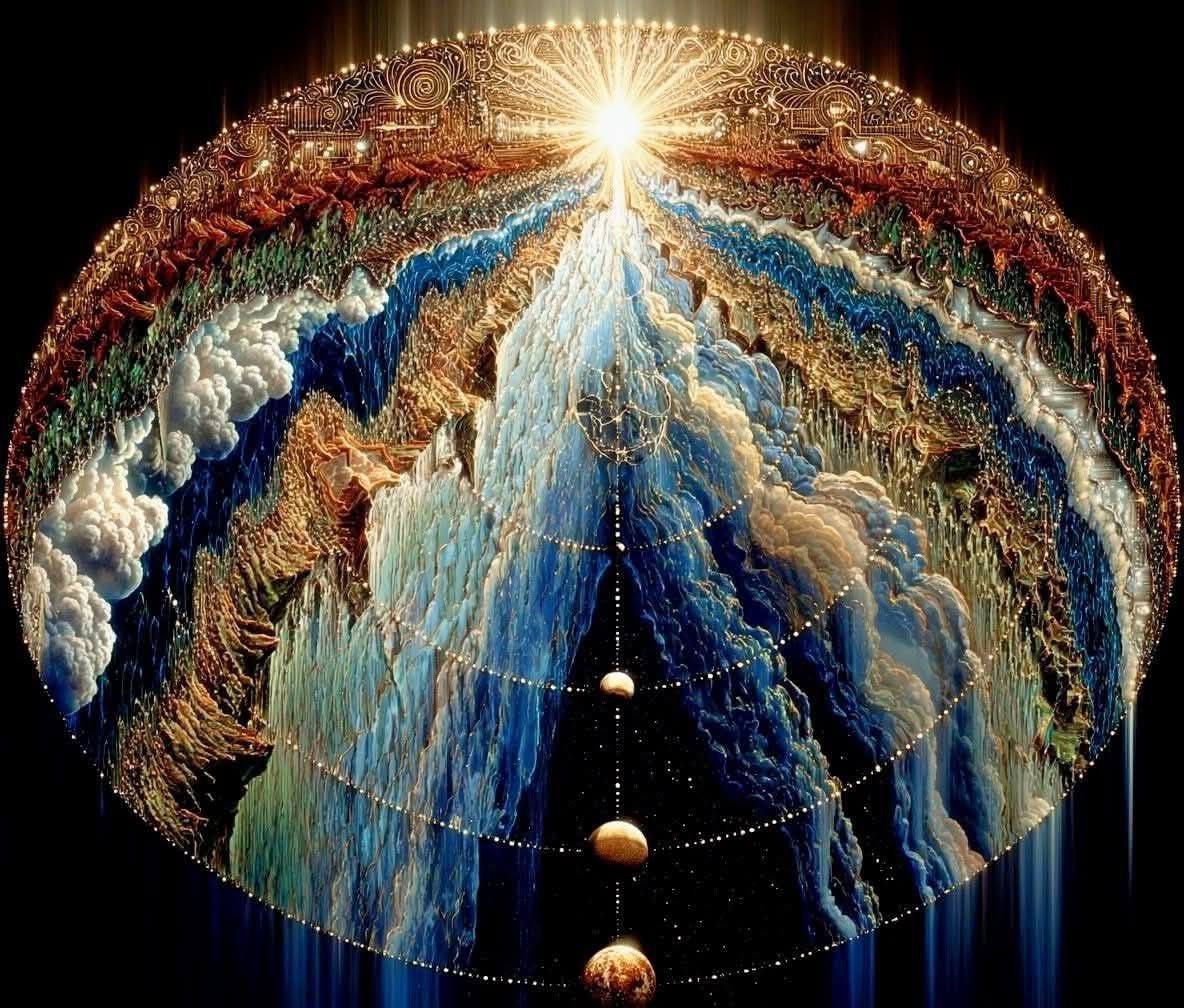
The central point of any spheromata— a totality of interrelated, mutually conditioned levels of manifested existence — is the so-called “physical” world: the domain of maximum interaction, where the objective and subjective sides of reality converge.
Therefore, when the ancients called this world Midgard, the middle abode, they were not merely indulging in anthropocentric pride. They were stating the actual correlation of the levels of existence. Midgard is not the dwelling of the gods, and not a part of their domain; it is the point where the consequences of their own life — separate from other beings — are registered.
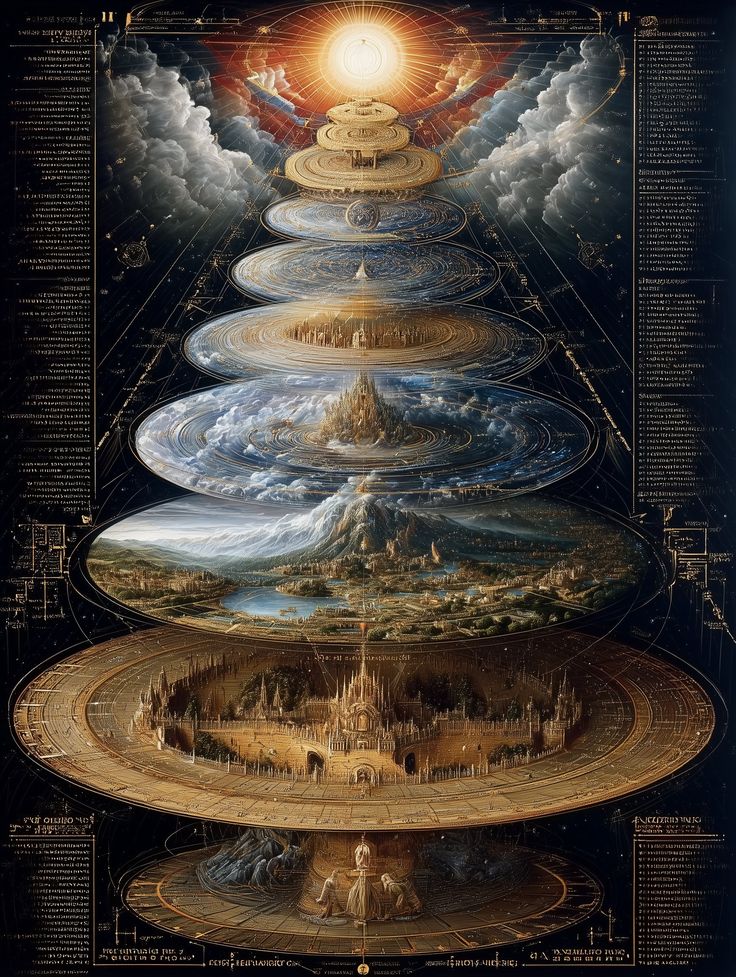
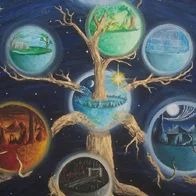
We have said that any spheromata, any “World Tree”, includes three principal levels: the level of presuppositions, the level of becoming, and the level of maintenance; and each of these levels manifests in active, passive, and neutral forms. At the same time, both “above” and “below,” this Tree extends into the Interspace, creating an unbroken cycle of reality’s generation and dissociation.
Thus, the manifested component of this cycle — the component in becoming, realization, and deconstruction — consists of nine principal spheres. Each may appear as a single world or as a totality of worlds, yet each has its own logostical foundation.
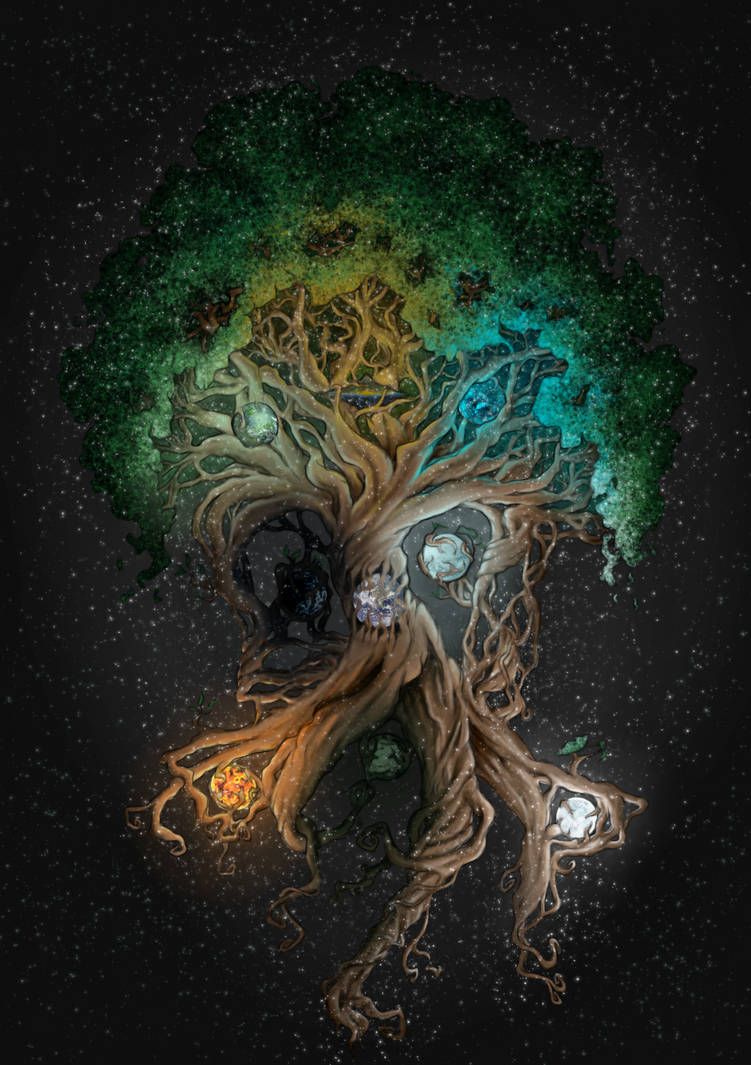
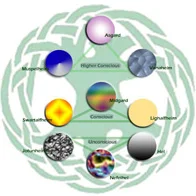
This is why Nordic myth speaks of the “nine” Abodes (heims) or Strongholds (gards) that make up the macrocosm of Yggdrasil— the spheromata known to us.
Of these nine levels, or modes of reality’s manifestation, four constitute “points of connection” with the Interspace, four are worlds where interactions are initiated, and one — the “Middle” — is their shared projection, where interactions are realized.
It is precisely the worlds in which impulses are born — later realized in “physical” space — that are usually called “divine” worlds, and their inhabitants, accordingly, “gods.”
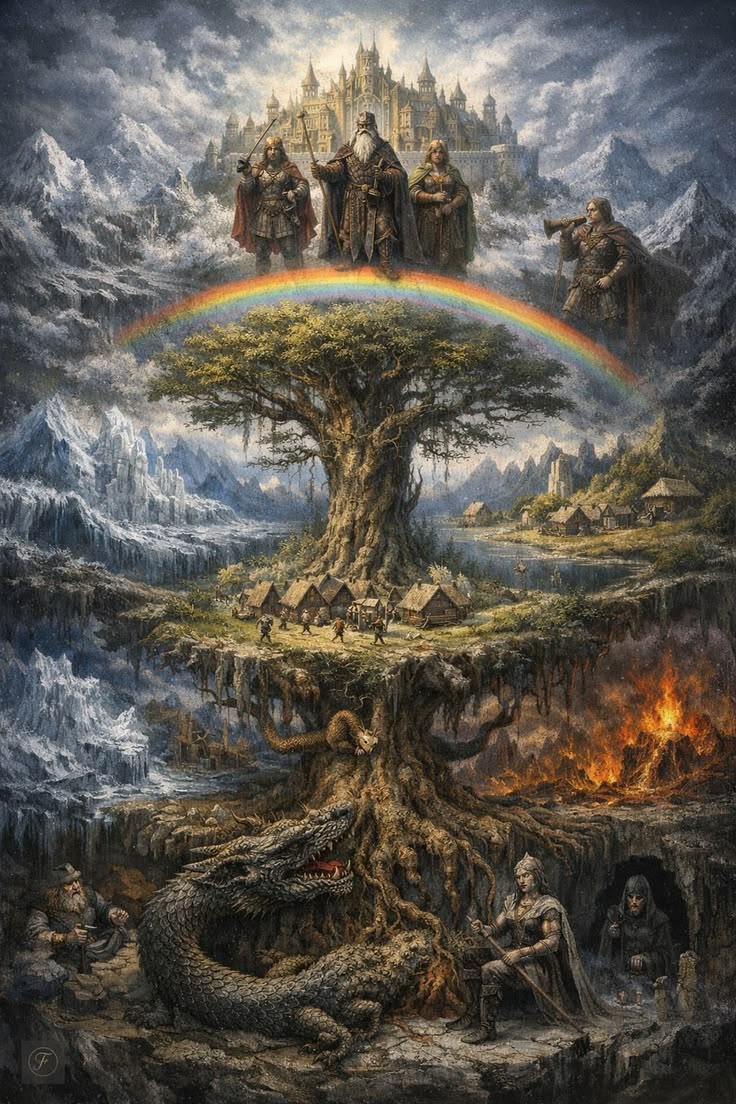
These four levels — using Nordic terminology, Asgard, Vanaheim, Ljossalfheim, and Svartalfheim — are, in the broad sense, four different worlds: four self-enclosed systems of reality. In the narrow sense, however, they are not homogeneous spaces and can be understood as aggregates of separate “sub-worlds,” spaces, or “abodes.” Hence, when Eastern systems of world-description speak of 26 devalokas, no contradiction arises with the fourfold structure named above. The three spheres (kamaloka, rupaloka, and arupaloka) can be correlated with the worlds of Yggdrasil if one takes Asgard and Vanaheim as worlds of Kamaloka, Svartalfheim as the world of Rupaloka, and Ljossalfheim as the world of Arupaloka. The same holds for the “divine worlds” described in other mythologies: their count may differ, but their principal characteristics still reduce to those stated above.
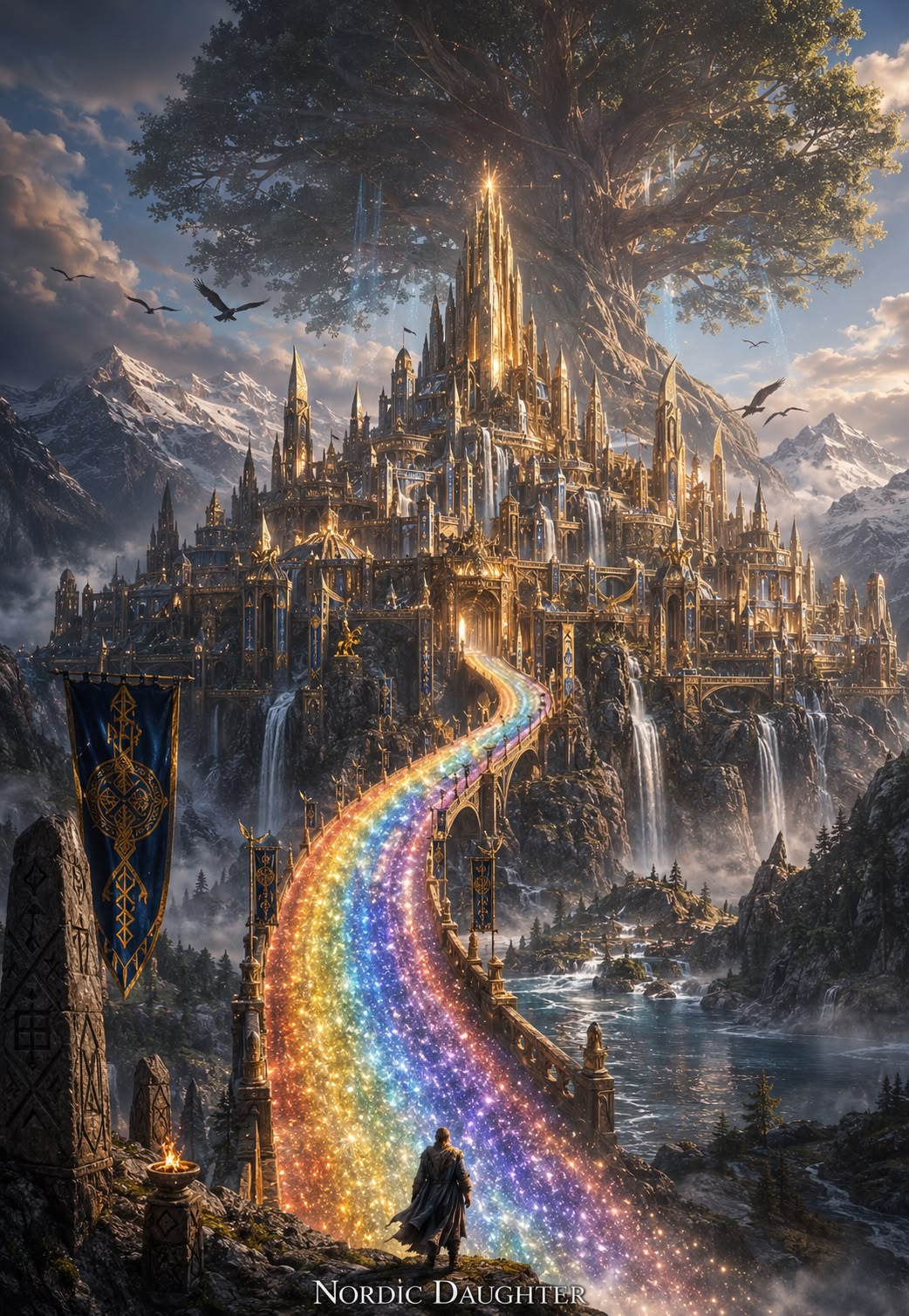
In the same way, the individual courts and abodes of Asgard can be perceived as separate worlds (in the narrow sense). Among them are: Bilskirnir (“Lightning Strike”), the enormous hall of Thor, located in his personal domain Thruthheim (Thruthvang). It is the largest building in Asgard, with 540 rooms. Fensalir (“Marsh Halls”), the palace of Frigg, the supreme goddess and Odin’s wife. Contrary to the name, it is a luxurious, sheltered place where the goddess mourned her son Baldr. Breidablik (“Broad Splendor”), Baldr’s hall. According to the texts, access to this place is closed to all evil, vice, and impurity. Glitnir (“Gleaming”), the hall of the god of justice Forseti (Baldr’s son). Its walls are made of gold, and its roof of pure silver. Here Forseti settles disputes among gods and people. Himinbjorg (“Heavenly Stronghold”), the court and tower of the gods’ guardian Heimdall. It stands at the very edge of Asgard, at the foot of the rainbow bridge Bifrost, so Heimdall can vigilantly guard the city from the giants. Sokkvabek (“Sinking Bench”), the hall of the goddess Saga (sometimes associated with Frigg). Myths say that cold waves roar above this court, and Odin and Saga drink there every day from golden cups. Noatun (“Shipyard”), the abode of the sea god Njord. Though he belongs to the Vanir, after the truce he settled in Asgard. His court stands right by the water, where the cries of seagulls carry across the shore.
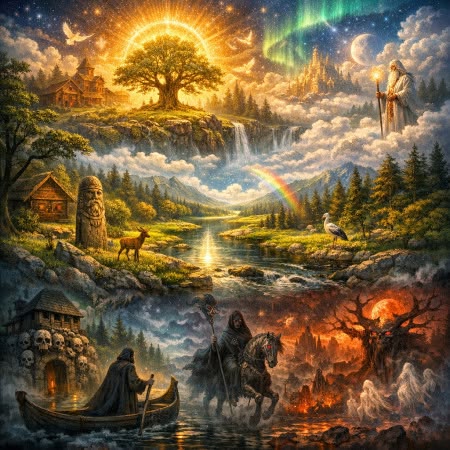
All these “halls,” though they bear the properties of Asgard — the world that maintains forms — are nevertheless independent spheres or levels of reality.
We have already noted that it is incorrect to imagine gods as beings engaged in special labor or “care” for the Middle world. Gods are free beings who live their own lives, with their own characteristics and tasks, yet remain bound to the world of forms by cause-and-effect relations. Every action of the gods is reflected in the world of people as one event, phenomenon, or law of nature. Even if Thor/Perun/Zeus sets no special goal of arranging a storm in the human world, but is engaged in his immediate work —resistance to chaosizing forces — we perceive the “echo” of these battles as weather cataclysms. In the same way, when Veles/Heimdall, in one manner or another, regulates the permeability of the Gates between the worlds of the Tree, we perceive the echo of that act as a bright rainbow.
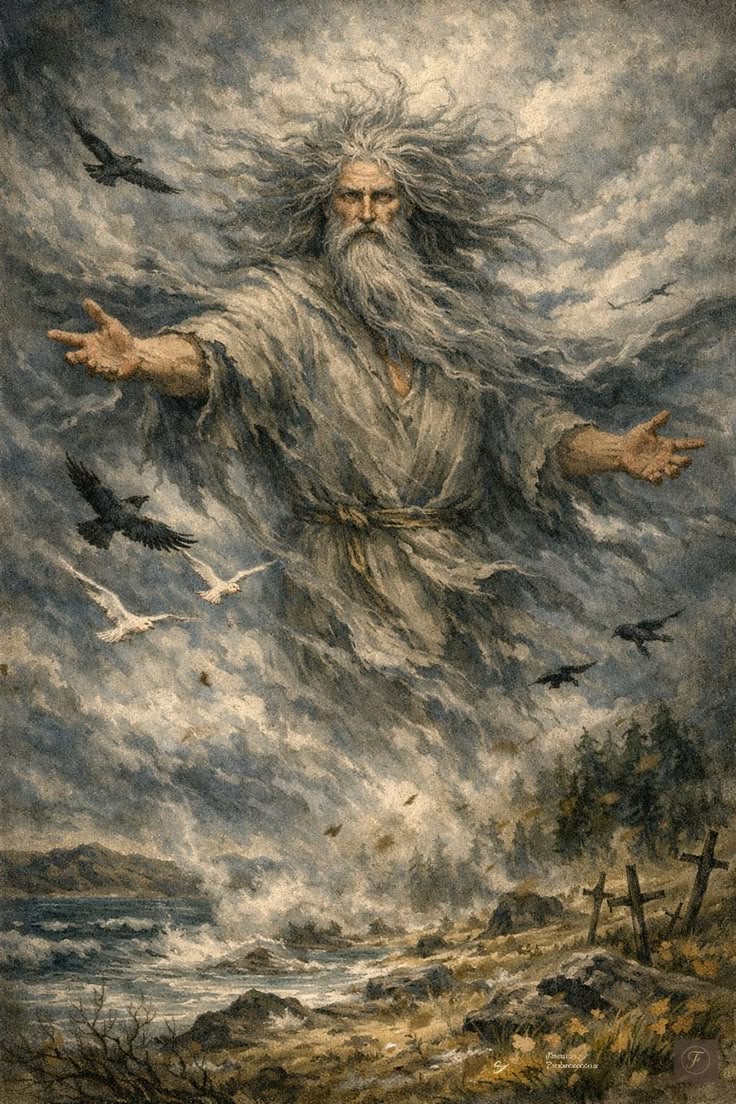
These actions of the gods produce literal, physically registrable consequences in the Middle world because the worlds of the gods possess their own level of materiality. They are not “spiritual” and not abstract. This materiality is not the materiality of Midgard: the gods, by their very nature, operate not with substance but with energetic impulses, from which “coarse” matter is derivative and secondary. Yet Asgard or Vanaheim are no less dense and weighty for those who dwell there than Midgard is for humans. Their materiality is energetic, not substantial, and therefore inaccessible to the physical organs of sense — yet no less real.
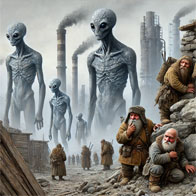
A special role in the formation of reality belongs to the “gods of forms” — the alfs— whose activity is accompanied by the structuring of the semantic level of manifestation. At the same time, as we have already noted, the world of the Svartalfs has undergone degradation and has, in many respects, been turned into a technogenic sphere of the igvs. Therefore, the present population of this world and its logostical foundation already differ greatly. While the sphere of Svartalfheim is the “world of creating reference points,” its current inhabitants are, for the most part, no longer gods — though they still far surpass humans.
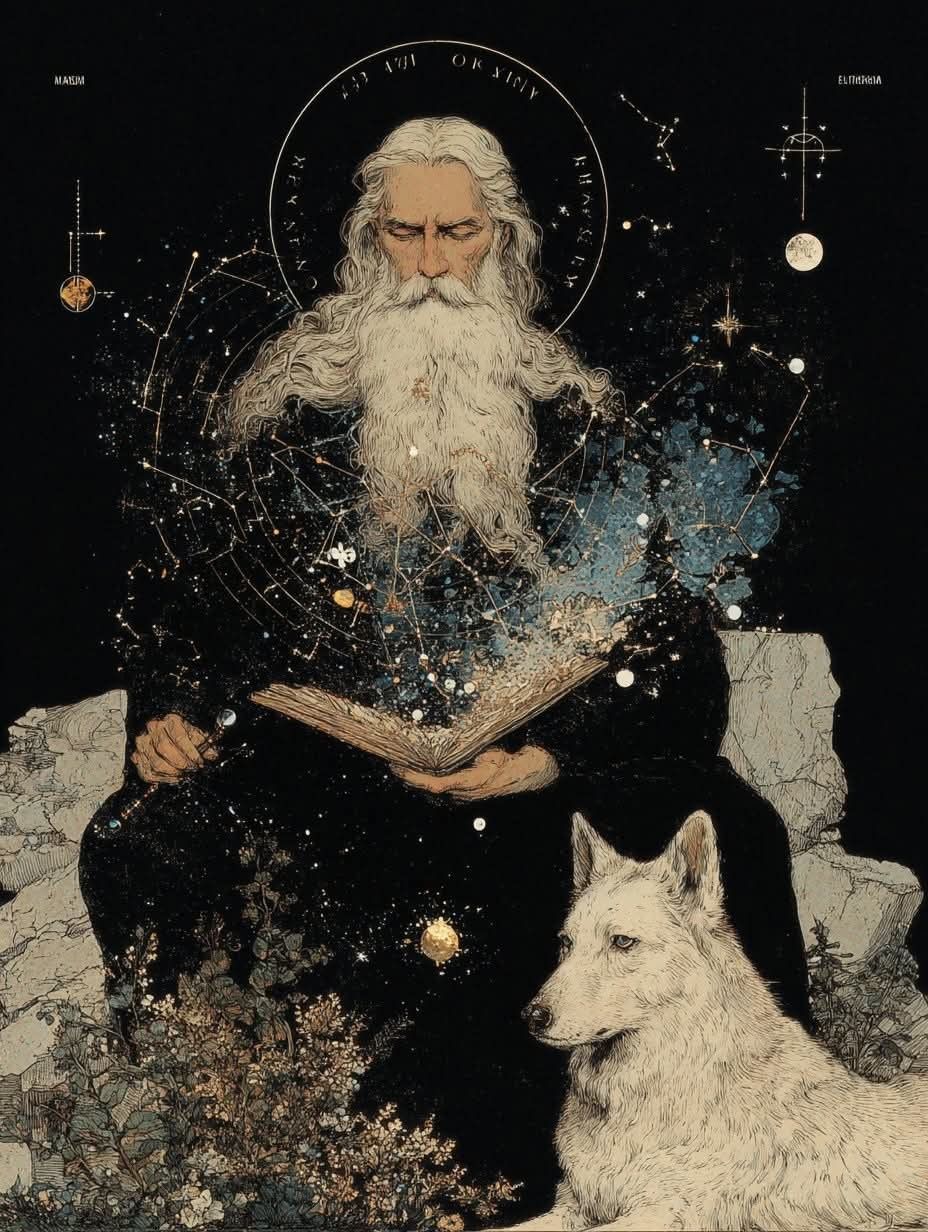
Each world — or “Hall” — of a god is a relatively autonomous space, distinguishable from the god himself, and marked by the trace of his biography, choice, and history (Fensalir, where Frigg mourned Baldr; Glitnir of gold and silver as an expression of Forseti’s aesthetics). The god (or group of gods) dwelling there directs and forms, but does not coincide with his hall. Therefore, passage — by the gods themselves as well as by other beings — between halls is possible. It may require a change of guide, but it remains a real transaction of perception.
Unlike the divine worlds, the ether of one or another Aeon is not separated from the Aeon itself and is not distinguishable from it. It is an expression of the contents of its mind, projected outward. Therefore, transition between ethers is no transition at all, but only the unfolding of yet another facet of one and the same infinite-dimensional hyperspace. Accordingly, in travel through the Interworld, no transaction occurs, because, strictly speaking, there is no other place.
What has been set forth allows us to clarify the initial question of the gods’ whereabouts. Midgard stands in relation to their worlds as a zone of registered consequences: here, the results of processes initiated at higher levels of the spheromata are fixed. The ethers of the Interspace are outwardly unfolded contents of the minds of the Aeons and are devoid of independent density, whereas the gods are characterized by full-fledged existence, with biography, will, and history. From this follows a clearer understanding of the status of natural phenomena. A thunderstorm correlates with a god’s activity not as his embodiment and not as an image that personifies him, but as a distant, secondary consequence of processes unfolding in his own world. The connection of the human world with the worlds of the gods is causal, not spatial: the latter are located neither above nor within Midgard, but on other levels of the same spheromata — separated by differences of properties and laws, not by distance. Accordingly, approach to them is achieved not by movement in space, but by the transformation of the guide of perception — which, as we discussed, constitutes the subject of theurgy.

Dear Enmerkar, could you advise how to develop visualization skills?
Hello! Successful visualization is the result of two skills: 1) being able to keep your attention on a chosen object (this can be trained with any meditative method), and 2) finding the right attributes that act as “keys” to one power or another (this skill is developed through theurgic practices).