
Although freedom itself, as an absolute state, cannot have gradations or subdivisions and therefore does not depend on the ways by which it is attained, there can nevertheless be several such ways


Other Magic
Пишите мне
Enmerkar's Blog contains over 1200 original articles of an esoteric nature.
Enter your search query and you will find the material you need
Although freedom itself, as an absolute state, cannot have gradations or subdivisions and therefore does not depend on the ways by which it is attained, there can nevertheless be several such ways

The Magus does not hope to preserve his knowledge and skills; yet he strives to imprint his Power and Authority into the very fabric of the flow of mind, he seeks a stable transformation of that flow, and thus the evolution of mind as such.
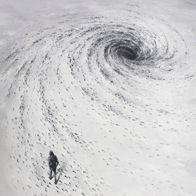
The combination of “supporting” approaches and practices that produce “breakthroughs,” leading to transcendences of the mind, is the key to the progressive development of the mind.
Not fleeing, not hiding, not clinging, but also not being lazy or asleep — in a sober, wakeful state of mind the Magus can attain the effectiveness of his realizations, and, by being aware of them, of their content and of the responses they provoke, the Magus develops his mind.
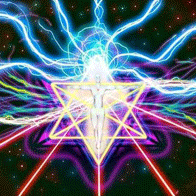
By identifying our state as a position on the Tree, we gain a powerful toolkit for increasing the effectiveness of our movement.

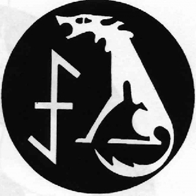
The Wolf’s Hook, in its abstract section, expresses the principle of uniting a binary into an androgyne — that is, the holding of the poles of duality by their conjugation with a third, neutral element.

Although Authority includes experience — that is, an authoritative Magus is necessarily an experienced Magus — experience does not necessarily lead to Authority, and an experienced Magus is not necessarily authoritative.
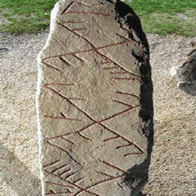
In order to bring about any realization, both on the macrocosmic and on the psychocosmic level, one must find, activate, attract, and bind together a number of energy flows.
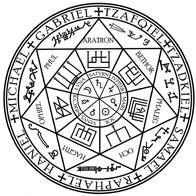
Two differences — source of Power and the demands placed upon the operator — give rise to the methodological divergence within the directions of Graphic Magic.
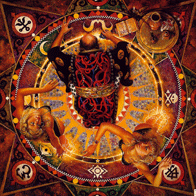
All the objects, items and actions that surround the Magus perform both of the functions described — they order the environment by drawing certain energies into it, and they induce specific states in the Magus’s mind.
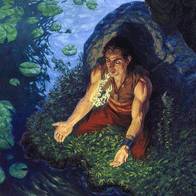
One must be fully clear about the specific mechanism of each carried-out realization: where it draws its energy from, how that energy is transformed and amplified, and what consequences this carries for the operator and the world.
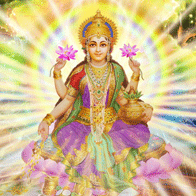
For the Magus, the level of his Luck is a consciously appreciable factor in his development. “Luck” for the Magus is not an inexplicable play of probability, but the result of a certain energy at work—an energy that can be assessed and measured and must be used according to its purpose.
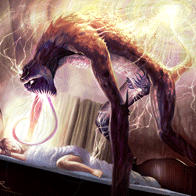
The danger that destructive forces may be actualized — forces that can “awaken” in the Interworld when potential space comes into contact with the actual mind — is perfectly real.