The Energy of Destruction
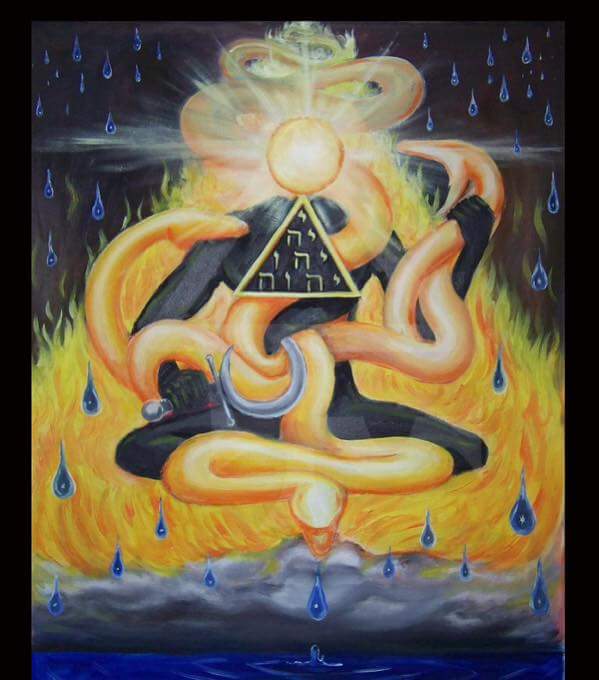
Although the Way of the mind’s development is one of realization, attainment, and integration, the cause of delay — the obstacle upon the Way — is very often not a lack of what is needed but, on the contrary, the presence of alien, disharmonious structures. Most of these are built by the mind itself, as the result of accumulated errors and miscalculations.
Accordingly, a necessary condition for further creation often proves to be destruction, and an indispensable prerequisite of rebirth —death.
Neglect of destruction — an obsession with construction, with “growth” without the needed “molts” and transformations — often drives the mind into the cramped confines of its own concepts: concepts that stifle the very possibility of freedom and movement.
For this reason, both forces — both creation and destruction— must manifest one another. What is built is usually subject to destruction, and upon the ruins of what has outlived itself the new must be raised. This cycle is unalterable until the system passes into one of two fully harmonious states: either the undifferentiated homogeneity of Choshekh, unmanifestation, or the crystalline homogeneity of the Pleroma. And these states themselves, of course, are not truly distinct from one another.
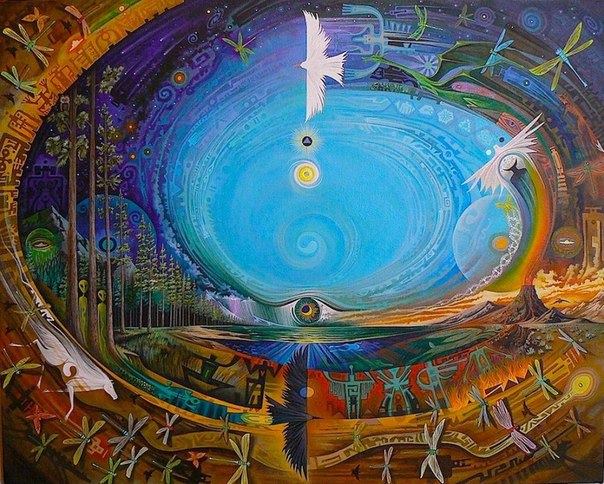
So long as manifestation exists, the forces of destruction are no less — and at times even more — essential drivers of its development than the forces of creation. Moreover, manifestation itself arises through the destruction of unmanifestation, and the passage to each new stage of existence signifies the destruction of the previous one. Even the very exit beyond the limits of manifestation may likewise be understood as the destruction of the necessity for manifestation.
For a chick to hatch, the eggshell must be broken; for enlightenment to occur, ignorance must be destroyed.
Thus, the forces of destruction — the energies of death — though they evoke instinctive terror in any manifested being that clings to its own existence, are in essence primordial forces of the cosmos.
Chaos always precedes cosmos, and chaos also engulfs cosmos. One may say that the forces of creation are but a small island in the raging ocean of the forces of destruction.
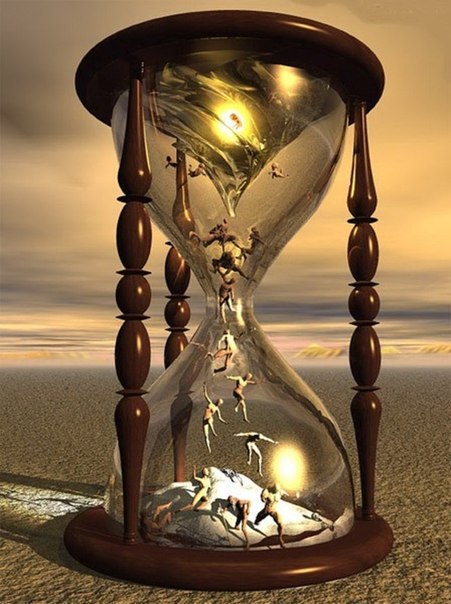
It is therefore unsurprising that the energies of destruction — so frightening to some — are so attractive to others: everything depends on one’s point of view, on the emphases the mind sets for itself. Yet both activities — the condensing and the rarefying — are indispensable components of any process.
Any magical act begins with purification, with the banishment of alien energies — and thus with the forces of destruction, with repulsion.
The energies of destruction, of death — or, as they are now often called, necro-energies— are a condition for the operation of the energies of creation. Yet the energies of destruction themselves neither require nor imply creation. Their action is only dis-ordering, de-differentiating, whereas the activity of the energies of creation often demands further destruction. In other words: if creation can reach an impasse, requiring destruction, then destruction simply calms, bringing the system into a homogeneous state without requiring or implying further creation — while still containing within itself the possibility, the potency, of a new arising.
Let us repeat once again: creation contains within itself the possibility of destruction, and destruction the possibility of creation. Both forces merge and are held in balance in their common source, of which they are modes of manifestation.
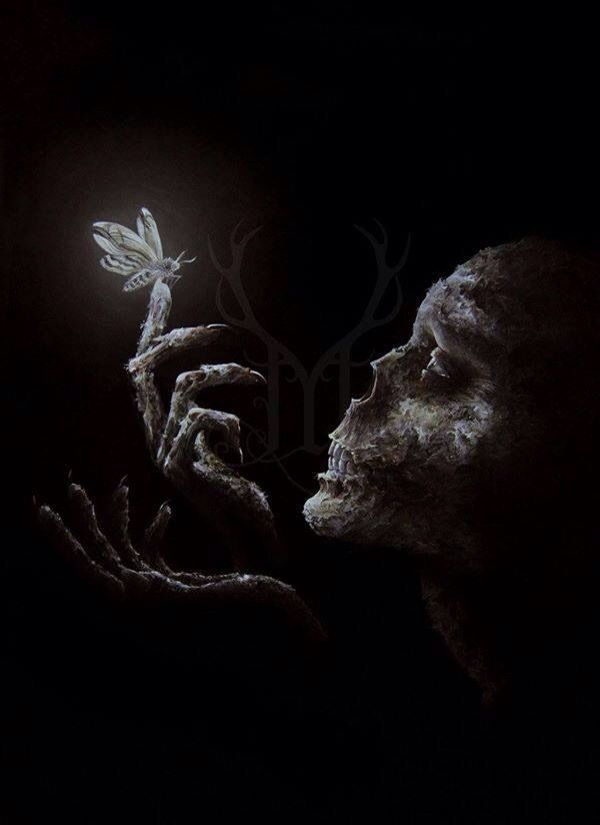

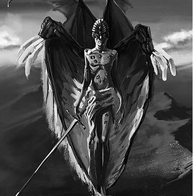
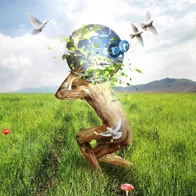
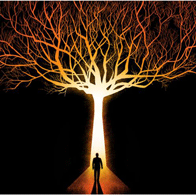

The son asks his dad: – Dad, you’re a Mage, you must know, does Chaos differ from Thanatos in any way? Dad replies: – For you, son, definitely not, because if you scatter your toys once more – I will kill you for sure 🙂 The son asks dad: – Dad, tell me, is a more structured person more alive? Dad replies: – Well, something like that, son, frozen climbers, turned into crystals, look almost alive after 20 years. 🙂 Seriously, life is built on balance, on creation and destruction. This happens almost synchronously, because by destroying one substance, we synthesize others from it, by destroying one structure, we create another. Moreover, by destroying time (sending your future seconds into the past) – we synthesize our microcosm and expand the power of awareness. Any disruption of balance (Equilibrium) leads to the scale tipping toward Death. Excessive synthesis forms tumors, clots, cholesterol plaques, kidney stones. (Nothing organizes a person’s inner world like the incantation ‘Turn to Stone’ 🙂 ) Excessive synthesis is just as much a flow of Thanatos (necroenergies) as is excessive destruction (Those who think chaos adds life might reconsider after being hit by a bullet.)
Destruction is not synchronous with creation. Limitation comes from the nature of space: in one place – one object. The expansion of the power of awareness will occur if your body of awareness does not let the power of time through various ‘gates’ and ‘cracks’, like a leaky balloon lets out air. Plaques, stones, and other stuff form not from excessive synthesis, but from excessive free (read, unmastered) energy. This is so because there are two paths for spending surplus energy – destruction or creation. There is no balance in the material world. Death is the fate of every born being. Eternal life belongs only to those who are unbidden in the first place. Although the article outlines the second principle of dialectics – development occurs through the negation of negation (through the prism of myth), using the example of a ‘control point’ denoted by the banner creation-destruction. This is one of the most important points.
Here is the translation of the text into English:
Do you think, then act, or… Do you act impulsively? In any case, everything you do is filled with meaning; otherwise… you wouldn’t be doing it. Isn’t that right?
_
Perhaps your actions are dictated by duty, the necessity to fulfill obligations, or need, or… they are filled with feeling, impulse, inspiration.
_
…Or… Maybe you are mistaken, and there is no meaning in what you do…
There will come a time when your life begins to fade, and it will no longer matter what you did or didn’t do.
Everything will lose its value.
__
A moment will come that marks the beginning of Agony, perhaps swift or stretched over decades, but Relentless and Final.
_
And it doesn’t matter what Picture of Myth you uphold.
_
It happens to every person.
_
…Perhaps you are missing Something,… a Turn in Another Direction that Exists, but is not visible.
_
It exists but is inaccessible to perception, … and it doesn’t matter why it’s inaccessible; indeed, the Turn itself is beyond importance and unimportance, just like dust on the ground.
When the Self realizes that, aside from the mask of personality, there exists a more influential structure in the psycho-cosmos that is given the more exalted name of Spirit in an esoteric sense, it begins to plaintively wait for its “death”—the loss of its comfortable personality—fearing it, but secretly hoping that the Spirit will take its place, bringing enlightenment and a better, more genuine life. Meanwhile, with every “swing of the pendulum,” it desperately tries to maintain the adequacy of the personality and not convince itself that schizophrenia is looming at the doorstep.
In this case, the Spirit is perceived as something dangerous because the personality is not particularly eager to disappear, while the Self is hesitant to change; however, in contrast to this danger, this same structure is also seen as something desirable for the Self. The Self takes on the position of the “waiter,” for the awakening of the Spirit here is a desire not of the personality but of the Spirit itself. The Spirit dreams and envisions how it will awaken on earth, descending into the filth of earthly existence—this is a fixed idea, according to the Self, where all events line up in a chain and the hand of the Spirit leads it like a small child towards enlightenment.
But it turns out that this “Spirit” may be deeply indifferent to earthly life, this senseless river, and the trivialities of life so often extolled by sages. It is not in a hurry and doesn’t even think about “waking up,” or rather descending. The Self starts to understand, puzzled, that there will be no handouts. And that the desire to ascend must come from within itself and be strong enough to subdue a Power greater than itself. Thus, the path of the Hero emerges.
The path of the hero is clearly described by Jung in his book “Man and His Symbols,” if you’re interested.
………..actually, I was writing about something else.
………I’ve been pondering for a long time that a person is like a perfect mechanism that was created and released into the world, but no instructions for use were provided intentionally. Perhaps because Eve ate the metaphorical apple or because Castaneda’s flyers clouded human consciousness and implanted their own reason into us, or maybe one day we came to a foreign world and forgot who we are and where we came from………but that’s not the point………………………….
Sometimes, through the fog, astonishing things emerge. For example, there’s a person standing at night on the sidewalk in front of a pedestrian crossing, at an intersection. No one around. The green light comes on. The person takes one step onto the roadway and… nothing suggests impending trouble. No premonitions, no signs, no visions, and, God forbid, no voices in the head. Nothing. Not a single thought………. and suddenly, unexpectedly for their own mind, the person sharply jerks their leg back, quickly returning it to the sidewalk. And… at that very moment, a cyclist speeds around the corner of the nighttime intersection, who would have definitely knocked our person down if they hadn’t returned to the sidewalk in time.
…….as if there are no separate objects, no separate people, but there is only something unified and whole.
I think we miss a lot because we don’t know about its existence. No one taught us to perceive it. And this idea holds immense potential for understanding something new, unexplored, that exists right here and now 🙂
Tavita, the phrase that made me think the most in your entire response was “…actually, I was writing about something else…”. This means that your thought follows a clearly defined path, much like a person who decides to cross the road when the green light comes on. What would happen if everyone followed only this direct path and didn’t listen to what might sound outside of it? I hope that person is not you, otherwise it creates a kind of contradiction))) You say… “as if there are no separate objects, no separate people, but only one unified whole…”, yet these words stem from your separateness perfectly, if we’re not talking about that moment that has passed but about the moment of writing the message. Why is that? After all, you are originally perfect and even know of the existence of this perfection, right here and now…)))
We are unaware of many of our qualities and abilities. This is something to learn about. The perfection of a person is Potential, Unmanifested. The mind understands fragments (puzzles), and then assembles pictures from these fragments using logic. And then, unexpectedly, events occur that destroy the logical constructions of the mind. This indicates that the mind is imperfect… and there is always more to learn… I cannot claim that you understand what I am writing about. You and I look in different directions. And this is neither good nor bad. It’s a fact.
Tavita, —- “We are unaware of many of our qualities and abilities. This is something to learn about…”. What should we learn? The multiplication table, how to make origami, how to plant a tree, build a house, raise a son, crochet in retirement, dance when you have sciatica, etc?))) Yes! We are unaware of many of our qualities and abilities. Even if the sentence is constructed in such a way that we need to “learn about OUR abilities”, the question “how?” still arises. Or should we grab everything – it’s all yours? —- “The perfection of a person is Potential, Unmanifested….” Is this knowledge from “books” or knowledge based on experience? And to what knowledge does that case belong where a person just didn’t go on the green light?) —- “The mind is imperfect… and there is always more to learn….” Can one become perfect if one is limited in understanding? After all, the mind is merely the ability to think. For some reason, perfection is associated with a state of inner silence, rather than the ability to create increasingly beautiful patterns on the surface of the water. —-“The mind understands fragments (puzzles), and then assembles pictures from these fragments using logic. Then, unexpectedly, events occur that destroy the logical constructions of the mind….” All of a sudden, a person starts to feel, instead of blindly following the picture of the mind. Which, by the way, is not very alive. By the way, you cannot take the mind with you to the other world, so why all of this? ——– “… you and I look in different directions. And this is neither good nor bad. It’s a fact)…” And a view at 180 degrees))
“How?” is a good question. It can become the first step in a New Quest, or it may not. “Why all this?” – the eternal question about meaning. I wrote about this above: “everything you do is filled with meaning, otherwise… you wouldn’t be doing it. Isn’t that true?” When you find meaning for yourself, you find the answer to the question of why? And this pushes you to search for answers to the question: how?
“Life is a journey of the soul to the spirit.”
“Many letters and meanings, but it’s strange that no one has called all of this by simple and clear names – good and evil, constantly swapping places.”
Here’s the translation to English:
“Changes are needed when they are needed. And if a person, while doing something, is already preparing for the destruction of what they are doing, then why even do it at all? If I anticipate something bad in the future, then it has already happened to me automatically. If you are prepared for the bad, then turn around and leave; the bad has already arrived. If you seek spots of evil in goodness, you will surely find them. If you look for glimmers of goodness in evil, you can find those too. Another favorite question of Enmerkar is honesty. When we look for good in evil, it is to justify our weakness and inadequacy in the face of that evil, to justify ourselves. You cannot be loyal to evil. And in goodness, we seek evil for the same weakness. After all, it is impossible to believe in its existence. People dislike taking responsibility. If you are trusted unconditionally, then you must trust in return.
For this reason, there cannot be many close people; they are difficult to find. If you love someone, you are responsible for them, but can they be equally responsible for you? Are they willing to make sacrifices for you? As a rule, no. Thus, it turns out that goodness is always at a deficit, and actually, there is no such thing as “good” and “evil.” What is good for one person is bad for another. There is “me,” and what is beneficial and good for me is goodness. All romantic demagoguery is just words.”
What you see around you is Good. It is the presence of structures in a stable, steady state. Evil enters the block of Darkness, preceding Change. A simple example of Evil is ISIS, Syria. A banal destruction.
Tell our dark one that evil does not exist, and he will laugh for a long time.
And what do you think, does ISIS consider itself Evil? Or do ISIS representatives still need to be convinced that they are Evil?
If the responsibility for choice did not lie with the individual, but with something else, the balance of power in the world, the consequences, and the degree of responsibility would be different.
The saddest thing is that I am not in this chat for the defense of common goals; I see the defense of personal interests.
I admit I am ashamed of this world. Ashamed of those who, knowing the problems of this world, act enlightened instead of explaining while reveling in their significance. Ashamed of those who barely survive in this corrupt system and pretend to be masters while being just bugs themselves. A system built on nonexistent values will not last long.
Information is strictly for mages. Due to a strong merger (” ”), the potential of our world (and not just ours) will noticeably decrease. Please strengthen the influence on maintaining occupied positions.