
The Grey Magic of the Heptameron
Since the Heptameron has come up, we should determine whether this book is truly as luminous as it is commonly believed to be.
Authorship of the “Heptameron, or the Elements of Magic” is attributed to Pietro d’Abano (c. 1250–1316), a professor at the University of Padua — physician, natural philosopher, alchemist, and astrologer — who studied Greek in Constantinople. Suspected of heresy, he died in prison while awaiting judgment by the Inquisition. Though Abano was a close friend of Pope John XXII, he spent the last eight years of his life incarcerated. After his death, the “Heptameron” made him notorious as a great sorcerer. They even claimed the Devil took him. Frustrated that they had failed to execute Abano, the inquisitors at least burned his portrait.
It was said that Abano kept seven Demons in a glass jar, and that they made him a great master of all the “seven liberal arts” (that is, secular learning).
The first edition of the Heptameron was published in 1496 in Venice as a supplement to the works of Heinrich Cornelius Agrippa, appended after his Fourth Book. The book was also published in Latin in Lyon around the turn of the 16th–17th centuries.
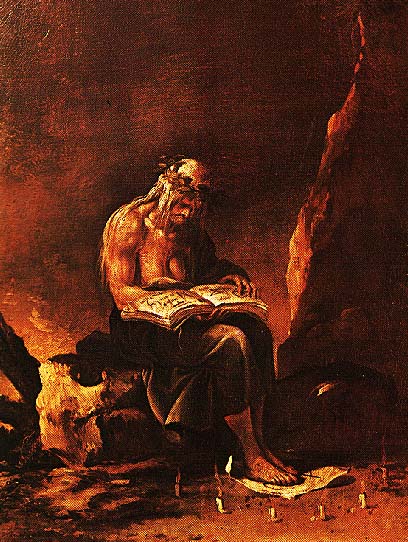
The book lays out in detail the signs, names, and numbers one must know in order to summon the spirits it calls “angels of the air”:
“and if they should become acquainted with this work, then they could learn the various duties of the spirits, how they may be summoned for discourse and communication; what ought to be done each day and each hour”
It is believed that the Heptameron draws on the truest magical books, including the Book of the Angel Raziel, which, according to tradition, an angel gave to Adam during his exile so that people could live on Earth and remember the Lord.
The Heptameron is mentioned in Sepher Maphteah Shelomoh (The Book of the Key of Solomon), where it is called the Book of Light. As one of the earliest books of medieval Magic, the Heptameron is also regarded as a primary source for the Lemegeton and for the entire Solomonic cycle. Agrippa wrote that Pietro d’Abano’s works were among the sources for his famous Occult Philosophy.
Arthur Waite regards the “Heptameron” as a continuation of the “Fourth Book” of Agrippa.
He was the first to note that the Magic of the Heptameron “is not as white as it wants to appear.” Although the spirits the Heptameron works with are described as angels, the operations proceed exactly as they do with Demons: they are constrained by Divine Names, threatened, and bound.
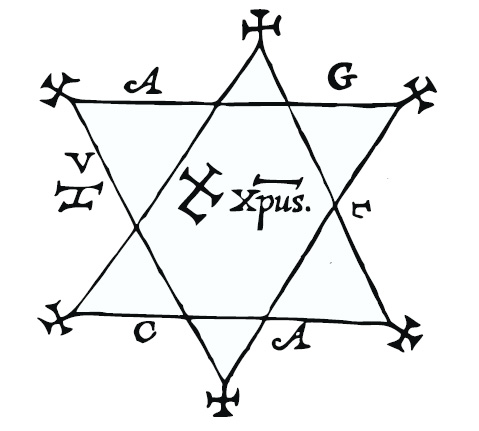
The Heptameron’s pentacle also matches the general character of Solomonic books. The hexagram, bounded by crosses and the Name AGLA, plainly recalls the Almadel and other comparable pentacles.
No less strange for angels are the aims of these operations. They present themselves as directed toward “knowledge,” yet the listed duties of the summoned spirits include the classic repertoire: “open locks or bolts,” “provide with silver; carry things from place to place; make horses swift and reveal people’s secrets,” “bring about wars, epidemics, death, and fires; and provide, at one and the same time, two thousand Soldiers; bear death, sickness, or health,” “tempt men to love women,” and the like.
A sober look at both the character of the summonings and the stated duties shows that they are called “angels” only for appearances. In fact, the Heptameron works with the same ministering spirits as other Grimoires.
To understand the nature of these “spirits,” we must first clarify whom medieval Grimoires, in general, call “demons.”
Beginning with the Gnostics, the Christian esoteric tradition — with its concept of “fallen” spirits — placed these beings not in “hell,” that is, not in the Qliphothic regions, but in the “subcelestial world.” Abano, familiar with this doctrine, clearly meant by his “Spirits of the air” not Elementals— not the elemental spirits of air masses — but precisely these “subcelestial” spirits.
We have already said that the Magical myth distinguishes ministering spirits that carry out the Descending Current, those that impede this Current, and those that dwell within the Vertical Flow itself. It is the first — inhabitants of the Qliphoth and Sheol — obligate predators who draw Power through insatiability, that, strictly speaking, should be called Demons.
Those spirits that dwell in the Flow are, in principle, able to draw power from its Ascending part and therefore are not exclusive predators. Their “positive” basis, traditionally called “Genii,” is usually not active. Nevertheless, they cannot generate power on their own and therefore strive to devour both Life energy and the energy of desires (the “Red Light”) of Free beings.
Most Goetic spirits belong to this category. Contrary to later notions, they come not “from hell,” but “from heaven” — more precisely, from the subcelestial realm — inhabiting the Vertical Current.
Abano is therefore entirely precise when he conjures his “angels”
“by the ruling cherubim; and by the great Name of God Himself, mighty, strong, exalted above all heavens”
This is exactly how nominative governance of ministering spirits works, including those of the “Grey” hierarchy.
From a practical standpoint, the distribution of the “Spirits of the air” among the “Winds,” that is, among the cardinal directions, also matters: it helps, first, to choose the direction of the operation correctly; and second, to grasp certain traits of the spirits themselves. This division differs from the familiar distribution of spirits by planetary regions, but it pursues the same aim and sometimes proves even more productive. The Heptameron still counts the same seven regions — seven winds — corresponding to the seven days of the week. In some cases it even sets Winds equal to Planets, for example:
“The Spirits of the Air of Monday pertain to the Western Wind, which is the wind of the Moon”
Thus, the Heptameron does not depart from the general line of Grimoires in the Solomonic cycle in anything except technical details and the habit of calling Goetic (“Grey”) spirits “angels” or “spirits of the air.” There are no grounds to consider it more “luminous” than, for example, the “Lemegeton.”


Okay. If the Demons of the Lesser Key are not Klippot, then which demons correspond to Klippot? By the way, is Astaroth of the Lesser Key and Astaroth of the Greater Grimoire the same entity, or are they ‘namesakes’? Just like Archangel of Fire Michael – this is not the same as the Archangel of the Sun, although they share the same name. And also – Sorat, Taftarat, Barzabel, and other planetary spirits – I understand, are also entities defined as ‘heavenly’? And if we are talking about planetary spirits, then what is the nature of the spirits of Arbatel in that case? These are entities of a completely different plane compared to Sorat and Taftarat, for example? Specifically, if we consider the accepted hierarchy in the West: Divine Name – Archangel – Choir of Angels – Genius – Demon, what place in this chain could the Spirits of Arbatel, presumably, hold?
1) Lemegeton is not a manual on demonology, but a practical guide. It describes spirits that are located in the decans and available for interaction with people. And among them, there are both ‘black’ demons of klippot, and ‘gray’ demons of the ‘heavens.’ The Astaroth you mentioned, like, for example, Sidonai – these are, without a doubt, absolute predators. 2) A name is an entity and there cannot be two different entities with the same name. Astaroth is always Astaroth, and Michael is always Michael, and regardless of which aspect of their activities is considered, their self-identity is preserved. If you consider yourself at work and yourself in a family circle – it may also seem that your functions and even personalities are completely different, but that does not mean that the entities are different. 3) Regarding Klippot in Western tradition, there is a habit of mixing the ‘husks’ as a principle and their inhabitants. As a principle, Klippot are a necessary component of existence; any object or partzuf must have its ‘husk,’ without which Power will not flow into it. Nevertheless, the spirits of klippot, despite their ontological necessity, are subjectively absolutely hostile to existence and beings. As for the spirits of Arbatel, they are probably also worth referring to the Gray hierarchy, but they express its neutrality, disinterest in the Flow of Power as such. 4) In the ZZ system, spirits of Arbatel should most likely be classified as Chinas, understood as the individualization of collectivities (in the spirit of Swedenborg).
I am shocked. In essence, this explains their inherent cunning. But there is a question about passages like ‘I summon you, Michael, do everything I need.’ In this way, do we include Michael in the hierarchy of the Heptameron and relate him to the heavenly?
Angels are also service spirits. In principle, they can also be summoned and called upon; the question is whether it makes sense to summon spirits whose very nature is to hinder the flow of Power.
So what do you mean by ‘that does it make sense’? Does a preliminary summoning corresponding to the day make no sense?
Summoning and calling are not the same. In traditional Evocation rituals, Archangels are called – just as the Names of the Most High are invoked, not to compel them to do something, but to identify one’s own power with their power. A magician identifies himself with the Forces that are on the same Axis of Analogies as those he calls upon, but standing above those called, thus gaining power over them.
Wait’s views on Black and White magic are quite controversial (at least those who compiled the Grimoires hardly shared the same opinion). But if working with the Heptameron implies working with the Spirits of Air – then perhaps it is rather gray magic. But in my opinion, it can be used as a basis for many other works.
In general, to be honest, I still do not quite understand what in practice your words mean that “Angels are spirits whose essence prevents the flow of power”. So, it is useless to call them for practical operations, but only, for example, to gain knowledge, etc.? Or is the work with them useful to the Magician for something else?
{Not taking into account the invocation to them as an intermediary link in the hierarchy during the invocation of lower spirits. They must still be remarkable for something besides that?}.
Calling Angels for practical purposes is not useless, but dangerous – and not less dangerous, and sometimes even more dangerous than calling demons. Have you tried to summon an angel? If interested – try – You are right, the Heptameron method can be used for any evocations (as can the method of any other Grimoire), and you will see for yourself what is particular about their nature…
I have tried to summon Angels and largely agree with you. For working with Angels, a person must possess certain qualities, and for those who do not possess them, calling them can indeed be dangerous {to the extent of this inconsistency}.
But to be honest, I still have not answered the question for myself – why work with them (especially compared to other spirits, with which interaction is often much more productive due to their greater proximity to human nature).
Thank you, Master!