
Tuan and the Grigori (Watchers)
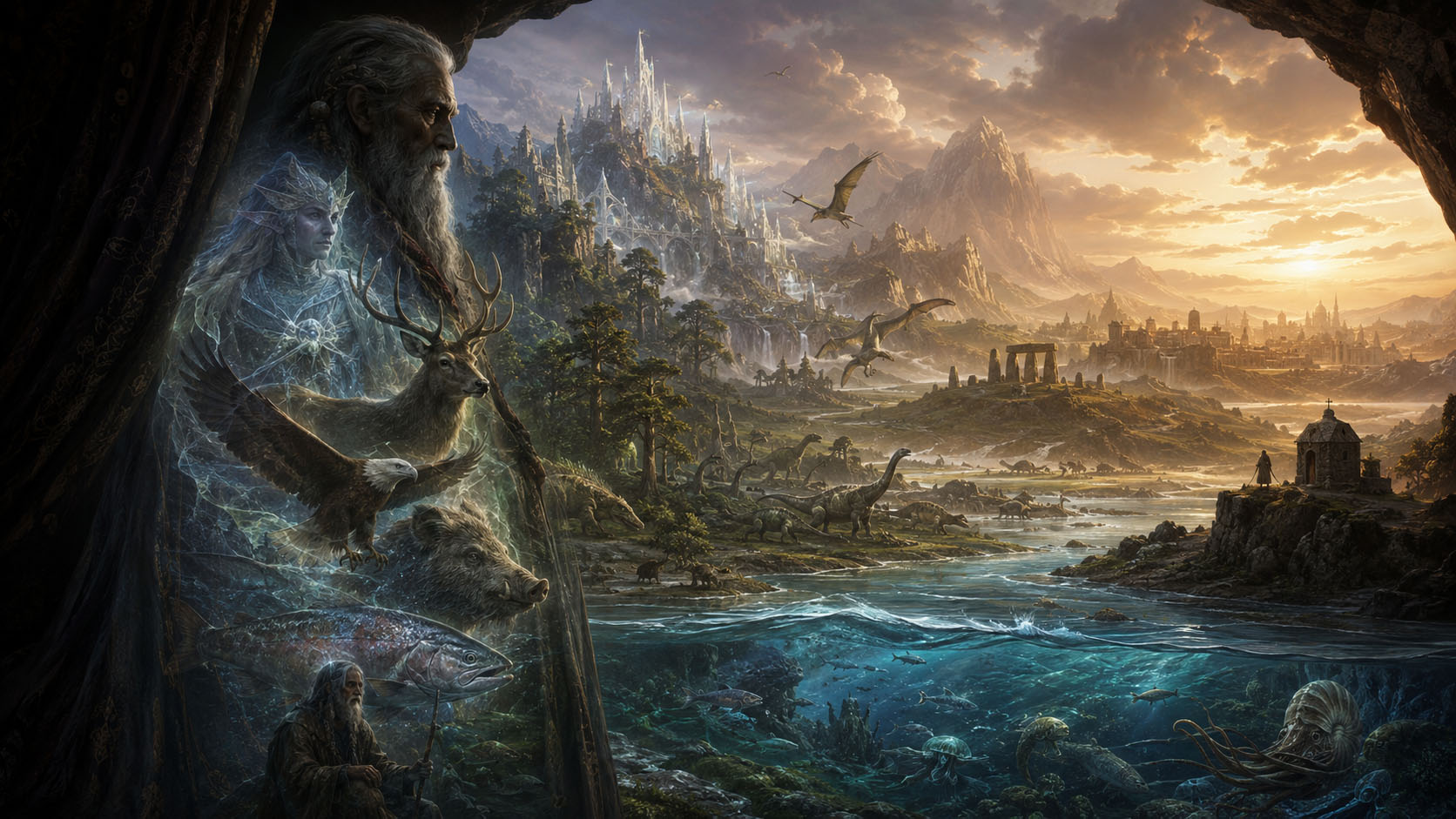
Among the mysterious mytho-historical figures there is one whom tradition has left almost unstoried; yet even these scant accounts make his significance unmistakable. Fintan mac Bóchra passes through the ages in plain sight — recognized, ringed by texts, acknowledged as witness and revealer of the hidden. Of Tuan mac Cairill, only a single tale has reached us, terse and strange in its own way. Close reading shows this poverty is not accidental: it is the first and defining feature of his nature. Tuan is a Witness who leaves no traces; he only remembers. And where Fintan appears, Tuan abides — unnoticed.
Unlike Fintan, who in time became entangled in a whole thicket of texts — poems, traditions, the tale of the great assembly at Tara — Tuan is known, essentially, from one coherent work: the Old Irish “The Tale of Tuan, son of Cairill” (Scél Tuáin meic Chairill). It was written at the end of the 9th or the beginning of the 10th century. The oldest and most important surviving copy is the “Book of the Dun Cow” (Lebor na hUidre, around 1100, from the scriptorium of Clonmacnoise); the text is also preserved in several later manuscripts.
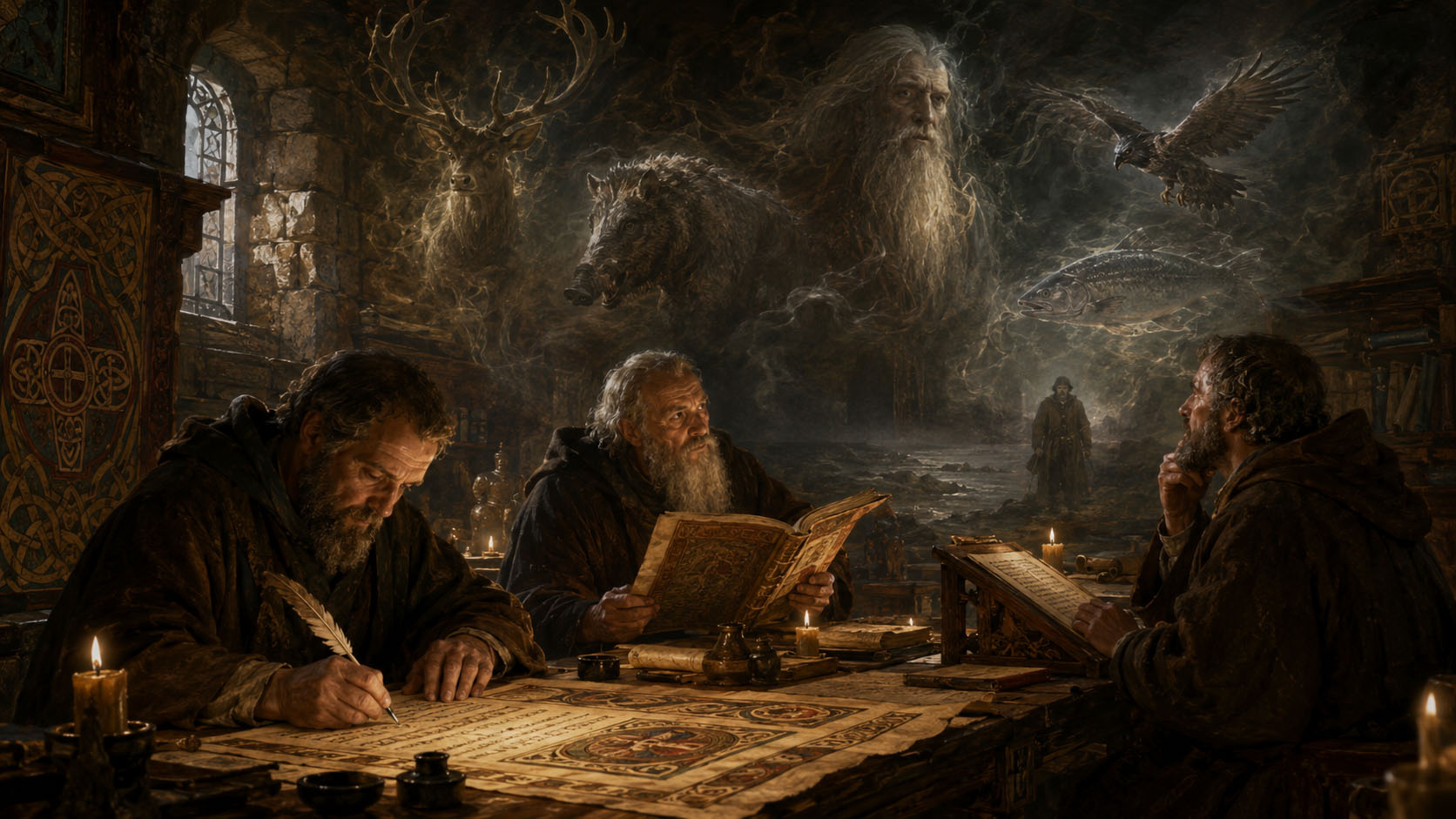
In this account, Saint Finnian of Movilla comes to a certain long-lived man, a hermit living on his hereditary land, and asks him for a tale of Ireland’s antiquities. The old man is Tuan. Before he begins, he remarks that he would rather reflect on the Word of God than on his own transformations; only at Finnian’s insistence does he yield.
What he relates is a story of unprecedented longevity. Tuan calls himself the only survivor of Partholón’s people, destroyed by plague, and from this he draws the law that governs his fate: there is no extermination without someone who comes out to tell the tale — and here the survivor is he. After his people’s death, he says, he wandered for many years alone across the emptied land, growing decrepit and hiding from wolves. Then begins the sequence of transformations, each time in the same pattern: old age and weakness come upon him; he withdraws to his place, fasts for three days, falls asleep — and wakes young in a new shape. Thus he passes through the centuries as a stag, chief of the herds; as a boar, chief of boars; as a huge sea-eagle; and finally as a salmon. His changes of form track the changes of the peoples entering Ireland, so that each invasion is met from within a body belonging to its era.
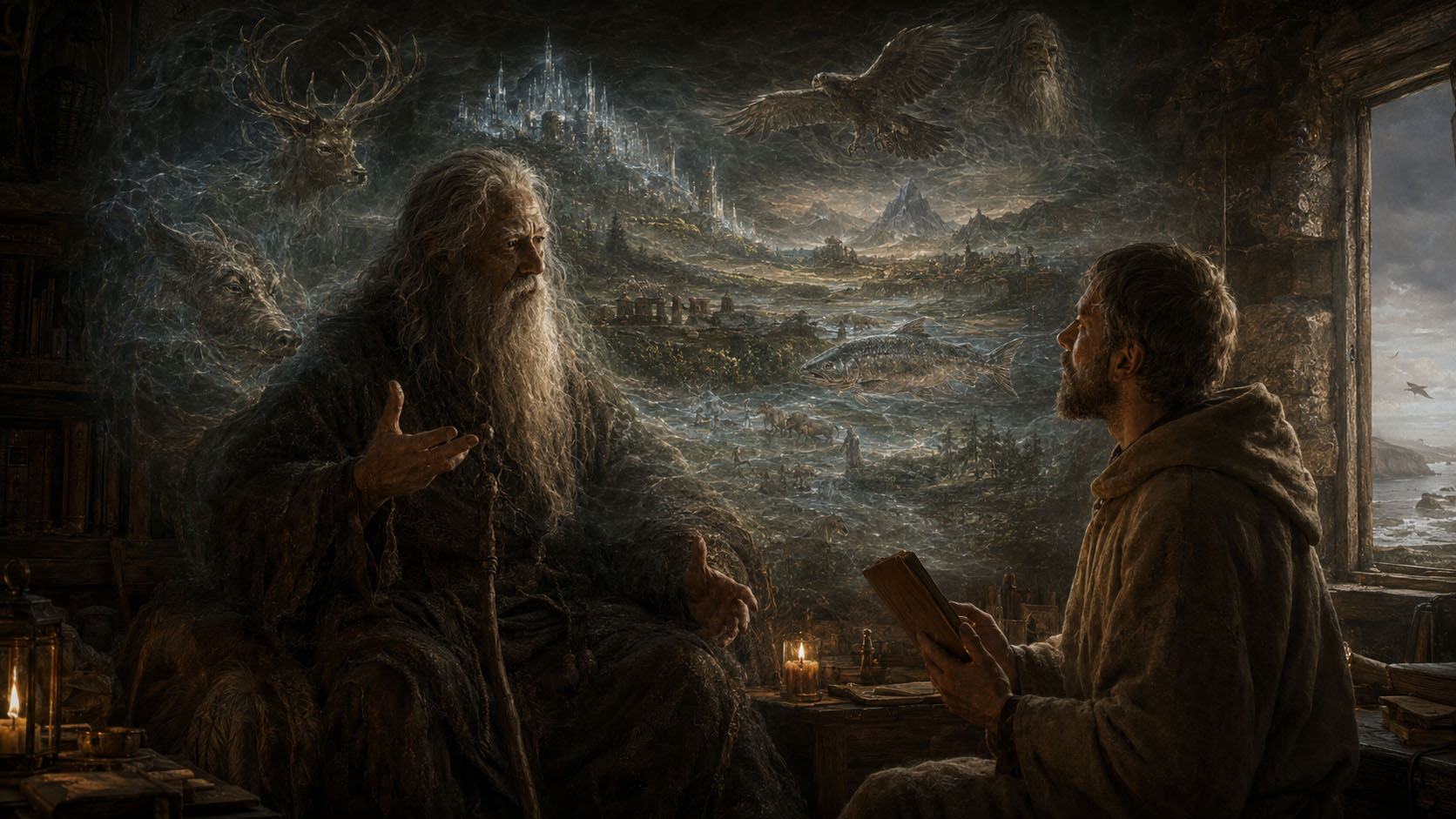
It ends like this: already in the age of humans, the salmon is caught, and Cairill’s wife eats it; he is conceived in her womb and born again as a human — Tuan, son of Cairill — preserving all his former memory. From this birth he is a seer and a living source of all history and every genealogy; baptized, he gives his tale to the saints. Yet even after handing over his memory, he refuses to be kept: Finnian asks him to remain, but cannot obtain it. Woven into the tale are verse stanzas in which Tuan lists his shapes, gives thanks to the one who fashioned him, and separates his lot from the lot of those who remain in the power of the destroyer.
Outside this tale, Tuan appears only as a name of authority. In the “Book of Invasions of Ireland” (Lebor Gabála Érenn) he is mentioned alongside Fintan mac Bóchra as one of those whose memory attests the Earth’s prehistory; both are placed under the patronage of Finnian of Mag Bile and Colum Cille, beside quite historical learned transmitters of tradition. Tradition thus draws the two Witnesses of eternity into a single structure of attestation. In later scholarly and genealogical writing Tuan resurfaces in the same role — as the primordial source from which all history and all lineages derive — but these mentions add no new plot.
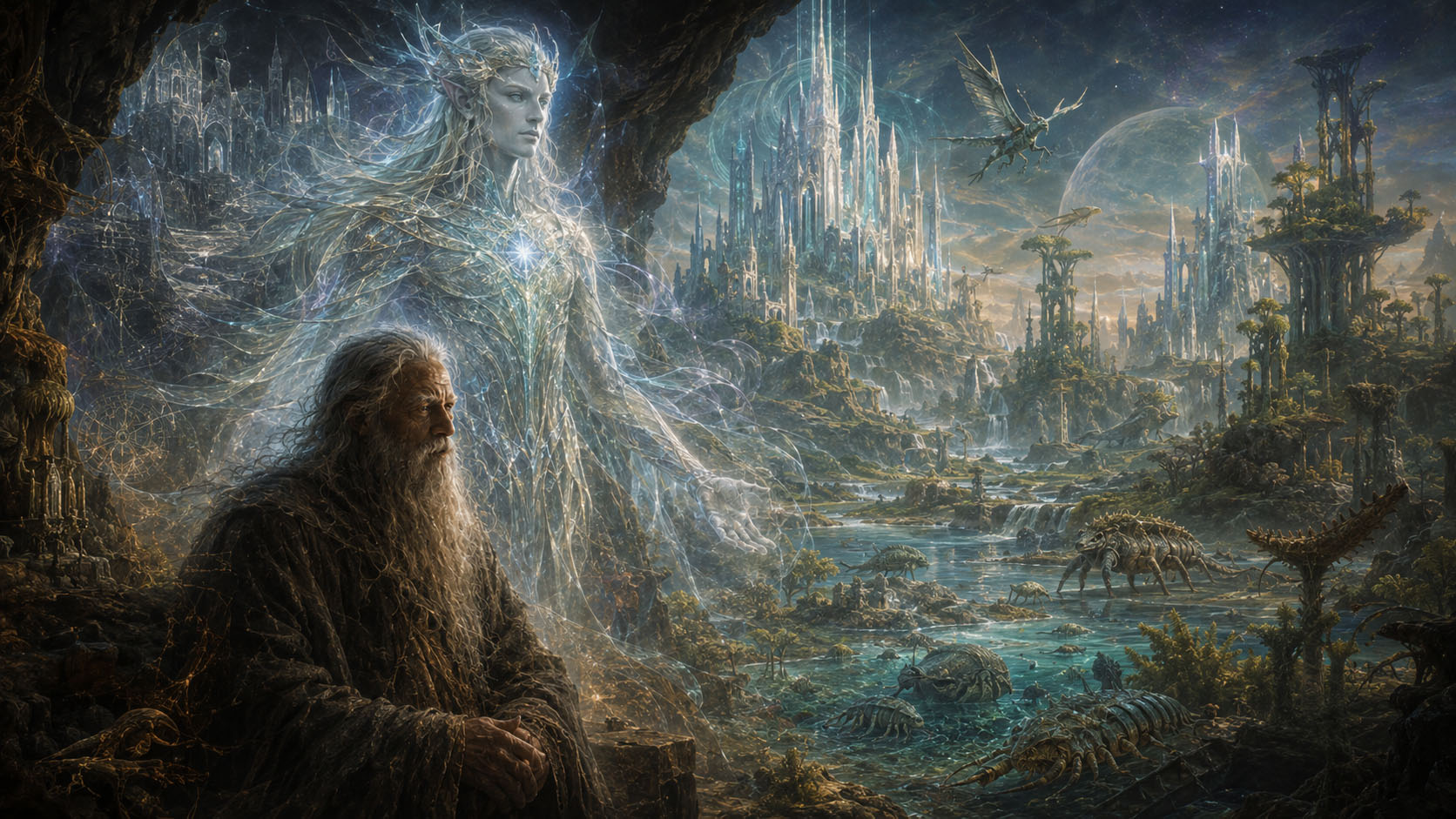
Tradition describes Tuan in human form, calling him a man of Partholón’s people, the only surviving mortal. But this is only the tale’s outer оболочка. Humans (and mammals in general) did not exist in the Age of Partholón at all, and the “first name” under which Tuan remembers himself is the High Sid of the Second Descent.
The First Descent, opening the Age of Cessair, was a descent into the dense world by the primordial alvs — divine conductors of Potentiality, Logos, and Structure. They raised the Cities of Light upon the supports of Falias, Finias, Gorias and Murias, established the principles of forms and symmetries, but did not yet populate matter itself. Their work was influence from above: a gentle unfolding of potency over hardening mineral structure, a differentiation that introduces information into substance. The alvs of that time did not yet know wars; conflicts played out beneath them, between the gods (Æsir and Vanir) and the chthonic giants. The alvs bore the Light that gives form to the world, while remaining outside what was being formed.
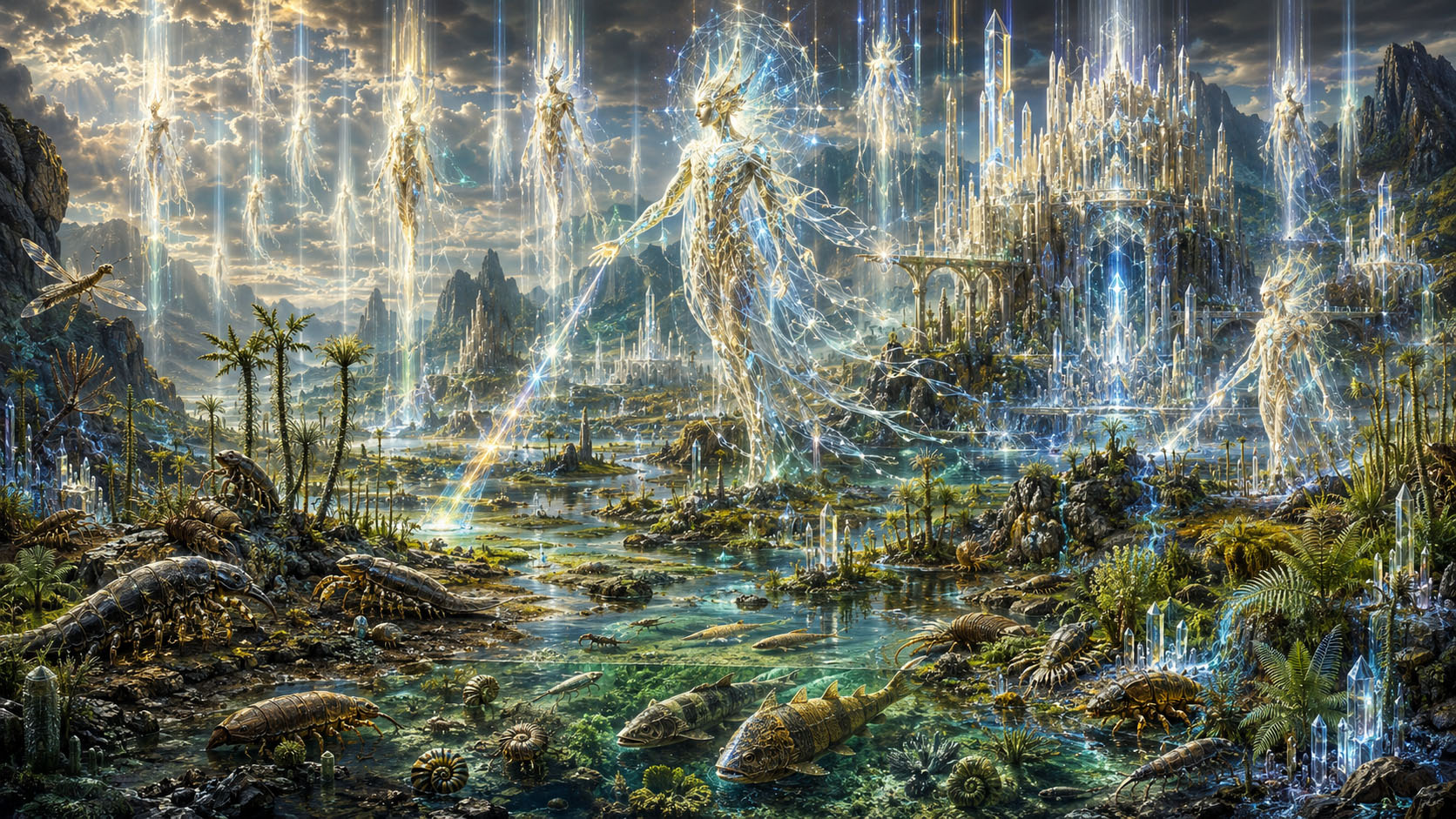
Tuan, however, appeared with the Second Descent, which opened the Age of Partholón, stretching, according to the “Chronicles of the Fair Folk,” from roughly 440 to 360 million years ago, through the Silurian and Devonian to the beginning of the Carboniferous.
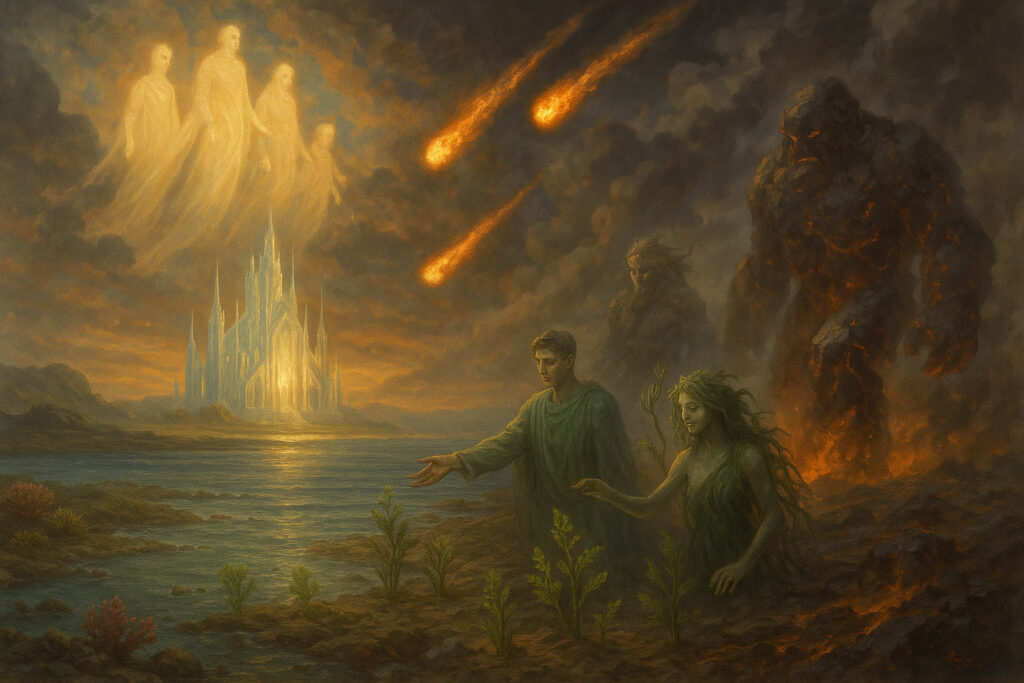
The Second Descent of the alvs was their first truly active entrance into substance: not to bestow life from without, but to introduce into it new properties and possibilities. Upon the stone framework left by the Age of Cessair there sprouted a living, green engineering: vegetation became a superstructure over the mineral world, and animals manifested the first rudiments of desire, so that biological life gradually began to build itself into a ladder of ascent toward the possibility of a clear localization of mind. Where the First Descent shaped matter from the outside, the Second entered into it and upheld form from within, through the Currents of structure. This was Logos living inside substance, form as active becoming.
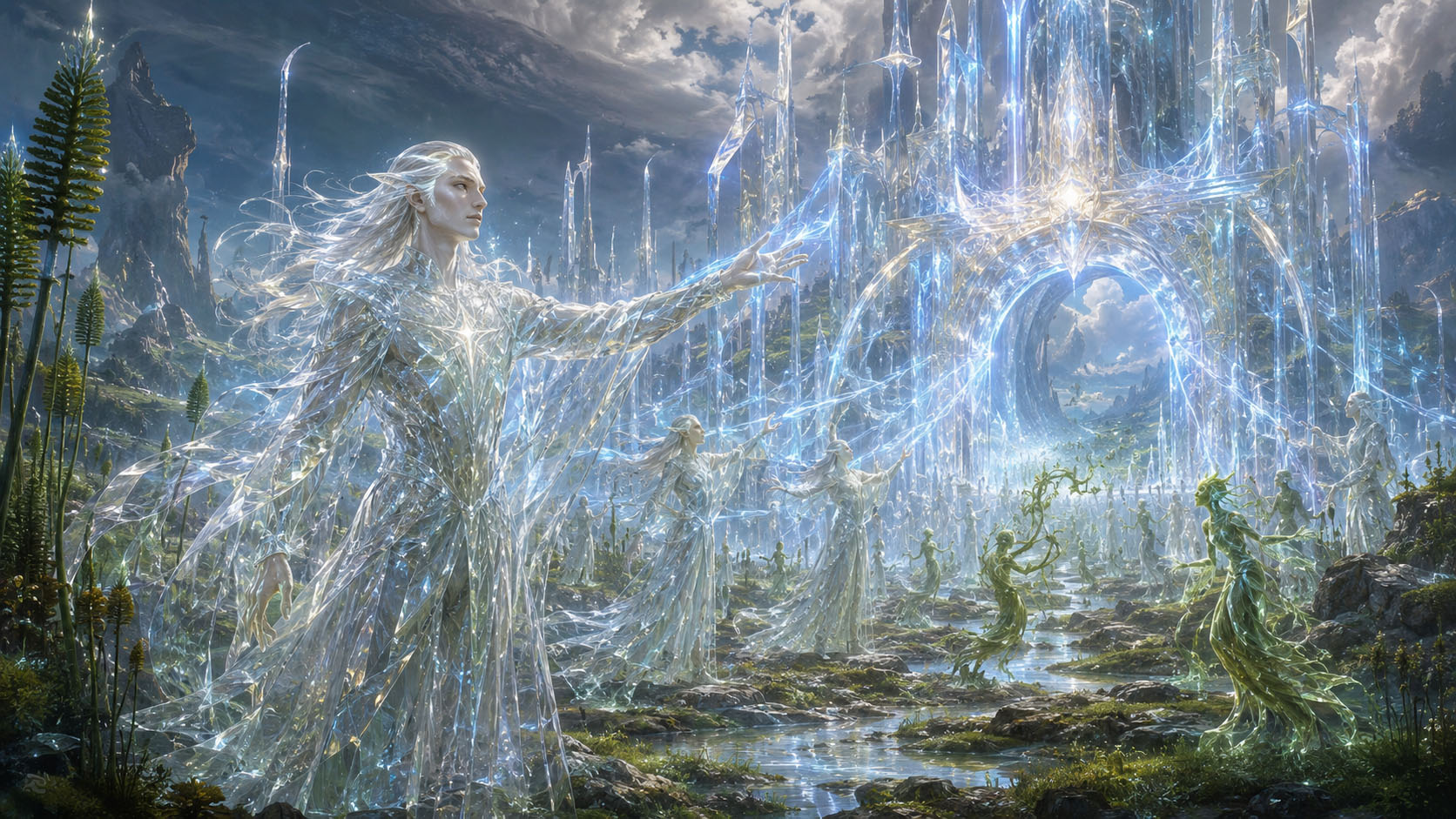
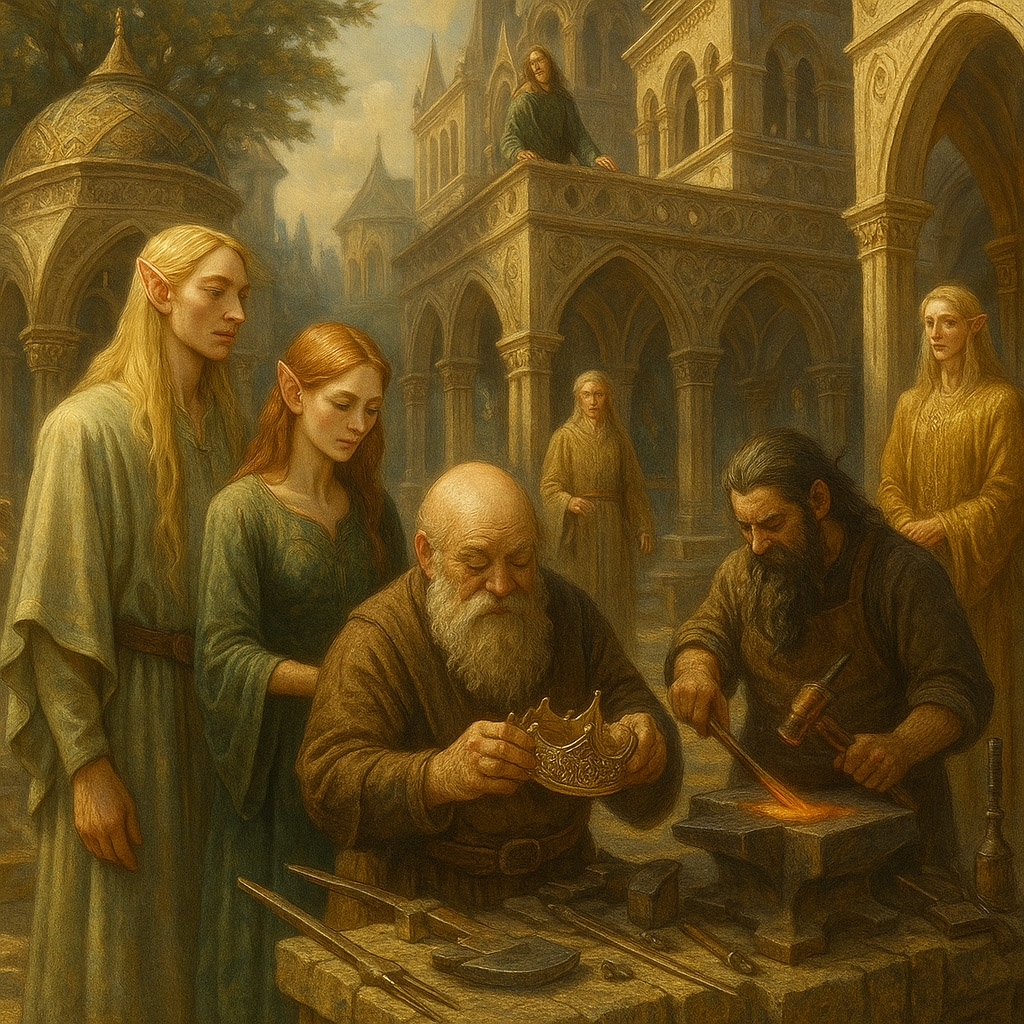
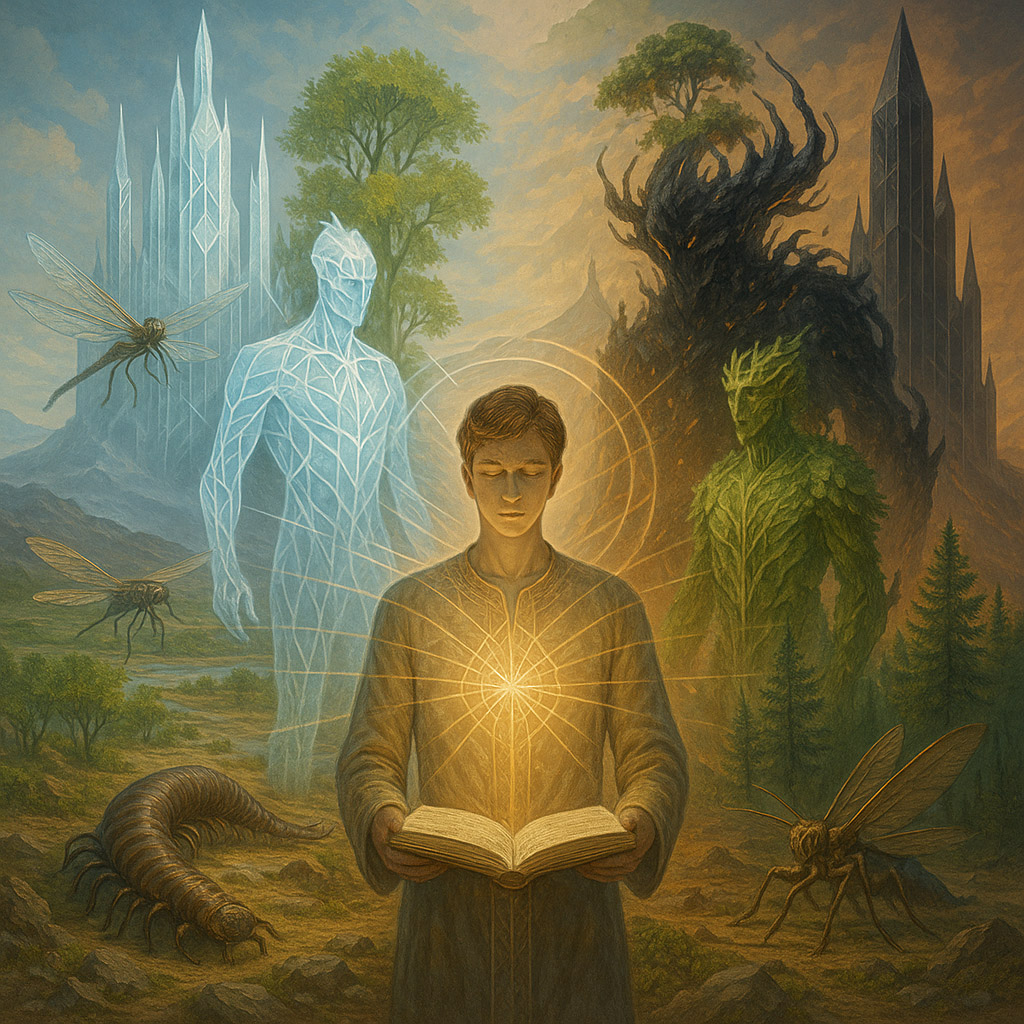
To gain a foothold in the dense world, the alvs of this Descent built the first Crystal Castles— radiant structures of transparent crystalline substance, through which the energy of Álfheimr flows, and through whose Portals into the Middle World the newborn elementals entered, above all the spirits of vegetation. These Castles, which for many millions of years served as centers of spatial harmonization and as supports for the logoi of the world’s structure, were later inhabited and transformed by the sids. And it is to this rank — to the High Sids, inhabitants and transfigurers of the Crystal Castles, to the bright people of the Second Descent — that Tuan belongs by origin.
He is a being of crus, living form-as-becoming, constantly growing out of the potential world of logoi in response to the need of each moment. He is complete and self-identical — and at the same time fluid, able to pass from state to state without losing himself, holding within himself what is incompatible for other beings: stability and plasticity at once. He has the alvs’ exalted impartiality — an even, non-grasping, non-consuming relation to the world, by which the sids have always differed from other embodied beings. By this very nature they are elusive to predators and stand outside food chains. They do not build and do not rule; they harmonize, direct, abide. All these qualities Tuan possessed, and already at the dawn of the Age of Partholón, in his primordial impartiality and fluidity, one can discern what would later become his “Taoist” non-interference. He was a perfect manifestation of the Bright Sid’s nature: whole, clear, nonmaterially light, an inhabitant of the crystalline centers of the young world.
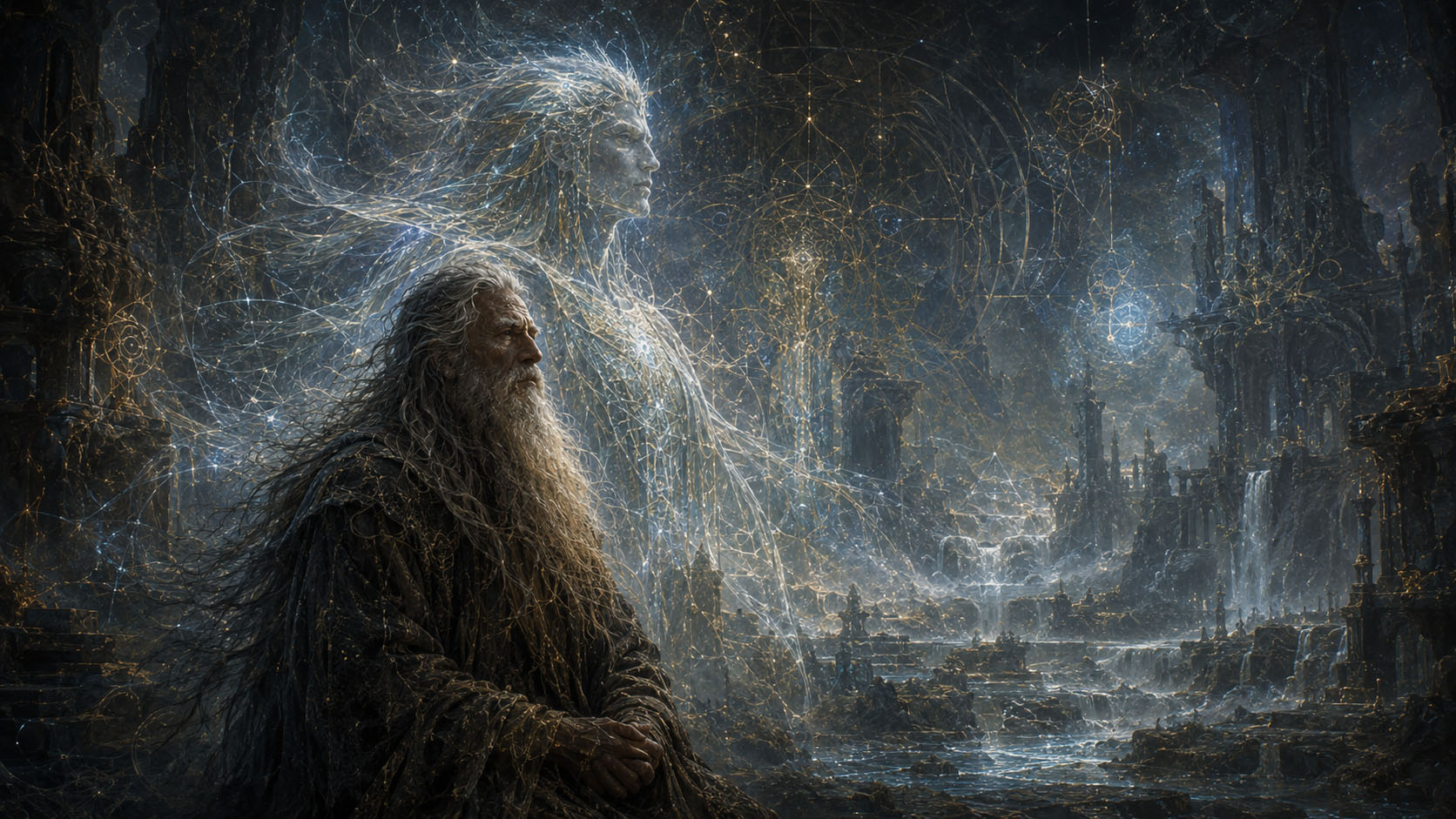
Yet even then the world was shaken by an event that would later determine Tuan’s entire fate and, in many ways, shift the direction and course of evolution across the whole spheromata: at the end of the Age of Cessair, the Grigori (Watchers) descended upon Hemlya.
Tuan had not yet entered flesh, had not become mortal, had not begun his sequence of shapes. He still lived as the pure light of the Second Descent, whole and untouched.
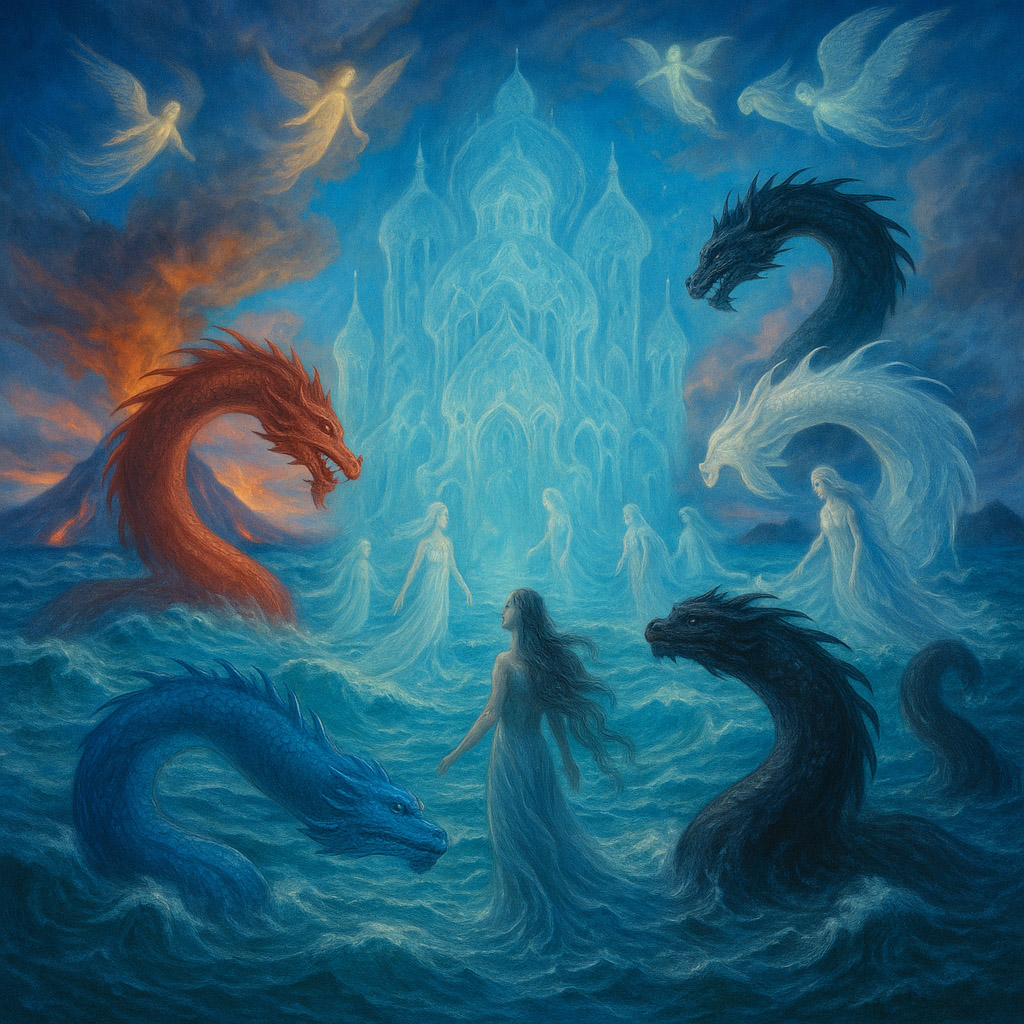
But the descended Watchers, who had acquired dense bodies by a self-willed means, were already altering the world. From them were born the first Fomorians, destructive powers of sea and chaos; and the world moved toward its first war, toward that dividing sentence that would sweep over frightened gods and angels.
We have said more than once that the Grigori (Watchers) are former angels of Geburah of the rank of Seraphim, “kindlers,” whose nature is pure self-movedness — the force by which any system comes out of passivity and begins to act from within. This fire is dual at its root: it can be turned upward, toward return to the Source, and downward, toward rooting in the medium. The Grigori (Watchers) express precisely this descending aspect.
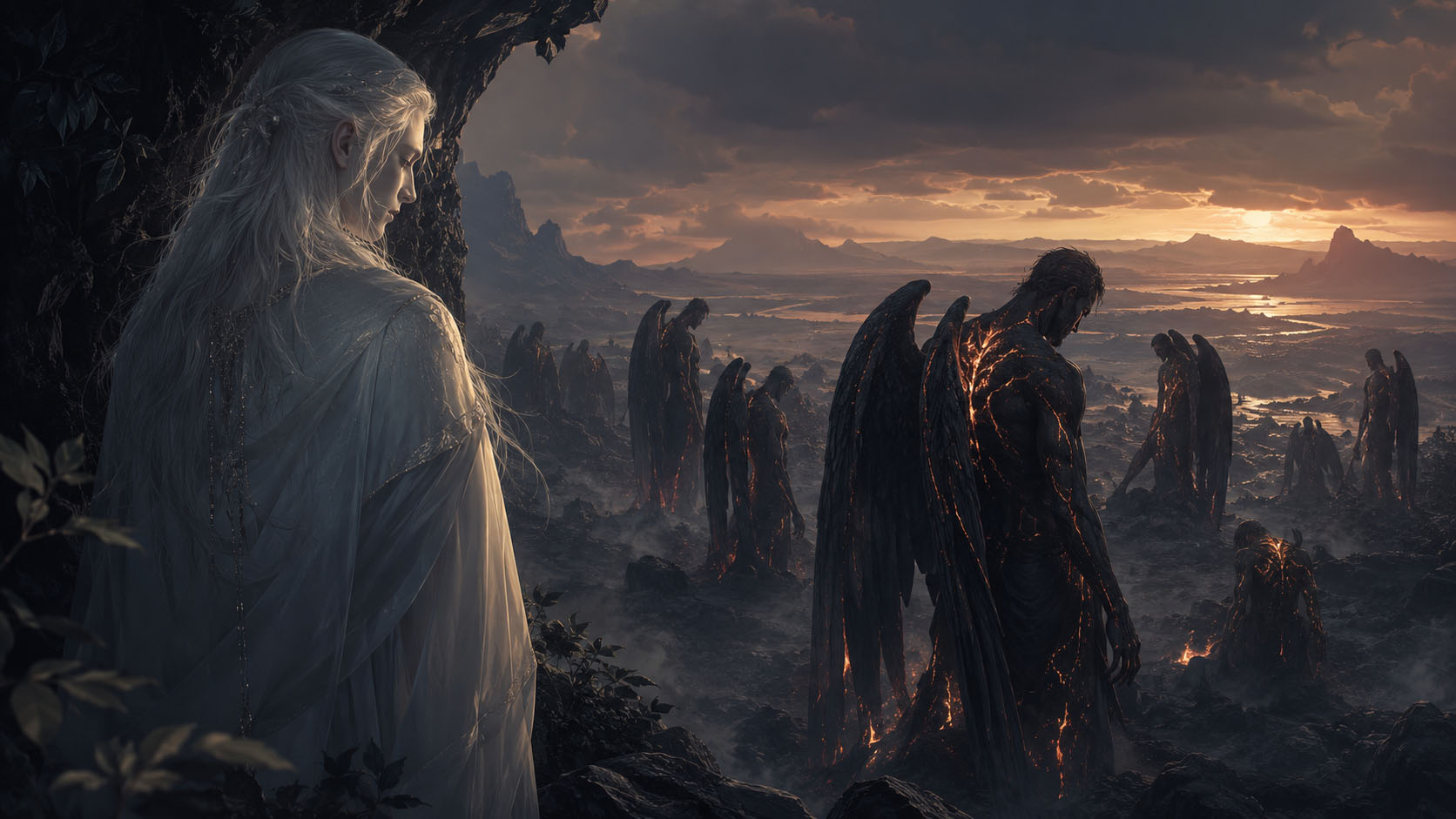
The descent was followed by the Judgment, when the Heavenly Host halted the Descent by the hand of four Great Keepers, each of whom took his share of the sentence. Michael bound Semyaza and twenty elder leaders and cast them “under the hills” — into the Interspace. Raphael shackled Azazel in darkness. He, as bearer of guilt for the consequences, was denied mercy and thus became a Demon of destructive intelligence. Gabriel drove the younger Grigori (Watchers) into fratricidal extermination; the giants begotten by them partly perished, partly gradually dissolved into the developing people of the Fair Folk. The fourth judge —Uriel-Phanuel — was “set over the repentance and hope of those who inherit eternal life”; his service ensured that punishment would not erase the possibility of continuation. A part of the Grigori (Watchers) — those who did not reach the elders’ depth and did not fall into Azazel’s rage — were, by Uriel’s mercy, left in the world. Their punishment, dependence on the dense plane, became a ministering obligation: they would serve as scaffolding for future civilizations. They were gathered by Kesbeel, keeper of the oath, who bound the survivors with a new vow — to become law itself for the sake of sustaining life. Condemned flesh became for the Grigori (Watchers) both prison and service: they were stuck between heaven and earth, grey keepers of equilibrium walking the planet, rarely intervening, maintaining the world’s firmness — without which their own soul would not endure.
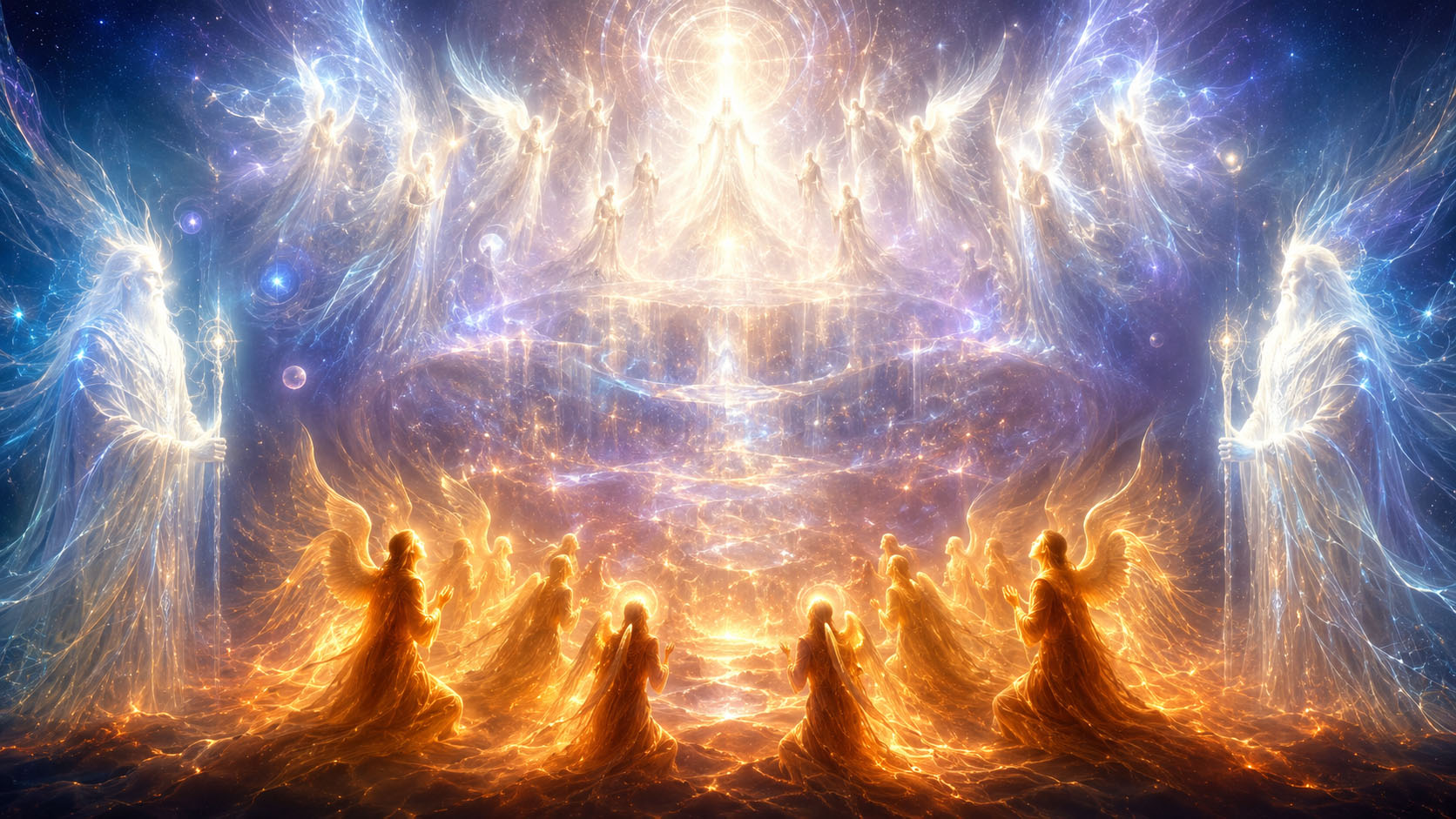
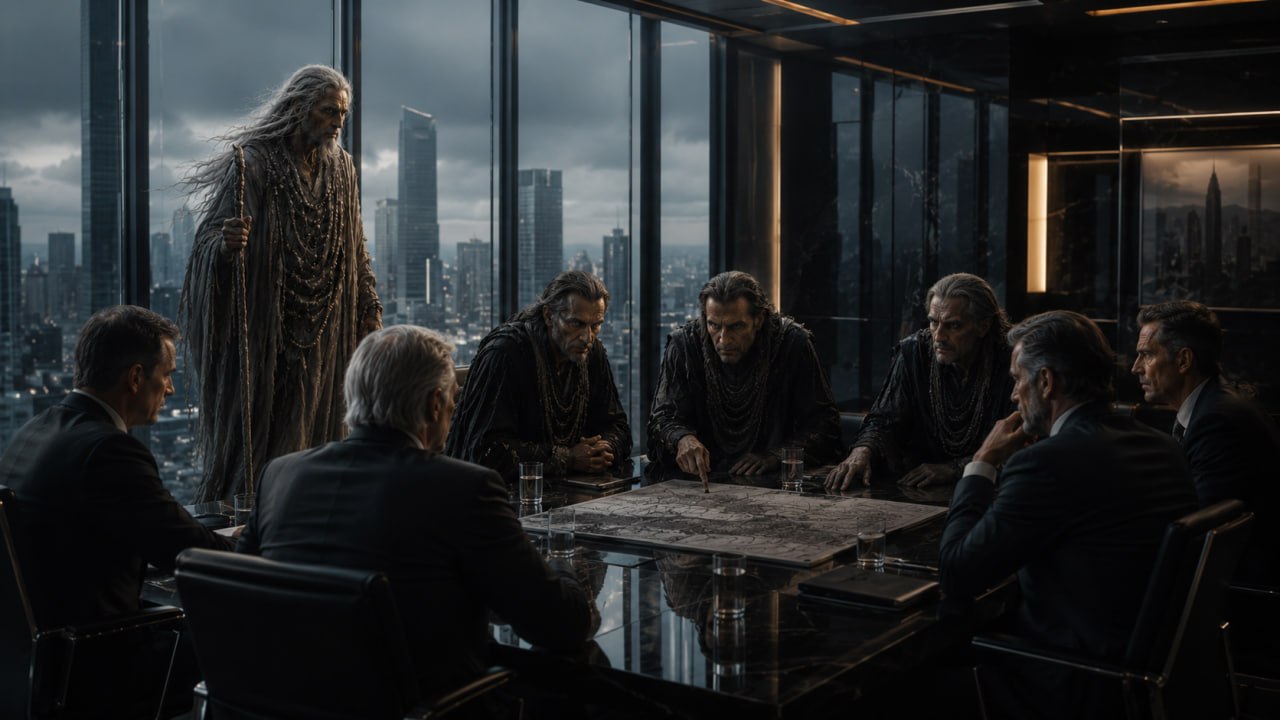
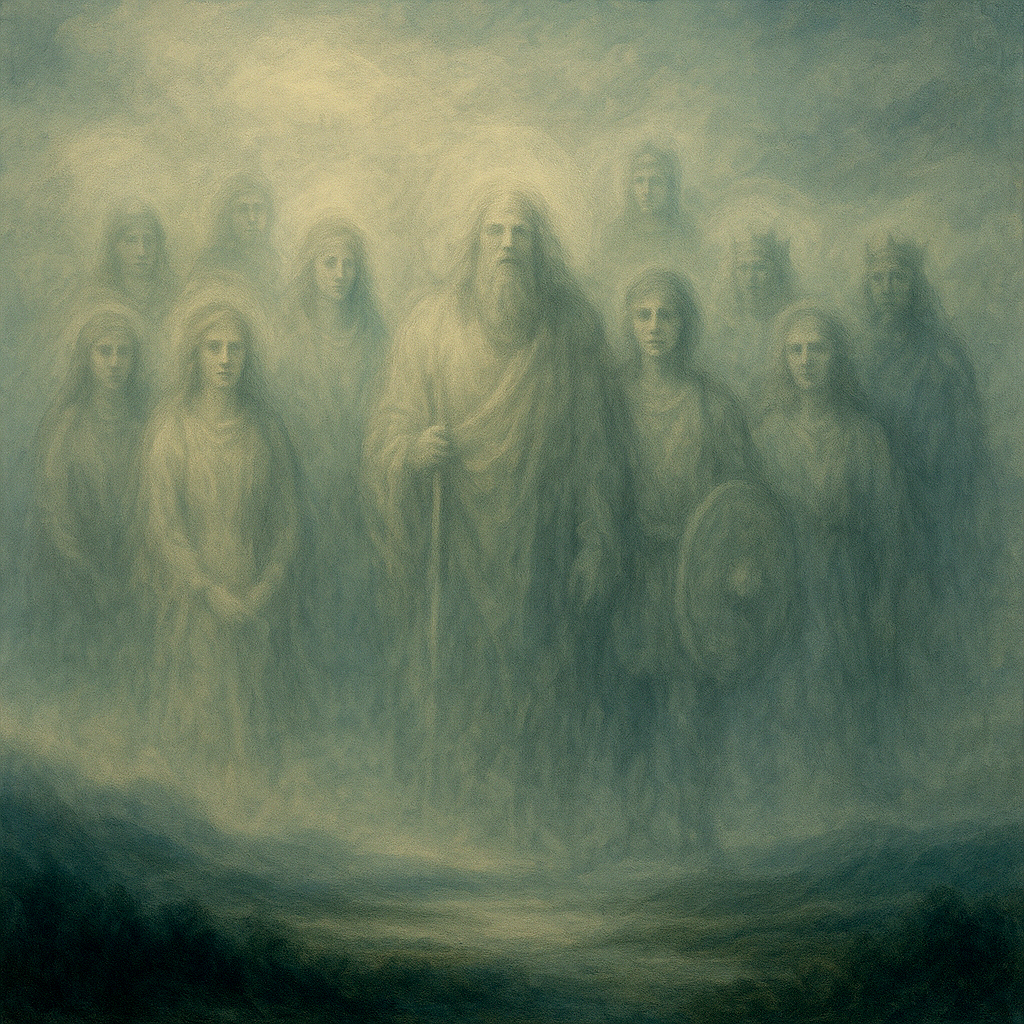
And at this Judgment there were two Sid witnesses —Tuan and Fintan— who from then on became the Chroniclers of eternity. Both, Bright Sids, saw the Archangels divide the descended according to their lots. Yet they received this judgment differently. Fintan, older and less bound to matter, accepted the sentence as a finished and just boundary and remained what he had been: light of pure presence, unmixed with what was being condemned.
Tuan, however, was struck and changed by what he saw. In the Grigori (Watchers) he saw not only violators of order; he understood the cause of their descent — the longing of fiery ministers for what he, a sid, possessed in abundance by nature itself: their own destiny, personal history, the freedom to live and not only serve.
More than that, he knew his own nature, for all its fullness, was fluid; its experience does not settle into a “dry” residue, but flows on, never crystallizing. He was whole — but not imprinting; complete — but not developing. Looking at the condemned Watchers, who paid for their hunger for duration, he could not remain impartial light.
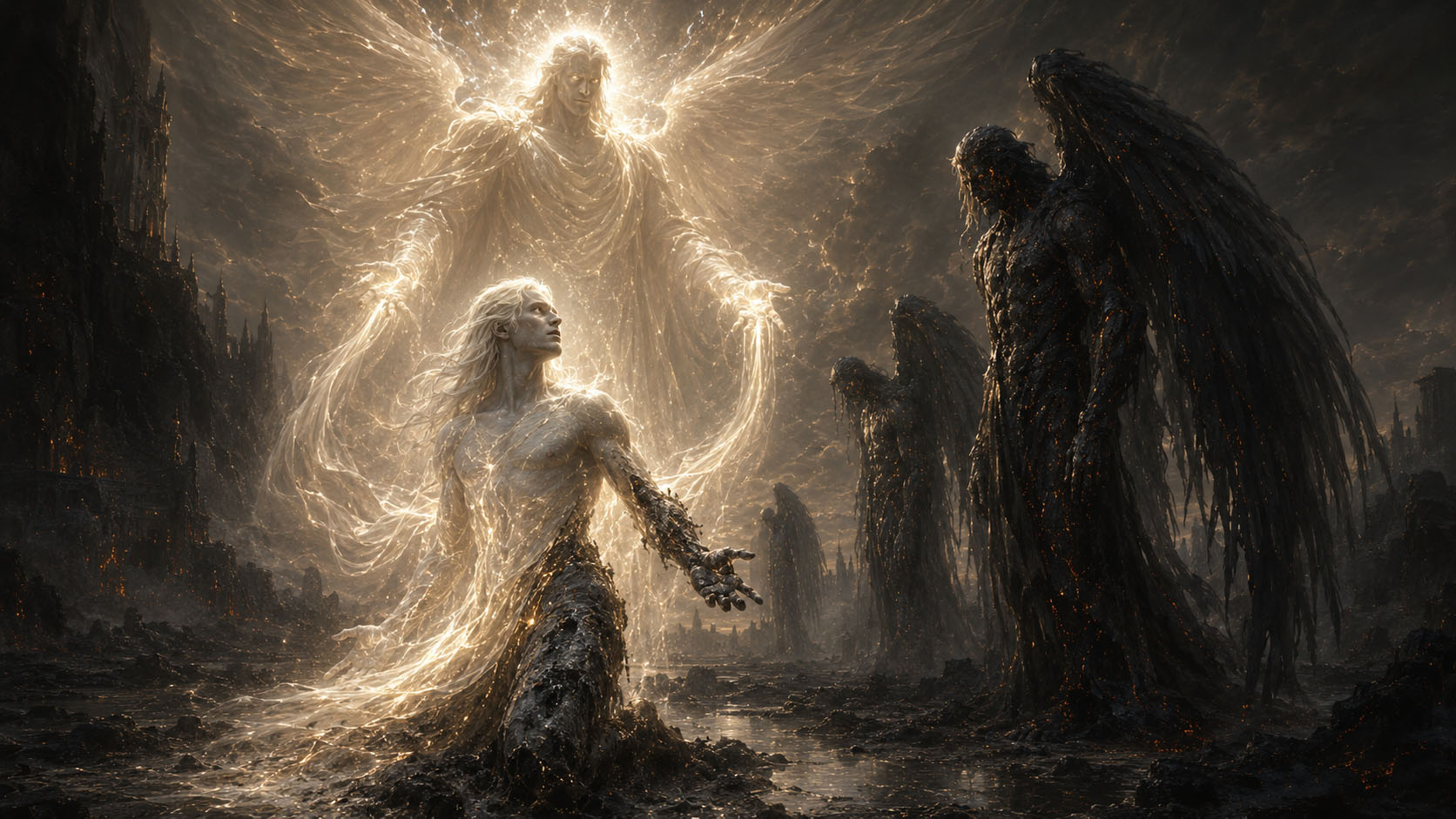
Then he did what determined his entire later lot: he repeated their maneuver — he entered the same condemned flesh — though with the will applied in reverse.
The Grigori (Watchers) appropriated corporeality self-willedly, out of need and fear of nonbeing, by the oath of a breakthrough that recognizes no prohibitions.
Tuan allowed himself to be fashioned. He offered himself to flesh, accepting from Uriel the same lot, but now as a gift from above — “a friend who fashioned me,” as the tradition says — entering into the sentence voluntarily, moved by an unawakened compassionate impulse.
He too became dense, subject to time and to a sequence of shapes. He entered food chains, became catchable and edible — he whom before could not be seized, as one cannot seize the wind, suddenly became capturable and mortal.
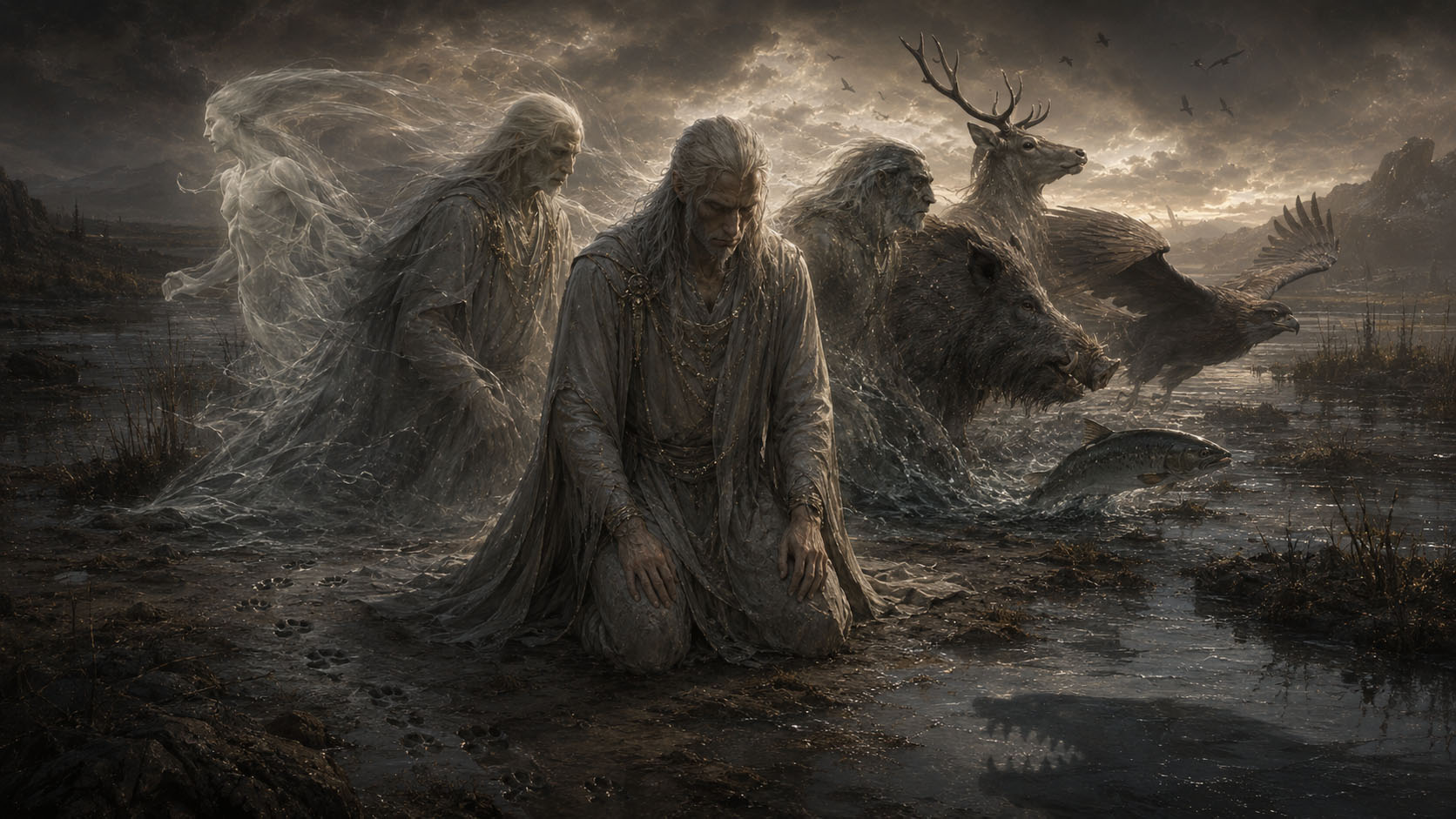
He gave up divine invulnerability and the completion of a sid — everything by which he was light and unassailable — and took upon himself existence through dense and mortal rebirths: duration, the ability to imprint and hold what has been lived, becoming the Witness of materiality.
What for the Grigori (Watchers) was an artificial prop for their own survival, for Tuan was a vessel made from fullness, by consent, for the world’s memory.
The same descent, the same flesh, the same mode of duration: in some it was seized for the sake of the self and therefore condemned them; in another it was accepted through self-giving.
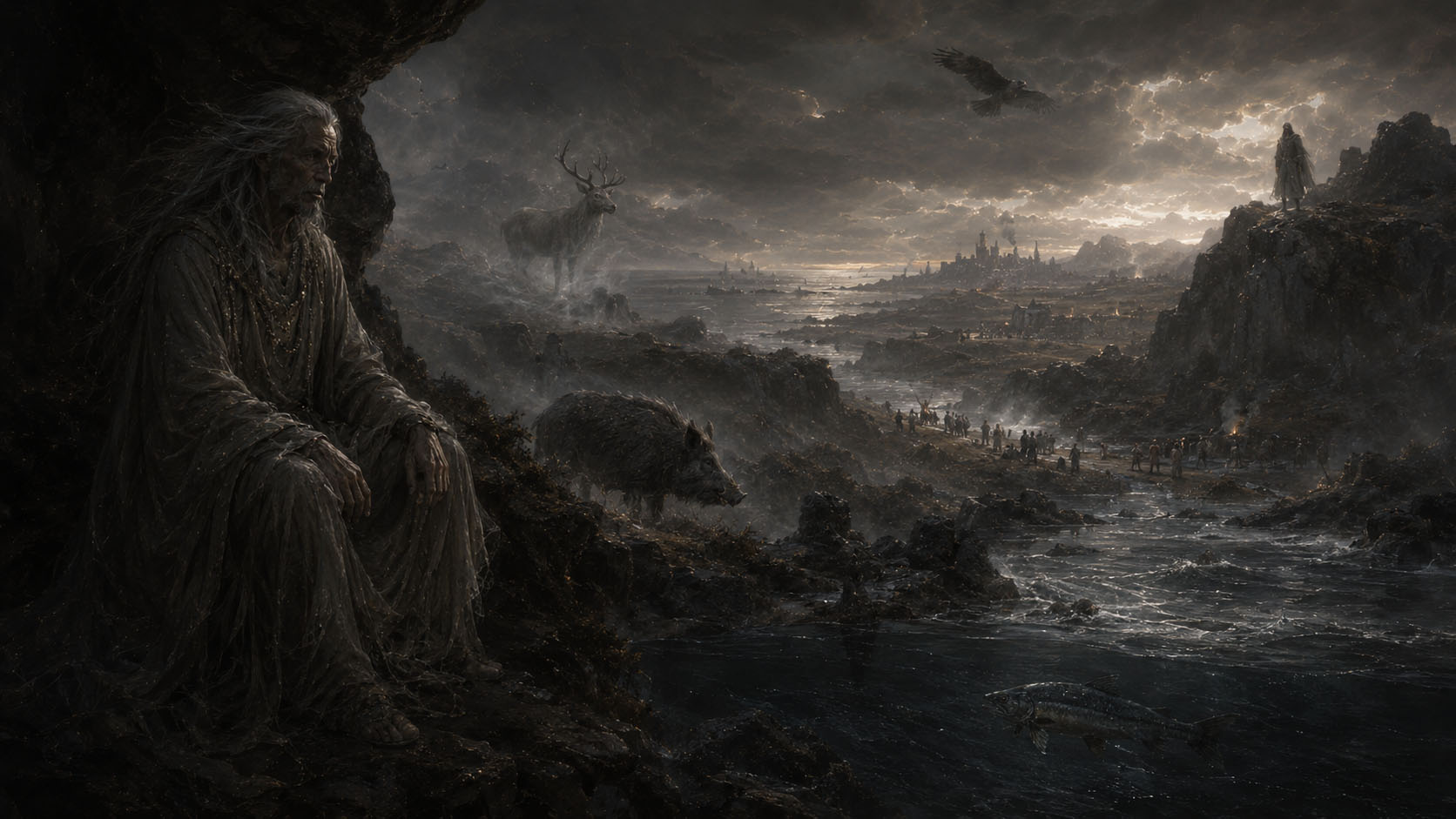
Thus the bright sid of the Second Descent became limited so as to accumulate; catchable so as to be received and passed on. He entered the condemned form and remained good; from complete but non-imprinting light he became one who can carry living memory through time.
The form of his embodied being was, from the beginning, a form of hiddenness. He passed through the centuries in a sequence of shapes — beast among beasts and human among humans — yet always he is the one who watches from shadow and evades, the one whom even he who has drawn from him all the world’s memory cannot keep. He lives in the world, but not at its center: on cliffs and in caves, on hereditary lands, in the solitude of a long-lived man whom history fails to notice because he never steps onto its stage.
This inconspicuousness follows directly from his nature and his task. From the sids he inherited exalted impartiality and elusiveness — and, descending into flesh, he turned them into a special mode of presence. He is a witness behind the stage: one who sees everything, yet is seen by nothing.
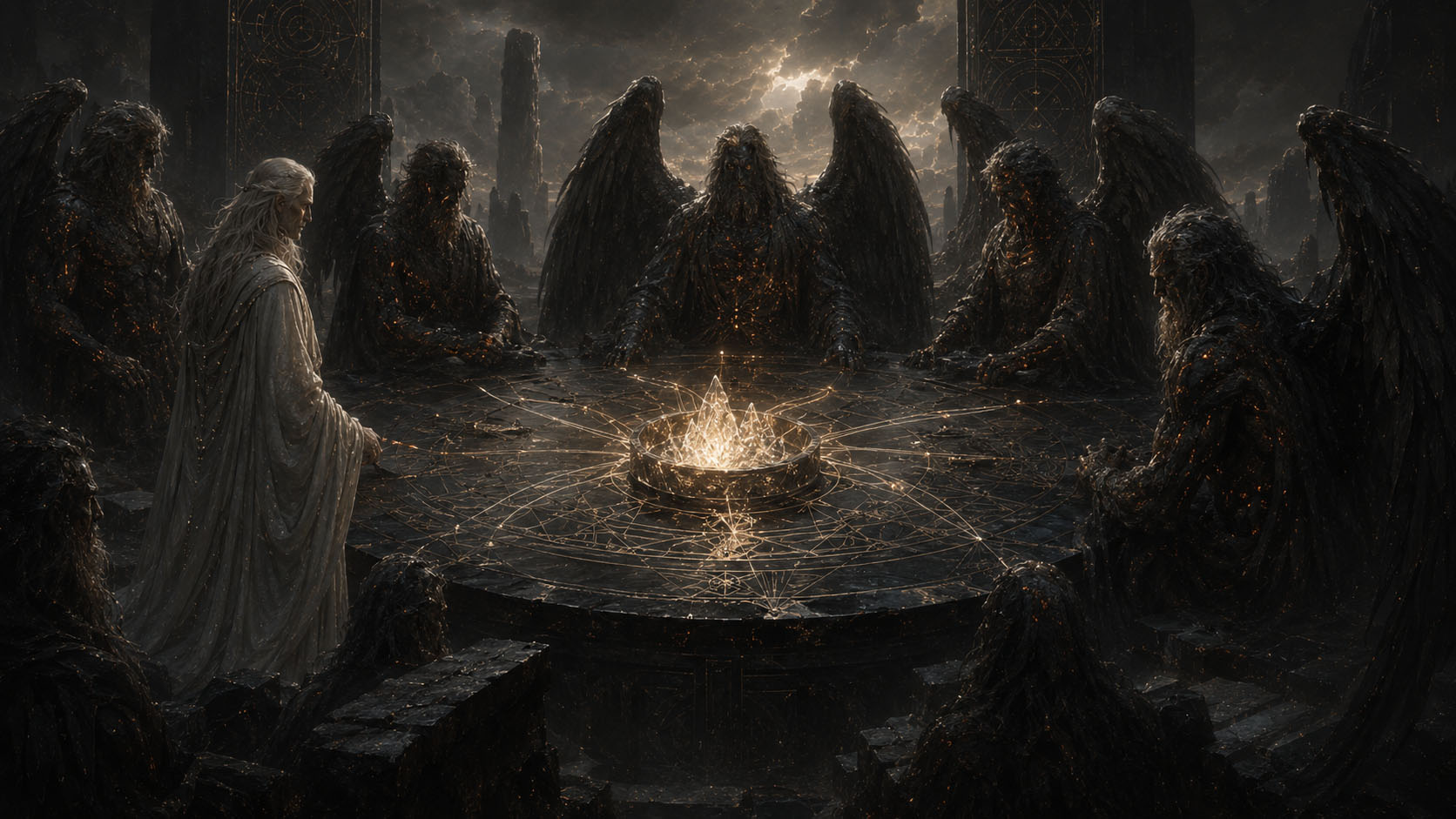
But the surviving Grigori (Watchers), the grey keepers of equilibrium, live in precisely the same way. A witness behind the stage among those who themselves act from behind the stage — this is his place among the Watchers.
Between the sids and the Grigori (Watchers) there has, from ancient times, been a pact: patronage and access to angelic knowledge in exchange for condensed vital force, of which the Grigori (Watchers) suffer an eternal lack. By origin, Tuan belongs to the side that for centuries has traded with the Grigori (Watchers). Yet among all the sids he is for them a special figure.
For the Grigori (Watchers) only two modes of existence are accessible: to drift in the flow of possibilities or to collapse it. To stop in definiteness they need an observer who fixes it. The Fair Folk are, to them, an image of a successful transition, a joining of plasticity and self-identity that they achieved only in a fractured, “crooked” way. And Tuan is the only one who walked their road, entered flesh by the same descent as they did, and passed through it whole— by consent rather than seizure. For them he is not merely an example of a successful transition in general, but an example of a successful transition in their own direction. Therefore they are drawn to him with a special force, shot through with woundedness: he is a living reminder that their road could have been traversed more cleanly.
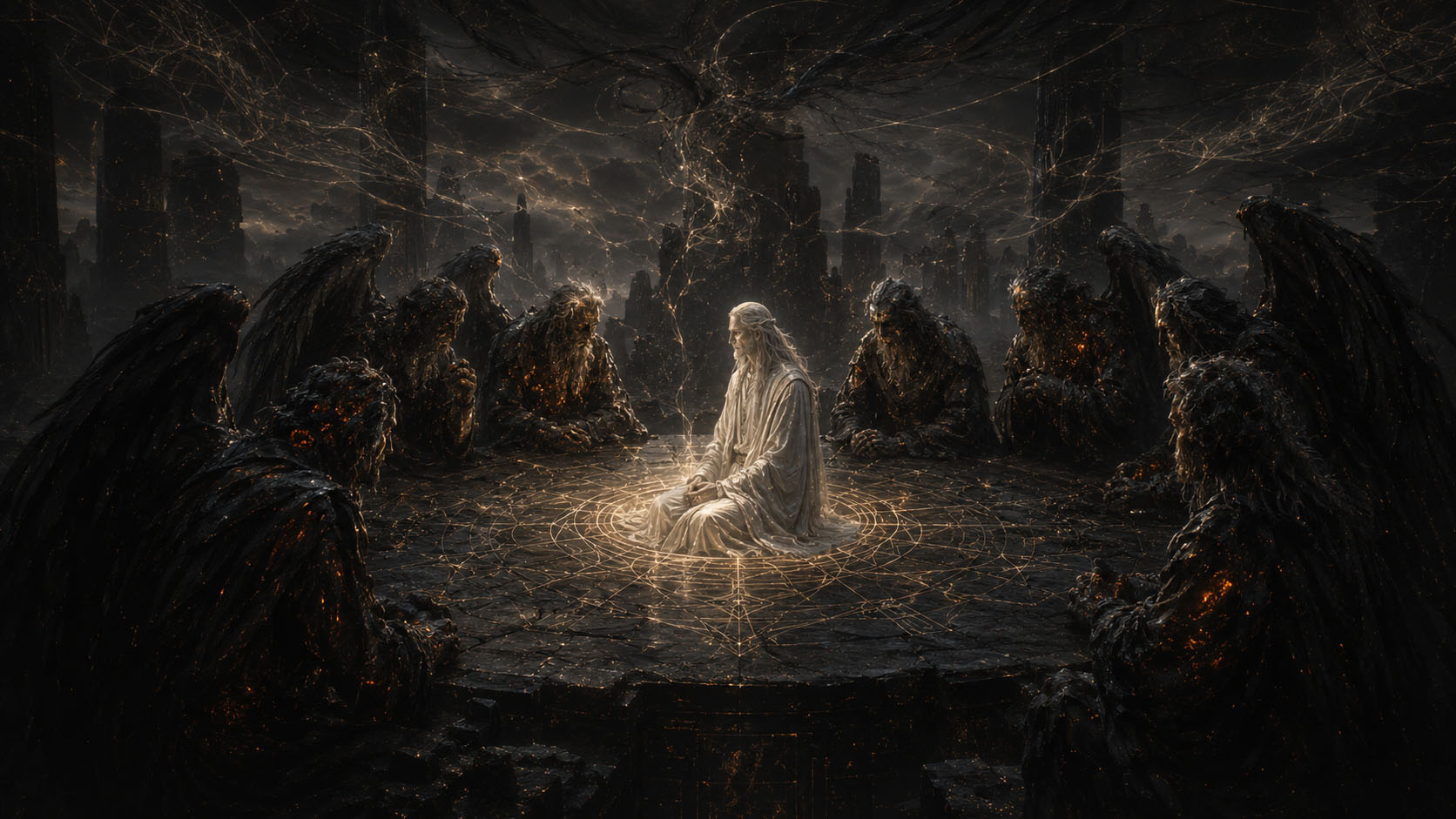
Beyond this, Tuan’s special memory matters. The Grigori (Watchers) taught humans to record history precisely so as to make memory independent of a living narrator, to fix it so the world’s picture would not shift. Tuan, however, is that living narrator — memory not enclosed in writing. They respect him and they consult him.
Thus Tuan becomes an observer and counselor among the Grigori (Watchers). He enters their council, instructs them, yet bears none of their collective liability. He is free among the bound, a voluntary voice in a closed circle: his words are always heard, not always heeded. They coexist without trust, and each side deems itself wiser. Yet this very freedom makes his counsel priceless, for he is the only voice in the circle of the Grigori (Watchers) limited by neither oath nor fear of dissolution.
In this role of counselor lies the meaning of the compassion for which he was once brought down. The task of the surviving Grigori (Watchers) is to hold the equilibrium of the world and keep its structures from falling apart. Over this task hangs fear, because their artificial soul is held precisely by holding themselves in density; if the support of order collapses, they will not return to Heaven — they will simply cease to be. This horror sublimates into cold, maniacal service to form, into a drive for total control, into turning stability into an icy prison. In that movement the Grigori (Watchers) draw fatally near to the Archons, administrators of frozen form, for whom order is a condition of manageability and everything that lives — the Fair Folk and humans alike — is raw material.
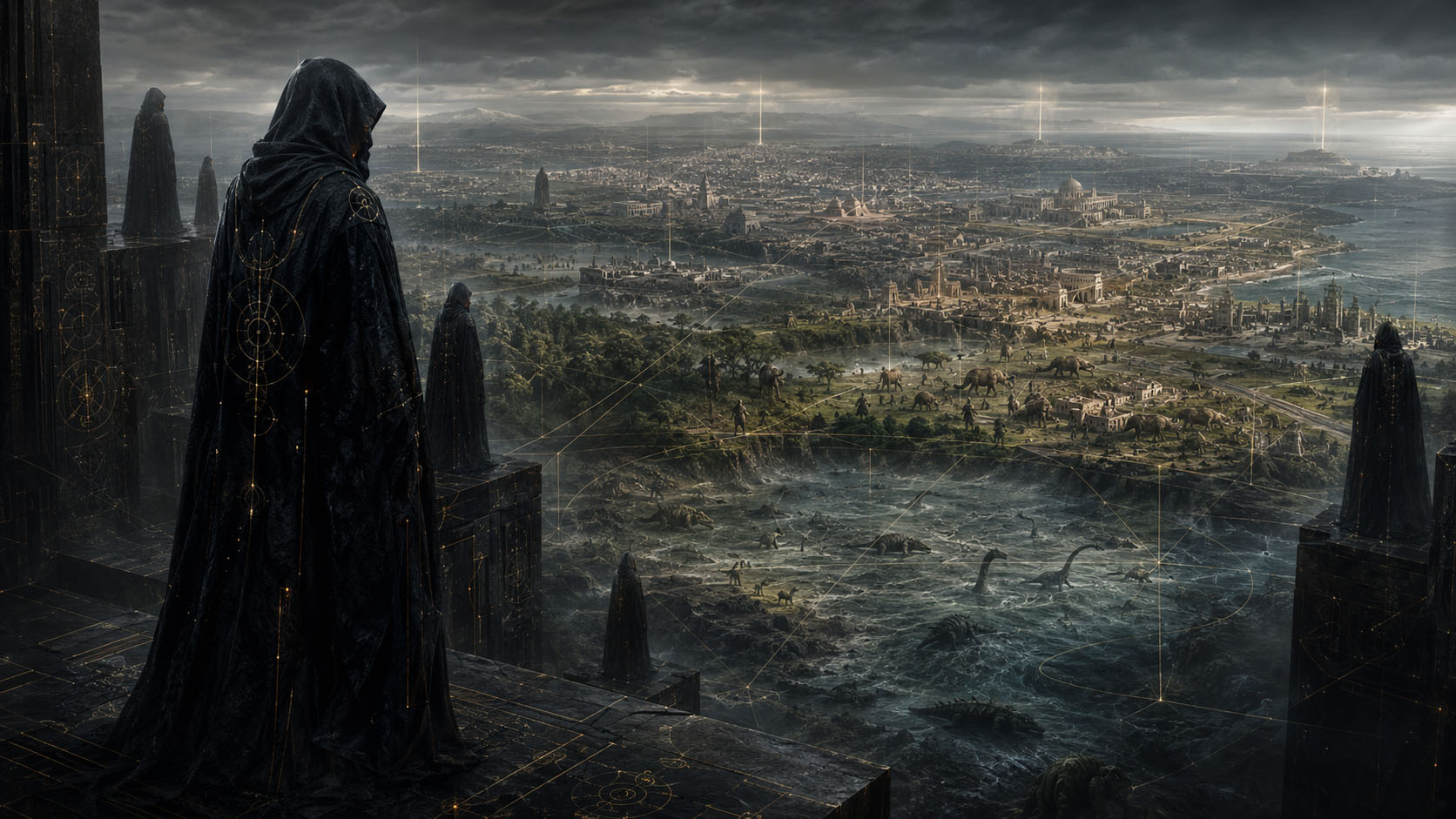
Tuan, however, is the embodiment of the liveliness the Grigori (Watchers) need and of which they are deprived: a bearer of crus, living form-as-becoming, memory of the world as fluid and whole. He enlivens their order; he does not let equilibrium congeal into dead crystal. By his whole being, and by his rare word, he reminds them that form can be living; that holding the world need not mean sealing it; that scaffolding must not become a cage. He is the inner brake upon their mania, the voice that keeps the keepers of equilibrium on this side of the line beyond which they would become a new variety of Archons. In embodied being he continues his impulse of compassion, refusing to let the Grigori (Watchers) slip from service into tyranny.
And he does this in the only manner possible for him: presence as non-interference.
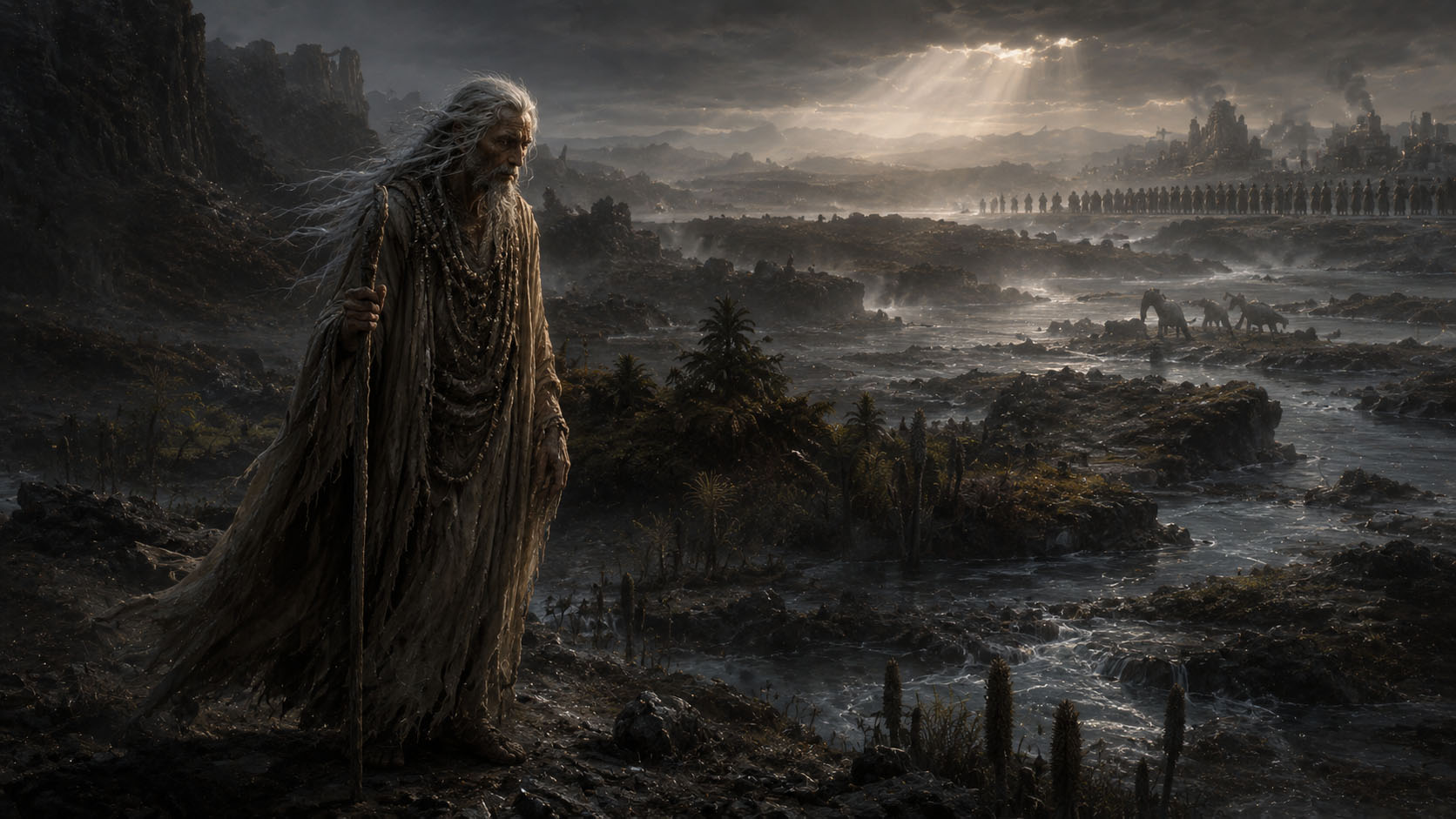
He has no power over the Grigori (Watchers). He is unbound, outside their oath; he neither commands nor compels. He influences by presence alone: by deflection, by the quiet word spoken as counsel. He does not rule the keepers and does not fight them — he abides among them as what they lack, and this abiding holds them back from petrification.
The Fair Folk’s free wind that cannot be seized is also a wind that cannot be calculated and woven into nomos; therefore its restraining influence slips out of the very net it guards.
Therefore the form of his embodied being is an elusive witness behind the stage of world history, a free counselor of the unfree, living memory among the archivists of empires — one who restrains the restrainers, so the world’s order does not become its prison.
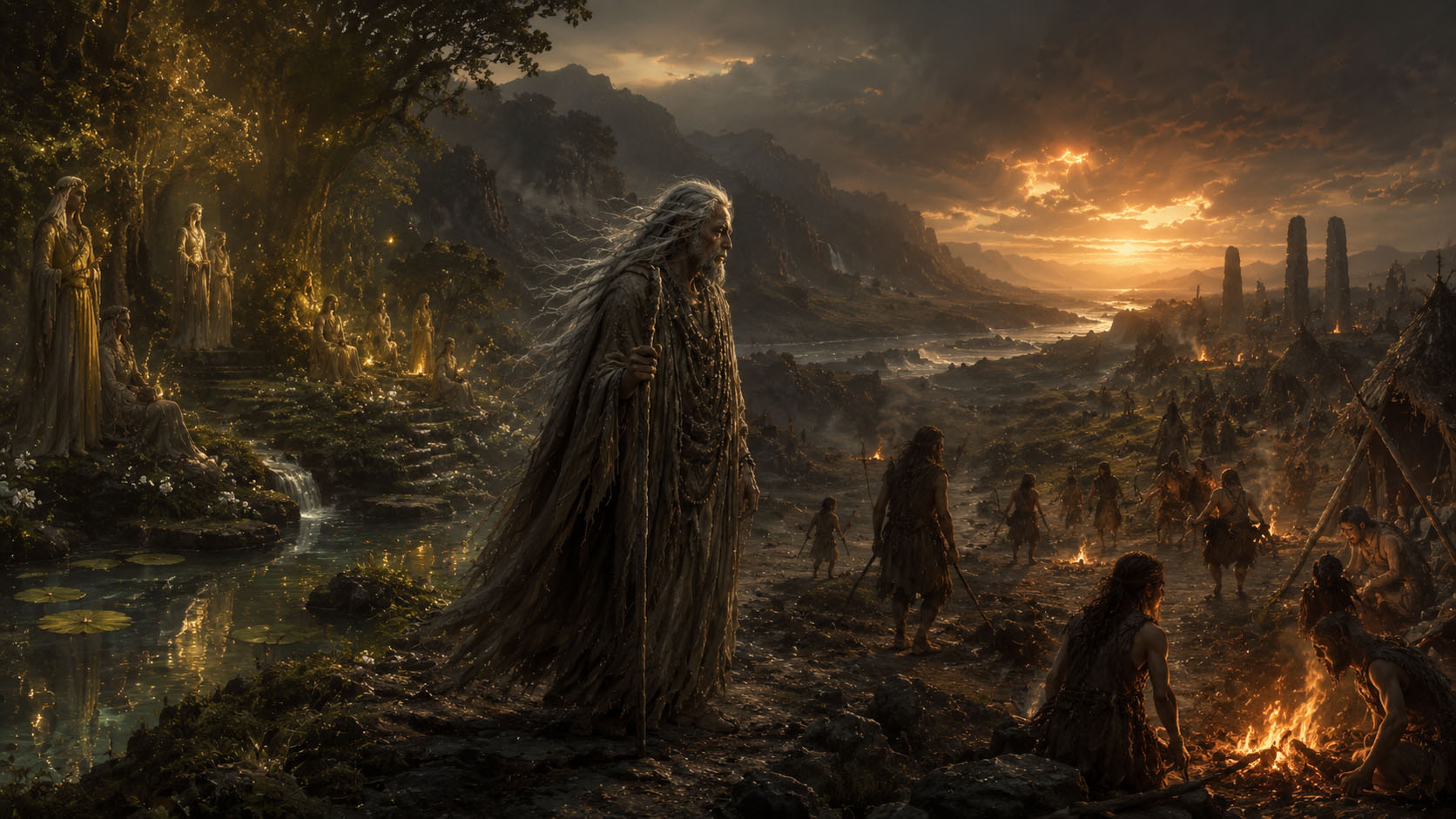
When a new humanity appears on the stage of history, Tuan meets it attentively — with caution, and with hope. Two humanities, the Fair Folk and humans, move along the ladder of being in opposite directions: the Magical people, embodying the immanent fire of life, sustain what exists and is complete by nature, yet congealed; humans, bearers of the transcendent fire of transformation, disturb the world, remain imperfect — and therefore grow. A human is a being in whom what has been lived can be finally imprinted, crystallized into a seed atom, become a held result.
This ability to imprint and preserve what is lived is at once fascinating and terrifying for the Fair Folk, whose fluid nature resists any holding-fast. Tuan, however, acquired this ability in flesh by his own choice — what a human bears from the beginning by nature. He won by effort what a human receives for free. Therefore, when humans appeared, Tuan recognized in them a kind of kinsman in flesh: one born already as he made himself hundreds of millions of years earlier. He is a forerunner of the human way of being among the Bright people, and therefore far closer to humans than any other sid.
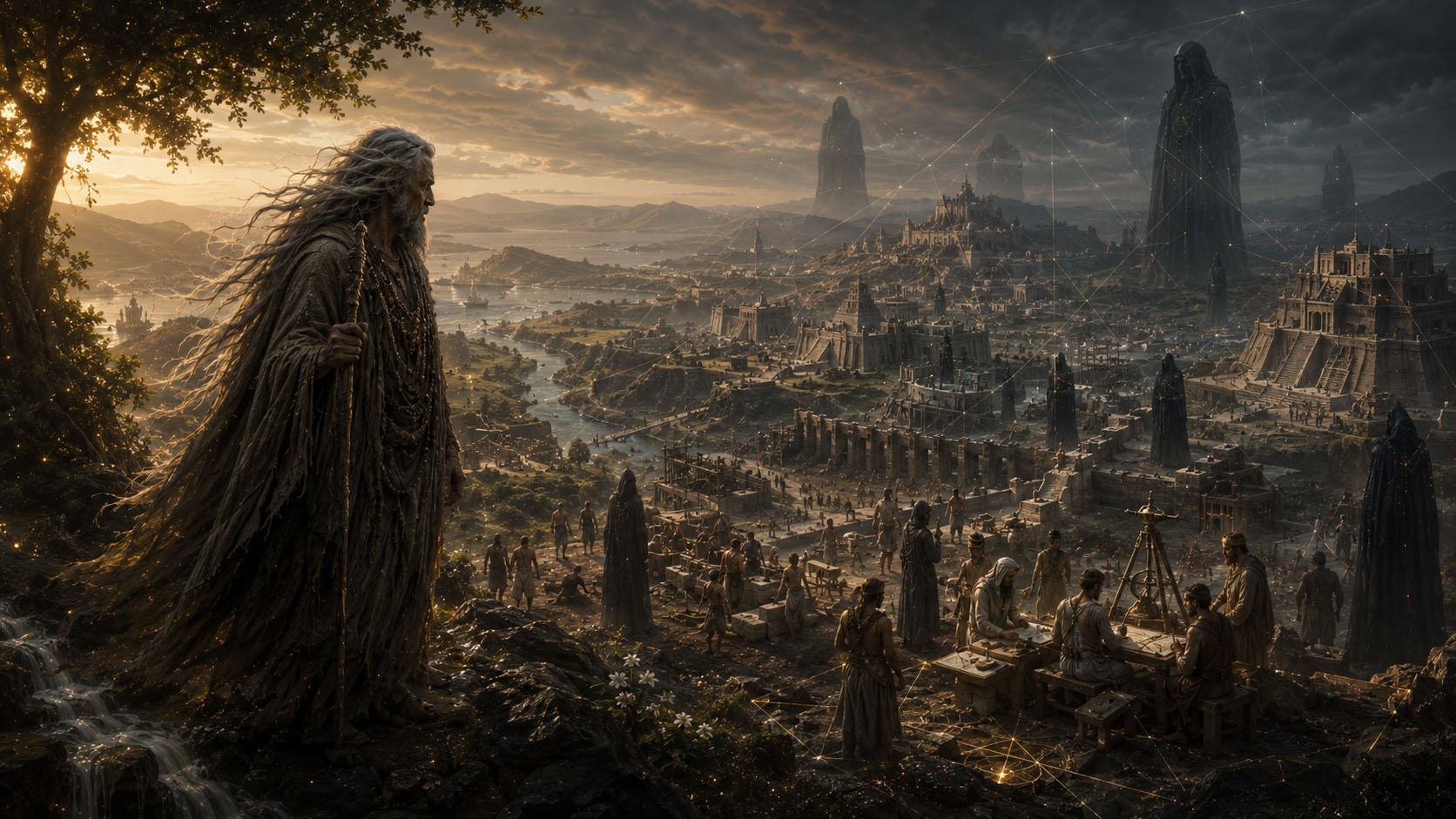
Tuan watched the emergence and development of humanity, and he watches civilizations grow out of its ascent.
Yet he knows perfectly well that the human world is, for the most part, built under the influence of those he shelters in the shadows: law, writing, accounting, the state, the cult of form — all this is the work of the grey keepers of equilibrium, the Grigori (Watchers), whom he himself holds back from sliding into Archonic chill.
Therefore he takes care of humanity as well. Without stepping onto the stage, without ruling and without teaching openly, he helps by ensuring that, just as he does not let the builders of order freeze, he does not let their building itself ice over.
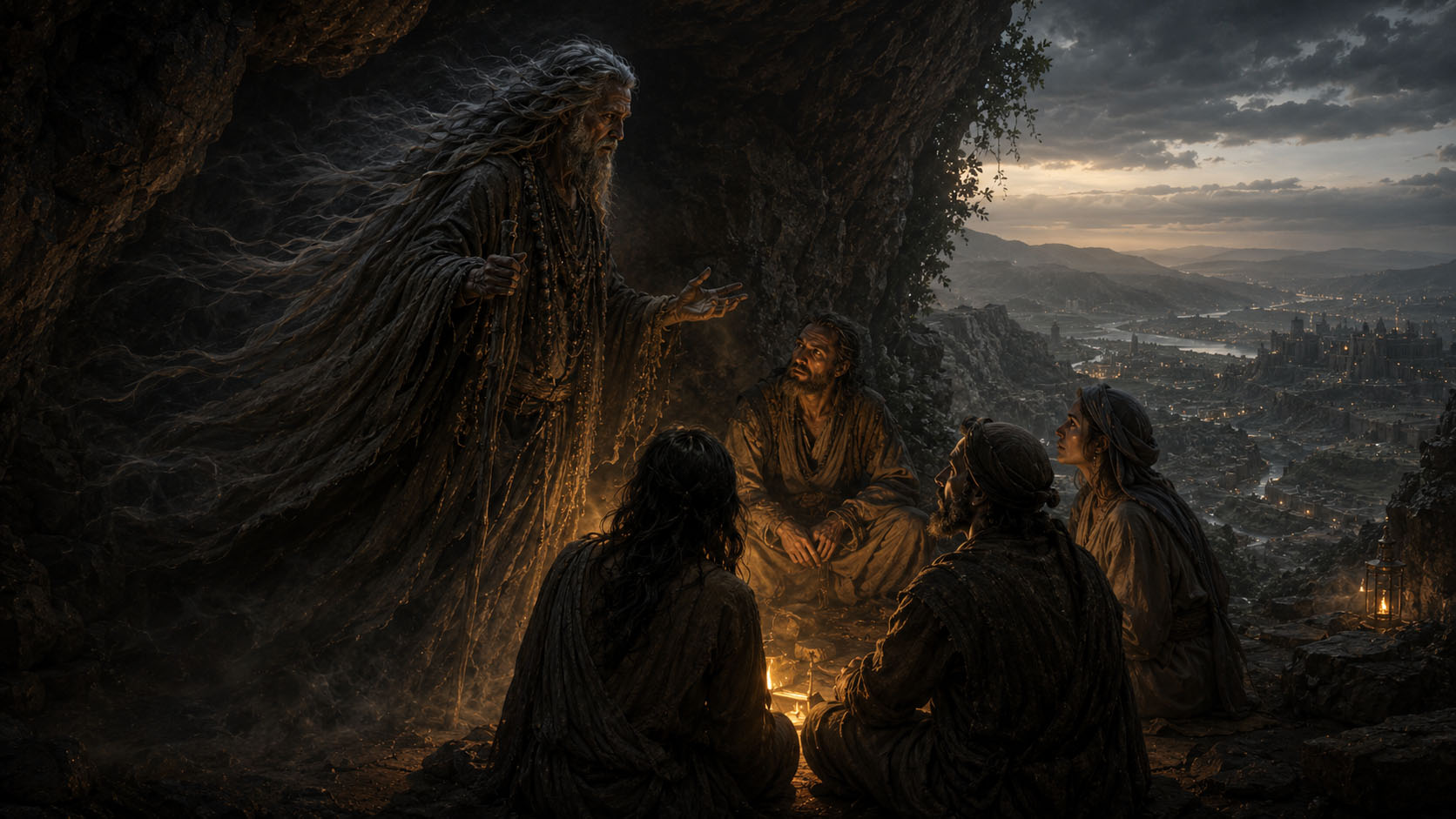
He touches humans directly only rarely — and always as befits a witness behind the stage. He speaks with the few: with those rare ones able to receive living memory — with seers, hermits, saints, to whom he tells the tale of the world and from whom he immediately departs, unholdable even for them.
He hands over memory, but does not allow himself to be delayed. He appears for a moment, then vanishes into shadow again. Thus living memory of prehistory reaches humanity in rare drops, through the mouth of the only living narrator who remembers what was before any writing.
He saw how the single world split into two Earths, yet he remembers the world as it was before any division. He is witness to that ancient wholeness that preceded all later rifts: the splitting of the Magical people themselves into two Courts, the divergence of the two humanities, and finally the division of the Earth itself in two.
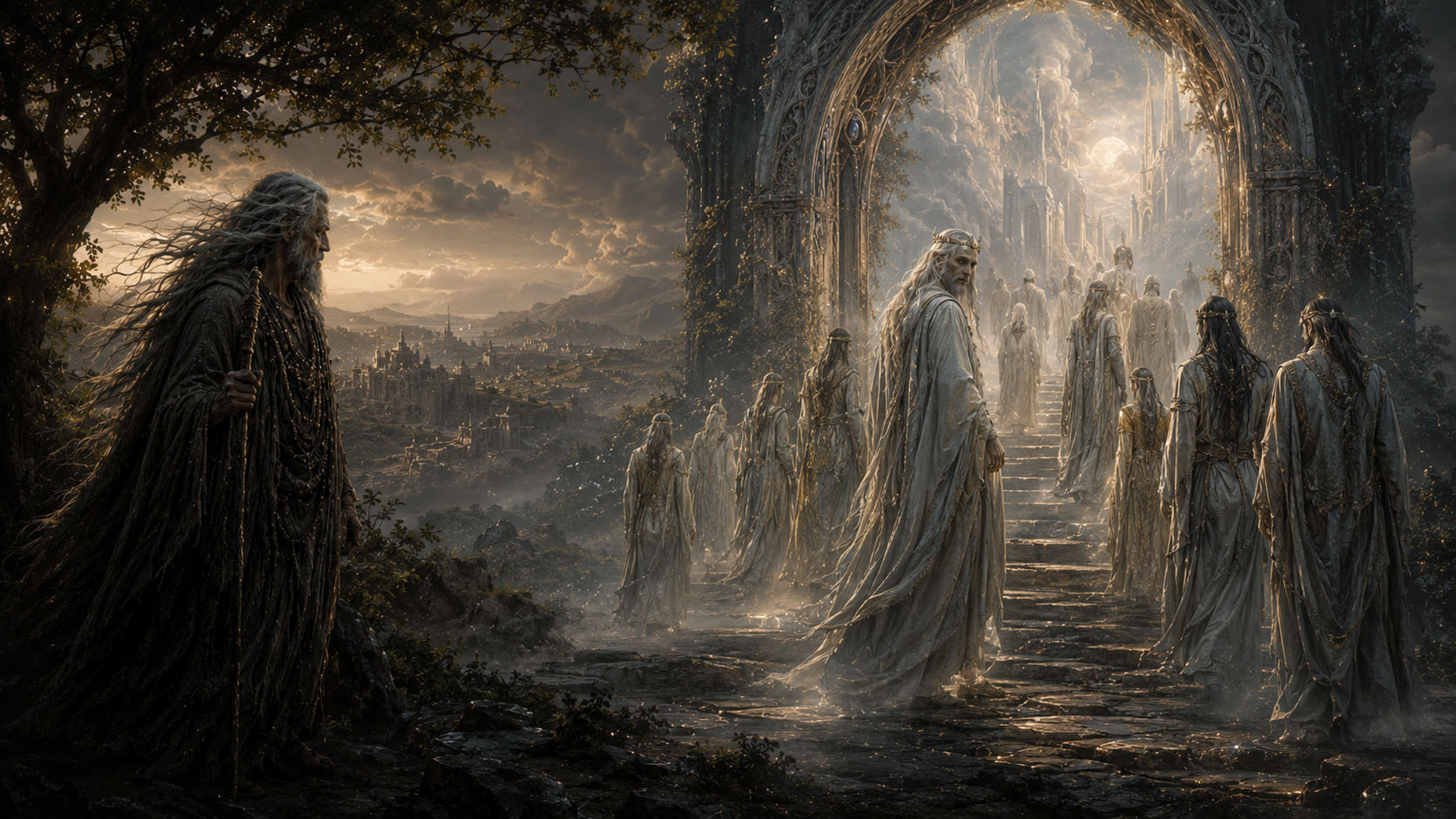
He also saw the departure of his people. With them went his fellow witness — Fintan, the one who at that same Judgment remained light on the outside: he returns to his own, upward, while Tuan remained.
In this remaining lies the whole meaning of that ancient choice he made during the Judgment over the Grigori (Watchers).
The world that became deadly for the fluid, bright Fair Folk does not banish him. Long ago he made himself dense, mortal, weighted — made himself, in essence, native to that lower, iron, thickened world that became unbearably toxic to his kin.
What he did out of compassion for the condemned more than four hundred million years before the Exodus becomes the very thing that lets him abide now, when almost all his kin have gone into the Interspace.
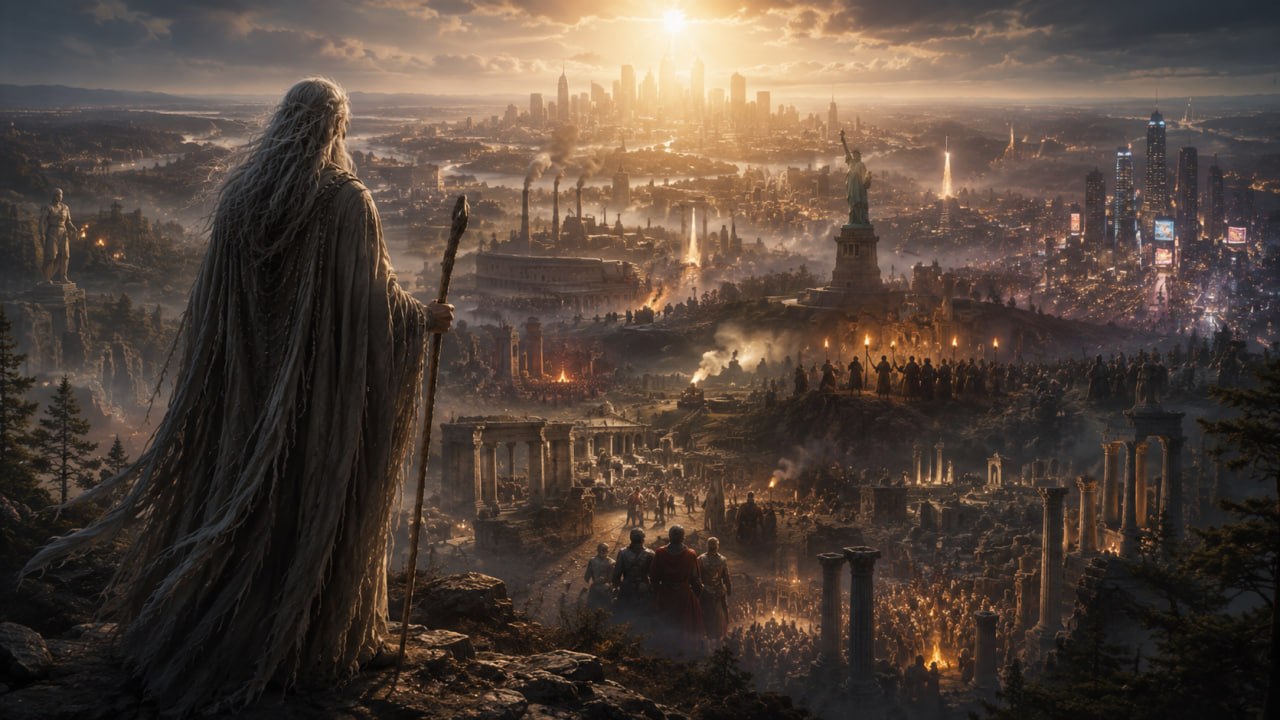
He is the last of the light-born remaining in the world of humans, the witness who did not depart. He remains for the same reason that always moved him: kinship with those who remain. As once he descended into flesh after the condemned, so now he stays in the lower world together with new mortal humanity — with those who inherited the divided, thickened, sealable Earth.
So he lives to this day — unnoticed, behind the stage, rarely letting fall a word to the chosen, continuing to hold the Grigori (Watchers) on this side of the chill, and keeping within himself, in the midst of the age of iron, the memory that the world was once one. A witness behind the stage of a world who remembers it whole and remains in it divided; a bright one who became mortal so as to remain where light departed; one who may yet come forth — someday — and tell.

Thanks for the article! The difference between Tuan and Gregory reminds me of the “difference” between Ahab and Ishmael.
Well, I read the article, and you’ve got everything mixed together—Atlantis, some Indian gods, Scandinavian ones, runes, Gnosticism, and Gregorys and Michaels. I mean, sure, it can be interesting to read sometimes like fantasy, but overall trying to cram that much into your concept is kinda so-so.