
Village Magic and Witchcraft
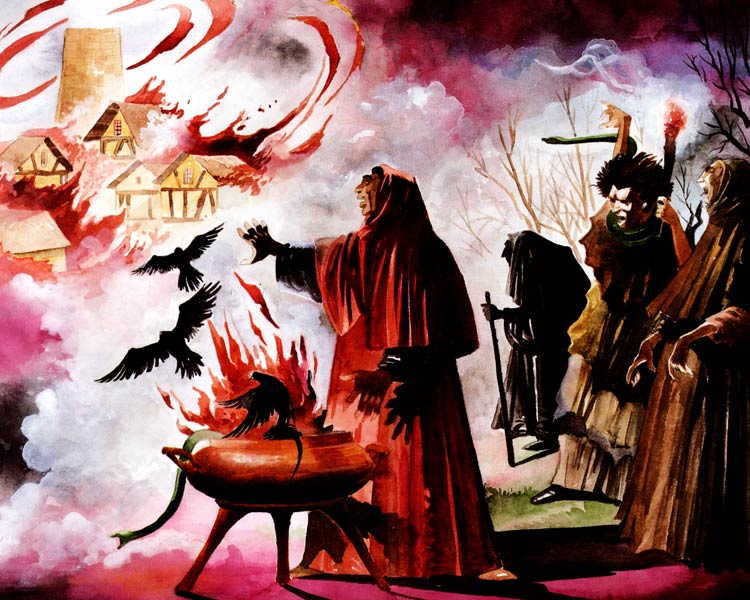
In the everyday mind, village — “social” — Magic is far better known than invocational and evocational work. Despite its secondary significance compared with appealing and summoning practices, “social” operations — aimed chiefly at creating, destroying, or manipulating larvae— are most often what people mean by the word “magic” itself.
Spells and love charms, curses and “crowns of celibacy” — these familiar manipulations either grew out of, or, rather, are the degenerate product of, two branches of Magic: Nominative and Contact (contagious, partial, sympathetic). Vortices are often manipulated unconsciously; when the operator does not understand what he is doing, tradition calls it “witchcraft.”
The same action, depending on the degree of awareness, is either “magical” or “witchcraft.” The task of the Magus is the evolution of himself and the world. Accordingly, realization is only a tool of that evolution, a means of actualizing potencies. The Magus must understand with precision what he is doing, what unfolds in the process, and what effects (beyond the expected one) it can produce. For the witch, the main thing is to obtain the result and avoid harm; long-term and branching effects are usually ignored, and the mechanism of the operation is grasped superficially (or not grasped at all). For the witch, realization becomes the sole goal of the act.
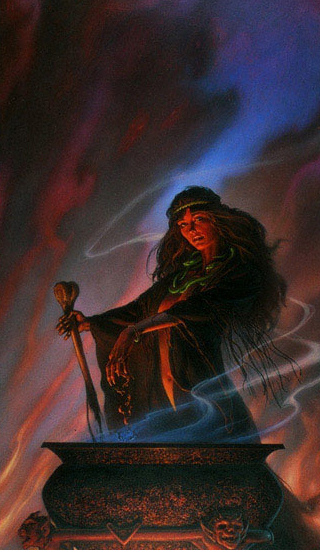
Magical thinking is not a theory or a concept about the structure of the world that must be disproved or proven. It is the deep, ancient foundation of the human mind. At the core of this worldview lies an ощущение — often not fully articulated — of unity and the hard interconnectedness of everything with everything: of separate layers and levels of being with one another, of being and mind, of actions on different levels, and of reality itself.
From this feeling, the Magus applies his will to specific “trigger” points in being or mind, bringing about restructurings of systems and driving them toward development. Witchcraft, although it uses magical, volitional techniques, also preserves many shamanic traits: clan continuity, the compulsive force of the “witchcraft” gift, and painful experiences when one refuses it.
Since “witchcraft” approaches most often reduce to the creation and manipulation of various vortex structures, it can be considered from the standpoint of the “reification” of desires.
Traditional Contagious Magic proceeds from the notion that two objects, once having interacted, preserve a connection between themselves forever.
This notion follows from the idea of the absolute passivity of the Immanent medium, which retains the memory of all volitional acts. Such an “imprint,” “reshimo,” lies on one axis of analogy with the objects that interacted; therefore, by influencing one of the objects, the operator influences the entire system — and thus the second object as well. Such a substitute is a particle of the object of Magic (cut hair, nails, saliva, and so on) or an item that was in contact with it (food scraps, a footprint, parts of clothing, and the like). On the one hand, by manipulating hair, nails, and similar objects, the Magus influences their source — the person.
On the other hand, by forcing a person to interact with objects (tossed balls of thread, bunches of herbs, and the like), the Magus in fact brings him into contact with larvae, for which these objects serve as anchor points.
In the Middle Ages, many peoples observed a custom that survives to this day: carefully hiding cut hair and nails, and a child’s shed teeth. Schismatics, after cutting hair and nails, collected them in special caskets and instructed that, after death, they be placed in their graves. Among the inhabitants of the Carpathians, a strict belief persists: if mice get hold of someone’s cut hair and build a nest from it, the owner will suffer headaches and may even go mad.
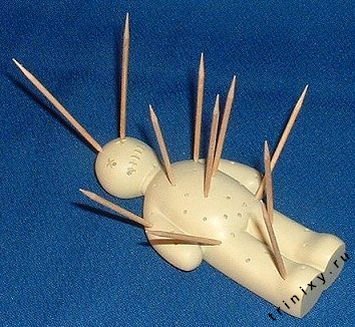
When it is impossible to find an object that has interacted with the target of a magical operation, another object is artificially placed on the axis of analogy with it — by naming, by giving the desired name and thus the essence. Such a realm of Magic is called Nominative. It proceeds from the fact that the Name of an object is bound to its essence; by naming the second object with the name of the first, one binds these objects into a single system in which manipulations performed upon the second object affect the first. The Magus acts upon a thing through its likeness, or by performing magical rites that imitate the action one wishes to evoke. For example, by naming a doll with the victim’s name and manipulating it, the Magus affects the victim himself.
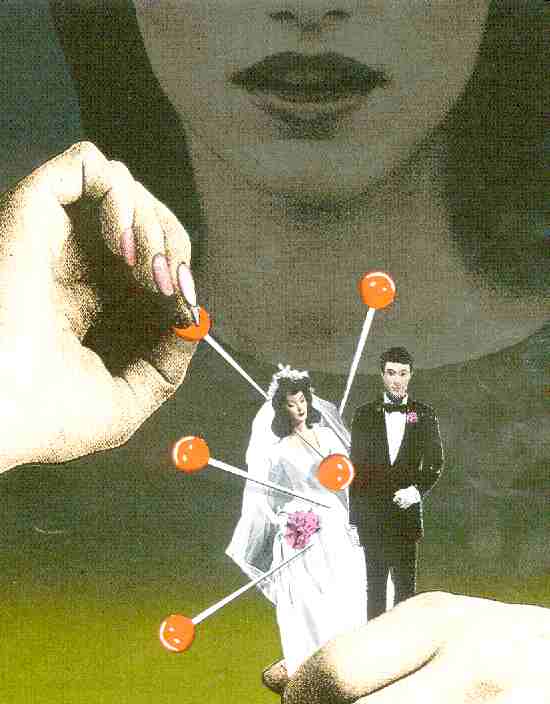
The ancient Egyptians already believed that if a person, addressing a god or a Demon, calls him by name, the latter is obliged to answer and to do everything he desires. Knowing a person’s name, those around him could help him or harm him. A name could be cursed, and then it would harm its owner; but if a blessing or a prayer for well-being was directed to it, it would bring benefit. Without a name a person could not be recognized at posthumous judgment; as he was born on earth after the utterance of his name, so a person could obtain his future life only when the gods of the afterlife recognize and name him.
The same principles underlie love (sexual) Magic. All rituals of love Magic rest on the principles of contagious Magic. One such technique is described in Prosper Mérimée’s “Chronicle of the Reign of Charles IX,” where a lady in love melts a wax image of her beloved in a fire, expecting his heart to melt as well. In the healing Magic of certain regions of Germany, peasants treat a broken leg of a sheep or pig by wrapping the leg of a chair with bandages and splints. Among other peoples there is a custom of applying healing remedies not to the sick person, but to the doctor. The war Magic of the aborigines of Australia presupposes an imitation of battle so that it may influence its outcome. In Africa, during the campaign of warriors, the wives who remain at home arrange a staged battle, and the women of the Haida Indians stage a feigned attack on their children and kidnap them into slavery.
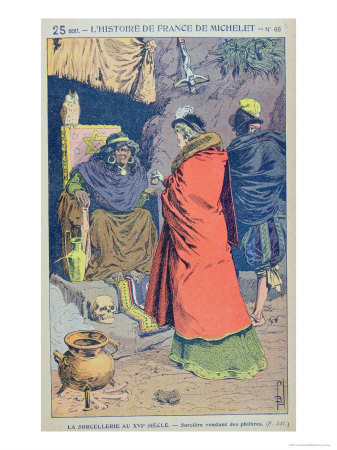
Moreover, by naming an inanimate object with the name of a living one, and addressing it as though it were alive, the Magus can compel the object to change its properties. An attitude toward a sword as a living being appears both in medieval epics (for example, in “The Song of Roland”) and even in later ballads and legends. In antiquity, many blades had their own names. The sagas, for instance, tell of King Magnus, who possessed a magnificent sword whose guard was made from a walrus tusk and whose hilt was covered with gold. The sword was named Leggbitr, meaning “Leg-biter.” Other sword names known to us include “Odin’s Flame,” “Ice of Battle,” “Fire of Shields,” “Fire of the Sea Prince,” “Torch of Blood,” “Serpent of the Wound,” “Hammer of the Bond of Battle,” “Dog of Helms,” and so on. In the same way, knives and spears also often had their own names. Naming a weapon made it possible to address it as something living, possessing its own will — a helper in battle. There are objects on which a single inscription combines an incantation and the object’s own name. Thus, on the blade of one early medieval sword one can see a runic inscription that says: “May Marr spare no one”; “Marr” here is the name of the sword.
In practice, both of these types of Magic are often combined. A doll depicting the object of Magic usually contains contagious elements, is named with his name, and is made externally similar to him.
Despite the high effectiveness of many witchcraft techniques, their common flaw is insufficient awareness. Since the witch does not set himself the task of comprehending the action being performed, but aims at the result, he does not need to understand how or why this or that approach, this or that technique, works.
From his own point of view, such a взгляд is understandable and justified. Yet the dangers lie not only in this: with insufficient understanding, the slightest deviation from the algorithm in use is fraught with unpredictable consequences. No less significant is the fact that, by relying on such rigid schemes, the witch does not develop the freedom of his will and often becomes a hostage to those Flows and actors with which he operates. Therefore, “good realization,” “good witchcraft” does not mean “good development.” Every witch must clearly understand what price he will pay for each realization and for the Flow as a whole; he must be ready for this payment and for responsibility for the actions he performs.

Interesting. Thank you, En.