
Mother of the Lot
“And Vladimir began to rule alone in Kyiv. And he set up idols on the hill outside the court of the princely palace: Perun of wood, and his head of silver, and his mustache of gold, and Khors, and Dazhbog, and Stribog, and Simargl, and Mokosh.” In the “Sermon on Idols” we read: “…to those same gods they lay down offerings and perform rites, and in the Slavic tongue: to the vilas and to Mokosh, to Perun, to Khors…”.
(The Tale of Bygone Years)
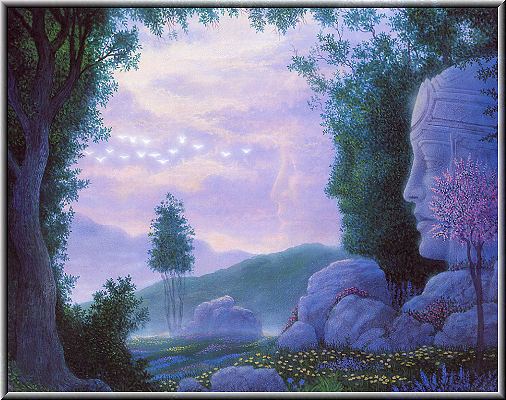
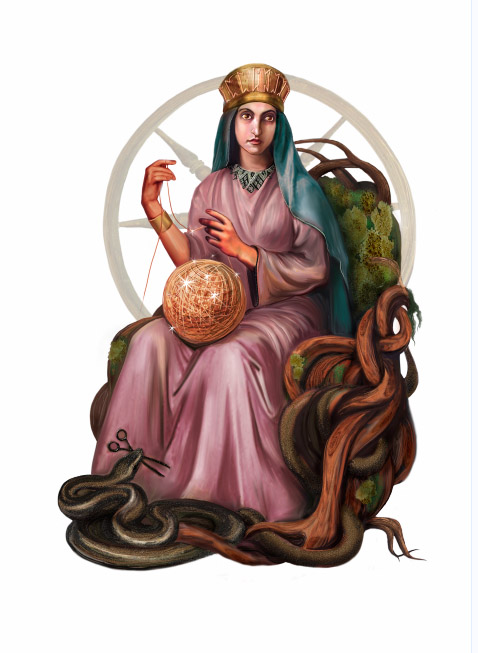
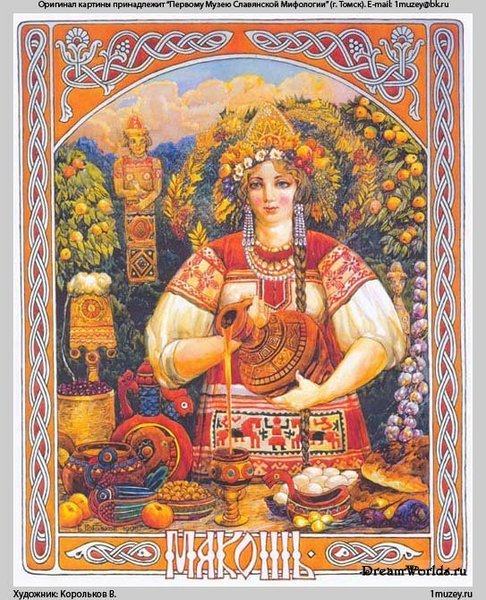
The great Slavist B.A. Rybakov characterized the Great Goddess of the Slavs as follows: “Makosh is a female deity — one of the most enigmatic and contradictory. Mentions of this goddess appear in many sources, but they are fragmentary and brief. We cannot even answer the question of the geographical range of her cult… Everything suggests that Makosh (long before she became merely the patroness of women’s work) was a very important goddess of the Proto-Slavic pantheon….”
B.A. Rybakov also noted that “in anti-pagan teachings of the 12th–14th centuries we see a definite system in the lists of pagan gods. Makosh sometimes stands alongside the chronicle gods (Perun, Khors, etc.), but more often her name appears near the vilas-rusalkas and the dog Simargl. This forms a distinct complex of agrarian-magical representations, since Simargl was connected with seeds and shoots, and rusalkas with the irrigation of fields by mist (dew) and rain. The proximity of names in these texts is not accidental; it is meaningful. The most stable association is Makosh’s proximity to the vilas-rusalkas. Yet the goddess cannot be equated with them: Makosh is always written in the singular, while the vilas are always in the plural — just as one Rod is linked with several Rozhanitsy.”
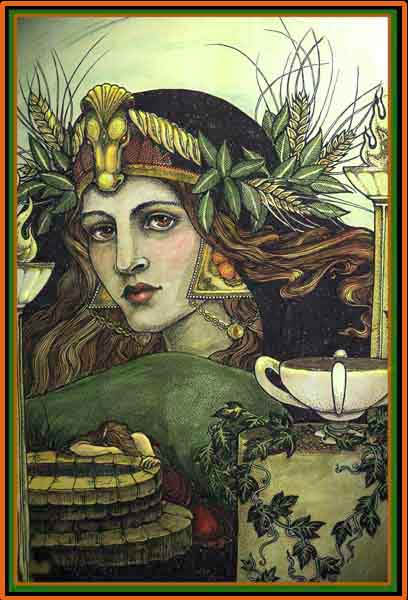
The ancient Mother, Mokosh is older than Creation itself. She does not belong to the strictly Creative pantheon of the Slavs, yet she stands within their great Ennead. Together with Veles, Mokosh completes the Septenary of the Creators and holds it in balance. She expresses the pre-creative principle of Passivity. Mokosh corresponds to the Immanent Face of the Absolute, the Most High, and at the first moment of creation forms a binary correspondence to Rod-the All-Sustainer.
As Creation unfolds, the Great Mother manifests in her Receiving hypostasis as Lada-Matushka, yet Mokosh remains the unshakable foundation on which the world-process rests. Lada was perceived as the Lady of the world; Mokosh, as the embodiment of the feminine principle in the cosmos. Mokosh is the only female deity whose idol in Kyiv stood on the summit of the hill beside the idols of Perun, Veles, and the other gods of the Slavic Septenary.
A great manifestation of Mokosh is Mother Damp Earth, the primal Goddess of the Universe, holding the potencies of all that Rod sows into Her Womb.
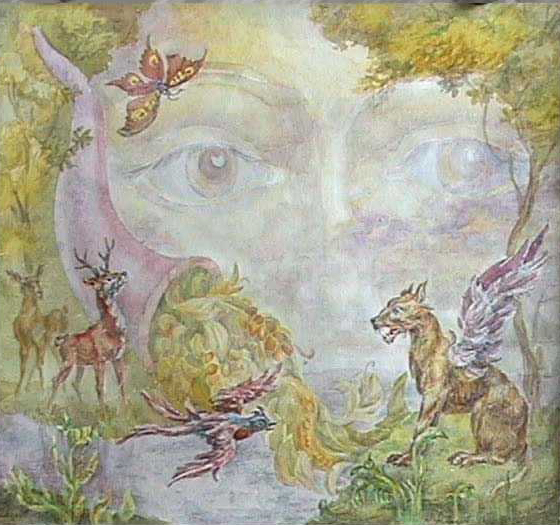
Mokosh is counted among the pan-Slavic deities (her name occurs not only among the Eastern, but also among the Western and Southern Slavs). Given the deep Indo-European antiquity of the word Ma (mother), the name “Ma-kosh” is commonly read as “Mother of the fortunate lot,” and the Goddess is therefore taken as a goddess of luck and fate. Yet “kosh” denotes less fate than harvest — the lawful result of an event. The name of the Goddess translates literally as “mother of the filled basket”: mother of harvest, mother of abundance. Mokosh is not a capricious dispenser of luck; she is the Lady of the world’s flow, of cause-and-effect itself. In this sense Mokosh is the Great Mother, the Heavenly Law, expressed in the principle of Pravi.
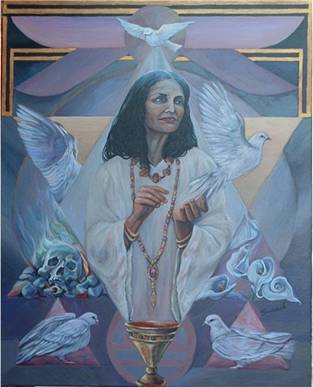
The name of the Goddess also reaches into water and spinning. The more archaic form, Mokos, carries the sense of “wet” (damp, raw). It may also connect to Proto-Slavic “mokos” = “spinning”. The Goddess is therefore bound not only to Earth but also to Water — the principal passive, life-giving principles. Hence the well-known Czech custom of praying and offering sacrifice to Mokosh during drought.
The link between Mokosh’s name and the notion of the Top is also clear (compare the cognate meaning “crown of the head”).
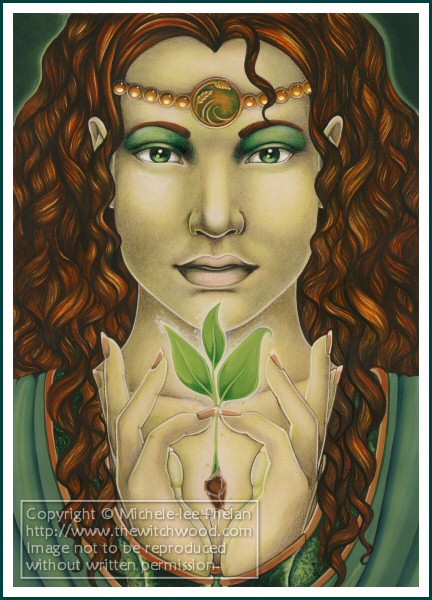
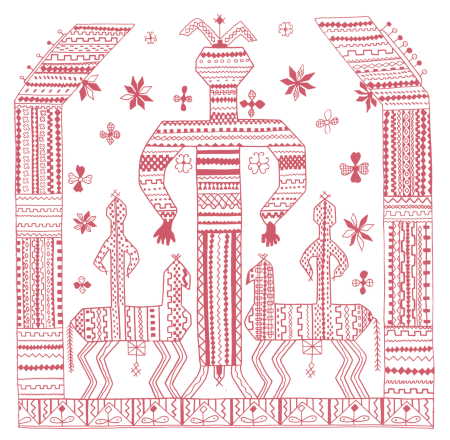
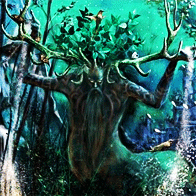
Mokosh is the spirit and life of the World Tree— the world ash, the world pine, or the world birch (among different Slavic tribes). Iconographically, Mokosh is often shown exactly in this form: a tall woman with upraised hands, broad sleeves falling down from her wrists. The pose signifies the World Tree: the body as trunk, the arms and fingers as crown.
As Lady of the flow of life, Mokosh is also the mistress of time. She is therefore associated with the Moon— the ancients’ measure of time. The characteristic feminine horned headdress was still worn in the 19th century at folk festivals. She is mentioned in Russian chronicles and in numerous anti-pagan teachings.
Life itself lies within Mokosh’s Power: the force of plant growth, the vital force in animals’ blood. She stands at the beginning of life on Earth. Her presence is mandatory and inescapable at the birth of every living being. She sends the souls of people from the heavens to Earth when children are born.
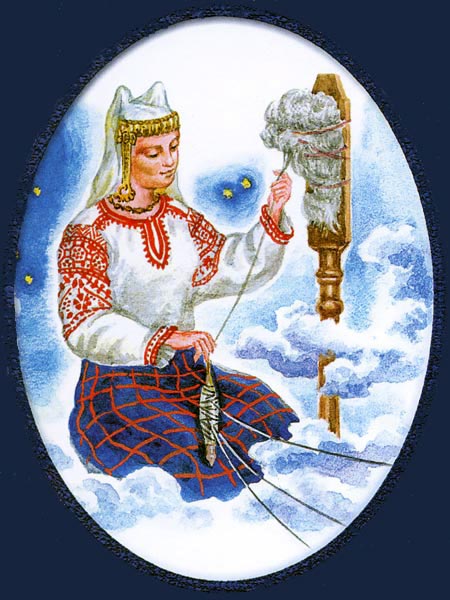
That is why the Slavs imagine Mokosh as the goddess who spins the thread of fate — fate understood here in the broadest sense. The cornucopia in images of Mokosh likewise marks Her life-emanating essence. The proper goddesses of fate — Dolya and Nedolya (Srecha and Nesrecha, Zhiva and Morena) — are only a lower manifestation of Mokosh’s all-encompassing principle. Mokosh is the Goddess who pours her special Power upon people: the power to create one’s fate. Because of this Goddess, Rus’ preserves the notion of an “unknown fate,” since every thread of fate lies in Mokosh’s hands (and her Will is known only to Rod). Mokosh, as Fate itself, is understood as “blind,” “dark,” impersonal justice — “unconcerned with any private being and hastening to dissolve it in the universal, carrying out ‘retribution.’” She is ruthless; she is judicious — Mokosh even toward the gods.
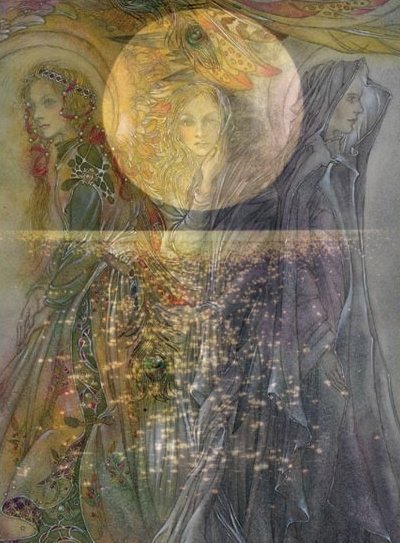
As the Pramother of all goddesses, Mokosh is not only the Source of Life but also a Goddess of death. In this hypostasis she corresponds binarily to Veles — the keeper of the Gates — manifesting as Yasun, the goddess of Transition. Not without reason Veles was sometimes called Mokos, Mokosh, and the sanctuary of Mokosh in Novgorod depicted the Goddess with a cow’s head.
The sacred animal of Mokosh is the goat. Her symbols are yarn, a ball of wool, and the spindle — offerings brought to Her sanctuaries. Kapi (images) of Mokosh could be made from “female species of wood,” foremost aspen. The kap’ of Mokosh could also be horned or hold a cornucopia. The servants of Mokosh are spiders; therefore it is considered a good omen when a spiderweb flies into one’s face. An amulet-cord tied on the right wrist is also associated with Mokosh. Mokosh the spinner is called Friday, after the day dedicated to her. On that day it is improper to spin: on that day the goddess herself spins. On other days she aids spinners and needlewomen. In popular perception, the image of Mokosh merged with the image of Friday, to whom sacrifice was made by throwing yarn or tow into a well. From this arose the name of the corresponding rite — “mokrida”.
Appeals to Mokosh take place in spring and autumn. These are agricultural festivals, since Mokosh showed people how to cultivate grains and how to call forth their growth. Two weeks devoted to Mokosh in our time are called “Indian summer”.

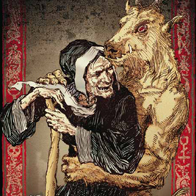

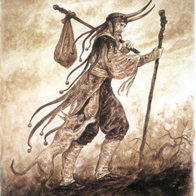
Makosh is a woman, and therefore changeable – she can bring both joy and sorrow. She favors and rewards only the strong in spirit, those fighting for happiness. She provides a way out of the most hopeless situations if a person has not despaired, if they push on with their last strength, if they have not betrayed themselves and their dreams. And then Makosh sends the person the goddess of happiness and luck – Srecha. And then a person opens the door, takes a step, and Srecha meets them. But if a person has fallen, lost faith, betrayed their dream, grown weary, and waved their hand at everything – saying that the crooked will carry them away, then they await bitter disappointment. Makosh will turn her face away. And the rejected will be led through life by monstrous old women – Likhо One-Eyed, Crooked, Unlucky, Non-Encounter – to where they mourn over the graves of Karn and Zhele.