The Aetts of the Runes
It is well known that the runic order — the Elder Futhark — is divided into three parts: three Families (Aetts) of eight Runes each. By the names of the first Runes of each Aett, they are called the Aetts of Freyr, Hagal, and Tyr. The association with these gods is largely conventional: it is linguistic rather than mythological.
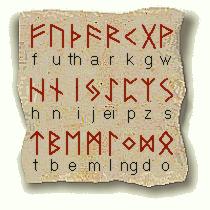
At the same time, each Aett marks a complete cycle traversed by the World Wheel. The first Aett corresponds to the birth of Being; the second, to the establishment of the laws of its existence; and the third, to the forms of existence of this manifested being.
 Another meaning of this division of the Futhark is that it testifies to the threefold nature of the world in traditional scripture. The first Aett corresponds to the affirmation of the Upper World; the second, to the Lower; and the third, to the Middle.
The First Aett contains the Runes that mark the appearance of the principal attributes of the Universe: the Cow Audhumla; the first Jotun, Ymir; the Forefathers of the Jotuns and their children — the Thursar and the Aesir; in particular, Odin and Thor; the creation of the Sun; the War of the Aesir and the Vanir, and the peace between them; and finally, the affirmation of Asgard as the capital of the Universe.
The Second Aett continues the account of the creation of the Worlds. It describes the establishment of the regularities of existence: the appearance of death and the birth of Hel — the place of repose for those who did not enter Valhalla; the necessity of effort to overcome obstacles; the establishment of intervals — pauses in the flow of events; the closure of the world cycle; the forging of connections between worlds; the appearance of the Norns, who establish the fates of gods and humans; the affirmation of the crossroads of worlds and its Keeper — the God of the Boundary, Heimdall, the God-Keeper of the Universe; and finally, as the result of all this, the establishment of Manifestation: of Light as a stable Reality.
The Third Aett describes existence within this affirmed reality: Struggle as the condition of accomplishment (as a consequence of the inertia of the medium); Birth as the passage from potential being to actual being; Collectivity as a new form of being — a social level of organization. Moreover, the collective is considered in a twofold way: as a set of units, and as their co-existence — that is, as the totality of existence of Monads and Multiplicities; the necessity of Intuition for knowledge of Synthesis as a consequence of the differentiated multiplicity of the manifested world, 
Fertilization as the imparting of impulses to the world toward development and generation, and, as the result of all this, the emergence of property as an external supplement to the manifestation of beings. The Futhark ends by manifesting the possibility of a further Way — beyond the worlds and the image of Manifestation established within them.
It should be noted that there are divergences in the details of the order of the Runes in each Aett, and different ways of reading these orders (when they are not arbitrary). Yet these interpretations, mutually complementing one another, sharpen understanding of the unfolding of the Universe and the relations among its parts.

Quite insightful; I at least read and understood the essence in a comprehensible language, thank you.
Good afternoon, how does the fourth aett (ethir) from the Northumbrian futhork fit into this system? There is a clear structure that repeats and supplements the classical futhark.
Yes, the Northumbrian row brings the runes to the level of specific manifestations.