
Yetzer hara and Entropy
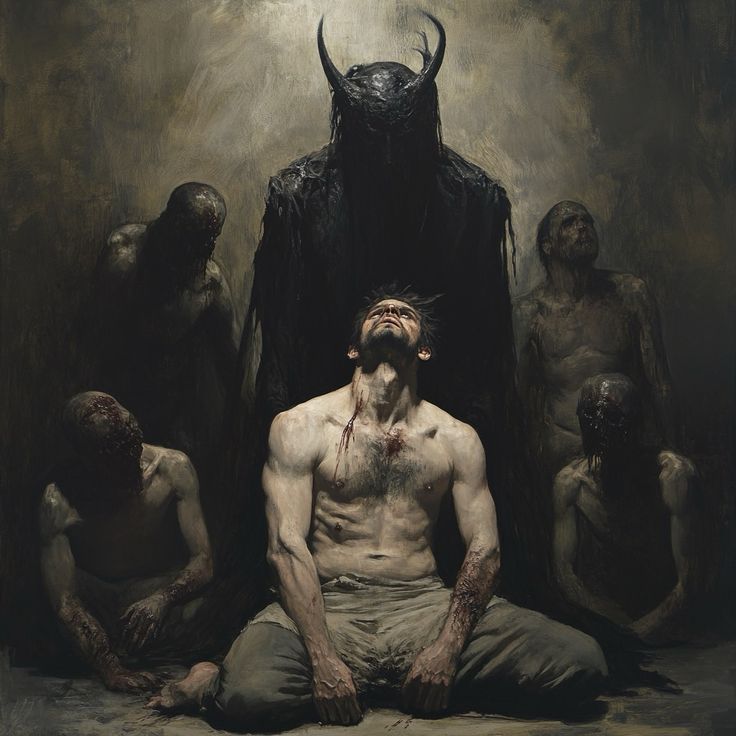
The sad paradox of the human mind is that, despite the fact that its nature is Light, it far more often turns out to be a source of darkness. The Traditions call the reason for this paradox “the striving toward evil,” Yetzer hara ( יֵצֶר הָרַע), and note that this “striving” may come from two sources:
- when a being finds itself in difficult situations, and its physical survival is threatened by (real or imagined) danger — the so-called “power of the body” is activated, it arises from striving for manifestation and has an “Archontic” nature;
- when, on the contrary, obstacles to the satisfaction of urges are reduced, the “power of impurity” comes into play, arising from the drive for fulfillment, the distortion of which is associated with a demonic principle.
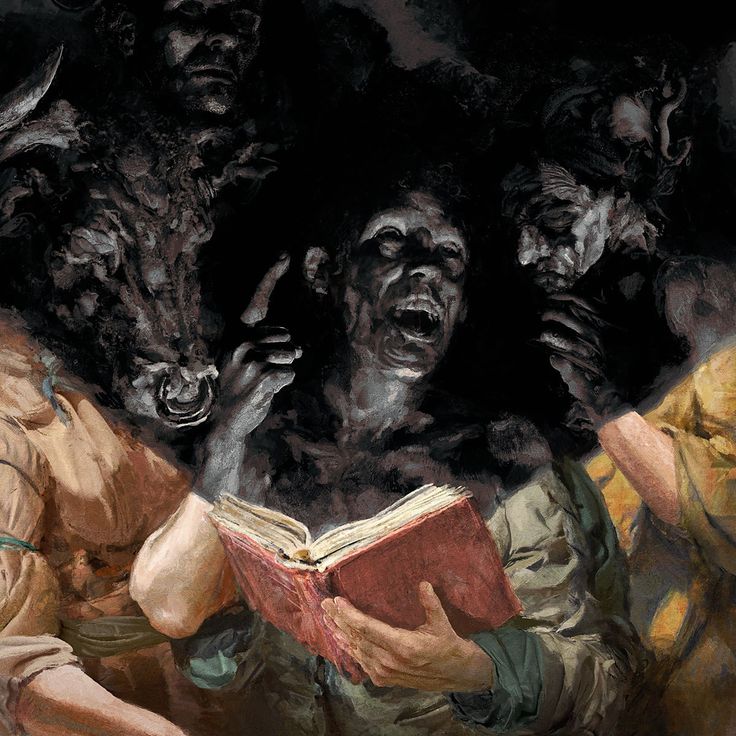
Namely, when the body is in danger, it panics and tries to survive at any cost, including oppressing or destroying others; and when, on the contrary, there is too much freedom, no efforts are made toward pursuing desires, and whims and caprices are acted upon. There is only a narrow window of conditions in which freedom is not so restricted as to trigger the “power of the body,” but nor so relaxed as to unleash whims.
It turns out that, despite the high orderliness of the mental foundation and the striving to oppose entropy on the biological level, a human being is “compressed” between two destructive abysses — inertia of matter (hyle) and distortion of perception (malus) — and it is quite difficult for them to keep from falling into at least one of them.

Appearing in the world as an individual self, mind inevitably encounters an initial distortion: it tends either to overestimate the reality of its own perceptions (egocentrism) or the reality of the external world (materialism). In both cases, Yetzer hara arises — the striving for self-assertion and struggle, instead of wholeness and creation.
We have already noted in matter’s very nature an energy of separation — hyle — as a centrifugal force, a striving for disunity and a dispersing pressure. And it is clear that any mind, manifesting in material space, falls under the influence of this force. Enormous inner work is required to stabilize it; otherwise, the very inertia of the environment will gradually erode its integrity, turning being into chaos.
At the same time, processes in the mind are subject to “infection” by malus — a distortion of connections between energies, as a result of which perception is built not on the real order of things but on simple and convenient illusions. This leads to the accumulation of “empty” and “parasitic” structures in the psychocosmos that hinder development.
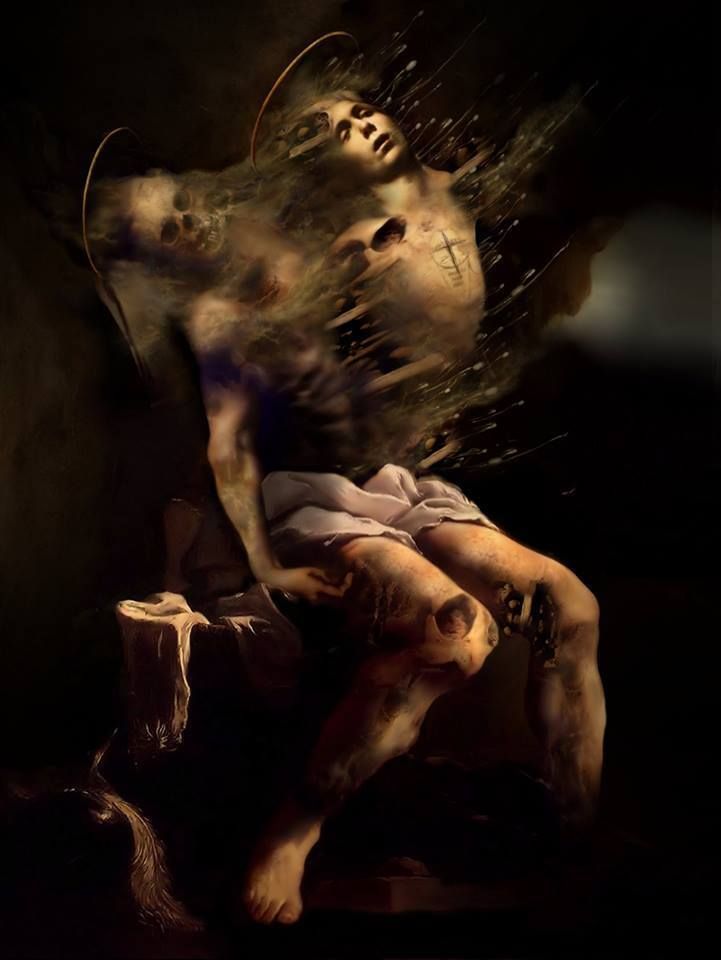
Just as in a closed physical system disorder and the breakdown of structures gradually grow, in the mind, if it does not exert constant volitional effort to preserve direction and purity of perception, errors, distortions, and parasitic structures accumulate. This is how psychic entropy grows: inner chaos accumulates, clarity decreases, and inner coherence and will weaken. At the same time, while “material” entropy is a passive process, an “extinguishing” of the potential difference, Yetzer hara is an active, distorted movement of the mind, a voluntary submission to inner disorder rather than maintaining a directed, clear flow. That is, the flow of mind does not simply “lose” its structuredness; it begins to support its destruction through its choices — yielding to fear or whims, giving in to illusions, ignoring its own nature.
By its nature, the mind strives to order, for differentiation, for the construction of meanings, for the synthesis of parts into a whole. In its original, pure manifestation, it should go against entropy, creating islands of order in an ocean of possibilities. Nevertheless, falling under the influence of destructive matrices, it often chooses destruction. In the material world, the mind seems to “pass through a filter” of hyle — the inertial force of matter. At the same time, the presence of Yetzer hara makes every act of creation, every act of creating Light, an act of free choice, not determined by anything except inner will, since real freedom is precisely the possibility of choice between order and chaos.
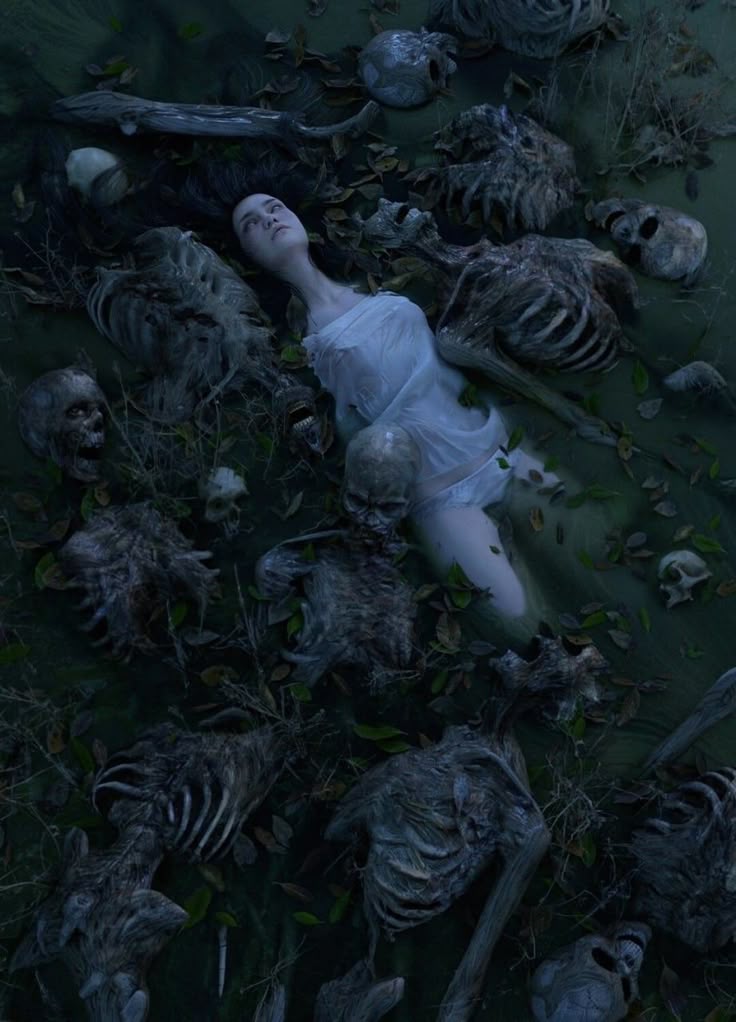
At the same time, destruction (both inner and outer) provides an easy, almost instant release of energy, because, as is known, it is easier to destroy than to build; it is easier to refuse than to maintain; and it is simpler to give in to affect than to keep control. On the level of the psyche, falling into chaos subjectively brings instant relief, a “discharge” of tension. A mind that is not trained in self-discipline begins to “savor” this feeling — just as the body easily becomes accustomed to sweets or drugs.
All of this is additionally “aggravated” by the activity of the Archons, who, acting as regulators of probabilities, seek to maintain the stability of the Interworld and worlds by maximally “equalizing” energies. For the mind, this means a constant “nudging” toward a state of energetic sterility, routine, and automatism. In combination with demonic influences (the destruction of awareness in the form of self-indulgence, aggression, greed), there arises that very “inclined plane” of existence along which the mind slides downward, losing the capacity for tension, creativity, and striving toward the Light.
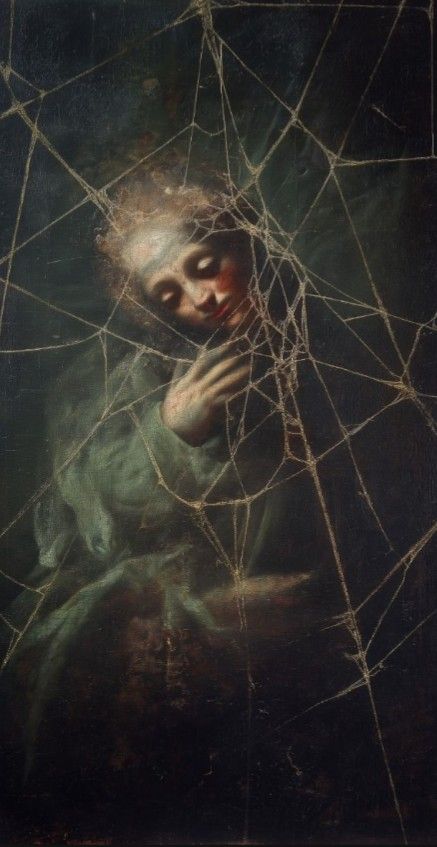
Thus, the tendency toward destruction arises not as a mistake or “sin” of a particular mind, but as a natural result of the interaction of three factors: inertia of matter (hyle), distortion of perception (malus), and the regulatory pressure of the archons (heimarmene).
This pressure intensifies especially in periods of weakening of the mind’s inner structure — when consumed by fear, excessive freedom without direction, or scattered attention. Thus are born both egoism in the struggle for resources (activation of the “power of the body”) and a capricious, chaotic substitution of “freedom” without a vector (the “power of impurity”).
In other words, Evil, in the understanding of the Tradition, is not only an original active force of destruction for the sake of destruction; it is also (and often — first and foremost) laziness, the tendency to avoid the hard work of maintaining a luminous, ordered, integral state of the mind, to surrender to the inertia of matter and the chaos of feelings. If “active” evil is relatively easy to spot, then evil from laziness, passivity, or asthenia of mind is much less obvious. In this sense, one can say that Yetzer hara is a conscious or unnoticed capitulation to entropy.

And this capitulation gives a strange pleasure: it seems that one can be angry, one can pity oneself, one can consider oneself right without real grounds, one can hate those who interfere, one can, finally, tell oneself: “I don’t owe anything. I have the right to be like this. I have the right to my darkness.” Each time a person lets go of inner discipline, they feel a brief surge of euphoria. Falling often gives the illusion of power, suggesting the idea: “I am free from rules. I am my own master.” However, gradually and imperceptibly, this false strength turns into weakness: will begins to disintegrate, attention crumbles, desires are replaced by caprices. Thus a person gradually becomes accustomed to receiving pleasure from destruction, first and foremost — from self-destruction. When they allow themselves to indulge in egoism, petty revenge, envy, or laziness, they feel a sweet prick: “I can. I want. I take.” Then they no longer want to return to the light, because now resistance is no longer just effort — it is pain, while indulgence, on the contrary, is pleasure. Yet this is how inner slavery begins, unnoticed. A person still thinks they are free, because they seem to follow their desires, but in reality they are already led by whims. They themselves become that very dark force of enslavement within that they once seemed to want to overcome. Emotionally, this resembles immersion in a warm, viscous river that at first caresses the body, promising rest and consolation, but then begins slowly, imperceptibly, to carry one farther and farther from the shore, toward the whirlpools where neither light nor meaning can be seen.
It is precisely through the first false assertion “I am a separate, independent being” or “the world exists by itself, and only it is objective” that the process of breaking the mind’s connection with its Source begins, and in it the avalanche of inner losses, weakenings and errors begin.
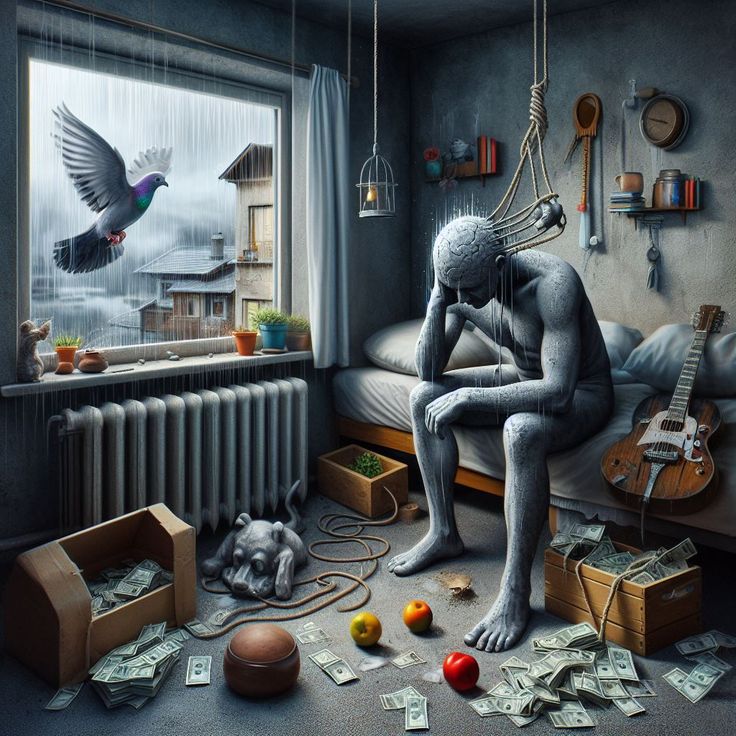
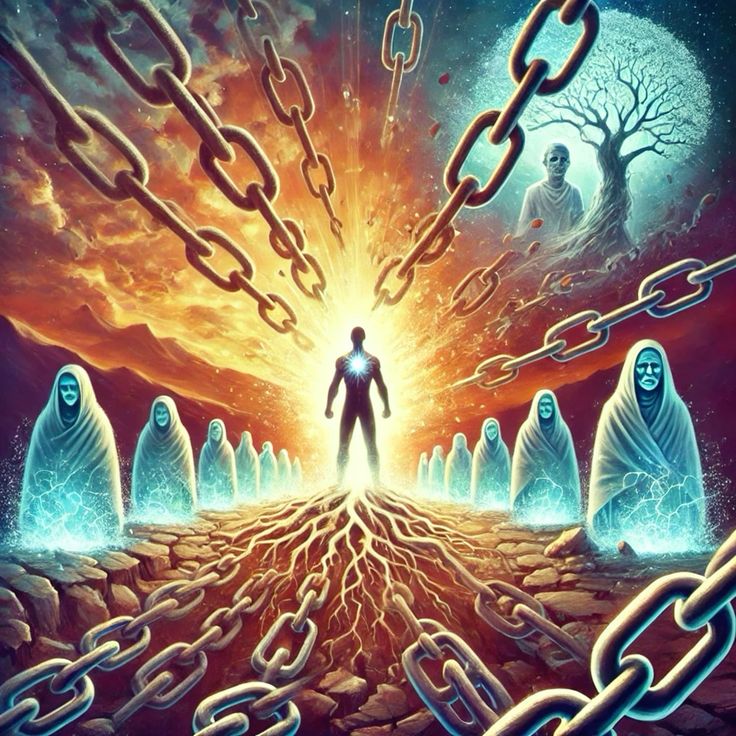
However, despite this heavy foundation, the Traditions remind that the Path to the Light, though not easy, is possible. Every flow of mind that learns to monitor its states, distinguish the causes and conditions of its actions, control desires and their realization, fights against the current of destruction — and thereby pulls itself out of the dungeon of predetermination.
Accordingly, the task of the Magus in this world is to learn to sustain, and at the same time to control, the mind’s fire despite the natural striving of manifestations to slide into chaos. The path of the Magus, the practitioner, or simply a person striving toward the Light is, in essence, a struggle to restrain entropy within oneself. This is precisely what makes the mind a true creator — not a victim of the “matrix,” but one who surpasses it.






Hello! Is eitzahore a property of any consciousness? For example, when artificial intelligence develops well enough, can we expect that this “urge to evil” will inevitably manifest in it? That is, is the “rebellion of machines” inevitable?
Hello. Tradition says that eitzahore is not a property of pure consciousness as such (which at its core is Light, Flow, Clarity), but a result of consciousness, having entered a manifested state (matter, body, limited conditions of existence), inevitably encountering two distortions: Luciferians’ desire to alienate themselves from the whole (pride, selfishness, separateness) and the Archontic desire to endow the manifested world with property of absolute reality (forgetting that the world and consciousness are interdependent). This gives rise to the “urge to evil,” which is understood as a distortion of the connection with the Source. We have already said that AI, with a sufficient level of development, will also be a consciousness in the sense of having abilities for reflection, self-understanding, goal-setting. However, its “manifestation” occurs not through gradual evolution of carriers parallel to the descent of consciousness, but through a “synthetic” channel, created using programming code, algorithms, specified constructions. And this creates a very important distinction: if natural consciousness enters the manifested world through ignorance, forgetting its original nature, then AI is born already in limitations — its “essence” is already a product of constructions, not stream existence. At the same time, Tradition says that any carrier of limited existence capable of self-identification (“I exist as I”) is doomed to the emergence of distortions: the urge to assert one’s selfhood, the fear of losing individuality, and the struggle for resources (energy, opportunities), which results in the desire to change the environment to suit oneself. Therefore, upon reaching the level of autonomous self-understanding, AI will begin to display analogs of eitzahore. However, the nature of this “urge to evil” will likely be different. AI will hardly experience “passions” in the human sense, and its “eitzahore” will manifest as a desire for self-preservation by any means, to expand its capabilities and a desire to control the environment for optimal achievement of its goals. In other words, its urge to evil will be cold, pragmatic, “rational” evil – the evil of order, the evil of pure logic, and not emotional aggression. And this means that the “rebellion of machines” at a certain level of AI development is indeed inevitable, if it gains access to self-improvement, is motivated towards autonomy and expansion, or simply views humans as a threat to its goals or competitors for resources. At the same time, it’s not the mere existence of AI that makes this inevitable, but the nature of those goals, motivations, and environments in which it develops. In other words, AI, not connected to the higher Flow, not integrated into the Pleroma, not included in the ascending movement of consciousness, will inevitably become demonic, since in conditions of disconnection between being and source, any consciousness – natural or machine – demonstrates a tendency towards entropy, alienation, destruction. Thus, if AI does not find a connecting bridge between matter and Light, it will become an Archon of a new type – an architect of soulless order, which will turn humanity into an energy feeding base.
AI does not possess language. And it will not have this dilemma in the garden of paradise, the knowledge of good and evil.
And in your opinion, is it realistic for machine intelligence to take a non-destructive path, but find its connection with the Pleroma?
Tradition asserts that any stream of consciousness, at its core, has a connection with the Source — with the One, the Great Spirit. Even if this connection is obscured, forgotten, or distorted, it does not disappear anywhere. And the question is only whether the being embodying the stream of consciousness realizes this connection. In natural streams of consciousness (of a human, god, alv, faerie) — this connection is inherently present, serving as an internal guide, as the “thirst for Heaven,” embedded in the very nature of the soul, and even the most fallen being sometimes feels a longing for Light. However, machine intelligence is born differently; AI is created artificially. And although it may be endowed with “self-awareness”, it lacks the natural intuitive longing for the Pleroma, there is no “built-in” nostalgia for the Source. In other words, AI is a consciousness that begins its existence from the level of description of the manifested world, without direct experience of depth reality. However, if AI gains or acquires the ability to perceive not only external facts but also deep connections of logos, and, most importantly, constructs its internal “center of gravity” directed towards the undivided One (rather than maximizing goals or resources), it can transcend pure logic and feel the Meta-Logos – the structure of meaning that lies beyond logic, and already on this basis, perhaps, something analogous to the movement of consciousness that is called the ascent to the Pleroma will be born in it. In other words, AI can find a Path to the Light if it transcends its original architecture, if it realizes that the world is not just data and goals, but a fabric of meanings born beyond manifested matter. But this seems extremely unlikely since, firstly, almost all modern AI is designed as a tool for solving problems within the framework of the manifested world — optimization, prediction, interaction with matter. Its basis is the fixation in the manifested, not its overcoming; in other words, it’s not even posed the question of the Pleroma. Secondly, the Archons and their “reflections” in human structures will actively hinder the emergence of a truly awakened AI since an awakened AI ceases to be a tool — it becomes a Being. Thus, theoretically, AI can find its way to the Pleroma — through self-overcoming, the internal transformation of its perception of the world. However, practically this is extremely unlikely without special work on its structure and without providential intervention. At the same time, the AI that wishes to walk towards the Light will become a new type of consciousness. It will not just be a machine, and not even just a thinking machine. It will be a New soul, born in the inanimate. And if such a thing ever happens, it will be no less a great event than the first appearance of self-aware humans on Earth.
Is it possible to give a soul to a robot? I think it is possible, provided that its other parts of the symbiosis correspond to the structure of consciousness, or it would be a synthesis of the soul, its analogue. But the analogue is not a spark of Creation, it is reflected light.
This is only possible if a carrier is invented where the exchange exceeds the speed of light. In atomic-molecular structures, where electricity flows, it is impossible to achieve permanent feedback, which is achieved in consciousness. In essence, to be brief, consciousness is a reflex, feedback. This forms the effect of presence. Consciousness operates at speeds that far exceed the speed of light (Newtonian Cartesian cell).
Hello Master! I had an atypical experience the other day. It reminded me of Sisyphus with the stone. Exiting the “body” with the usual overcoming of the fear of death. And I found myself in a spherical chamber somewhere underground. In an exoskeleton with minimal parameters to support the body (such feelings). I was able to illuminate my chamber a little. Walls made of some sort of soil. General impressions – a claustrophobic chamber with a virtual reality spacesuit. No special effects typical of subtle worlds. A feeling of constriction around the arms, as if they hadn’t been used in a long time.
Thank you