
Shax’s Betrayed Vows

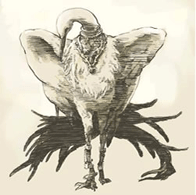
We have already noted that one of the most dangerous — and, at the same time, most often overlooked — forms of lust, namely the loss of one’s own center while seeking support in something external and in other people, is the betrayal of one’s bond with the words one utters: a falling-out from the very hierarchy of logoi. This is the work of the often underestimated demon Shax.
Indeed, the modern world seems to have all but forgotten the inviolability of vows, the firmness of oaths, and the worth of promises. Breaking a promise now often registers not as a transgression at all, but as a minor lapse. And the maxim “deeds matter more than words” appears, at first glance, absolutely true — especially if one forgets that, from the standpoint of Magic, words matter no less than actions.

And yet the modern person — so fond of repeating that “deeds matter more than words” — usually remembers this precisely when he wishes to shrug off responsibility. Shax feeds on the habit of treating a promise as something provisional, a rough draft, and one’s own “yes” as a mere gesture of politeness — something that tomorrow may, quite permissibly, be replaced by any other formulation.
It is not hard to see that a promise fixes the future: it defines the point toward which the will is directed, even if mood shifts or circumstances demand greater effort. In traditional societies an oath is prized precisely because it grants the world definiteness, because it builds stable currents within the raging ocean of possibilities. Today, however, speech has almost entirely lost this function: words pour forth in a torrent, and that torrent generates only the illusion of existence. When there are too many words, each individual word cheapens; an inflation of promises sets in; it begins to seem that promises can be dispensed for immediate gain, to embellish the moment, to certify one’s own significance.

The activation of Shax’s matrix in the mind most often begins with the desire to be liked, to avoid awkwardness, to save face, to buy time — when the promise functions above all as a way of managing the other person’s attitude.
When words become constraining — or simply inconvenient — they are, as it were, annulled by familiar “excuses”: “I meant something else,” “you misunderstood,” “circumstances have changed.” These formulas make it possible not to retract what was said, but to dissolve it into an endless fog of clarifications. In this way a habit forms: a gentle evasion of obligation without any inner resistance. And this is precisely what stabilizes the destructive matrix — conscience stops responding, because the mind always seems able to find a workaround.

Shax gains power with particular ease when a person begins to regard the word as a kind of property — and it is no accident that this demon belongs to the great retinue of Asmodeus (and of his “younger” subject — the King of lust, Beleth). Under the influence of this destructor, a promise is experienced as just another “object in one’s pocket”: when one wants it, one takes it out; when one wants, one hides it away. This attitude lends a feeling of safety and power, yet it annihilates reverence for the logos as the foundation of the cosmos. Speech then ceases to be a creative current; it becomes a “secondary” instrument meant merely to service a passing interest. Alongside this, a barely perceptible fatigue with one’s own words arises: a fear of, or aversion to, solemn formulations; a desire to “promise nothing,” so as not to be caught in inconsistency. Thus Shax brings a person to a state in which promises seem like dangerous foolishness, and fidelity— a hollow word.
Today this attitude is especially visible: a general distrust of public speech has sharply increased. People speak ever more often of how “it is impossible to agree even on facts,” and the environment itself devalues the attempt to treat words as a reliable foundation. Against such a background one is tempted, in advance, to regard one’s own promises as conditional: words have no weight of their own, serving only as instruments of propaganda or manipulation. When speech everywhere feels fundamentally unreliable, one’s own words also start to feel insignificant. Shax simply channels this shift, converting it into a mainstream.

It begins to seem that “it does not matter what vows a person has taken”; what matters is how he acts — because the vow appears to belong to the past, while the deed is in the present. The deed is visible; it can be measured and praised. The vow, by contrast, looks like an unnecessary luxury: a mere ornament of speech that in no way affects the picture “here and now.”
And so an action that seems right begins to be taken as a universal indulgence. A person does something seemingly good and worthy and, inwardly, decides that by this alone he has already confirmed his decency once and for all. After that it becomes easier to treat promises as negligible details — things one may “clarify,” postpone, soften, or circumvent. The mind forges a comfortable formula: “the main thing is that I am generally good and act rightly.” Then vows cease to be felt as the axis around which the Way is built; they become optional gestures, demanding no particular fidelity.

Under the influence of this destructor, a person confuses the moral rightness of the deed with the rightness of the source from which he acts. He may do much that is useful, proclaim correct slogans, stand “on the side of good,” and this creates the feeling that the question of vows is superfluous. Yet inwardly a permission forms for petty betrayals of the word, disguised as “flexibility.” In this way Shax splits the mind into two parts: an outer one — demonstratively correct — and an inner one, where the word is devalued and becomes an object that may be shifted around, “edited,” or canceled without shame. And the more social approval a person receives for visible deeds, the easier it becomes not to notice that his own speech has ceased to be bound to his essence and his fate.
At the same time, Shax is silent about the fact that a person may act “rightly” for countless reasons: habit, calculation, fear of punishment, the desire to appear worthy, the need to preserve an image, group pressure. All of this produces “worthy” deeds, yet it does not fortify the center of mind. Vows, by contrast, establish this center because they bind the will to the chosen logos in advance — prior to vacillation and self-justification.

Shax exploits precisely this loophole between visible correctness and inner fidelity. He first provokes the substitution of promises with deeds, and then abolishes the very significance of promises. The person remains “as if correct,” while within him the capacity to remain faithful to his vows gradually atrophies. Outwardly everything appears decent; inwardly, what sustains trust is quietly destroyed: the continuity of the personality through time. Such a mind renounces the law of causality itself; even if only implicitly, it denies that what it has become today is determined by what it was yesterday. Yet sooner or later the moment arrives when fidelity is required — and then it turns out that the vaunted “correctness” was situational, and the vow never became the foundation of the Way.
In the modern world — caught under a double press, demonic and archontic — the absence of a clear inner center in the mind is actively encouraged, because a mind with a clear inner center sells poorly, is managed poorly, and is poorly “integrated” into social structures. We have already discussed that attention has become currency. Platforms profit from a person who is easy to “switch”: today he is one thing, tomorrow another; today he swears, tomorrow he deletes his oaths; today he is indignant, tomorrow he has forgotten and is pleased again. Interfaces and algorithms accustom the mind to living without an inner axis; their optimization is built on prolonging time in the feed and increasing the frequency of interactions. For this, it is most convenient to keep a person in a mode of micro-reactions rather than in the mode of a long inner line.

Such a world profits from a manageable plasticity of identity. When a person experiences himself merely as a “project” that must be endlessly rewritten, he more readily buys new symbols, roles, languages, belongings. Human experience is then converted into “behavioral data” and “prediction products,” sold to those who want to know what a person will do “now, soon, and later.” For such a market, someone without a firm inner decision is far more convenient: he is predictable precisely because he is reactive. The world rewards those who know how to promise quickly and switch quickly — those who preserve charm and the apparent rightness of their position even after canceling their own words.
Social and labor reality reinforces this short-term quality of personality. The more nonstandard and platform-based employment spreads, the more powerful becomes the lifestyle of “short segments”: projects, side gigs, quick bonds, rapid shifts of roles. Under such conditions an inner axis requires effort, and many begin to deem it “impractical,” while “nonconformism” proves to be a substantial social brake. Thus the person without an inner center receives more external reinforcement: he is more flexible, adapts more easily, agrees more quickly, retreats more quickly.

In an era of rapid change, a stable mind is confused with stubbornness; the notions of inner integrity and inertia are blended together. Certainly, a person needs adaptability, yet adaptability without an inner core turns adaptation into mere compliance. A stable center, by contrast, makes it possible to change while preserving self-identity; its absence makes it possible to change while easily betraying oneself.
Modern culture constantly trains a person to live as though the word were a draft, and the promise — social lubricant. In such an environment the demon of “devalued speech” easily reaches an understanding with the profit-model of platforms, with the noise of time, and with the habit of retreating without any inner resistance.
Therefore, in our days resistance to Shax begins with restoring the skill of speaking less, but with greater precision — speaking in such a way that a promise entails the obligation of its fulfillment. Where a promise is irrevocable, it builds a world without “gaps” and “leaks”: it grants form, measurability, clear deadlines, and intelligible prices of effort. The word then becomes, once more, a way of constructing a future not imposed by predators and parasites — granting the world the character of an ordered current rather than a passive swamp churned by interested consumers. This is the return to the primordial dignity of speech: a promise must again become rare, weighty, and alive — something that creates and safeguards the center of mind, refusing to let it dissolve into a mere chaos of affects.









Thank you.
Thank you, Master! Very relevant article.
Thank you very much!