Attachments and Connections
We have repeatedly stated that a vital skill for a magician is identifying binaries, then neutralizing and integrating them. In truth, all distractors in human consciousness emerge from failing to properly discern or dissolve these binaries.
A pivotal binary for the Path of the magician is that of forms of connection and the pleroma principle as its integral.
Individual consciousness, on one hand, is a projection of the Monad— an absolute mode of self-recognition of the Absolute. Yet, it is also part of the greater system, finding its affirmation only through interaction within this web.

Self-assertion, self-identification, and self-sameness stand as essential traits of any advancing consciousness. Their disruption signifies a blow to individuality, severing the link with the Monad, defeating the purpose of incarnation.
Simultaneously, every embodied being is part of a shared stream of consciousness —Mezla, originating from and returning to the Great Spirit.
Overemphasizing uniqueness casts consciousness into the Apollonian abyss, losing its realm of action; fixating on the general stream thrusts it into the abyss of Dionysus, losing its structure.
Eastern Paths, focusing on the Flow, assert non-attachment’s importance. Western Paths, driven by tangible realization, emphasize selfhood’s value. All highlight love’s unifying principle when adequately developed.
Misinterpreted, non-attachment degenerates into cold apathy or pride, just as “universal unity” becomes engulfing homogeneity.
A magician must masterfully navigate balance between these extremes.
Attachments should never constrain; for a magician, love means both parties grow stronger together. Self-sameness must resist Lucifer’s influence. The magician acknowledges individuality’s vibrance within the equal tumult of others, seeing oneself as one focus of the Absolute, each focus a singular point of self-discovery.
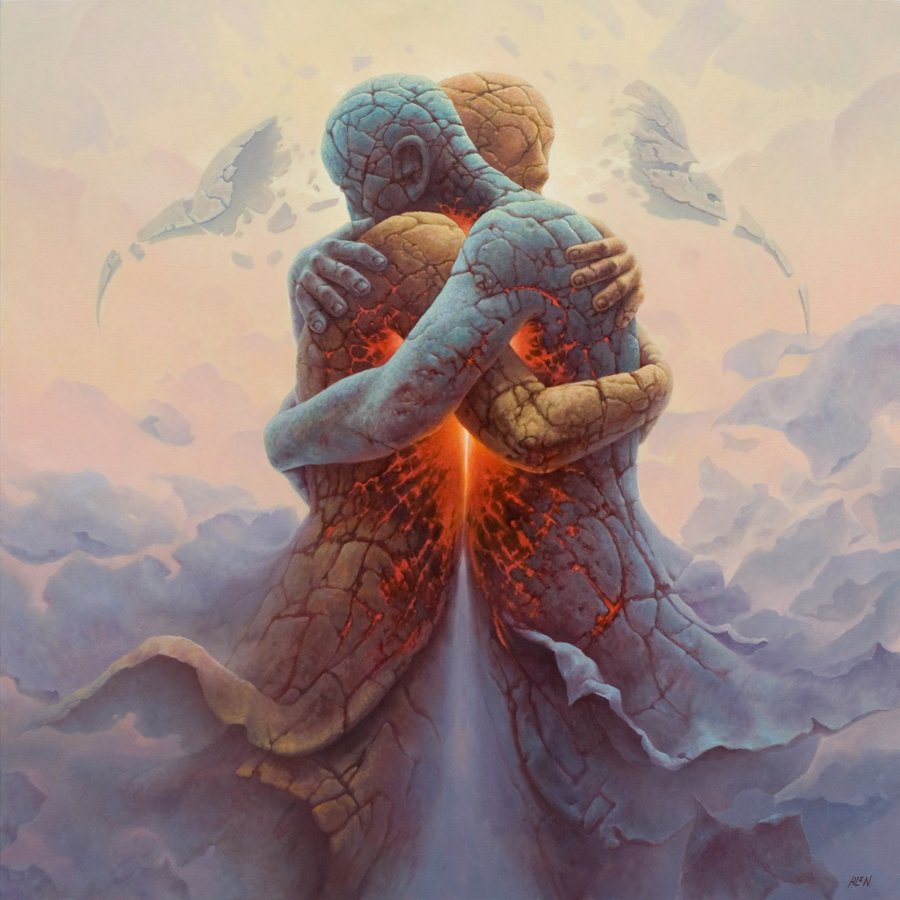
In uniting, the magician must resist the drive to possess; in crystallizing, remain within the Flow.
Despite the apparent serenity of such binary neutralization, the practitioner often succumbs to extremes — madness of mystic ecstasy or crystal-clear rational stagnation.
The magician must remain unbound, yet avoid the cold void of uniqueness. Love as force and pleroma as principle form the bridge over dual chasms, drawing from both, yet succumbing to none.
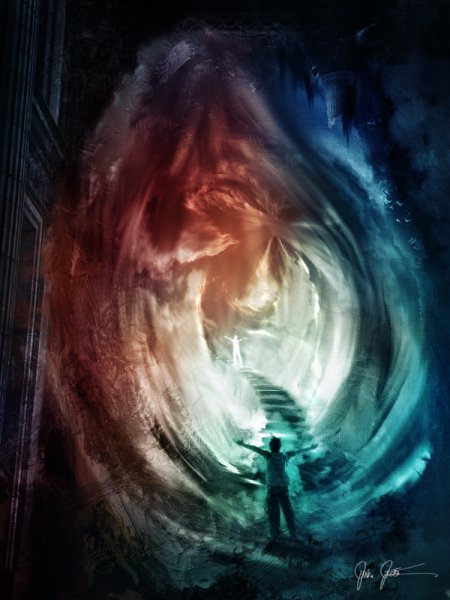

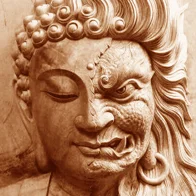




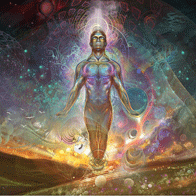
Initially, there comes an understanding that every person is free. Despite borders in the form of family, societal norms, or any other restrictions.
Then I start thinking about how to live in this state.
I realized what I accepted.
The main dangers are: dissolution, excessive crystallization (retreating into oneself and complete isolation). But there is one more danger – imposing one’s will. When in a connection, you begin to decide for everyone. My will absorbs (suppresses) the other.
And the main thing is that I understand that I impose and that is that. Justification is like – I feel that it’s better this way. Or – you should trust me.
On one hand, I consider myself right, but I must still provide the right to choose.
It is also important to find the line here.
I see the way out in the ability not to break through walls with my forehead, but to find a breach. In the ability to explain the situation correctly.
Hello! Please tell me, is it true that to avoid losing the desire for development in pure reason, one needs to develop a body of feelings within oneself, by trying to increase one’s openness (so to speak, walking with one’s eyes wide open), and conversely, so as not to burn in the fire of emotions – to train the body of thought through imagination and attention? The most interesting part is HOW. I know you have already described all this, but somehow my understanding has formed from analogies: the “solid” plan – striving for calmness, the emotional plan – striving for movement, the plan of forms of reason – striving for the balance of the first two, which is why there is confusion with traditional approaches (what is for what).
Perhaps this is the most painful topic at the moment. I didn’t want to get attached to anyone or anything, seeing it as a weakness, and now when talking to anyone, when they tell you about life, or just about weekend purchases, sooner or later you catch yourself thinking, “What nonsense, if they only knew…” and then comes a whole tirade with myself. I notice this lethargy, coldness towards my surroundings.
And most importantly, you always think you are right, and only you… to compare, you can imagine as if on huge scales on one side a bunch of people, and on the other your rusty importance and uniqueness slightly overweighted.
I tried to solve this problem, found a couple of tricks (either in books or articles), but they constantly slip my mind, thoughts confuse me and I forget how to act, the article returned my memory 🙂 As it seemed to me, I found a way out in detachment, looking at myself from the side, sometimes I fly and watch myself as another person living my previous life at the right moments, and you don’t dissolve in the community and don’t get “rusty” and covered with mold, although it’s hard at first to look from the side and catch the train of thought. Or option number two, trying to imagine myself and those around me as energy spheres (or reflections of each other, whatever pleases), absolutely equal, but each uniquely individual, regardless of what they say or do – at this moment in time, no one can do it better than them. Here the main thing is not to fall in love with your own reflection)
I have no idea if this is effective or not, but it seems to me that for starters it’s suitable to prevent the nose from accidentally being raised to the heavens or getting stuck in the ground and rooting forever.
Good afternoon! Dear Enmerkar, please clarify what holds the individualities in the Pleroma? Are they, like beads in a bowl, connected only by external limitations, or like atoms in molecules: Oxygen, while remaining Oxygen, attracts two Hydrogen atoms, which remain Hydrogen atoms, but together they create a Water molecule with new properties due to the joint use of their electrons?