Self-Knowledge of the Great Spirit
However monotheistic the contemporary magical outlook may be, at its root it undoubtedly rests on a pagan view of the world — a view that admits a multiplicity of active agents in the cosmos and the significance of individual will within its flow.
Unlike the mystic, for whom multiplicity is lost in the great indivisible unity, the Magus seeks above all to perceive the harmony of multiplicity. For the Magus, each element does not dissolve into the One but is itself a necessary link in the One, contributing its own properties. The One unfolds in infinite diversity.
In other words, the Magus does not deny the Unity that lies behind the many, but he emphasizes the many.
At the same time, for the Magus, as for the mystic, the search for the Spirit takes place within his own being. This God, discovered within, supports the Magus’s action and is the very thing that engulfs the being of the mystic. The Magus experiences the ecstasy of union with the Spirit, but having passed through it he reintegrates into the Pleroma, reconstructing his selfhood rather than remaining in a state of blissful dissolution.
In his ultimate experience, the Magus perceives the diversity of the world within its unity, and this unity, considered in itself — in the aspect lying beyond being and non-being — is named the Great Spirit, the Absolute.
In other words, the magical worldview at its core carries the same concept of the Great Spirit that is characteristic of any polytheistic myth.
Although in its primordial essence the Great Spirit is free from any conditions, limitations, divisions, or causal chains, it is equally free from the necessity either to exist or not to exist.
From an absolute standpoint, the Great Spirit has never departed from its integral state; yet that integral state contains all possibilities and potentialities, including the potentiality of manifested existence. Thus one of the possibilities contained within the Great Spirit is existence itself, creation, manifestation.
Moreover, the ultimate first cause of the world-forming process is considered to be the Great Spirit’s striving for self-knowledge not only in its absolute unity but also in the differentiated multiplicity of its infinite aspects.
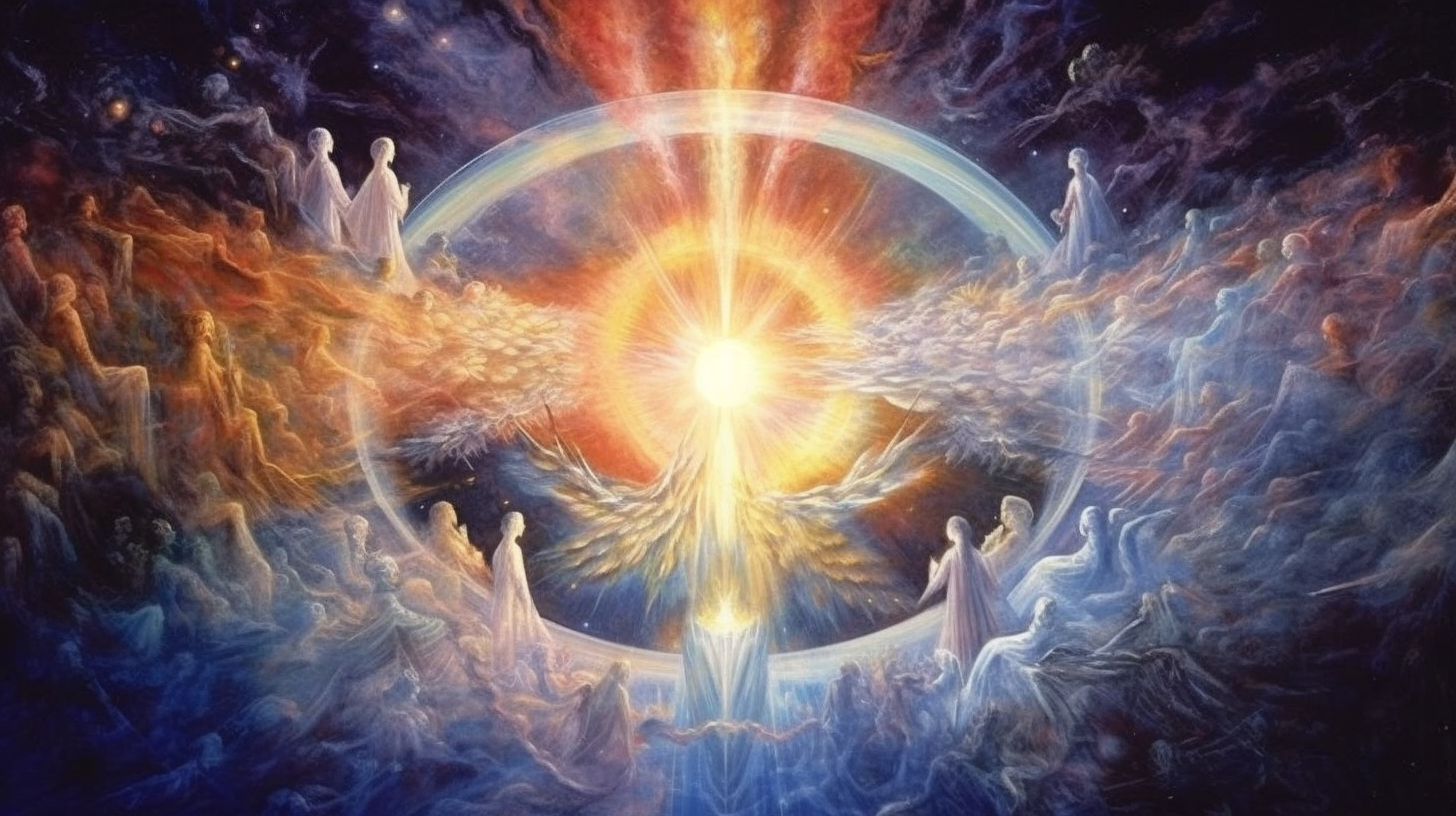
It should be understood that the word “striving” in this context does not imply any purposeful action, since the Great Spirit, as absolute perfection, is wholly unmoving and immutable. When we speak of processes connected with It, we do so from the standpoint of a relative, finite observer, who is perceived as a distinct mode of the Unity’s gaze upon itself.
In the aspect of being this self-knowledge manifests in the differentiation of an infinite number of elemental energies — emanations of the Absolute — and in the aspect of consciousness, it manifests in an equally infinite fragmentation of Its integral consciousness into a multitude of Monads.
Each Monad is both part and whole, in the words of Giordano Bruno:
“The Monad is God itself, yet in each Monad It is composed and manifests Itself in a special form. This is the deepest opposition contained in the universe: every Monad is a mirror of the world; it is at once whole and a thing distinct from all others: it is everywhere the same world-force, yet always in another guise. The whole exists because it lives in the singular; the singular exists because it carries within itself the power of the whole.”
We emphasize again that the Great Spirit, manifesting in a diversity of forms, does not lose its unity. Therefore every being is part of the whole world, although it may “never speak, think, or create anything more significant than the being of its kind. In it is life. In it is Spirit. In this sense, it differs in no way from any man, any stone, tree, or river. In all there is life, and in all there is Spirit. Life is Spirit, and Spirit is life.” The life of nature, as well as the life of the human mind, despite all their multiplicity and boundless variety, forms a single stream.
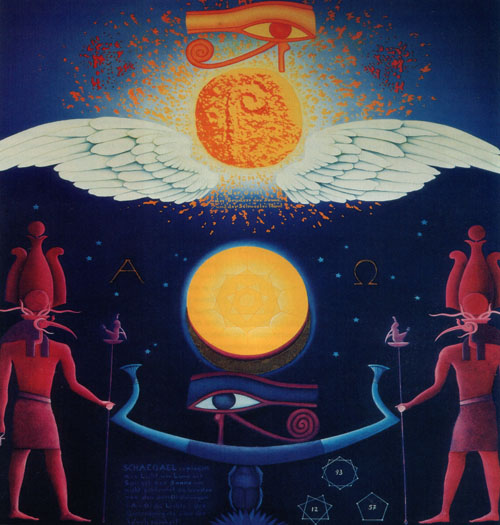
The Spirit in Itself simultaneously apprehends its indivisible synthesis and the synthesis as an assemblage of separate particulars; It is One and All-encompassing, and by opposing one aspect of Self-awareness to another It generates the manifested world as the link between these aspects.
Since, from the standpoint of this Unity, its original integrality, its self-knowledge in the totality of its aspects, and its eventual Pleroma are united — and since time itself exists only for the relative observer immersed in the process of becoming — one may say that the Unity remains intact: the Great Spirit has not been fragmented, has not revealed its aspects; it is eternal, immutable, and transcendental.
However, to a singular aspect immersed in the process, life appears continuous not only in the passage of time: all forms of being not only pass from one form to another over time but remain connected to one another.
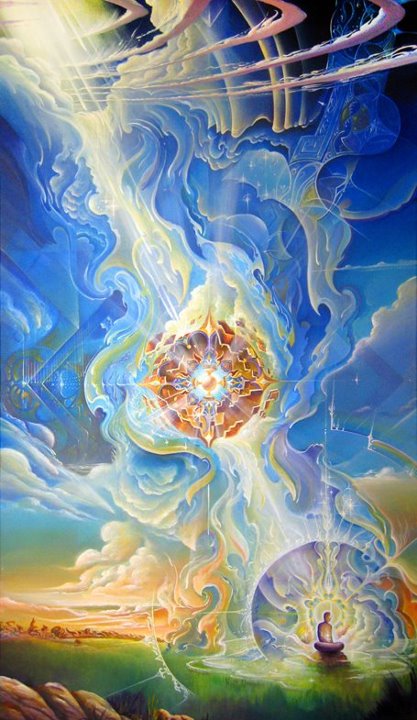
Accordingly, in discovering within itself the nature of the Great Unity, the individual mind understands that it is itself merely a means for the Supreme Reality’s self-knowledge; it is merely the Spirit’s gaze upon itself, merely a particular point of view. But although it turns out that perfection does not need to be “attained,” that it already exists in every atom of the universe, one must be clearly aware that, from the standpoint of individual reality, Unity is potential — both as the original Integral and as the final Pleroma.
Recognizing the Great Unity that stands behind the varied multiplicity, the Magus avoids the danger of unjustifiably elevating the importance of some parts of the One at the expense of its other parts, and he does not sink into an undifferentiated state, understanding that his unique individual perspective is a necessary element of the Great Spirit’s self-knowledge. This is not the deification of natural phenomena, nor the attribution of absolute meaning to the finite, but an awareness of the binary, mutually complementary, and mutually necessary nature of Unity and Multiplicity in the cosmos.
The Magus seeks to fully realize his individuality as a mode of the Great Spirit’s self-knowledge; the Magus does not detach from Unity, but he does not dissolve into it either.

Hello! I would like to inquire, if we accept the concept of the Great Unity and that any consciousness in the world is a reflection of the Spirit of this world, which after fully realizing its potential re-dissolves into it, then I have a question: why have magicians, from ancient times, tried to reveal themselves as efficiently and quickly as possible (to influence, to somehow shape this world)? And there are such beings as Gods and Spirits (angels, etc.) whose potential is almost limitless and are not tied to time… This seems strange in the context of the self-realization of this Spirit. Why not give such opportunities to every embodied being, the efficiency would be billions of times greater, and for consciousness, freedom would be more (after all, I think there are no limits to freedom) 🙂
From the magicians’ perspective, consciousness, upon reaching the maximum of its realization, does not dissolve into the Great Spirit but rather becomes part of the Pleroma – ‘Unity without mixture’, thus each form of consciousness development contributes to the total self-consciousness of the Spirit and cannot be replaced or altered. This view grants great value to the individuality of both the magician and the individualities of all embodied beings, who are valuable not only as manifestations of the Great Spirit but also as unique forms of awareness development – and each form is unique in its own right. From this perspective, the world is an infinite diversity of forms of consciousness, each with its own area of development, possibilities, and limitations.
“And from this point of view, the world is precisely an infinite diversity of forms of consciousness, each of which has its area of development, its possibilities, and its limitations.” This philosophy does not require the existence of an absolute in any form and can, like any other worldview, be adopted only from the desire to see the world ‘like this,’ which, in principle, can be interesting, simply due to the limitations of black-and-white paradigms stemming from their own content. But the principle ‘Everything is limited by itself’ is universal and will work in any organized universe as well as in hypothetical Chaos. And this allows suggesting that instead of the term Absolute, using the term Unity is much closer to what they try to describe. Can one imagine the unified as processes of all – and what about the term absolute? To artificially attribute greater value, and for what? Exact value is more useful than exaggerated.
How do you define the ultimate limit of your realization? As it seems to me, the world is so multifaceted that one can refine their spirit (expand horizons) indefinitely.
It’s always nice to meet reasonable people online. Everything is very well thought out. Regarding the limit of realization – there is one for the human form. This is the absolute goal of a magician.
What is interesting is how the Spirit describes its transcendence (I probably broke the language). The knowledge of the Creator of oneself as a Spirit can be described as the creation of thought forms possessing certain qualities of vectors regarding the development of consciousness of beings in a particular world. Depending on the tension of the energies of beings inhabiting this space, the quality of the vibrations of the foundational spaces is regulated.
[…] The modern magical Tradition explains the necessity of creation by the Absolute’s drive toward self‑knowledge, for which He must move from integral unity to the differentiation of His distinct qualities, […]