
Golden-Haired Apollo
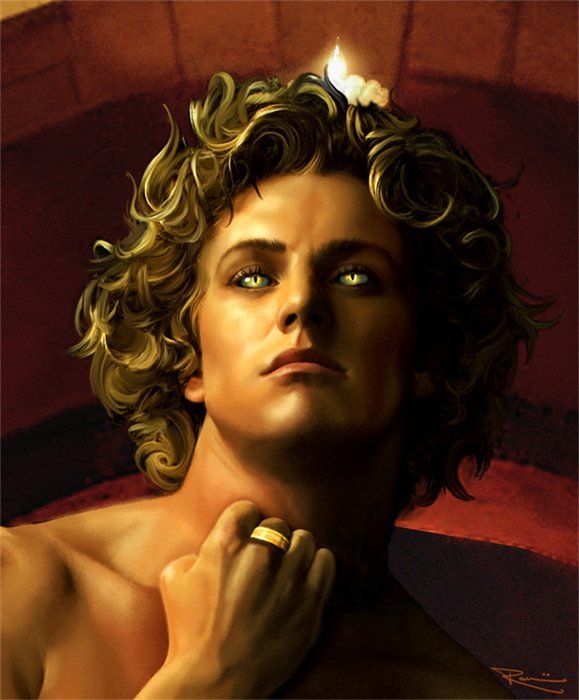
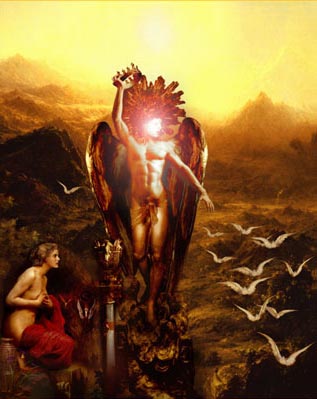
Among the many solar deities, one commands attention through extreme ambiguity, having absorbed the very traits of the Luminary itself —Apollo. No people except the Greeks — and not the early, radiant Greeks, but the later ones who had touched Egypt and Chaldea and been scorched by their wisdom — captured so precisely the Spirit of the Day-Star: illuminating, mercilessly exposing secrets, scorching, and self-sufficient in its perfection.
The solar gods of the Slavs are warm, and even Yarilo, for all his frenzy, is creative and kind; even Khors — the noon sun — lacks the radiant mercilessness that belongs to Apollo.
Having absorbed the traits of formidable Shamash, who supplanted Utu in the Mesopotamian pantheon, the victorious might of Horus, and the tenderness of the Greek Phoebus, the later image of Apollo differs sharply from the original.
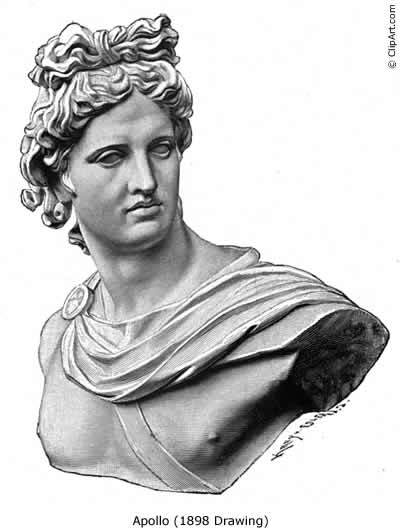
Apollo is one of the most ancient gods of Greece. It is believed that his name derives from the Greek àπελάω “the averter,” or from απέλλα “assembly.” In the Cretan-Mycenaean texts his name does not appear. Apollo is thought to have been originally a pre-Greek deity, probably from Asia Minor. His deep archaic character shows itself in a close bond — and at times even an identification — with the plant and animal world. In myths of the earlier period, Apollo is prone to rash acts and swift to punish; in myths of the later period he is prudence itself, harmony, creation — though a cold breath of perfection emanates from him. Apollo is the second most important god in the Greek pantheon, уступающий only to Zeus. He is the god of the sun, of the arts (especially music), prophecy, and archery. He is lawgiver and executioner; patron of medicine and sender of disease; protector of shepherds.
The cult of Apollo was widespread throughout Greece. Temples with oracles of Apollo stood on Delos, at Didyma, Claros, Abai, in the Peloponnese, and elsewhere; but the chief center of Apollo’s veneration was the Delphic temple with the oracle of Apollo, where the priestess — the Pythia — seated on a tripod, delivered prophecies. In Delphi, festivities were held in his honor (theophanies, theoxenia, the Pythian Games). In Delphi, all the months of the year except three winter ones were dedicated to Apollo. From Greek colonies in Italy, the cult of Apollo entered Rome, where this god took one of the foremost places in religion and mythology. Emperor Augustus declared Apollo his patron and instituted secular games in his honor; the temple of Apollo near the Palatine was among the richest in Rome. In Arcadia, Apollo was worshiped depicted in the form of a ram.
Myths about Apollo are well known. He is the son of the goddess Latona (Leto) and Zeus, the twin brother of Artemis, the grandson of the Titans Coeus and Phoebe. He was born on the island of Delos (Asteria) (Greek δηλόω —I reveal), where his mother Leto arrived by chance, driven on by jealous Hera, who forbade her to set foot on solid ground. When Apollo was born, the whole island of Delos flooded with streams of sunlight. Apollo was born on the seventh day of the month, at seven months, embodying the totality of the symbolic field of the heptad. At his birth, swans from the Pactolus made seven circles above Delos and sang for the newborn god. Leto did not nurse him: Themis fed him nectar and ambrosia. Hephaestus brought him and Artemis arrows as a gift.
Epithets of Apollo are numerous and diverse: Paean and Paeon (“Reliever of diseases”), Musagetes (leader of the Muses), Moiragetes (“leader of fate”), Phoebus (“Radiant” — indicating purity, brilliance, and prophecy), Smintheus (Mouse), Alexikakos (“Averter of evil”), Apotropaios (“Averter”), Prostates (“Protector”), Akesios (“Healer”), Nomios (“Shepherd”), Daphnios (“Laurel”), Drymas (“Oak”), Lycean (“Wolf”), Letoid (from his mother’s name), Epikourios (“Guardian”).
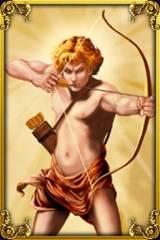
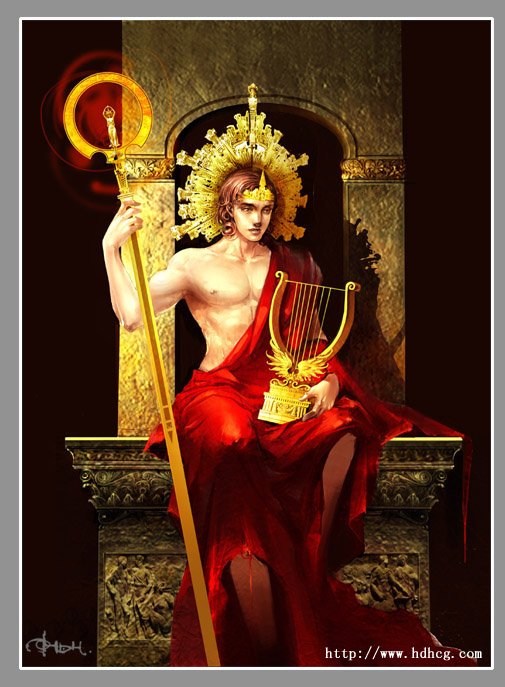
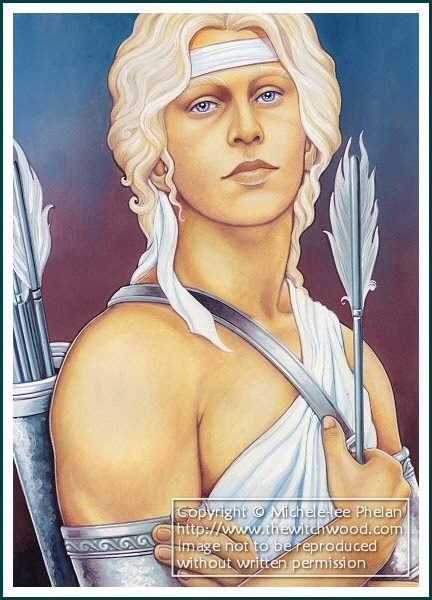
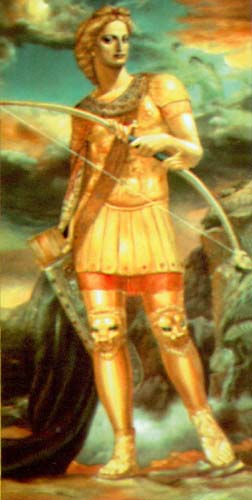
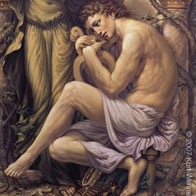
Plants and animals associated with him: laurel, oak, cypress, palm, olive; wolf, raven, swan, hawk, snake, mouse, ram, and grasshopper. Apollo’s attributes are a silver bow and golden arrows, a golden kithara (hence his nickname Kitharoidos — “playing the kithara”) or a lyre.
The deeds of Apollo are also well known. Most famous is the serpent-slaying hypostasis of this god. Apollo matured early and, while still quite young, killed the serpent Python (Delphynios), who had pursued Leto and laid waste to the environs of Delphi. In Delphi, on the site where an oracle of Gaia and Themis had once stood, Apollo founded his own sanctuary of prophecy. Apollo also struck down with his arrows the giant Tityos, who attempted to insult Leto; the Cyclopes who forged Zeus’s thunderbolts; and he took part in the battles of the Olympians against the Titans and the Giants. Even in these myths, the punitive nature of Apollo is unmistakable.
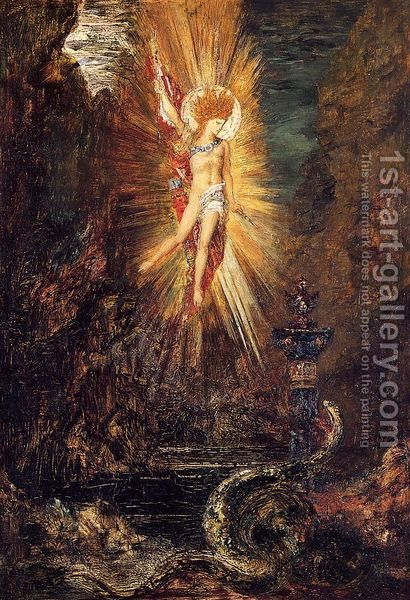
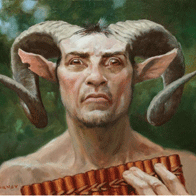
The deadly arrows of Apollo and Artemis bring sudden death to the old, sometimes striking for no cause at all. In the Trojan War, Apollo the archer aids the Trojans, and for nine days his arrows drive plague into the camp of the Achaeans; he invisibly participates in Patroclus’s killing by Hector and Achilles’s by Paris. Together with his sister Artemis (most likely Apollo and Artemis were, in origin, different hypostases of a single androgynous deity — there is ample evidence for this, but the subject lies beyond the scope of the present discussion), he destroys the children of Niobe. In a musical contest Apollo defeats the satyr Marsyas and, enraged by his insolence, flays him. This is a defining trait of the Golden-Haired god: once Apollo gains the upper hand over a rival, he can, without mercy, coldly strip the skin from him. When the restrained, rational Apollo gives free rein to emotion, it turns brutally irrational. He becomes a venomous serpent, driving poisoned fangs into the victim.
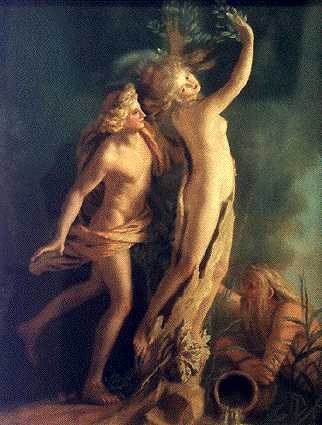
Apollo, like other young gods, chose not to bind himself with the bonds of marriage. He is not amorous and is usually too fixed on the goal before him to be diverted by women. Apollo’s first love was Daphne — yet through Eros this love brought the sun god no happiness. Apollo mocked Eros, claiming he did not know how to shoot a bow accurately. The angered god of love sent a golden arrow of love into Apollo’s heart, and a leaden arrow that repels love into Daphne’s. Consumed with passion, Apollo pursued Daphne, and when he had almost caught her, the girl cried out to her father, the river god, and he turned her into a laurel tree. Yet Apollo’s love for Daphne did not die. The laurel became his sacred tree, and a wreath of its branches crowned the god.
In the form of a dog he lay with Antenor’s daughter; in the form of a tortoise and a serpent — with Dryope.
The most famous woman to reject Apollo’s love — and pay for it — was Cassandra, daughter of the Trojan king Priam and queen Hecuba. Apollo taught Cassandra the art of prophecy, taking from her a promise to yield herself to him. Cassandra gave her word and broke it. Apollo could not take back the gift of prophecy, but in revenge for the deception he ensured that no one believed her visions. From the very beginning of the Trojan War Cassandra saw the disasters approaching the city, but the Trojans dismissed the prophetess as mad.
The Sibyl (whose name later became the title of prophetesses, the sibyls) also received from Apollo the gift of prophecy and rejected him as a lover. Apollo clung to the false belief that love can be purchased in exchange for something.
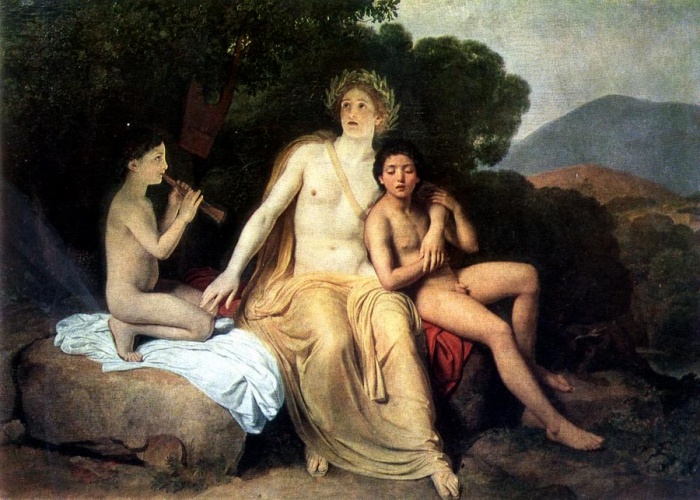
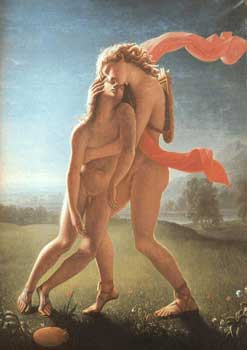
Once Apollo became so captivated by a youth named Hyacinthus, the son of the Spartan king, that he abandoned Delphi altogether and spent all his time with him. Once, during a discus-throwing contest, Apollo’s discus ricocheted off a stone, struck Hyacinthus, and killed him. Grieving the death of his beloved, Apollo swore that Hyacinthus would be remembered forever. From the youth’s blood grew a flower that still bears his name.
Functions of Apollo are profoundly contradictory. On the one hand, he is Musagetes, leader of the Muses, patron of the arts, poetry, and music. Yet with his arrows he brings death, destruction, and plague (as at the beginning of the Iliad). Sources also say Apollo hunted with his sister, and that hunt was terrifying and merciless. His image is outwardly noble; his garments exude enchanted light and fragrance; he plays a graceful instrument that releases a tender, measured sound. Beautiful as a white swan, Apollo is cruel and ruinous as a wolf. Therefore he was also called “Wolf,” and sacrifices were offered to him of the animals these four-legged destroyers of herds prefer. In one of the temples of Latona’s son there stood a bronze-cast image of Apollo in the form of a wolf.
Apollo continually opposed heroes. He refused Heracles a prediction when he came to the Delphic oracle. He opposed Achilles, the most revered and celebrated of Greek heroes. Achilles died when an arrow struck him in the heel — the only place not washed in the Styx. In some versions, Apollo himself killed him — either in the guise of Paris, or in his own form. In any case, it was not a heroic face-to-face duel, but a shot loosed from a distance.
Apollo prizes prudence, avoids physical danger, does not yield to emotion, and prefers the stance of an observer. He sees clearly from afar, surveying the whole of life while catching its smallest details. He can strike the precise mark with an arrow or create harmony through music. Apollo’s mind is logical; he moves with ease through objective reality. He does not need bitter experience or parental instruction to grasp cause and effect — they are in his nature. This very “omniscience” makes Apollo the most arrogant of the Olympians. His goals are realistic and demand definite effort. More than that, those goals are legible to everyone around him.
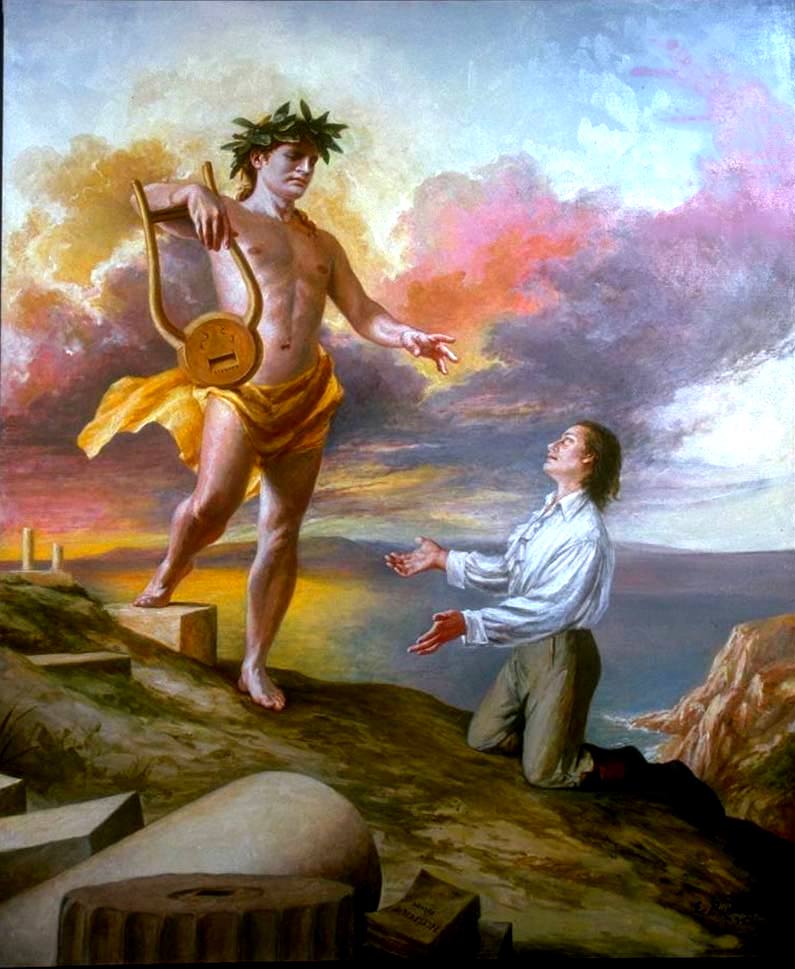
Apollo’s music, like Apollo himself, is linked to clarity and purity. Apollo bartered for his lyre from Hermes, who made the instrument from a tortoise shell and gut strings. No one could match Apollo in the art of the lyre. Unlike Dionysian music, where chaos, ecstasy, frenzy, emotional conflict, and passion reign, Apollo demands purity of note and transparency of sound, when music, like mathematics, carries harmony and measure through time. More than once, mortals and lesser deities challenged him to contests, and Apollo prevailed every time. The daredevil who opposed him received punishment.
Through rules and laws, as through measure and interval, Apollo forces order and strict form upon the world. Apollo gave cities laws, interpreted statutes, fought for moderation and order, organized local self-government, and provided mechanisms for resolving disputes. In the work of the musician and in the work of the lawgiver alike, this archetype’s drive toward order and form reveals itself. Apollo has no taste for chaos and frenzy, dissonance or passionate tension — whether in conduct or in music.
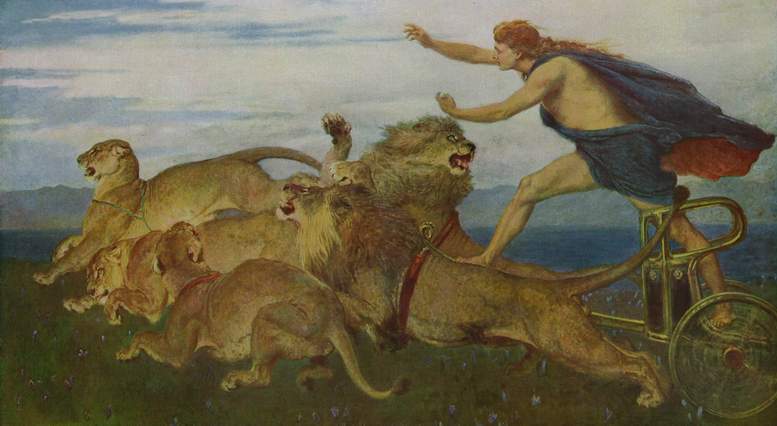
In Apollo there is something of another, distant world — something apparently shaped by his bond with the mysterious land of the Hyperboreans. When, after the birth of his son, Zeus gifted him a chariot harnessed to swans, Apollo rode it not to Delphi but to the Hyperboreans, and remained with them for a full year. Thereafter he withdrew each year for a time to that “blessed land of light.”
As a sun god, Apollo looks upon the earth from a distance — he is “above all this.” One way Apollo keeps his distance is by refusing problematic situations. When a sharp emotional conflict erupts, he withdraws at once: “the matter is not worth fighting over.” This is exactly how he acted during the Trojan War when Poseidon challenged him.
Thus Apollo is the principle of Order brought to perfection — and even beyond perfection. This order, unbalanced by spontaneity, becomes cold fetters on spirit and creativity, and at times turns deadly. In Nietzsche’s words,
“Apollo wants to bring individual beings to rest precisely by delimiting them from one another, and by constantly, again and again, reminding them of these boundaries as sacred world-laws…”
In Apollo’s view, there is not — and cannot be — any absolute mystery in the world; a day will come when every mystery falls beneath the all-subduing ray of absolute truth. To approach Apollo’s flaming light is to desiccate the soul, stripping it of fluidity. Inner meaning yields to formal meaning; the striving for harmony among living unities is replaced by the pursuit of an illusory coherence of abstract relations. Apollo’s crystalline clarity degenerates into ossification while still alive, into the deadening of the whole being, where contempt rises for everything and an unfulfilling pride takes hold — without which dark despair closes in. The highest light loses its creative power and appears only as a destroyer, an all-devouring fire.


Enmerkar, do you agree that Apollo corresponds to Lucifer and Veles?
I wouldn’t say ‘corresponds’, but in my opinion, Apollo and Lucifer express the same underlying principle; however, Apollo represents the ‘upper’ section of the principle of differentiation, while Lucifer represents the ‘lower’ section of the same principle. As for Veles, he does not differentiate the world; he maintains the separateness of objects, not allowing them to merge into one or completely divide. So he expresses another, essentially different, force, more synthetic in nature.
What an interesting analysis of Apollo’s personality. It was extremely interesting. Thank you! Because apart from Kuna, little can be found.
Along with destructive actions, Apollo also possesses healing abilities. He is a doctor, assistant, protector against evil and diseases, who stopped the plague during the Peloponnesian War. The first to begin healing eyes.
It’s interesting that the Hippocratic oath begins with the words: ‘I swear by Apollo the physician…’