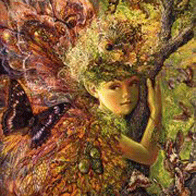
The Slavs were in particularly close communication with the spirits of nature, which is why Slavic lower mythology preserved numerous descriptions of the character and peculiarities of various Stikhials.
Other Magic
Пишите мне
Enmerkar's Blog содержит более тысячи авторских статей эзотерической направленности.
Введите интересующий Вас запрос — и Вы найдете нужный для Вас материал
The Slavs were in particularly close communication with the spirits of nature, which is why Slavic lower mythology preserved numerous descriptions of the character and peculiarities of various Stikhials.
Arguably it is difficult to find, in any mythology, a figure as contradictory both in its very nature and in the attitudes toward it as Loki — the Cunning Aesir of the North.
If the process of the Father entering the Mother, the Spirit entering Matter, is excessively accelerated, it leads to traumatic consequences, since the new, light-filled elements do not have time to integrate into the existing system.
The sole reality acknowledged was precisely the Most High, who, in proceeding to the creation of the World, was conceived in his creative aspect as Rod the All-Sustainer.
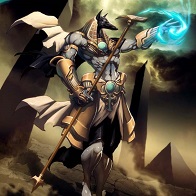
In addition to the Guide who helps the soul cross from life to death, this journey requires a figure who makes the process irreversible. It is precisely the Ferryman’s function of severing ties that renders him the bleakest character in the drama of disembodiment.
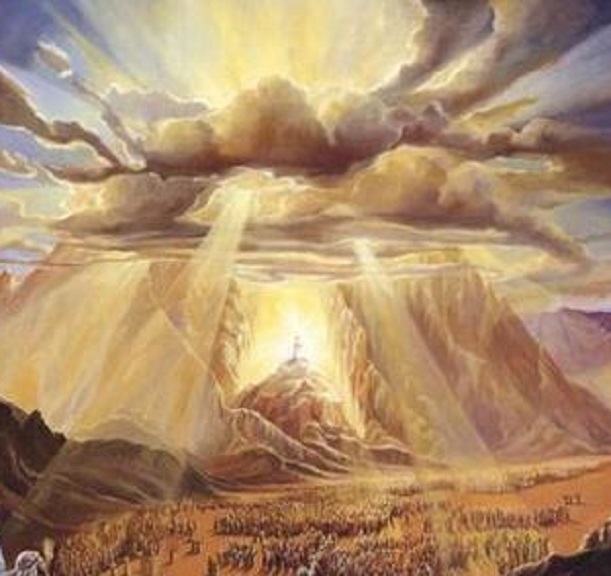
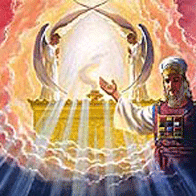
The Vertical Flow, comprising both descending and ascending currents of force, has several symbols; the best known among them is the image of the Chariot of the Most High — the Merkabah (Heb. מֶרְכָּבָה, “chariot”).
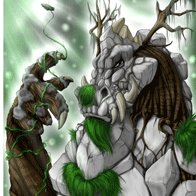
Just as air embodied the principle of horizontal mobility, so the Earth Element corresponds to horizontal inertia.
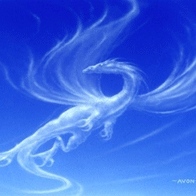
The fertilizing activity that fills and permeates the cosmos corresponds to the Element of Air.
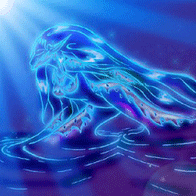
The element of Water corresponds to the passive, feminine principle of fluidity, adaptability, and to the Descending movement of Power.
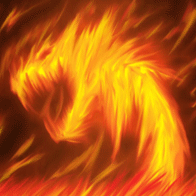
As we have already said, Fire is considered the Element of an object’s Activity, its ascending force.
It is unsurprising that Fire is also credited with the greatest destructive power, since the Principle of ascent that it denotes is often accompanied by the disembodiment of things, that is — their material destruction.
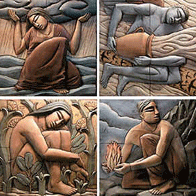
The primary division of the universe drives further polarization and brings forth the quaternity of the Prima Materia.
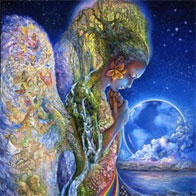
The Tauri — Indo-European first-settlers of Crimea — also revered the Great Goddess. What the Great Goddess was called in the Tauri tongue we do not know; the Greeks called her Parthenos — the Maiden. She was the great goddess of the earth, of the waters, and of all animal and plant life — sovereign of every life and every birth.
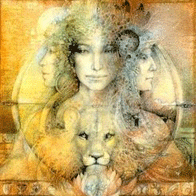
Tabiti was called “the Queen of the Scythians”; she appears as the Lady-goddess of the subterranean fire. She is a formidable, “enkindling” Goddess, whose various functions were those of the household fire, the sacrificial fire, and, consequently, of prayer.