
Son of the Sun – Ramses the Great
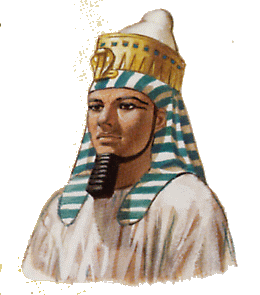
Among the kings and rulers of the ancient world several towering figures stand out, whose greatness exceeded ordinary human limits and were rightly regarded as demigods. One of the best-known rulers who manifested divine power was Ramses the Great.
Many pharaohs of the XIX and XX dynasties bore the name Ramses; it means “born of Ra” (Ra-Messu). Ramses II was the grandson of the dynasty’s founder, Ramses I, and the son of Seti I. Ascending the throne in 1279 BC, he proclaimed himself “son of the sun-god Ra, a god incarnate.” Interestingly, in becoming the son of Amon-Ra he did not cease to be the son of Seti. Ramses II ruled for about 67 years and died a very old man, leaving behind more than ninety sons and daughters. Seven principal wives are known — three of them his daughters (probably ceremonial marriages) — at least 45 sons and 40 daughters (by other counts, 111 and 67). The reign of Ramses II is reflected in the works of many ancient historians (for example, Herodotus, who calls him Rhampsinitus) and in the Bible.
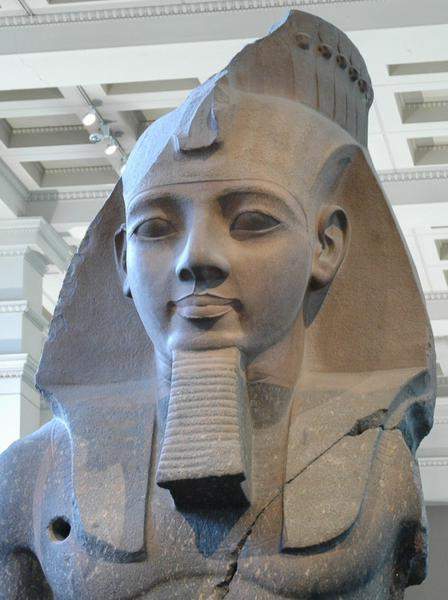
The pharaoh fought many wars, chiefly against the Hittites, and extended his realm to the borders of Syria in the east and Sudan in the south. During the reign of Ramses II, called the Great, Egypt reached unprecedented power and prosperity. Monumental building projects took place throughout the country — temples adorned with colossal statues of the pharaoh rose in Thebes, Abydos, and Nubia. It is known that the powerful pharaoh commissioned sea expeditions to explore the Mediterranean coast, and it is possible that his sailors ventured even beyond it.
Under Ramses II, Egypt reached its maximum extent. Upon taking the throne, Ramses continued his father’s campaigns and restored Egypt’s authority in Palestine. In Syria Ramses’ forces encountered the Hittites, who also laid claim to the region.
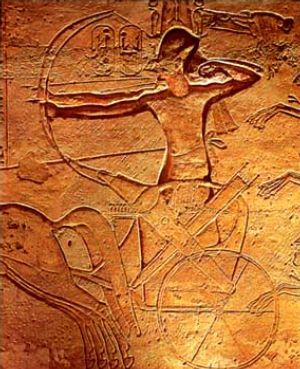
But the most famous — and at the same time the most enigmatic — victory of Ramses was the Battle of Kadesh in 1312. Strictly speaking, it was not really a victory: the battle ended in a “draw,” yet it resulted in a peace treaty that greatly strengthened Egypt. The battle is dated to 1274 BC. It may have been the largest chariot battle ever; some estimate 5,000–6,000 chariots took part. Among the sources recounting the Battle of Kadesh stands a remarkable historical and literary work, the so-called “Poem of Pentaur,” which tells of the extraordinary bravery of Ramses II and the aid the god Amon gave him during the battle.
Ramses led the vanguard “host of Ra” (2,000 men, 400 chariots), which supported the four-thousand-strong (800 chariots) host of Ptah. A 2,000-strong force of Arab mercenaries was advancing by a flanking route to join the host of Ra. In reserve was the host of Thoth — 8,000 men, 2,000 chariots. Not counting the reserves of Ramses and Mattusili, even the garrison of Kadesh — 28,000 soldiers of Mattusili’s combined army with 3,300 chariots and nearly 5,000 horsemen — opposed Ramses’ force of 6,000 with 1,200 chariots and 2,000 cavalry. After a long and unequal fight with 30 Hittite and 40 Syrian chariots, Ramses’ son was wounded and taken prisoner by the Hittites. “The Poem of Pentaur” conveys Ramses’ words: “If great Ra turns away from me, if it is decreed that I perish on the field (of battle), then, O Ra, when You come out from behind the cloud, the earth will gleam in Your rays like a ruby from the blood spilled by Your son who has gone into Your kingdom!”
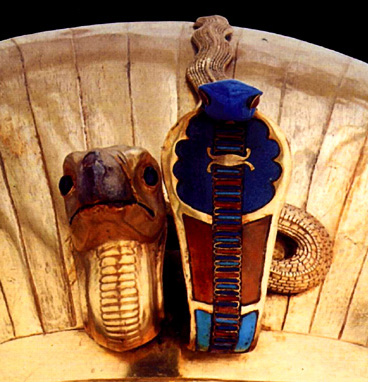
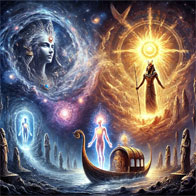
And Ra heard the pharaoh and granted him the power of a god. The sacred Uraeus on Ramses’ crown, the symbol of pharaonic authority, began to emit light and flame that routed the Hittites. “The crime of my soldiers and chariot-warriors, who abandoned me, is so great it cannot be put into words. But see: Amon granted me victory… not a single charioteer was at my side… They (the Hittites) had altogether a thousand war chariots, and all aimed straight at the fire (that is, at Ramses’ head, adorned with the diadem bearing the sacred Uraeus that emitted flame). But I charged at them! I… in an instant made them feel the strength of my hand. I threw down and slew them wherever they were, and one cried to another: ‘This is not a man among us, this is the invincible Set… What he does is beyond human power!’” The pharaoh, virtually alone, routed an entire army. “And I saw Amon come when I called. as soon as I called upon him. He gave me his hand, and I rejoiced. He cried from behind: ‘Forward. I am with you, your father! My hand is over you, I am more powerful than hundreds of thousands, I, the lord of victory, who loves might!’ I found my heart full of joy; what I wished to do was all accomplished. I am Montu, I shoot to the right. I smite to the left; I am Sutekh when his time is before him. I see the darkness of chariots that surrounded me become corpses before my team. Their hearts fell within their bodies from terror. Their hands all went slack… I overturned them into the water like crocodiles. They fell, I killed whom I wished. Not one looked back, none turned. Whoever fell among them did not rise again!” In any case, one cannot ascribe this “victory” solely to Ramses’ military prowess and bravery — the Hittites enjoyed an overwhelming advantage. Despite their tremendous numerical superiority, the Hittite warriors fled in panic from the bloodbath…
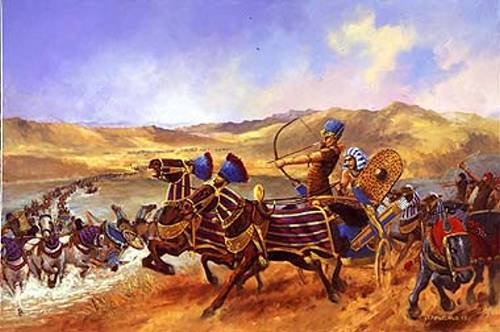
Thousands of Egyptians died, and an even greater number of Hittites and allied warriors lost their lives. After this, the Hittites retreated into the fortress. The siege of Kadesh brought Ramses no success, yet King Muwatalli asked for peace. Although the Hittites also considered themselves victors, soon Ramses received a document from the Hittite ruler in which it was written: “I, Muwatalli, your servant, acknowledge you as Son of the Sun and offspring of Light itself. My land submits to your will, it lies at your feet. But do not abuse your power. Your influence is inexorable, you have proven this by achieving a great victory. But why destroy the people of your rival? Why allow malice to dwell in your heart? Since you are the victor, agree that peace is better than war, and grant the Hittites mercy.” Thus was born the first political treaty in history.
This “victory” was immortalized on the temple walls at Abu Simbel, Luxor, and Derr, and celebrated by the court poet (in the Pentaur epic). The struggle with the Hittites concluded in 1266 BC with the signing of a peace treaty with King Hattusili III; this was the first known international treaty in history. Had this great battle not occurred, the tribal alliance later known as the Israelites as the Jews might not have formed; it was on Hittite lands that Israel arose. Without Kadesh, later history might have differed the modern Christian world.
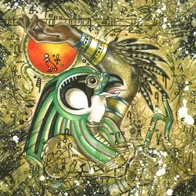
In the later years of his reign Ramses II was deified as the “Great Soul Ra-Horakhty” — the incarnation of the sun-god on earth. Ramses II outlived twelve of his sons, among whom two — general Amenherhepeshef and Haeemuas, high priest of Ptah in Memphis — wore the title of heir to the throne especially long. The Egyptian throne was inherited by the king’s thirteenth son, Merneptah, son of Queen Isetnofret I.

In my opinion, you have illuminated the topic quite reasonably and even interestingly, but this topic is still not complete and not fully explored. There are still many mysteries in the history of Ramses’ life.
I was very interested to read about the life of Ramses. I’m from Bulgaria, thank you!