Tzimtzum: The Great Concealment
The mystical experience of adepts of various schools and religions unanimously testifies that ultimate reality is one, indivisible, indefinable, and spiritual. At the same time, empirical experience speaks otherwise: we perceive the world as a manifold of separate objects and subject–object dualities. The question of why the One is perceived as multiplicity has occupied the minds of philosophers, mystics, and magicians of all lands and peoples, and in attempting to resolve this contradiction they arrive at a kindred explanation: the One is “hidden” in multiplicity. The cause and mode of this “concealment” have been named in different ways: illusion (“maya”), obscuration (“kleshas”), or “contraction” (“tzimtzum”).
In particular, the problem of “creation” – the transition from the infinite, undivided, and ineffable fullness of the Godhead in its Unity to a world of separate objects and forms – is one of the key themes in the Kabbalistic worldview. Kabbalah does not ask “why” or “for what purpose” God creates worlds; it takes His creative activity as a primordial given. The modern magical Tradition explains the necessity of creation by the Absolute’s drive toward self‑knowledge, for which He must move from integral unity to the differentiation of His distinct qualities, properties, and attributes.
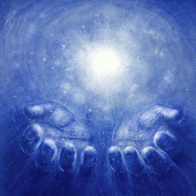
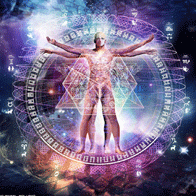
Since the Great Spirit is originally apprehended as Light that filled all infinite space and left no “place,” i.e. no possibility, for any separate existence, in order to open within Himself a place for finite being, He must limit Himself. To denote this process, Isaac Luria used the term “tzimtzum” (Heb. צִמצוּם, contraction, compression), known from early Kabbalistic literature, understanding it as the voluntary contraction of the Divine principle that had previously filled all. As a result, in the midst of the divine Light there arises a void (tehiru, Heb. טהירו) – a space in which creation is then enacted. Thus the act of creation becomes possible only after, and by virtue of, “God’s entering into Himself” – the act of tzimtzum, in which He “compresses” Himself and thereby grants the possibility of existence to something that is not Ein Sof. At the same time, the Light remaining around the Void (“the light that encompasses all worlds”) penetrates it in the form of a Ray that gives rise to all subsequent stages of creation (“the light that fills all worlds”).
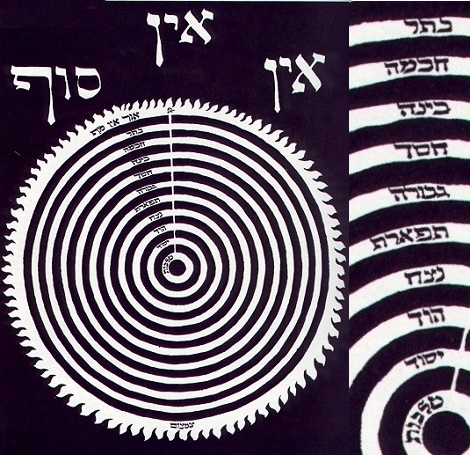
In Luria’s words: “Before all things were created… the Divine Light was simple, and it filled all existence. There was no emptiness… When His Will resolved to create all universes… He contracted this Light from all sides… leaving an empty space… This space was perfectly circular… After this contraction took place… there arose a place in which all that exists could be created… Then He sent forth a thread of Infinite Light… and filled this void with it… It is precisely by means of this ray that the Infinite Light descended below…”.
Modern Kabbalists more often interpret tzimtzum non‑literally, since from their point of view Ein Sof could not “remove” Himself from existence; He only “concealed” Himself. Tzimtzum is spoken of as the apparent absence of infinity in a particular place. Since the Godhead in itself is not limited by any “properties” – “physical,” “spiritual,” or otherwise – It can be secretly present in the “impure” while not being “bound” by it. In the strict sense of the word, Tzimtzum occurs only in the manifestation of the Light.

Thus creation is understood as God’s voluntary self‑exile, a kind of sacrifice that allows the world to appear and exist. At the same time, it is regarded as the result of a twofold activity of Ein Sof after tzimtzum: God appears simultaneously as the receptive substrate and as the form‑giving force that descends to bring order into the primordial chaos He Himself has brought forth. Therefore, although both the subject and the object of the process of creation proceed from the One, they are differentiated precisely in the process of tzimtzum. This division is manifested in the creation of “vessels” (kelim), into which the Divine radiation remaining in the pre‑eternal space then penetrates: first into the vessel called the “primordial air” (avir kadmon), and subsequently, in a purer form, into the vessel called the “primordial man” (Adam Kadmon).
We have already noted that, according to the Kabbalistic description of the world, after the process of tzimtzum and the emergence of the vessels‑kelim, a second cosmic drama took place – the “shattering” of these vessels (“shevirat ha‑kelim”). As a result of these two traumas, the “primordial” Light of the Deity acquired two “hypostases”: the “remaining” from the original Unity (which itself has two forms – the “echo of Unity” – Shekhinah and the “sparks” lingering in the vessels after the Shattering, together forming Mezla) and the “outer,” which presses to enter Creation. Both these “hypostases” of the light strive toward reunion (this is usually described as the mutual attraction of the Mother and the Infant).

This idea of divine self‑limitation, the Deity’s “self‑sacrifice” as a necessary condition for the existence of the manifest world, is not unique to Kabbalah; in one form or another it appears in many doctrines. What is specifically Kabbalistic is the assertion that creation arises not merely as the result of God’s “sacrifice,” not merely as a manifestation of His transcendental activity, but that it also has a task: the restoration of the integrity of the Light, achieved through the emergence of the duality Light–Vessel and their subsequent multistage interaction. In other words, the task of actual existence is the “unveiling” of the divine Light present everywhere – its knowing and its actualization as the result of the mutual striving of the “inner” and “outer” Light.
Regardless of how a magician describes the mechanism of the emergence of duality, the central idea of the Western myth is that Unity can be restored through the “alignment” of Light and Vessel, and the Path of the magician is described as movement through the darkness and out of the darkness.

Could you give more details on where to find information about techir? Are there any equivalents or things to compare it to from other traditions? Also, I remember the phrase “It’s scary to fall into the hands of the Living God,” so does that mean techir is ontologically an empty space of non-being, a place where there’s no God at all? Is the Pleroma in Gnosticism the same as the boundless radiance of Ain Soph, or are they different? After all, the Pleroma in Gnosticism still has a structure.
Tehira is the realm of the “Divine Darkness”:
https://www.enmerkar.com/en/myth/choshekh-divine-darkness
So you mean literally Hoshek))? That sounds kind of unbelievable. I thought Hoshek was Ain. If we’re talking philosophy, then it’s the “me-on” (non-being), the immediate indeterminate—Hegel’s Pure Being. After Ain comes Ain Soph—boundless radiance (the “vibration” of two zeros, nothingness). Then, according to Kabbalah and their concept of tzimtzum, Ain Soph transitions into Ain Soph Aur, and as I understand it, that’s like the Pleroma in Gnosticism. What’s interesting is that the ancient Hellenes don’t have any tzimtzum at all.
Tehiru is also interpreted as a space where there is no God, but what exactly is meant by “God” here? And it’s also unclear to me: if you stick strictly to the description—if you “compress” the boundless radiance of Ain Soph, how do you end up with an “empty circle”? Probably it doesn’t mean “compress” but “limit.”
If Ain Soph is a boundless continuity, then if there’s a “hole” in it (the presence of the Transcendent), that boundlessness would tear and, accordingly, close in on itself. And then, условно говоря, inside there would be darkness—ignorance of the Transcendent—and outside, let’s say, light (Ain Soph). But I think there isn’t just one of these “Tehiru bubbles”—there are countless of them. Little bubbles of darkness floating in the thickness of Ain Soph’s radiance. That’s the kind of model I end up with.
Exactly—and when the divine Light (Or) withdraws to make room for Creation, only the divine Darkness remains; that’s why Creation happens “ex nihil” (bara).