Enmerkar's Blog содержит более тысячи авторских статей эзотерической направленности.
Введите интересующий Вас запрос — и Вы найдете нужный для Вас материал
19.03.2009 / 9
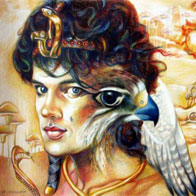
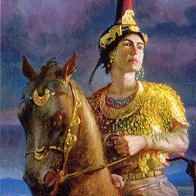
Although, according to Herodotus, “Among the Scythians there are many diviners who predict by means of numerous willow rods as follows: bringing large bundles of rods and laying them on the ground, they spread them apart and then, moving the rods one by one, they divine; speaking the predictions, they at the same time gather the rods again and lay them out one by one. Such is their ancestral method of divination,” the most venerated of the seers were precisely the Enarei, for the Great Goddess had given them this faculty.
READ ARTICLE
18.03.2009 / 1
Based on the beliefs of the peoples of Dahomey (now Benin, located in the region between the modern states of Togo to the west and Nigeria to the east) and their synthesis with Catholicism in Haiti several centuries ago, a system of beliefs emerged — Voodoo. A similar religion, Santería, based on the beliefs of the Yoruba people, arose in Cuba; macumba, likewise rooted in Yoruba beliefs, appeared in Brazil.
READ ARTICLE
17.03.2009 / 5
As we have already said, the kabbalists hold that the two world-principles—Attractiveness and Expansiveness—are not equivalent. Attractiveness is regarded as a created quality, while Expansiveness is an attribute of the Absolute. Nevertheless, when the Light of the Absolute enters the Vessel of Creation, that Vessel acquires certain properties of the Light. This phenomenon—the form of the Absolute’s presence in the world—is called the Shekhinah.
READ ARTICLE
16.03.2009 / 10
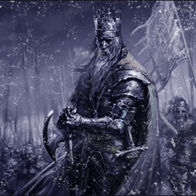
Alongside the well-known and indisputable wisdom of the druids, the literature about them often contains indications—almost bashful hints—of human sacrifices practiced by them.
It is well known that the druids and the religion they represented had, by the beginning of the 1st century CE, become the target of successive measures of suppression carried out by the Roman authorities.
READ ARTICLE
15.03.2009 / 9
Alongside the legends of Atlantis, the classical tradition preserves a legend of Hyperborea — a land where a sacred people with superhuman gifts once lived. According to ancient authors’ descriptions, this mythical country lay somewhere far to the north of the Mediterranean.
READ ARTICLE
14.03.2009 / 2
Among the kings and rulers of the ancient world several towering figures stand out, exceeding the bounds of ordinary humanity and rightly regarded as demigods. One of the best-known rulers who manifested divine power was Ramses the Great.
READ ARTICLE
11.03.2009 / 4
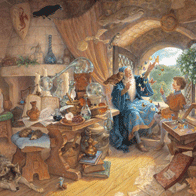
Among all Magi — real and mythical — perhaps none is as widely known as Merlin.
The last Magus and the most famous druid of Britain, he is remembered not only as King Arthur’s mentor but also as a distinct, deeply ambiguous figure who looks through the veil of later retellings.
READ ARTICLE
09.03.2009 / 5
Mesopotamian notions of postmortem existence are as elaborated as those of the Egyptians or Buddhists, although, unlike the latter two, they are not collected into “Books of the Dead.”
If, according to Egyptian myths (and, correspondingly, ancient Greek ones) the Judgement of the Dead leaves the soul a chance to enter Paradise (“Fields of Iaru,” “Elysian Fields”), Chaldean culture imagined a darker—and apparently, more plausible—picture.
READ ARTICLE
08.03.2009 / 14
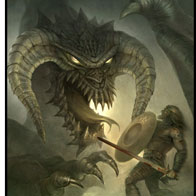
Strikingly, the mythologies of many lands share the same motif — the god’s victory over the Dragon. Typhon and Jormungand, Vritra and Vritra’s counterpart, and the Black Serpent resisted the gods’ formative influence on the world.
READ ARTICLE
07.03.2009 / 42
The Magus, step by step, frees himself from the destructors that enslave his mind and gains the ability to reduce losses of Power.
READ ARTICLE
07.03.2009 / 11
The postmortem disembodiment of a person must be accompanied by the departing entity’s withdrawal not only from our world but also from the Elements.
If this, for some reason, does not occur, not-fully-disembodied souls, lacking a guide and having lost connection with the monad, turn into demons.
READ ARTICLE
06.03.2009 / 20
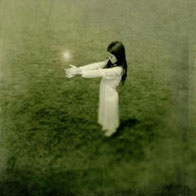
It is hard to find anyone who, as a child, did not at least once take part in—or at least hear of—the summoning of the “Queen of Spades”, the “red, blue, or ‘pencil’ gnome”, and so on.
What happens in such cases?
Are the “appearances” described by children merely products of their imagination?
READ ARTICLE
05.03.2009 / 15
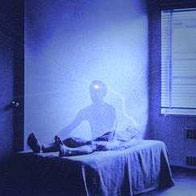
In the modern world, ideas about the dreaming body, the “astral” body and the “etheric double” regrettably remain at the level of the century before last, with its vulgar mediumism à la Cagliostro, muddled and lacking clarity.
One can only hope that dedicated groups seriously studying and applying this phenomenon will bring some order to the confusion.
READ ARTICLE