The Magus’ Harmony
We have repeatedly emphasized that the decisive point in describing the state toward which the Magus strives in his development is the harmony of his composition.
The first to bring the very concept of harmony into common use (Greek ἁρμονία — connection, order; concord, commensurability, symmetry) was, of course, Pythagoras. Concord — meaning the mutual strengthening of elements — is the primary sign of a system’s harmonious state. The measure of a system’s harmony is its symmetry: the mutual necessity of its elements. In this state, the system becomes greater than the sum of its parts; it rises to a new level of existence. Any element that weakens the system must be subjected to careful analysis: either it must be changed (or removed), or the entire system must be rebuilt so the interference disappears.
Another point essential to understanding harmony is the extraordinary stability of this state — its balance. In other words, a harmonious state is one in which nothing “pulls” anywhere, and movement occurs only under the influence of free will. This matters because the equilibrium of the Magus’ harmony does not mean immobility. On the contrary, the Magus’ harmony is dynamic; it is born in movement along the Way.
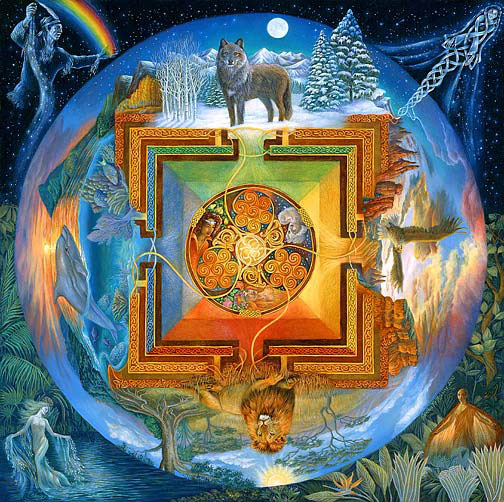
The Way to harmony lies in uniting desire, capability, need, and intention to act into a single whole. Only when the Magus wants to do something, is capable of it, when his Way needs it, and he himself deems it necessary, does the action become harmonious. These four elements are symbolized by four mottoes: to desire, to be silent, to dare and to know, describing the quaternary of the Magus’ Way. Accordingly, the Magus must receive an affirmative answer to four questions: 1) do I want this? (desire); 2) do I need this? (intelligence); 3) will I be able to do this? (will); and 4) should this be done? (intention), in order for action to be harmonious.
In this light, harmony for the Magus means minimizing the interference that certain elements of his composition create for others — that is, a state in which inner frictions are reduced to zero. In this form it is, of course, an idealization, unattainable in practice; yet as an idealization it sets the direction of the developmental vector: the Magus’ development must proceed so that the frictions within him continually diminish. In this sense everything is extremely simple: the Magus tracks the elements of the Psychocosmos that create interference, analyzes them for their correlation with the Flow of Power, and restructures the emphases of the Psychocosmos in accordance with the results of the analysis. Each of these three stages demands precision: tracking must be as attentive as possible, analysis comprehensive, and restructuring decisive.



I don’t quite understand regarding the fourth point. I thought that “should I do this” is a conclusion drawn from the three previous points, not a standalone category. How should it be understood then?
You are absolutely right: intention is what follows from the connection of Mind, Will, and Desire, but nonetheless, making that final step is not always easy 🙂
Regarding the question of harmony. As someone who started with religions, I find some contradiction in the questions of the will of the religious path and the magical one. As far as I understand, the will in religion is surrendered to God, while in magic – to the individual. Does this contradiction really exist, or is it smoothed over from the upper floors? Does anyone have experience resolving such contradictions for themselves, or is the only way to choose one of the paths?
I haven’t encountered similar contradictions; however, what made you think that the will should be surrendered? The Bible, for example, which has been one of my bedside books for about 20 years, does not contain any direct indications that the will of man must belong to God, although there are countless interpreters, and each tries to present their opinion as the only true one.
I had no contradictions. When I came to this blog, I simply understood that this was mine. If I had a different character of fate (I don’t know why I chose to say it that way), perhaps this path would have been linked to religion.
Currently, for me, the Path is the co-harmony of certain energies reflected in the properties that fill me with strength.
How harmonious is the state/action if: I need (have to) do this; I can do this; I should do this. But… I do not want to do this? That is, the necessity and possibility of some decision/action is obvious, but the desire is absent. Is it worth performing this ‘necessary’ action, or should it be abandoned (in the name of harmony)?
I think it all depends on the source of this ‘I don’t want’. It could be laziness or fear, and then it would be good to overcome them. Or it could be a deep understanding of the discrepancy between this action and one’s nature, and then it would be better to refrain from the action, no matter how right it may seem.
What does it mean for ‘the action to correspond to its nature’? One can imagine the ‘fruits’ of the action, but what is its nature?
The nature of the action is ‘the release’ of the corresponding desire, the impulse arising in consciousness. That is, the action corresponds to its nature the more accurately it realizes the arising impulse. However, often there is sublimation, and the action corresponds poorly to the impulse that produced it, and then a shadow and tension arise.
Hello! So sublimation is not always good, and it can create a shadow, or did I misunderstand? For example, the topic of sexual energy that has been ‘discussed’ for a long time – certainly, suppressing it is not very good, as suppression leads to aggression, but what about sublimation? After all, this is a very powerful source of energy in the body and perhaps it also needs to be worked with?
Hello! We discussed this question: https://www.enmerkar.com/en/way/control-or-restraint https://www.enmerkar.com/en/way/control-of-desires And from this perspective, any ‘non-targeted’ direction of energy leads to the accumulation of shadow: https://www.enmerkar.com/en/way/lack-of-realization-dissatisfaction-and-the-shadow As for sexual energy, it’s more complicated, since any energy a person can use passes through the stage of activation in the sexual center, and therefore, in a certain sense, is ‘sexual’: https://www.enmerkar.com/en/observations/energy-and-sexuality
Thank you! Once again I am convinced of how limitless your blog is! Just like the Vatican archives. How much remains unread and unthought! To be honest, there should be a section here like: ‘Start here’ or ‘Section for beginners’, and so on))) Thank you for such a titanic work.