The mind’s ability to correctly “name” is directly proportional to its “creative capacities”, and “knowledge of names”, identical to “knowledge of the Logoi”, is, in fact, a measure of magical Authority


Other Magic
Пишите мне
Enmerkar's Blog contains over 1200 original articles of an esoteric nature.
Enter your search query and you will find the material you need
The mind’s ability to correctly “name” is directly proportional to its “creative capacities”, and “knowledge of names”, identical to “knowledge of the Logoi”, is, in fact, a measure of magical Authority

The mind must strive to overcome the multiplicity of its manifestations, toward unidirectionality and precise focus, without which the depth of the mind’s penetration into being will be insufficient for their integration


We are real to the extent—and in those respects—in which will manifests, as an instrument of realization, as the cause of reality.

For the Way to become natural, one must first study it long and hard; and to understand that the Way was never lost, one must first search for it long and hard.

The mind must find the strength to abandon the habit of sheltering behind the walls of illusory harmony; it must stand face to face with itself and the world, and find balance not by ignoring but by integrating all opposites.



Only when the mind stops fleeing from presence, stops narrowing its field and striving to limit itself, to “forget itself,” does it find the keys to its nature — the nature of active presence, active creativity, active awareness.

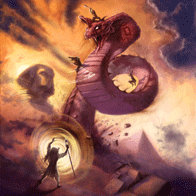
All inhabitants of the psychocosmos – Keepers, Demons, Predators, Parasites, idams – can be regarded as matrices comprising assemblages of individual Me of lower order.


The real situation is that most travelers lose their way, stray from the Way precisely by falling into the trap of indifference, rather than under the influence of greed or anger.
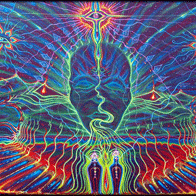
Only when the Magus has undergone and awakened Power within himself, and has undergone and realized Love within himself, can he integrate them into a unity and attain the Great Perfection of the pleroma.

The “strikes” of predators, coming one after another, steadily and tirelessly, pose a constant threat even to experienced travelers, since in this struggle there is always the danger of “burning” one part of one’s soul after another

The Magus must not merely become aware of unity, nor even simply see it; the Magus must also awaken his heart, find within himself a living source of love and compassion.
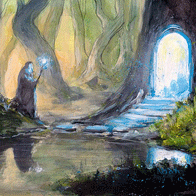
The Magus must constantly check what is happening to his mind, to his Power during an action: whether he becomes more harmonious, freer, or—sinks deeper into the abysses of illusion.
Just as the blissful reliance on materiality as the source of goods and pleasures is a dead end and leads only to the accumulation of empty experience, taking pleasure in negation drives one toward destruction and self-fixation.