Qliphoth and the “Impure Elements”
As we have already discussed, the Myth we are considering describes the “real” world as a field for the manifestation and actualization of consciousness. Yet this process does not unfold “smoothly,” not optimally, not with maximal efficiency.
The cause and mechanism of this “non-optimality” the Myth names the world’s “corruption,” its “obscuration,” which can be viewed from two perspectives: as a distortion of the subjective component, an obscuration of the surface of consciousness that interacts with reality; and as an “objective” imperfection, the unsuitability of the phenomena and processes of the cosmos to serve as “ideal objects,” interaction with which could ensure their perfect reflection in consciousness and, consequently, its actualization.
In other words, what is “corrupted,” “distorted,” is both the cognizing gaze directed toward the description and knowledge of reality, and the very “picture,” the very “reality,” the very field of cognition.
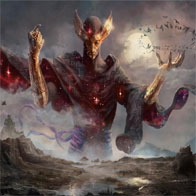
At the same time, the “distorted” component of consciousness, the forces of obscuration present within it, the Myth calls “demons” and treats them as beings and matrices of distorted desire; while the “obscuring” component of the objective field it names “archons,” describing them as distortions of the forces of realization.
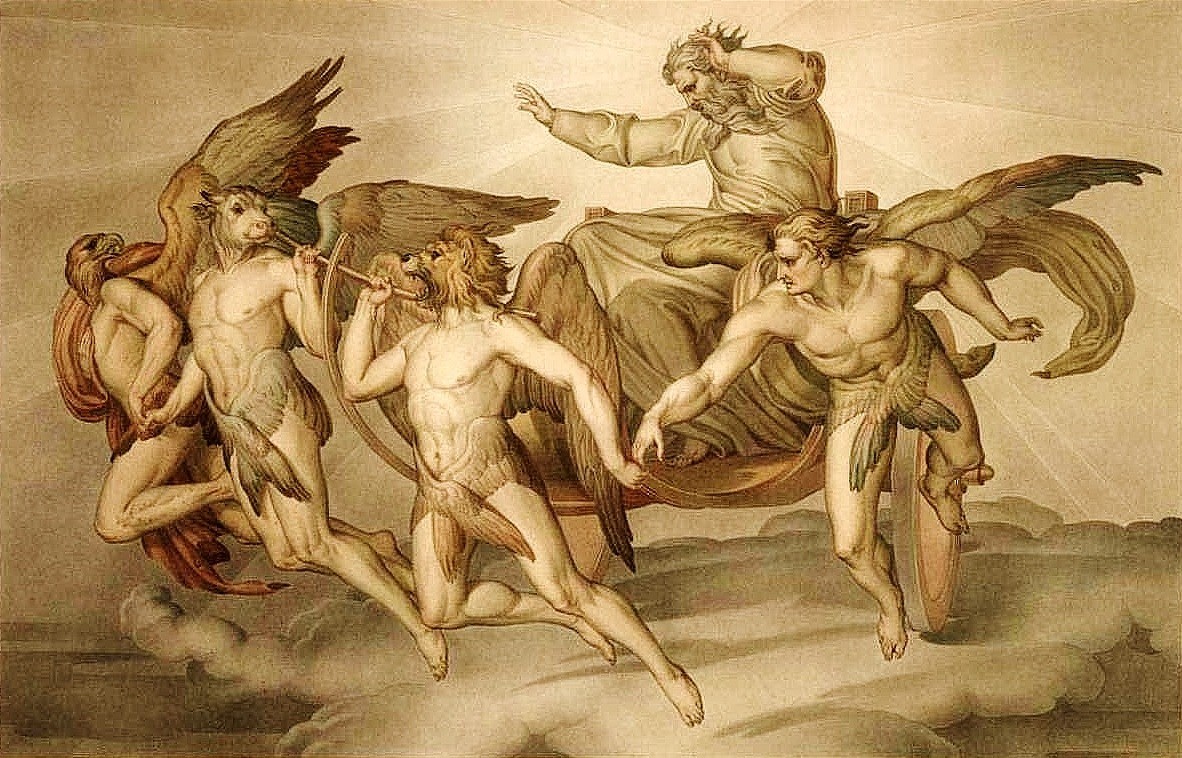
The Hermetic tradition uses a vivid image to describe the totality of the creative forces present in the cosmos: the “Chariot of God,” the “Merkabah,” as described in the vision of the prophet Ezekiel.
This synthetic image, which perfectly reflects the general “skeleton” of any creative act, includes both the “illumined” activities expressed in cherubic and ophanic figures, and the “obscured” components symbolized by the surrounding shells, the “husks”: anan gadol — “great cloud,” esh mitlakakhat — “flashing fire,” ruach se’arah — “tempestuous wind,” to which the “Book of the Prophet Elijah” adds kol demamah dakah — “the voice of subtle silence,” along with the “radiance” (nogah, נוגה) surrounding them, corresponding to the Limit, the Horos, between the obscured and pure components of world and consciousness.
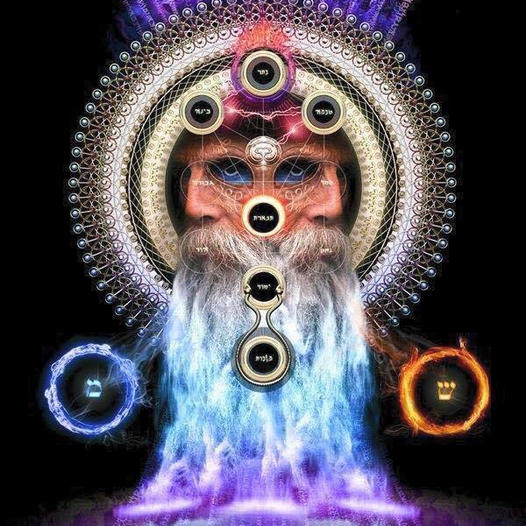
Thus there emerges a scheme of four “impure” and one “radiant” “husk,” a scheme that admits several levels of understanding and interpretation.
The “great cloud” is the counterweight to the “Cloud of Glory” (“Anan Kavod”); that is, it is the distortion of the Deity’s “concealment,” the transformation of the world’s “incomplete knowledge” into a refusal of knowledge itself. Instead of gradually unfolding the world’s filling with Light, gradually “revealing” it, the “cloud” divides Heaven and earth with an insurmountable barrier. In the same way, “ruach se’arah,” the destructive hurricane, is a distortion of Ruach ha-Kodesh, the Spirit of the Living; it is the destruction of the principle of vitality. And esh mitlakakhat, the “incinerating fire,” is a distortion of Shamayim, the heavenly creative Fire.
At the same time, the properly “impure” shells seen by Ezekiel can be understood:
- as three levels of the “corruption” of the cosmos: respectively on the Creative (Beriah), Formative (Yetzirah), and Manifest (Assiah) levels;
- as three forms of the corruption of consciousness: on the levels of ruach, nefesh, and guf;
- as three types of “impure” elements arising from the distortion of water, fire, and air respectively.
If this scheme is expanded in light of Elijah’s vision, one obtains the image of a “destructive quaternary” underlying all “corrupted,” demonic vortices; and if to this one adds the “radiant” image as well, the concept of the “five impure ones” emerges, as accepted by the Manichaeans and the Mandaeans. One may also consider Ezekiel’s “three shells” as three demonic worlds, a destructive psychocosmos, and the “voice of silence” as the apatheticizing influence of heimarmene, the imperfect creation of the Blind god.
The concept of the “impure elements” as the force of material “resistance” to the spiritual is examined most fully in Manichaean writings.
According to these ideas, the history of the world begins at the moment when Matter — the active principle of Darkness — attempted to seize the Light on its own, to take possession of it.
As a result, five elements of Darkness arose, also called the five “seeds” of the flesh (the Kabbalistic “koach ha-guf” (כוח הגוף), literally “the power of the body”): in opposition to the “pure” elements of air, fire, water, breath, and light, Matter created the “impure” smoke, conflagration, poison, hurricane, and darkness. “Smoke” is corrupted air and, at the same time, polluted thought; “conflagration” is destructive fire and ungovernable desire; “poison” is “rotten” water and destructive emotion; “hurricane” is the destruction of vitality; and “darkness” is ignorance. Thus impurity is described as the simultaneous distortion of the world (the three Kabbalistic primary elements) and of consciousness (the duality of life and cognition).
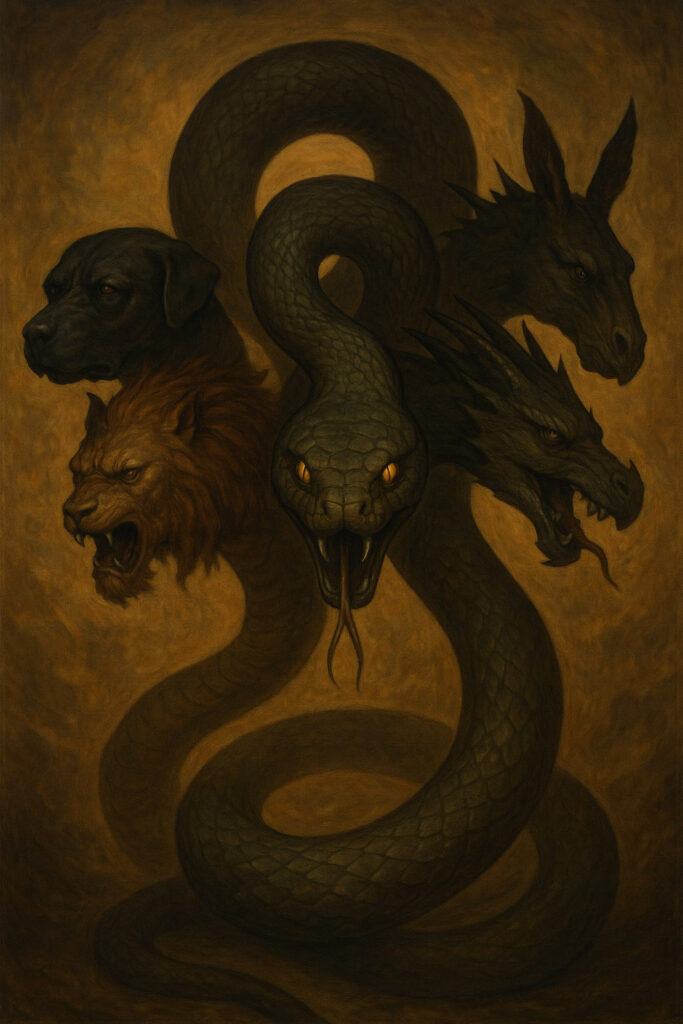
Then Matter began to grow from these elements five kinds of trees, its incarnations, which later ripened and bore their fruits of obscuration. From the fruits of the five trees grown from Matter were born five archons, the demons of Darkness. The demons of Darkness are described as two-legged, four-legged, winged, swimming, and creeping, depending on the world from which they originated. Each world has its own supreme archon, the king of that element: the king of the world of fire is a frenzied lion, the king of the world of wind an evil eagle, the king of the world of water a poisonous fish, the king of the world of darkness a dragon. The strongest of them is the king of the world of smoke, a five-headed demon, who led the forces of darkness raised by Matter in the attack on the Light. In the course of this war, the forces of matter captured part of the Light and mingled with it.
In response, the Mother of Light and the luminous gods sent the Primal Man into battle. Clothed in the luminous elements, he descended into the zone of mixture and entered the struggle. Yet as he won his victories, he gradually gave up his own elements, binding and limiting the elements of Darkness so that they could spread no further. Thus air bound smoke, fire bound fire, water bound dark water, and light bound darkness.
Such a picture not only emphasizes the “obscuring,” capturing, consciousness-enslaving aspect of the material world, but also lays out the paths for overcoming this obscuration. Each aspect of consciousness, each of its Enlightened activities, must “penetrate” the obscured region of being corresponding to it, correcting and purifying it. This concept has much in common with Buddhist ideas of the five Enlightened families of the Buddhas and their transformation of the poisons of consciousness into the corresponding wisdoms.
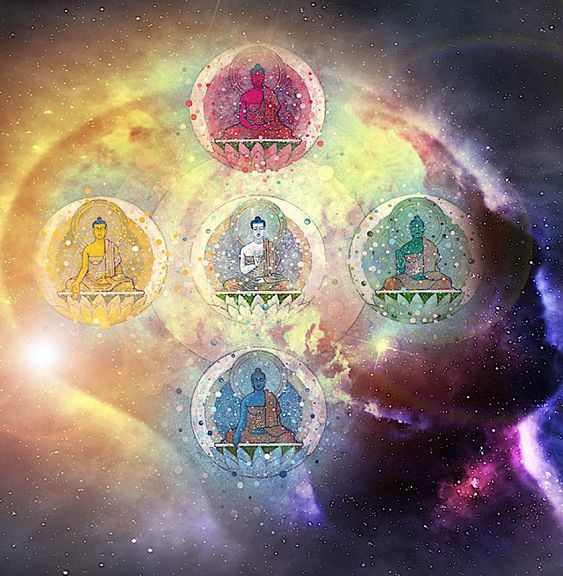
In any case, the crucial point is the idea that obscurations require a complex, two-sided transformation: not only consciousness but also the environment must undergo correction. The purification of view, the cultivation of gnosis, is interconnected and interdependent with the correction of the support, the transformation of the objective sphere.
This is precisely why the Hermetic tradition is a path of integral development, for which not only “inner work,” not only the purification and realization of consciousness, matters, but also “outer” manifestations, active work, directed toward the “cultivation of the garden,” the ordering and harmonization of matter.

If the environment in which consciousness exists is distorted, is enlightenment possible within this world, or is a fundamental transformation, a ‘correction’ of reality itself required? And if the purification of consciousness and the rectification of matter are interconnected processes, how can a practitioner balance work on both levels to avoid leaning either towards isolated inner development or utopian attempts to ‘change the world’ without inner realization?
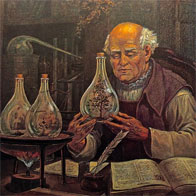
The Hermetic tradition asserts that consciousness and the environment are two sides of one reality, and their development must always be balanced. If a mage concentrates solely on inner transformation without engaging with the surrounding world, they risk retreating into isolation, creating mere self-deception that finds no real manifestation. Conversely, if they strive solely to change the external environment without working on themselves, their actions will inevitably be superficial, as they will act from a distorted state. Thus, the primary challenge is to align internal and external transformation while avoiding a one-sided bias that could lead either to illusory enlightenment or a utopian struggle with the world. It is clear that the correction of the world can occur from two sides: through consciousness (purifying perception, eliminating demonic distortions within, developing true knowledge), and through matter (working with the object-world, transforming surrounding reality, alchemical and magical work). A classical example of such balance is alchemy, which sought simultaneous transformation of matter and consciousness: alchemical sulfur embodies the activity of spirit, its penetrating, transformative power; alchemical mercury represents the inertness of the environment, its propensity for chaos and disintegration; and alchemical salt symbolizes their imperfect union, the material world. The task of alchemy lies in the proper integration of sulfur and mercury, creating the ‘philosopher’s stone’ – a perfect object, simultaneously a perfect state of consciousness. If a mage focuses solely on internal work (contemplation, meditations, visualizations) but ignores the object world, the risk of passive mysticism arises. Therefore, practices must include active work with matter, whether it be alchemy, craftsmanship, constructing harmonious systems, or organizing space. If the mage seeks to change the world but does not transform their consciousness, they fall into the trap of fighting against a distorted reality, being a product of it themselves. Hence, any work with the objectual sphere must incorporate self-development, purification of outlook, and liberation from illusions. In other words, matter must be rectified not just externally but also through the realization of its connection to spirit. Another example of balancing work on consciousness and the environment could be called ‘symbolic architecture’ – the construction of temples, altars, artifacts that are reflections of the spiritual path, as well as the creation of magical items, talismans, amulets that reflect the inner process of change. The same goes for organizing one’s physical space, following principles of harmony (feng shui, hermetic geometry), creating ‘places of power’, energetic points that not only improve subjective states but also enhance the environment itself. It is vital to continuously generate the consciousness that the external environment is not merely ‘the world’ but a reflection of consciousness that can and should be meaningfully corrected. The Hermetic tradition suggests that a perfect being is born not merely through the rectification of consciousness but also through the rectification of matter. Exit from duality involves not rejection of matter but its elevation and harmonization through conscious action. This approach creates balance between Spirit and the World, which is the goal of the Hermetic tradition and the Great Work.