
Inner Alchemy
The search for ways to move out of the disharmonious state in which the minds of the overwhelming majority of embodied people dwell — toward a more effective and evolutionarily promising state — has always been a central task of both Magic and other paths of development.
We have already noted that two such methods were discovered: replacement and transformation. They differ in which stage of the mind’s pathology the therapeutic work is aimed at: in the first case, a new “healthy” stream is created in the mind and then strengthened and expanded, gradually replacing destructive drives and tendencies; the second implies a “restructuring,” or more precisely a “remelting” of the basic, core psychic structures — a major overhaul.
Usually the first group of approaches is called “inner alchemy,” and the second — “inner goetia,” implying that they work, respectively, on the “passive,” underdeveloped components of the mind and on its active components that “resist development.” Nevertheless, both approaches can be regarded as both alchemical (in the sense of a transmutational orientation) and goetic (since they aim to eliminate destructors).
Namely, if we regard the stream of mind precisely as a stream — a current of perceptual and cognitive processes polluted by foreign elements or stabilized by unnatural connections — then its cleansing is treated as an alchemical procedure involving filtration, settling, putrefaction, and so on — that is, the “alchemical” path. If, however, we look “inside” this stream and treat it as a psychocosmos inhabited by various entities or matrices, we must approach its harmonization as restoring a lost balance among those entities — that is, we apply goetic approaches.

We have already discussed the methods of inner goetia in sufficient detail; now we will focus more on the approaches of inner alchemy. From a Traditional perspective, alchemy is the name given to an immanent approach to harmonizing the universe — an approach in which activity is applied to the “field of objects,” the supporting or “material” component, and by ordering it the overall “correction” is achieved.
At the same time, the entire process of transforming the mind and each of its individual stages includes four phases: the destruction of old connections (“nigredo”); the regrouping of their elements and the creation of a more harmonious system (“albedo”); consolidation of these new, “successful” combinations and connections (“citrinitas”); and the induction by which these produce further ennobling transformations in their surroundings (“rubedo”).
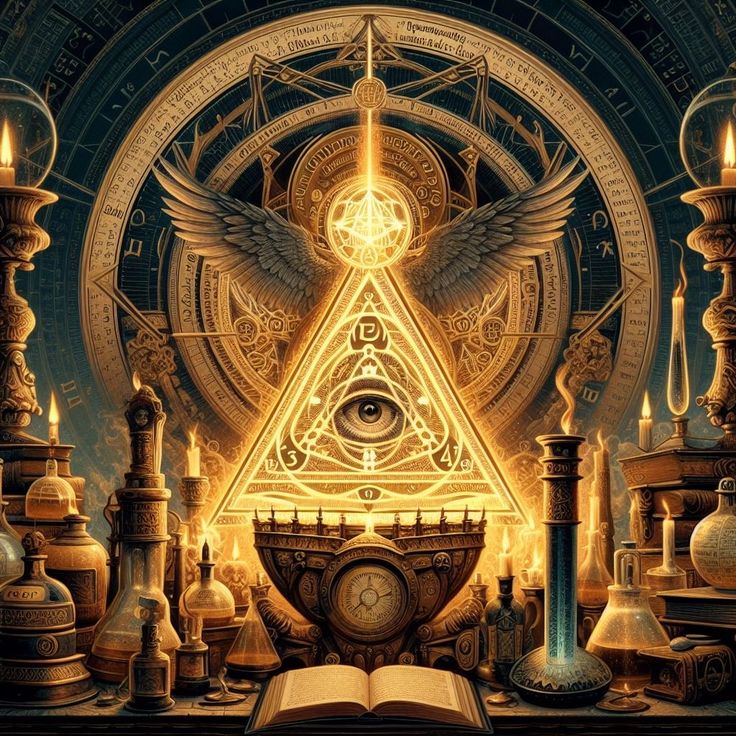
Thus, if the mind follows the “alchemical” Way of transformation, at the first stage it undergoes a more or less significant controlled disintegration: the breakdown of the former system and the maximum destabilization of its components. This can be a symbolic death in mysteries or Quest rituals, or a spontaneous experience of “falling into the abyss,” when all connections and supports collapse. In this process the body often functions as a key instrument of transformation: by working with it one can both enter “nigredo” (for example, through fasting, cleansing, or stress practices) and “seal” new states bodily (the fixation of new states). In other words, the body acts as an athanor, an alchemical vessel in which and through which the psychic work unfolds. At this stage, as we have already discussed, the hardest thing is not to try to “return to the familiar shore,” not to be frightened, and to face chaos itself. Classical alchemy thus distinguishes between the fire of spirit (Fohat, the natural inner heat that leads to transmutation) and external fire (artificial efforts that can burn the substance). Therefore it is crucial not to imitate heating, not to attempt to “fake” transmutation, but to make the mind incandescent in a natural way, generating in it a desire for perfection. Then, when the system reaches a state of complete fluidity and superposition, one can begin to create new structures and forms within it. Moreover, to prevent the recasting process from becoming purely destructive, certain anchors are required in the form of mystagogues, Masters (inner or outer), or Traditions.
The task of alchemy is not to “remove” some component from the mind or the Universe, not to destroy, but to transform, balance, and restore equilibrium. In exactly the same way, goetic approaches do not seek to “kill” a Demon, nor do they try to “befriend” it; rather they aim to place it where it belongs — as the agent of the descent of spirit. Likewise, alchemical techniques do not destroy supports but correctly arrange them hierarchically, according to their functions and value.
At the next stage, traditionally one of two approaches may be applied — the “calculative” or the “matrix.” The first implies a measured, architectural approach to building a new system, in which all forces and components are carefully examined and balanced. This is the method of constructing an “ideal Temple,” so beautiful and stable that Deity is inevitably drawn into it. Such an approach clearly requires great knowledge and well-developed gnosis and intuition, since any mistake can cause the entire structure to collapse. Therefore the second approach is used much more often: the new system is built “by pattern” or “on the matrix” of existing structures. This is what is meant by descriptions of “building the earthly Temple as a copy of the Heavenly,” or by the activation in the mind of one or another Enlightened or Divine matrix. In alchemical terms, this is described as introducing the “seed of crystallization” — the pattern around which the “noble” system is then constructed. Such a core of crystallization may be one or several, depending on the scale of the transformation, but in any case the mind must receive its “Great Seal” (“Mahamudra”), with which it will then “seal” its textures.

However, cleansing the mind is not the final aim of the Great Work. The next crucial stage is the attainment of the ability to transform negative influences and inner disharmonies. This stage corresponds to the phase of rubedo and leads to the creation of the mind’s “philosopher’s stone,” capable of actively transmuting “base” states into the “gold” of clear awareness. The Magus does not merely seek liberation from suffering; he acquires the ability to turn suffering into wisdom, darkness into light, affects into gnosis.
Thus, at the subsequent stages there is, as we have already discussed, a “polishing” and stabilization of the cast structures; then these structures are themselves used as inductors of transformation, spreading their ordering and transmutational influence outward. The success of the alchemical process is not individual perfection but the ability to become a conductor of higher logoi, capable of restoring harmonious structures in oneself and around one. At the rubedo stage some elements “return” into the past and “rewrite” its meaning, creating a new stream of probabilities; a sense of continuity and retrospective meaningfulness emerges, when everything previously destroyed is seen as necessary for the emergence of a new order.
Thus, inner alchemy is the Way from “correcting” oneself to “correcting” the world, from personal freedom to universal harmony, from a suffering mind to the mind of a creator, capable of bringing light into every aspect of reality.





I wish you well, dear Master, may I ask how often it is possible to approach the state of sublimation or distillation, I don’t know how to name it exactly, but if the result is unsatisfactory, when can one start acting again? Thank you.
Hello.
In the case of alchemical Work, everything is determined by fire – the inner ‘heat’, the fuel from desires, aspirations, and transformed energies, which gives movement to the entire process. Therefore, new attempts can be made when there is a sufficient amount of this ‘fire’ – perhaps immediately following a failure, or maybe it will take time to accumulate.
Hello, Enmerkar. Tell me, should the horror from the collision with the Abyss, stuck somewhere in the depths of psychocosmos, be eliminated in some way, or can one also ‘weave’ something constructive from it? And if so, how?
Any fear is a reaction to the unknown, and the Abyss, by its very nature, is absolute unknown, hence fear of it cannot just disappear. But the task is to move forward despite this fear, not to let it paralyze the consciousness.
The collision in the past has already occurred, consciousness was shattered to its core and reassembled.
Thank you for your opinion, it clarified the meaning of that dream which came to me as an answer some time ago.
“Thank you”