Gods and Archons
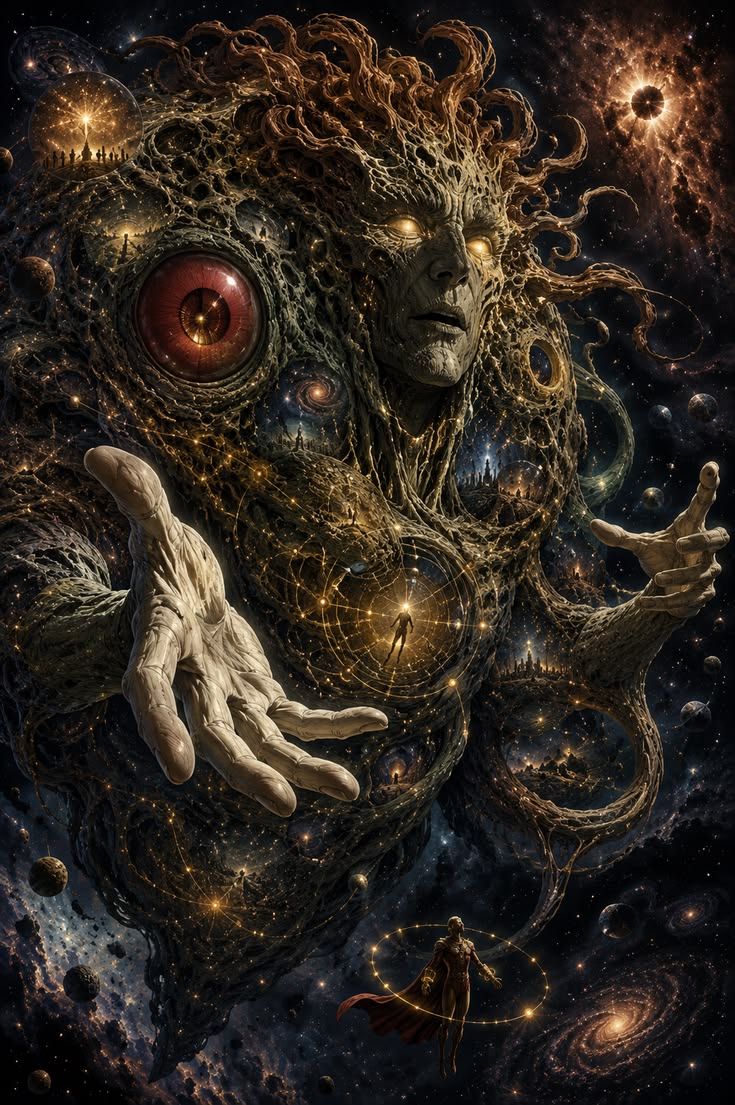
In speaking of the formation of manifested worlds, one must understand that this process can be considered from two sides: from the side of the Interspace, the field of potencies, and from the side of the world itself, the field of the manifested.
Accordingly, the emergence of phenomenal reality can be viewed both “from within” this reality and “from outside” it — that is, from the side of actual or potential forces and interactions.
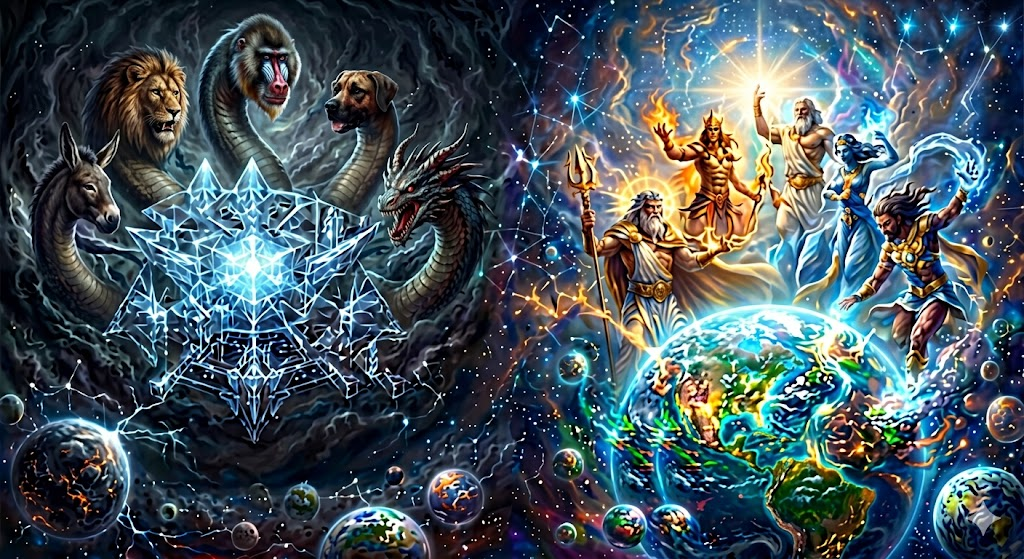
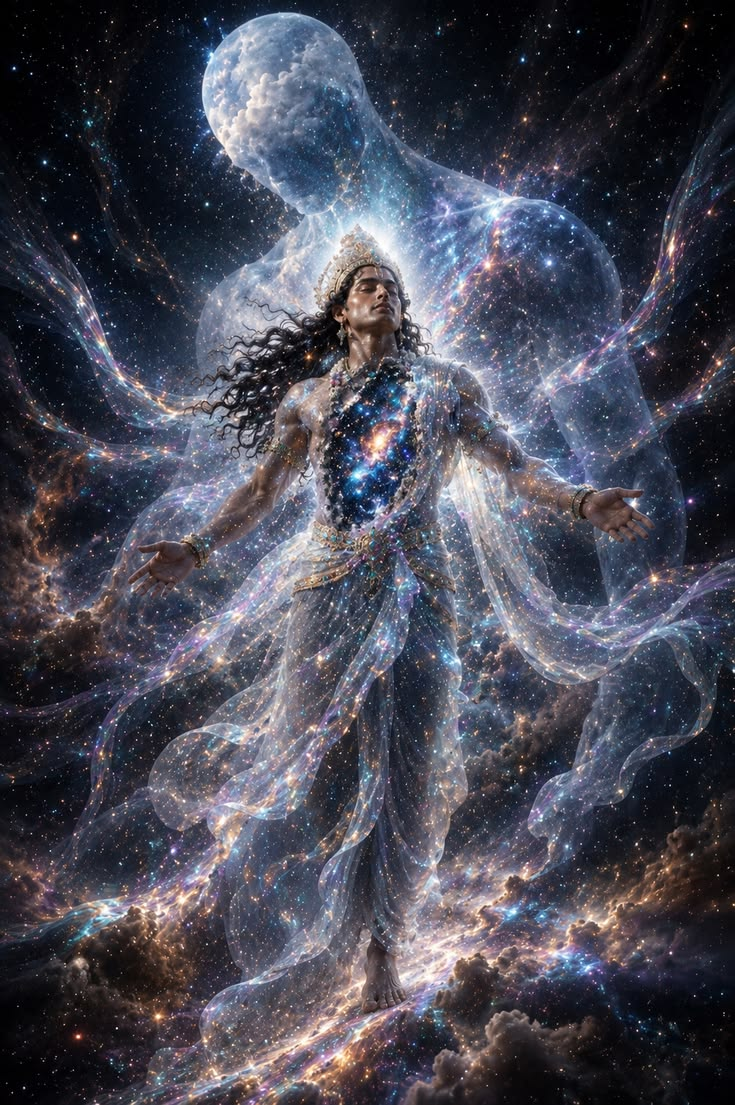
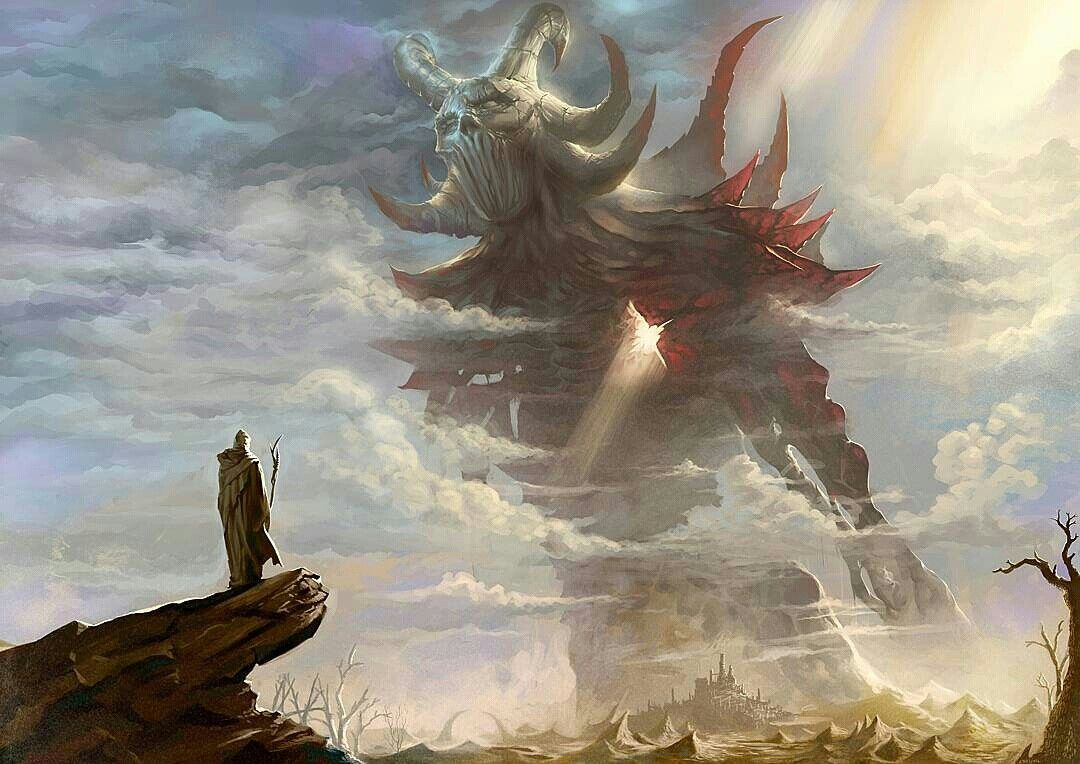
Those forces that build the structure of possibilities — the fields and flows of probabilities— are traditionally called Archons (or Archei), while those that bring forth, from this field of probabilities, systems of actual interactions are called Gods. Archons are beings or forces that determine what can exist; Gods determine what, and in what manner, will exist.
Thus, Archons and Gods are two parallel levels of a single descent of creative activity. Above them abides the level of pure potency —Aeons, manifestation as such. The Archons serve as the “lower,” structuring aspect of this possibility: what translates “possibility in general” into the “possibility of this given, particular cosmos.” The Gods are the actualization of this possibility in processuality. The Aeon secures what is possible in principle; the Archon, what can take form as a world; and the God, what and how it will endure within it.
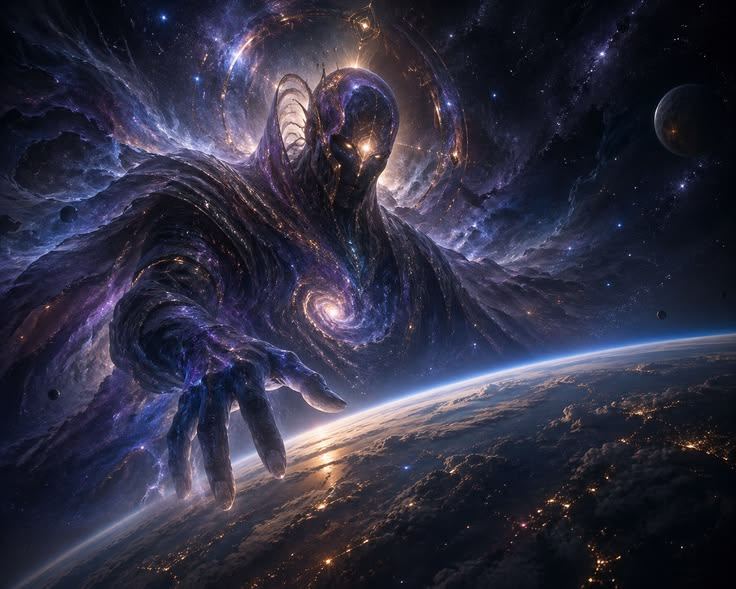
However, neither Archons nor Gods govern the meaning of the manifested — the logos, the purpose, that “why” for the sake of which manifested being unfolds at all.
At the same time, the Archons, as beings of one nature with the Interspace, stand outside the Currents of realization —outside time and outside evolution — forming only the channels and “skeletal” structures through which these Currents will pass. The Gods, even when they too dwell in the Interworld, are essentially one with the manifested worlds, and therefore act within time and the chains of causality.
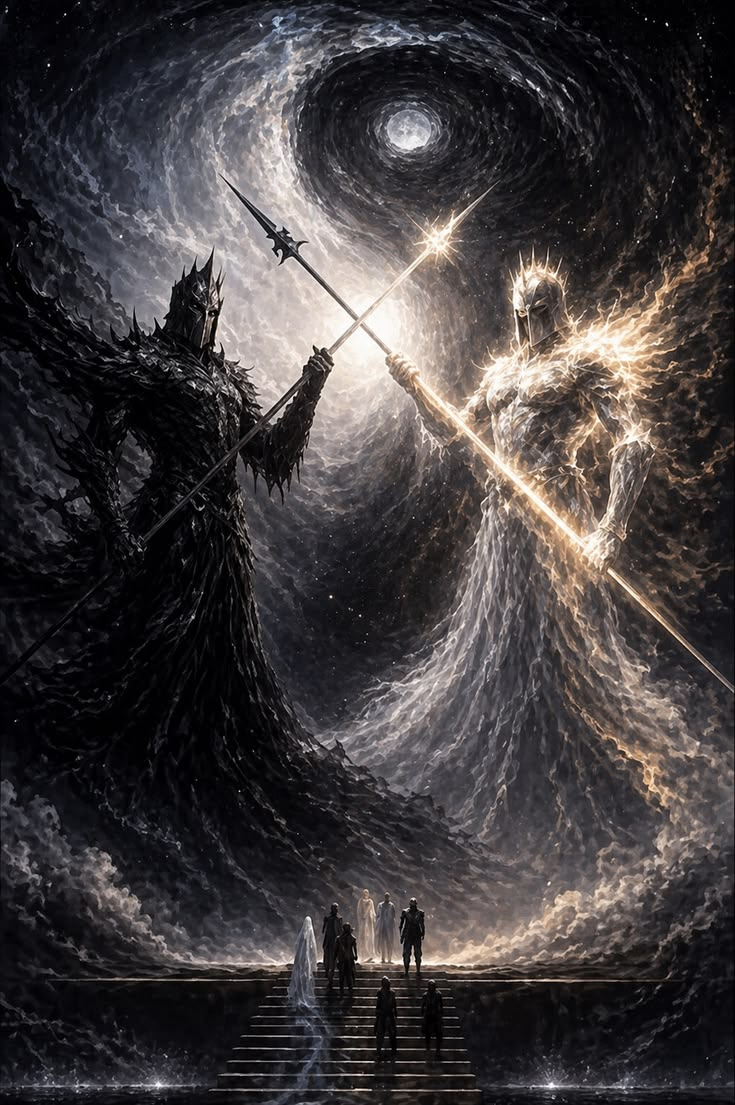
In “physical” terms, the Archons are boundary conditions, fundamental constants, and symmetries that define the very space of admissible states; the Gods are dynamics — the operator of unfolding, the concrete trajectory laid within these conditions. Semantically, the difference is the difference between grammar and utterance: the Archons set the syntax, the rules by which logoi can be combined at all, and the Gods pronounce, with that grammar in view, the world’s concrete, meaningful, time-extended “speech.” Grammar does not “happen”; it exists a priori, whereas any utterance has a beginning and an end. Likewise, the archontic structure abides outside time, while divine creation always takes place within it.
Therefore, the Gods always beget, form, and sustain worlds, relying on the substrate provided by the archontic side of reality — just as awareness itself crystallizes from the abyss of the unawakened.
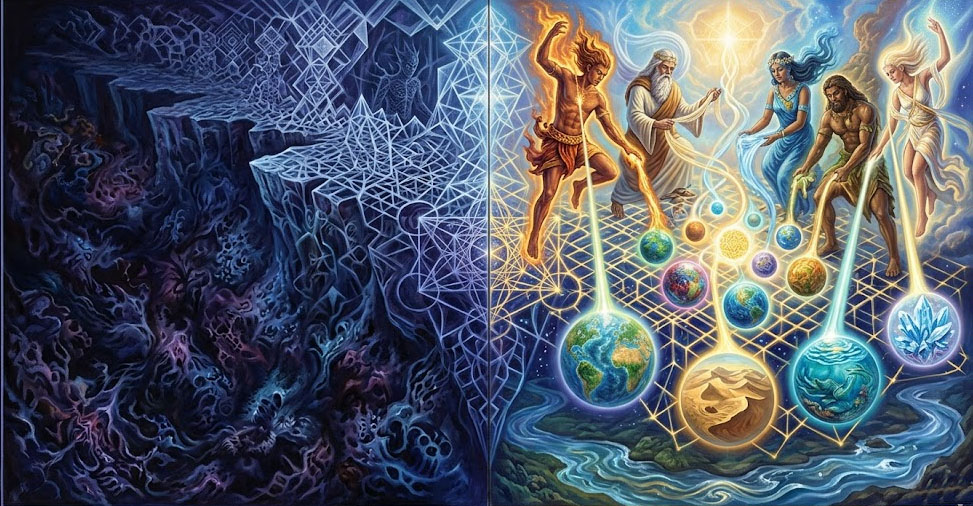
Accordingly, when speaking of the “Archontic” Myth — the fall of Sophia, the birth of Yaldabaoth, or the ascent of Sabaoth— one speaks of phenomena “outside time”: not events that happened long ago (or recently), but fundamentally atemporal scenarios that are merely “projected” into reality, because they set the field of its possibilities. In exactly the same way, when speaking of the Myths of the Gods — of creation, battles, Ragnarök, and so on — one always finds in them a sequence, a temporal component, even when these scenarios repeat across different times, worlds, and conditions.
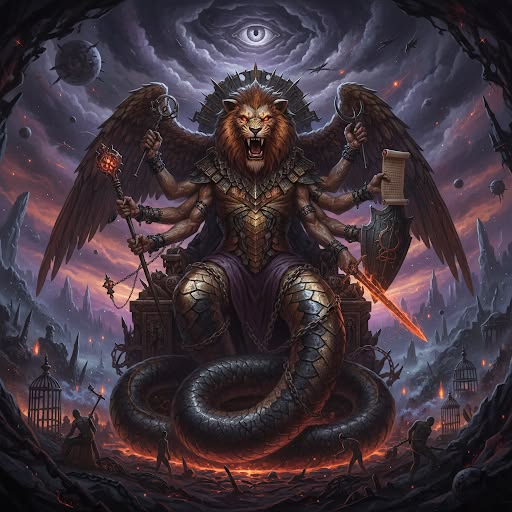
In this sense Baphomet, Yaldabaoth, Abraxas, Ariel, and Sabaoth are not “stages” and not “hypostases,” but scenarios of the manifestation of one and the same Power, “laid” over one another — appearing different only from the side of the worlds to which this Power provides a field of possibilities.
Nevertheless, any exposition of the Archontic Myth reads like a cosmogony, like a story about something that happened “once,” even though it describes not an event but a condition. Narrative, by its very nature, presupposes sequence — “before” and “after,” causes and effects — and therefore even a story about an atemporal archontic scenario inevitably “temporalizes” it. Saying “Sophia fell,” “Yaldabaoth was born,” “Sabaoth turned,” one conditionally overlays the grammar of events onto an atemporal structure. It is essential to understand that this is only a mode of speech, since speech itself belongs to the worlds of duration.
However, within worlds, the Archons exist only as Heimarmene— an enslaving structure of reality for the mind, not separate beings, wills, or agents. For the Gods, Heimarmene manifests as ananke, the inertia of the milieu: that quality of the “substrate of reality” which they must take into account in their creative activity. We have already spoken of how this inertia, ananke, manifests as the “viscosity” of materiality itself (hyle) and as its destructibility, its tendency toward disorder (malus).
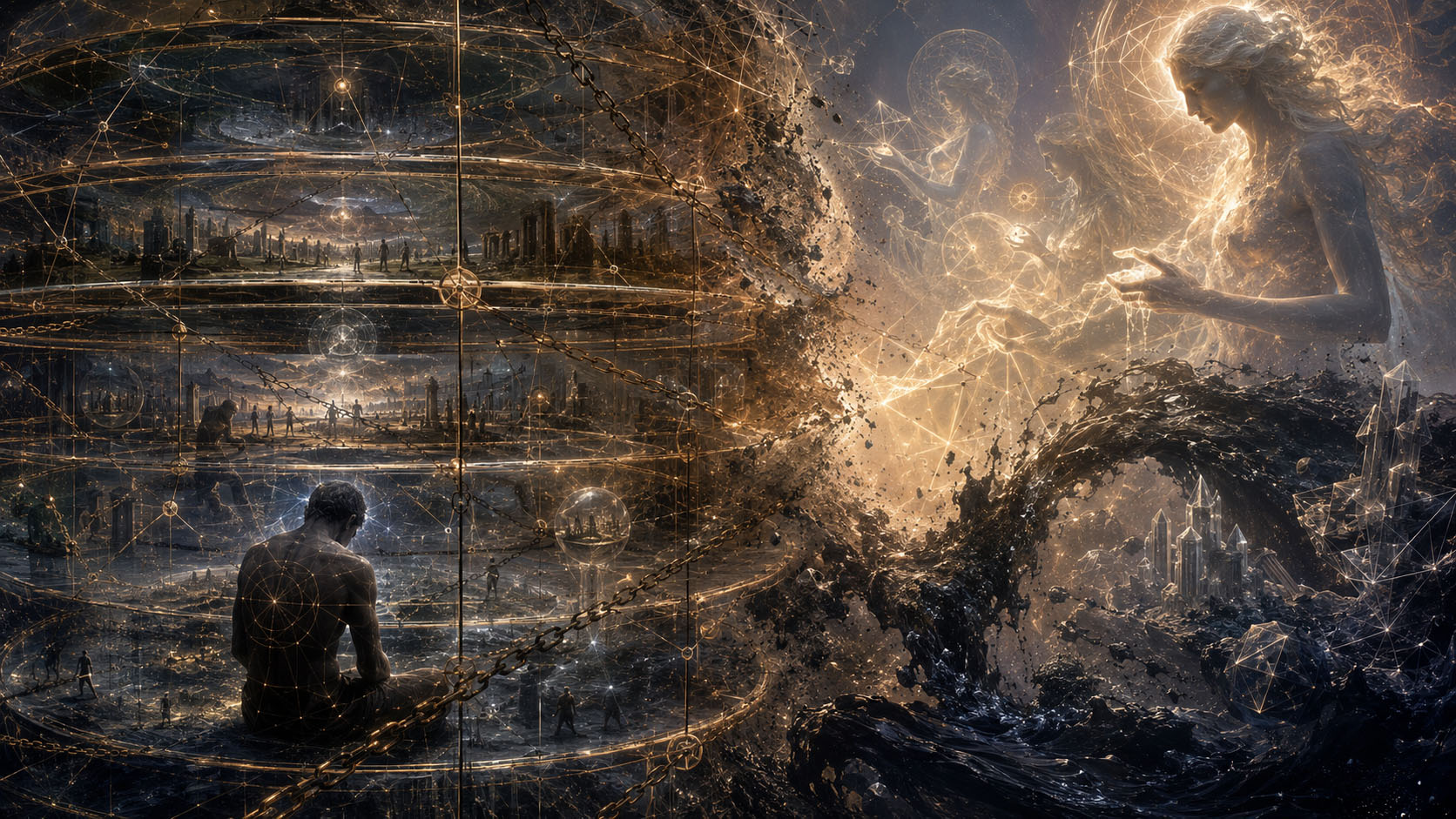
For the Gods, ananke is simply the impersonal viscosity of the substrate, which they merely take into account. For the “ordinary” inhabitant of a world, deeply immersed in conditionedness yet unable to distinguish its causes, it is not personified at all; it is experienced as an inconspicuous background, as the self-evident “this is how the world is made.” Only for the Magus standing at the rift — already identifying archontic influences, but not yet free of them — Heimarmene is perceived as a totality of agents, beings whose influence must be surpassed. That is why, in some descriptions, the Archons appear as impersonal laws, and in others as Rulers with definite appearances and characters.
Thus, the archontic side provides both a field of possibilities and a set of limitations imposed upon the process of manifestation, whereas the Gods are the structuring and cosmizing component that secures this manifestation in duration. The Archons, by themselves, cannot create actual worlds; the Gods, by themselves, require a substrate for creation.
This understanding has a practical consequence: it reveals two irreducible ways by which the Magus interacts with each side of reality. With the Gods — who have personality, will, time, and history —theurgic “subject–subject” relations are possible, in which the Magus correlates his nature and aims with the macro-Flows of the deity. With the archontic side, there is no one to negotiate with. Where it is presented as Heimarmene, no singular will can be discovered — no will that could be persuaded or appealed to. No bargain is possible with it — only re-description, a change in the basis of perception, a surpassing of the very grammar in which the mind is held. Where there are individual Archons (in the Interspace), there is no longer an incarnate Magus capable of relying on materiality and operating reality. Therefore, whereas the Gods are called upon and persuaded, the Archons are recognized and surpassed. Where naïve mind tries to “come to terms” with Heimarmene or, conversely, to “defeat” a god, the Magus does the opposite: he seeks alliance with the Gods as with living agents and works with the Archons as with a condition that cannot be abolished, but can be outgrown.

Tell me, please, dear Enmerkar: do the gods and archons influence the people of the parallel Earth differently than they do us? If so, what are the differences in that influence/relationship? Can we say that the heimarmene of the population of the parallel Earth is different as well? Besides humans, who else is affected by the influence of the gods and archons?
No, the Second Earth is affected by the exact same forces—they apply to any material world.
Thanks for the article. Am I understanding correctly that you can make a rough analogy like this: the archons provide a construction set (syncretically cobbled-together parts), and this set contains the logic of how the parts interact; while the gods then build the manifested cosmos from that set. And the pleroma provides the actual material that this construction set is made from? If we take the tantras, it seems like that’s called the essences and the basics—those very constituent elements from which the universe is woven (an interconnected system of worlds). If the gods are already creating the world, the cosmos, then what place does a human have—what is their role and purpose? It’s usually interpreted as being the gods’ toys, but lately I’m thinking that by status (freedom) a human has already begun to surpass the gods (though of course not all people—only a few). And one more thing about Enochian: is that the level of the Archons and the Fomorians? Because, as you wrote, those are the basic building blocks of reality—so if we use the Windows analogy, it’s like writing the OS itself, the construction set. Then it’s unclear how such a system was even given to people just to “grant wishes”… it’s kind of strange.