
The Sidhe — Fairy Demigods
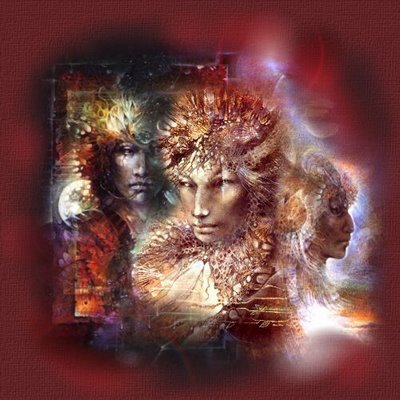
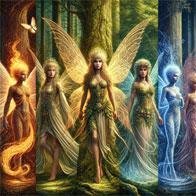
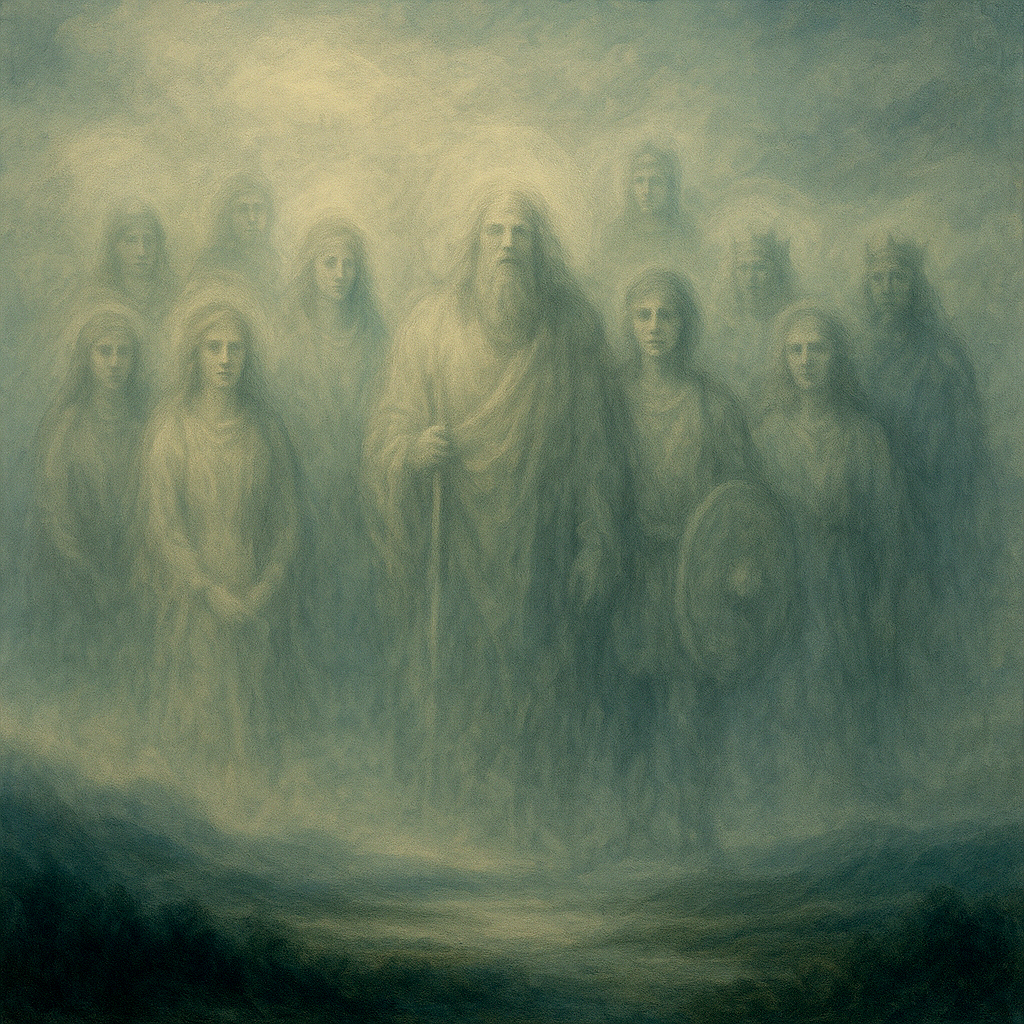
In Celtic mythic tradition, the highest Fairies are called the Sidhe (Shi). Above all, this name belongs to the High Fairies of the Seelie Court —Din Shi.
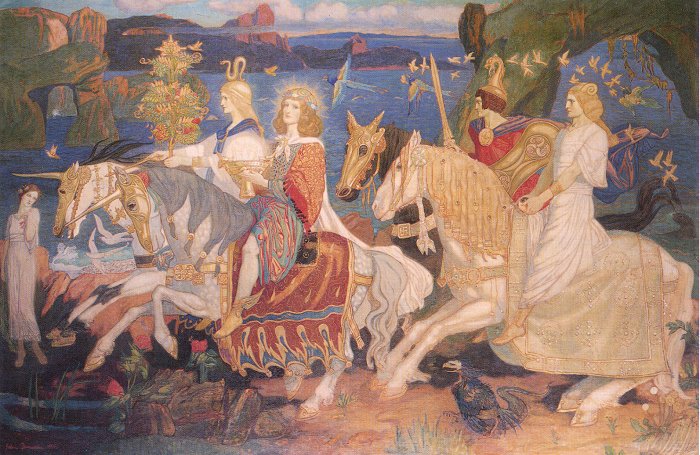
Like other Heroic Fairies, the Din Shi pass their time in aristocratic amusements: they dance, make music, hunt, and ride. They are also constantly at war with one another and with humans. Barely healed from one battle, they ride out to the next hunt.
The Magic of the Shi shows itself in the making of poetry and music — arts that grant them power, sometimes involuntary, over the elements and over human hearts. The great tradition of the fili and bards of the Celtic world is a subsidiary branch of the Sidhe’s own musical tradition.
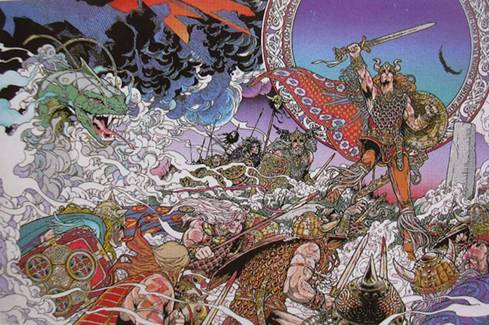
According to legend, the Din Shi were once gods (of the tribe of Tuatha Dé Danann), then became warriors who never suffered defeat in battle, and in the end turned into High Fairies.
We have already spoken many times of this idea: as it moves away from its source, a people degenerates —Jötnar become Trolls, Elves become Fairies.
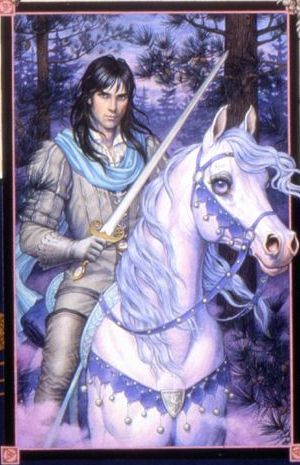
The Din Shi live like medieval knights, dividing their days between feasts and battles.
These Fairies can change form at will: at times they stand as tall as an adult human, or taller; at times they seem to become children.
The good Din Shi hunt deer with their white, red-eared hounds; the evil hunt humans and gather human souls. They race across the sky with a sound like the cries of migrating birds; their horses’ eyes blaze with fire.
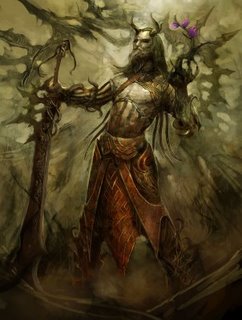
If the Sidhe are not pestered, they pay humans no attention. Yet a single touch is enough to drive a person mad; the Sidhe’s arrows, tipped with poison, kill on the spot.
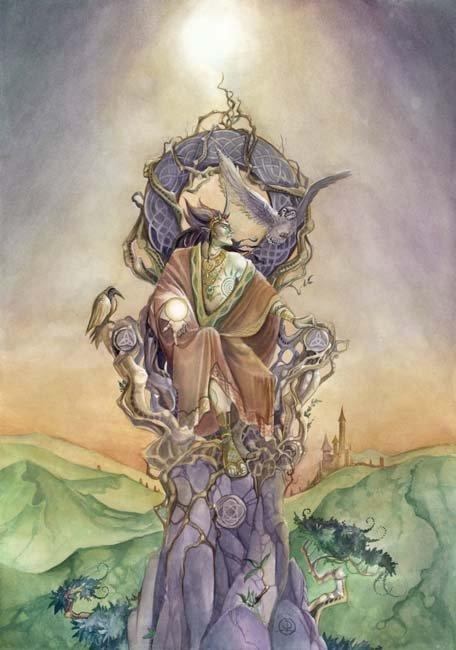
The Sidhe are a people of Magi, sages, and poets, perfected in art and enchantment. Their power lies not in bookish wisdom or the passion for natural inquiry so characteristic of humans, but in the deepest grasp of the world’s design and an uncanny kinship with it. It is even said that so much is given to the Sidhe from the beginning that they have no need of knowledge.
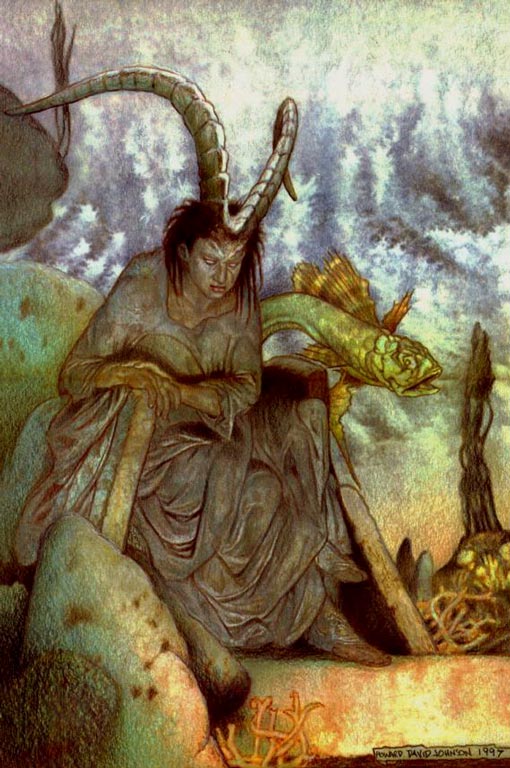
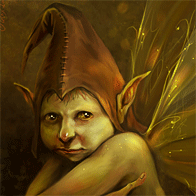
The Sidhe, like all Fairies without exception, are marked by an inhuman, unearthly beauty — darkened, however, by some deformity. Elle women are striking beauties, yet from behind the back of the head is hollow. Scottish Glaistigs wear long garments to hide their goat hooves. Shetland “Limpers” limp. Some have only one nostril or one eye; others have no nose at all; still others have fangs protruding from their mouths. A fourth have webbed hands and feet. A fifth have breasts so long they must throw them over their backs.
Dances and music occupy a central place in Fairy lore. Welsh Fairies are most often seen dancing. They try to draw mortals into their round dance, and if a person cannot resist, they will not be seen among friends for a long time. Thus the Fairies drew a certain Edmund William Rees into their circle, and he returned home only at the end of the year — and his face was gone. He scarcely remembered what happened and kept repeating only that he had been dancing. This is what happens in such cases. People either cannot — or dare not — speak of their adventure. In most such stories, the hero dies at the very moment he is freed from the Fairies’ power. Sometimes he simply crumbles into dust — suddenly and dramatically.
Fairies have their own codes of honor, which they follow strictly. Those who violate these rules the Fairies punish severely. Above all, they enforce secrecy: they have much to conceal, and they punish those who try to spy on them with cruelty. People who boast of their merits before the Fairies often fall ill; elven marks appear on their bodies; paralysis strikes them down. Those who try to steal Fairy treasures risk their lives.
It was likely these very notions that kept the Din Shi from coexisting peacefully with humans.
In ancient times the Sidhe readily mingled with people. Many mortal heroes took lovers among the Shi, and mortal women went to live in the Fairy Country (and later — in the Hills).
One of the most mysterious themes of Irish mythology is the love of Sidhe women for mortal men, whom these enchantresses lead away into the Shi. Even druids cannot withstand their charms. Thus the king, Condla’s father, begged a druid to protect his son from the enchantment of a female figure calling him to the Plain of Bliss. The druid could do nothing, and the young heir left this world forever.
In our time, the ways of mortals and the Sidhe have diverged widely, yet the ancient bond has not been severed: many old families of the British Isles count the Sidhe among their ancestors, and many of them the Shi still patronize — by the old memory of blood.
Although the Sidhe are known as brave and skillful warriors, there is almost no testimony of their wars or duels with humans. With the sons of Míl they prefer to settle matters not by force of arms, but by other means. Perhaps the reason lies in a special prohibition — a geis — shared by the whole people of the Fair Folk; or perhaps the tales are right, and cold iron, from which human weapons are made, is unbearable to the Sidhe.
Sometimes this is linked to the iron tools used to plow fields and cut down forests — that is, to humanity’s capacity for the symbolic killing of nature. Iron, then, would have filled the Fairies with revulsion. One legend tells of a man who, intent on forcing his way into the kingdom of the Shi, deliberately propped open the small door of the secret entrance with an iron rod so it would not slam shut behind him forever. That is how the clever fellow avoided a grim fate.
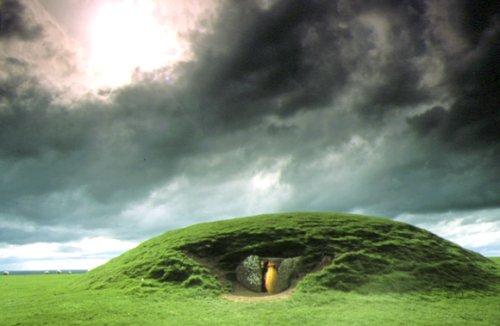
We have already noted that Celtic legends say that after humans spread across the land, the Fairies refused to share the manifest world with them and withdrew into the “Hills,” which also began to be called “Sídhe,” “Shi” (Ir. Sídhe, peace). They needed a new refuge, and their king, the great god Dagda, decided to assign to each of the Tuatha Dé Danann remaining in Ireland a sídhe. These sídhe were barrows, or artificial hills, each with a special gate leading into an underground kingdom of endless delight and unheard-of luxury — entirely in keeping with the primitive notions of the ancient Celts. A description has come down to us of one such sídhe, which Dagda took for himself and which his own son Aengus seized by deception.
Since then each Fairy is called Fer-Sídhe, “a man of the hill,” or Bin-Sídhe, “a woman of the hill” (the banshee of popular folk tradition).
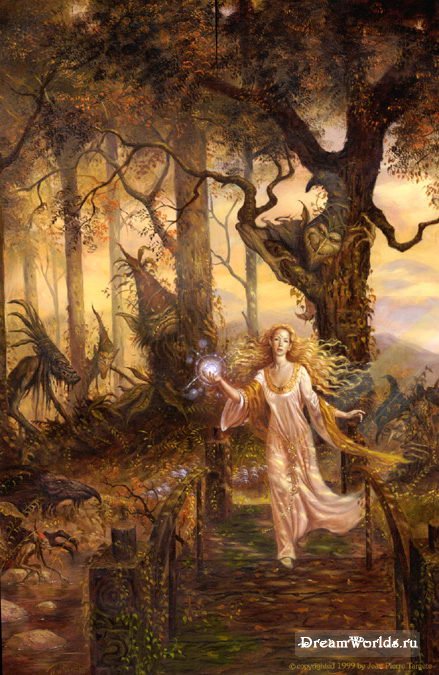
These hills are also called “knowe,” and are divided, as it were, into two parts: the outer (“Shi,” “Sídhe”) and the inner (“Bru” or “tulmen”). The Shi is a cave, while the Bru is a hall with a ceiling supported by columns.
Several Fairy families usually live in the Bru at once, while solitary Fairies dwell in the tulmens. Sometimes one can see the entrance to the bru. Most often this happens on the eve of one festival or another — say, at Lammas-tide (7 August). But on Hollan-tide (11 November) it is better not to go near the hills at all: on the night of 11 November the Fairies travel between the hills along their roads and little paths, spread out like a spiderweb.
The entrance to the Bru can be seen at other times as well: for this, one must go around the hill nine times at the full moon — no more and no less. Then the eye will behold what is happening within. On hills known to be inhabited by Fairies, one should not build dwelling houses, churches, or castles: the Fairies can move these buildings elsewhere.
Some maintain that in this guise the palaces of the Shi appear to humans; others say the hills are only gates, a kind of antechamber to the true country of the Shi (the Fairy Country).
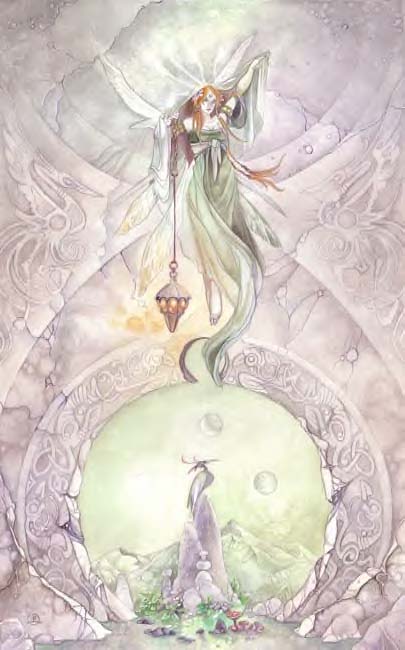
In Ireland, places dedicated to the Sidhe appear at every step. Place-names show how deep these legends run. Their favored dwellings are hills and knolls. On those same knolls once stood settlements or stockaded forts of the ancient Irish, and they are often taken for the dwellings of the enchanted folk. Yet the Fairies are by no means bound to all these raths, duns, and lisses; they often choose rocky rises, stony hollows, or deserted groves. There they are seen when they come out to attend to the affairs of their settlement. Fairies often travel from place to place along their own trails, invisible to the human eye; but woe to anyone who builds upon their trail and blocks them from moving freely wherever they please.
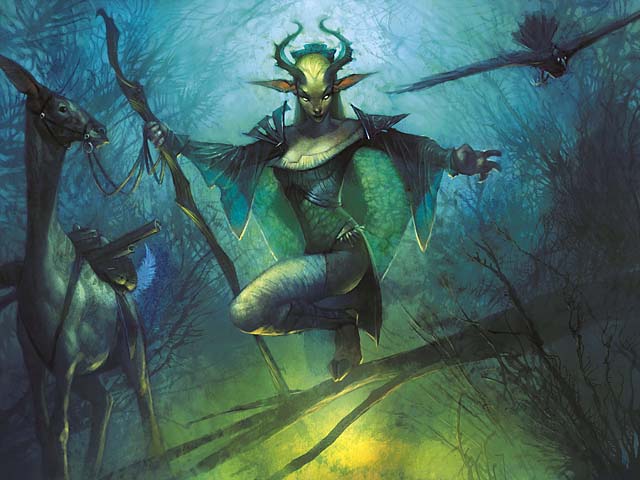
In the folklore of the British peoples, a plot appears often enough to be called “marvelous funerals” — the funerals of the Fair Folk. Yet tales and legends repeat that Fairies do not die — at least, not of old age (they can only be killed or mortally wounded).
Dying — or more precisely, perishing in the human world — Fairies return to the Fairy Country, where they continue to live as though nothing happened (there is no record of anyone ever dying in the Fairy Country; on the contrary, it is said everywhere that death is barred from entering it).
Yet at times they grow so weary of life that they begin to dream of death, which would deliver them from the burden of being. And to die, a Fairy must obtain an immortal soul, like a human one…
One would very much not want there to be more of such “marvelous funerals”…

Why do the good Dinn Shis hunt deer? Is it known how the common geas for fairies sounds? And, if it’s true that geas are used as a counterbalance, what counterbalance is referred to in this case?
Most likely, people perceived some other, incomprehensible activity of the Fairies as “hunting”. As for the geas of the Fairies, it is believed that it consists precisely in the prohibition of touching iron, martial, masculine metal, since the Fairies bear a considerable share of the energy of their Mother.
I’m also interested to know about geasa; as far as I understand, they are given in addition to a specific gift… and violating a geas leads to a kind of “backlash” on the recipient of the gift. It’s quite a double-edged sword, each side of which is quite hefty… Is that so? And if not, why did this practice arise?
Geasa are ritual prescriptions that can be individual for each person or common for groups of people. These prescriptions, the specific meaning of which is not always obvious, are associated with the characteristics of individual vortices and their interactions. Geasa can be unfavorable and favorable; that is, some say what the king must not do, while others say what the king must do (prescriptions).
The main task of geasa is to preserve the energies of their recipient from mixing with other energies, that is, to maintain individuality, selfhood.
Regarding hunting… Being, in essence, in the Interworld, the fairies are largely cut off from the flow of Power; perhaps the Deer, which in literary sources is usually described as magnificent and magical, and the pursuit of it is a way to replenish energy in the manifested world? In the remaining legends, this Hunt is a process without a specific result, i.e., the capture or killing of an animal.
From this point of view, those giving geasa must “see” those very possibilities of mixing energies… it is obvious that this is not the easiest task. And here it’s clear why they were given by gods and druids. However, in legends, others less exalted characters often give them too, and this may lead to conflicts of geasa. Moreover, there seems to be a parallel with Achilles, who was invulnerable until the geas was violated (not leaving the heel unprotected)… the violation of the geas is laid in the myth simultaneously with its imposition; otherwise, the owner of the geas becomes unbalanced and powerful, leading to the myth’s imbalance.
Hmm. A peasant from the 15th century saw the actions of a member of ‘Greenpeace’ from the twentieth… And we ourselves: how long has it been since we caught lizards and birds and then released them? This people has always been interested in the individual beginning, hence ‘hunting’ is just that – hunting, the only difference is the subject of it becoming Power, as in the case with peyote.
That is, the author does not want fairies to gain an immortal soul? This gives an undeniable advantage to such “notorious” peoples as humans. It would be worth pondering, “why?”
‘The Sidhe, like all fairies, are characterized by inhuman, unearthly beauty, overshadowed, however, by some deformity.’ Curious, why must fairies have a deformity? Perhaps because they are representatives of the Inter-realm and manifest in our world not quite fully? Thus, this ‘halfness’ appears as a defect in fairies.