
Spontaneity and the Logic of Myth
When consciousness adopts a particular way of describing reality, it often selects a few features of a Myth that appeal to it and rarely analyzes the spirit of this system itself.
Every Myth, as a form in which being exists within consciousness, obeys a binary that determines the possibilities for consciousness to develop within that description: the binary of logic–spontaneity.
A world-descriptive system formalized in a Myth remains stable only when it is systemic and carries inner regularities of its own operation.
Consciousness often accepts certain elements of a Myth and resists others that necessarily follow from the Myth’s own logic. A common source of suffering and inefficiency in consciousness lies precisely in its conflict with the unobvious yet necessary manifestations of the Myth in which it exists. Social Myths are a typical example. Their linear construction can be extremely attractive (for example, family–work–home; work–dacha–mistress, and so on). They give a sense of clarity and solidity, yet at their core they contain a drive toward mutual consumption and suffering. By accepting such a Myth, a person — usually without awareness — signs a “license agreement”: the appealing features of “ordinary” life appear in large print, and below, in small print, comes the addendum: “I undertake to suffer for a long time and painfully.”

The same situation also characterizes Magical Myths. Very often a person enters one Current of Power or another on the basis of a first impression alone. Later, when the person encounters manifestations of that Myth that feel disharmonious, the person ends up in a situation that is difficult to resolve. It demands either a significant restructuring of consciousness in accordance with the Myth’s logic, or a change of the Myth itself.
Although restructuring consciousness is usually necessary for increasing its effectiveness, it matters that this restructuring proceeds under the influence of one’s own resources, from inner necessity, and not simply because the Myth was not accepted with awareness at the outset.
For that reason, the analysis of a Myth that a Magus undertakes — both at its threshold and at every turning point of movement — must include less an analysis of the Myth’s “body,” its letter, and more a penetration into the spirit of the Myth: into its inner logic, into awareness of the regularities by which consciousness within that Myth must function.
The second element of the binary that governs the life of consciousness in a Myth is the necessity of spontaneity.
A harmonious Myth is not a rigid, ossified system that strictly regulates the actions and movements of consciousness. It is a seething stream of life in which consciousness not only develops but also increases its freedom.
In the final analysis, the movement of consciousness is a movement from illumination to illumination — and toward Enlightenment.

When the individual elements that consciousness has accumulated through an evolutionary, systemic expansion within a Myth enter into resonance with one another, they suddenly, for no visible reason, shift to a new qualitative level. They connect and synthesize, acquiring new qualitative properties, so that from time to time “evolution” inevitably gives way to “revolution.” Such revolutionary changes can be constructive, when the system rises to a new level of synthesis, or destructive, when the system suddenly collapses in order to open the Way to a new stage of the Way.
The development of consciousness within any Myth therefore falls under the action of two forces. On the one hand stands the organizing, systematizing logic of the Myth, which cosmizes consciousness. On the other hand stands the transforming force that provides “leaps” — transcensus — of consciousness.
The Magus must take both forces into account and understand, first, that by accepting some elements of a Myth, the Magus must also accept other elements that logically follow from them in order to use the Myth’s possibilities effectively; and second, that the Magus must be ready for transformation and for abrupt, leap-like changes in consciousness.

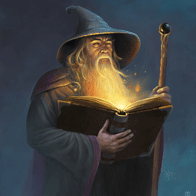
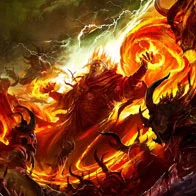
Hello! What do you think is the nature of the ‘jumps’ of Power, as awareness occurring directly through the contact of consciousness with the Myth, their symbiosis, or just under the influence of some accidental external influences on consciousness?
I think that the transcensus of consciousness only seems random from the lower point of consciousness; for a more highly developed, more synthetic consciousness, they appear quite logically as a continuation of a single, essentially, process of development.
I believe the nature of the ‘jumps’ of Power, as well as awareness occurs directly through the cognition of the logics of the Myth. The Archons bring spontaneity into the Myth. The introduction, the symbiosis of spontaneities is a test for those gaining knowledge of the logics of the Myth.
Similar thoughts, thank you!