Quaternary
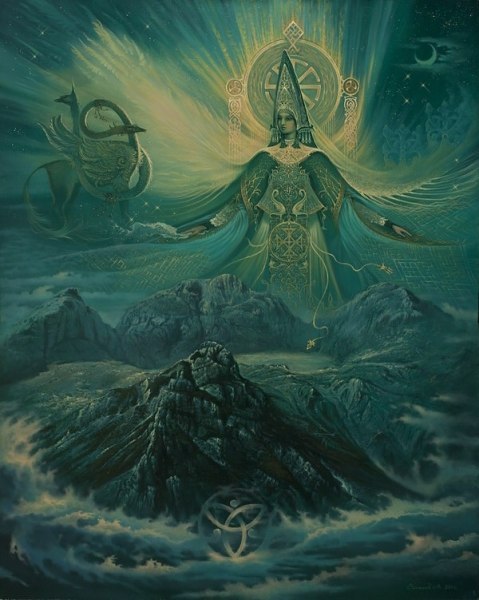
The ternary division of the spheres generates a quaternary projection.
In its development and projection onto a plane, three rays form a cross (see “Kolo of Veles”).
Duality, giving rise to the realm of mutual reflection of its poles — the “third principle” — endows it with activity, which in turn demands a certain “field of influence.” The ternary proves to be an active element and, as the binary’s correspondent, it actualizes the fourth element. The alchemical example we have examined helps to clarify this. Prima materia, Azoth, divides into the principle of Fluidity, passive (Mercury), and the principle of Combustibility, active (Sulfur). Their interaction generates the second modification of matter, Salt. Salt “dissolves” into the “contaminated” matter that is, in fact, physical substance itself.
Kabbalah offers the example of a family: Father and Mother beget a Son who, in order to continue the lineage, requires a Bride, thus reproducing the cycle anew. In other words, the quaternary arises wherever there is movement. If the binary and ternary describe only the emergence, the becoming of reality, the quaternary governs its further development.
At the same time, the transition to each new level entails the arising of that level’s own laws; therefore, although the quaternary is the lawful continuation of the ternary, it is formed and acts according to its own rules.
It is well known that the principle of the tetrad describes the mode of unfolding of any manifested being: the active principle, the Idea, the Father, is reflected in its analogue — the passive, receptive principle, the Mother — and this union begets the third element, the Son, who possesses both the capacity for synthesis (from the Mother) and for analysis (from the Father), and therefore is the only fully effective agent. Yet the activity of this element demands a corresponding Field of operation — thus the fourth element of the Quaternary arises.
I do not wish to repeat trivialities about the solar character of the Four; it is better to turn to the practical use of the quaternary in the mythological field under consideration.
What does this mean in practical terms?
In the Slavic tradition several cyclical rituals are known — “kolos” — which constitute a substantial part of the volkhv’s life. The first kolo — the Kolo of Veles — must be passed in order to acquire Power. This ritual in itself does not directly grant Power, but as a result of passing through it a specific inner space is formed, necessary for the reception of magical Power, and Power, as I have already said, flows only where there is room for it. The kolos of Svarog are also known — the path of attaining the wisdom of the world, “silent knowledge”; of Semargl — the path of union with the Powers of the elements, and others.
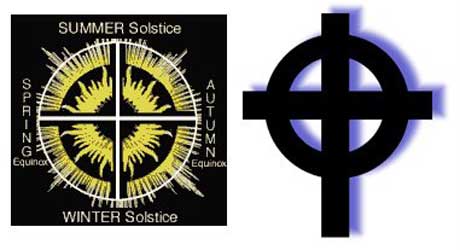
The meaning of any kolo — both symbolic and cosmic — is expressed by the symbol of a cross inscribed in a circle. Power moves along the circumference, which is divided into four sectors of differing character; in these sectors Power takes on four characteristic modifications. The world is symbolized by the circle — the most perfect of figures. The Four confers upon the world the quality of manifestation.
The quaternary division of nature is one of the basic modes of operation of consciousness. Primary duality engendered the four primordial Powers that breathed life into all that exists in the manifested world.
Everywhere in descriptions of the world and of world‑processes we encounter quaternity: the four cardinal directions, the 4 seasons, the 4 elements, the 4 royal stars (Aldebaran, Antares, Regulus, Fomalhaut), the 4 fixed signs of the zodiac (Aquarius, Leo, Scorpio, Taurus), the 4 ages of man (childhood, youth, maturity, old age), the 4 rivers of Paradise springing from the Tree of Life, the 4 Archangels of Christianity, the 4 Kumaras in the Persian tradition.
The square (and, when needed, the rectangle) is the figure most frequently used by humans in practical activity.
Jung distinguished 4 functions of the psyche: sensation, intuition, feeling, thinking. Three of them are conscious, and the fourth is unconscious (or repressed). The arrangement of these functions differs in each individual. These 4 functions are disposed around an essential component — volition or judgment. Jung adds that the principal psychological elements of human existence — the archetypes: animal, shadow, ego, persona — are likewise arranged in quaternary order and form around the Self.
Kabbalah divides the universe into 4 worlds; the alchemical process has 4 principal stages.
This directly concerns our subject, since any kolo is a kind of alchemical process taking place in the body of the practitioner or in the world around him.
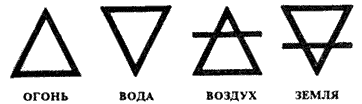
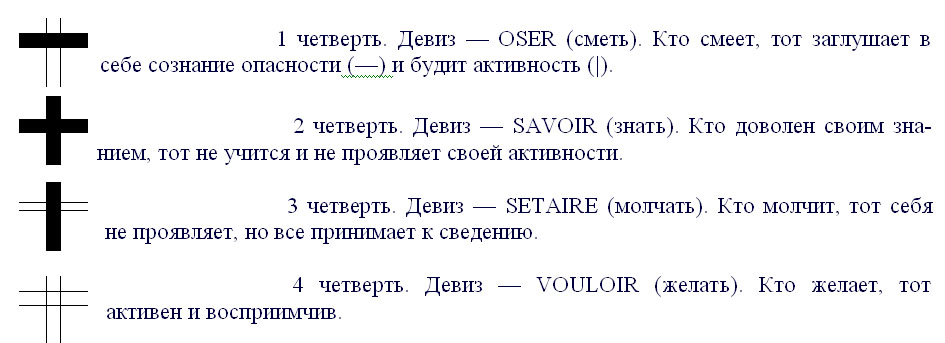
European magicians (according to G. O. Möbes) depicted the 4 quarters of the magical wheel as crosses, in which the vertical line signifies the striving toward activity, and the horizontal line — receptivity:
The symbolic series of the four Powers in the European tradition are presented in two forms of the so‑called quaternaries, each of which expresses a particular complex of metaphysical and realizational ideas.
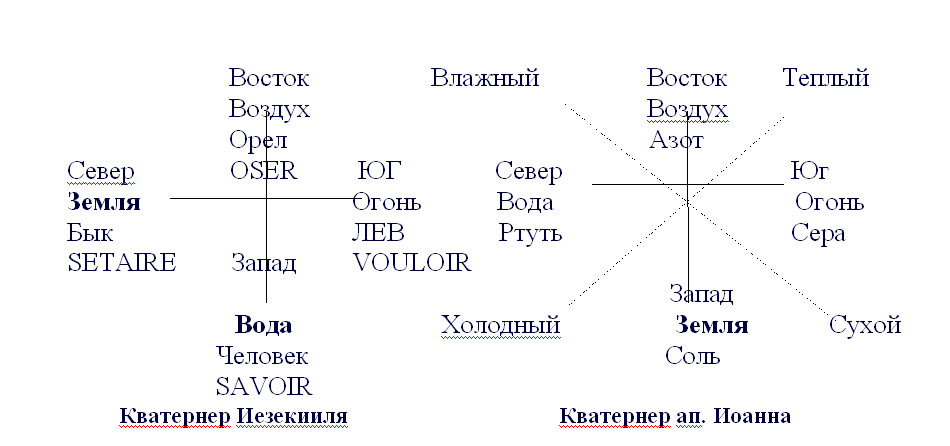
The Quaternary of Ezekiel symbolizes operations of summoning and adjuration, while the Quaternary of John symbolizes perception or action within the human being (and also astrology and alchemy).
The cyclical rituals under discussion are actions alchemical in their very nature; therefore they are symbolized by the Quaternary of John, which we shall examine in greater detail.
Air and Water are regarded as the virginal masculine and feminine elements, and Fire and Earth as fecundating and fecundated. Thus the opposition of the Quaternary of Ezekiel symbolizes harmony and stability, authority and power — qualities indispensable in operations of evocation. The Quaternary of John symbolizes a constructive imbalance that acts as the driving force, compelling attainment in the alchemical Work.
Power moves in a spiral, returning to the same themes on ever higher levels.
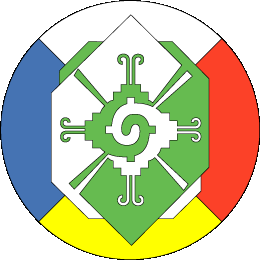
Power returned to its source is transfigured Power, having passed through the cycle of change. Every genuine beginning is the result of what preceded it.
The four primordial Powers with which the magician interacts in passing through any kolo are expressed differently in different aspects and, in their union, are symbolized by the Sphinx.
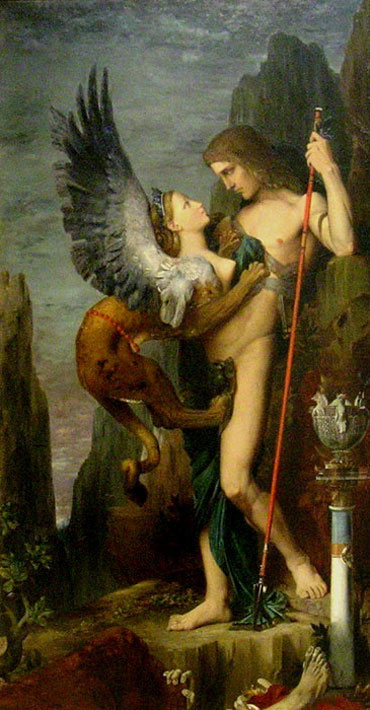
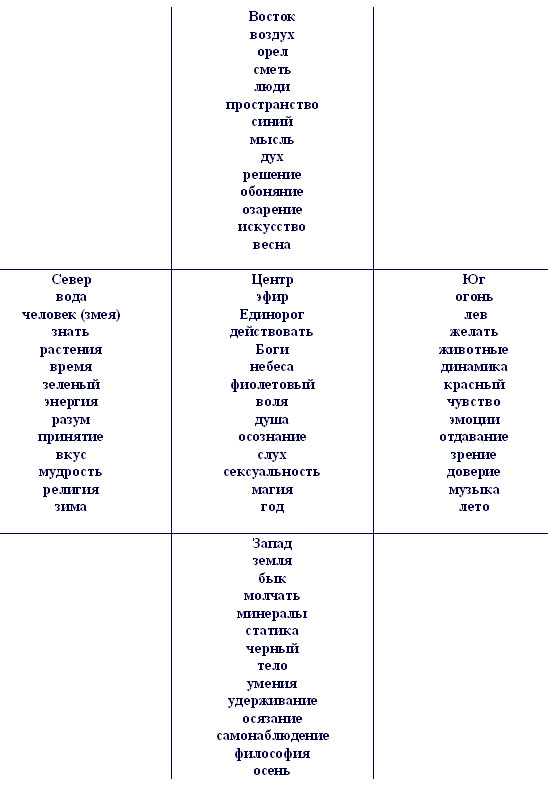
Let us consider further series of correspondences (within the scheme of the Quaternary of John).
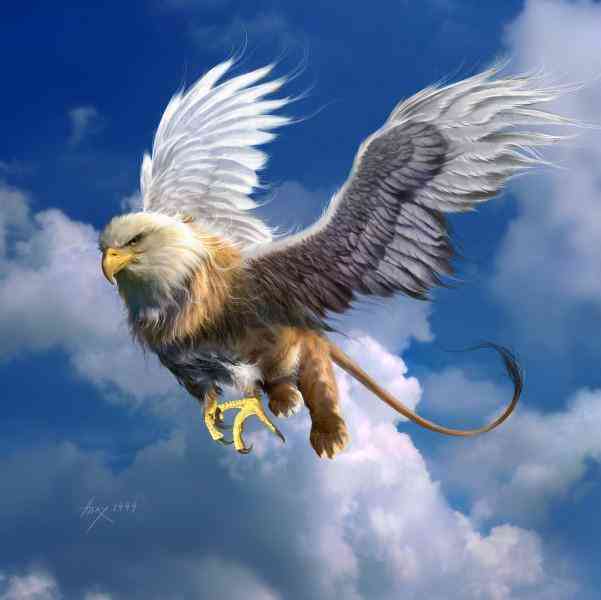
Pairs of correspondences, opposed along the cardinal directions in this scheme, complement one another, struggle and cooperate with one another, forcing action. Each of these symbolic series can be consciously realized and lived through, resulting in rebirth to a new action, a new Power.
Добавить комментарий