
Slav’ — the Principle of Honor

Among the principles of the Psychocosmos that generate the field for the development of the mind, the leading role is held by Slavi.
We have already said that the two spheres of being of Slavic myth — Yav (the manifest, the actual) and Nav (the unmanifest, the potential), which transform into one another — are suffused with a neutral principle — Prav, which converts Nav into Yav and Yav into Nav. Therefore, Prav exists in the form of two currents, embodied in the White and Dark principles, Belobog and Chernobog, and also the White and Dark goddesses. These are not separate gods but governing principles that ensure the flow of the World process, in which Belobog and Chernobog express the active aspect of Prav, while the White and Dark goddesses embody the substantive aspect of Prav.
The action of the White principle converts Nav into Yav, and that of the Dark converts Yav into Nav. Although these principles are mutually necessary, it is clear that they are also opposed.
The principle that arises from the action of the White principle in Yav is called Slavi (and that of the Dark — Kriv). In other words, the principle of Slavi includes an evolutionary current that raises the mind to ever-higher levels, and worlds to ever-greater perfection. In this sense, the concept of Slavi approaches the Gnostic notions of Sophia and Epinoya, although in its particular aspect it relates more to the state of mind than to the world it perceives.
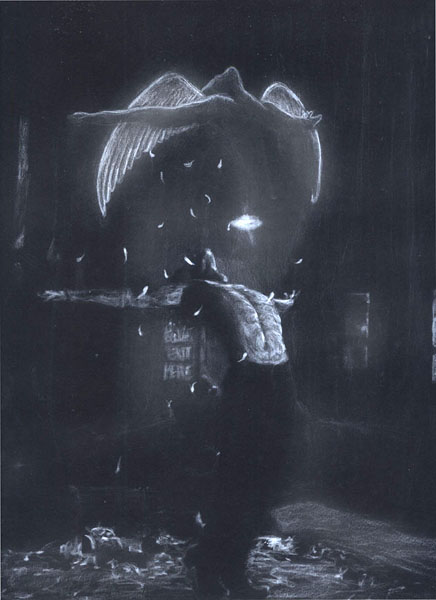
The principle of Slavi manifests in the cosmos as a striving for evolution, and in the human being as a striving for the stable expansion of mind.
Accordingly, the more fully a being is aware (in the broadest sense of the word) of the necessity of developing within it the manifested stream of awareness, together with an understanding of its origin as a mode of self-knowledge of the Great Spirit, the more it participates in Slavi.
It is precisely this awareness — a clear vision of the nature of the stream of mind and the aspiration to keep it in an unclouded, self-consistent state — that is traditionally described as honor. In other words, the more firmly a Magus’s stream of mind is rooted in evolutionary aspiration, and the more unswervingly he follows that aspiration, the higher the honor of that stream, and, correspondingly, the greater its participation in Slavi.
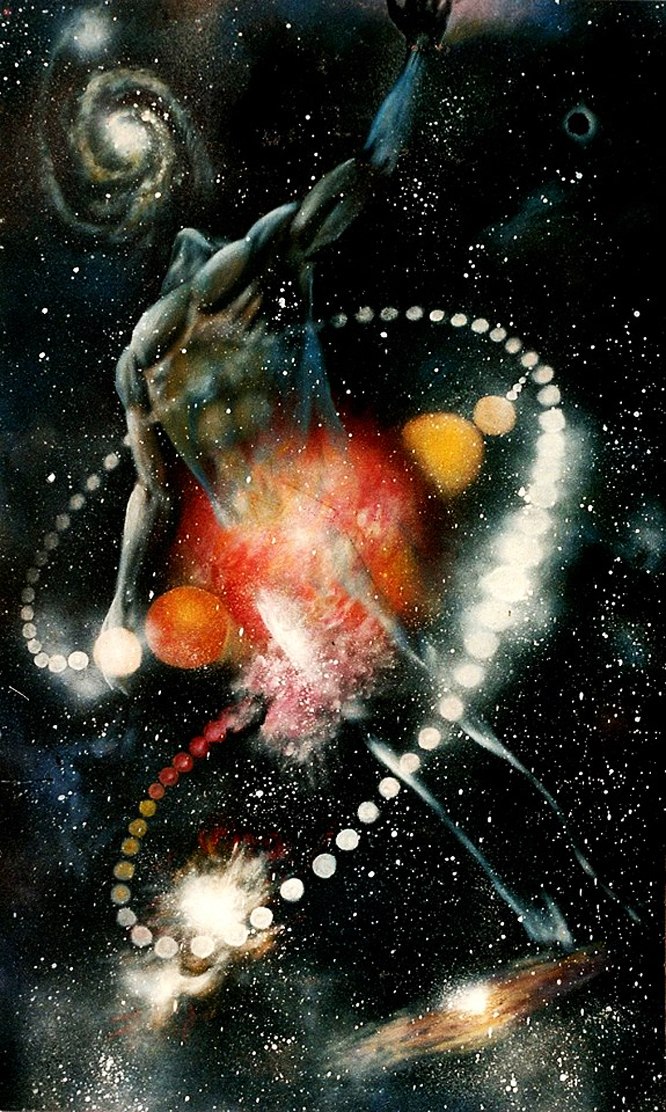
For a Magus, the notion of Slavi is practically important, since it denotes the degree of the evolutionary aspirations of his Way. The more a Magus is directed “upward,” the stronger his attraction to the cloud-capped peaks of the mind, the more “slavi” he is. At the same time, existing only in Slavi turns a person into a saint rather than a Magus, because it deprives him of a foothold in the manifest plane and of the possibility of dispelling darkness through its disclosure; for interaction with Kriv is also necessary, since Magic is not only existence and development in Yav, but also periodic immersion required in Nav, the dark sea of potential from which one draws possibilities to develop the specifically magical form of mind — the mind of freedom. It is important for the Magus not only to develop but also to overcome, for he sees that the world is a field of opposing forces, whose harmonization requires constant and considerable effort.
Therefore, the Magus is compelled to balance contact with Kriv and immersion in it, and it is precisely a correct understanding and acceptance of the principle of Slavi that helps him avoid falling into regressive currents.




Exactly, ‘vertical’ striving does not allow one to get lost. More precisely, it provides an opportunity not to get lost, like a lighthouse.