Simplifications and Profanations

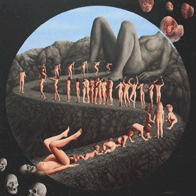
However we describe the Way of the mind’s development in the real world — whether as liberation from obscurations, from samsara, from illusion, or from a demonic condition — we must acknowledge that this Way lies not only beyond the Darkness, but also through Darkness. In other words, to attain anything one inevitably must overcome obstacles and apply effort.
At the same time, the idea of exertion, of effort and overcoming, in our modern debilitated, pampered and overindulged world — rich in both resources and information — appears terrifying and provokes fierce resistance.

Indeed, it seems that the favorite tactic of predators and parasites — the playing at giving in — has paid off, and as a result the world is filled with people too lazy even to scroll past the second page of an internet search, let alone to make the extra effort to open a book and (God forbid) read it. It seems the days when seekers crossed thousands of kilometers of rough country to reach a monastery or a school that guarded Knowledge are irretrievably gone, and the fate of the modern world is an all-pervading profanation.

We live in a world where it is respectable and even prestigious to be stupid, where effort is justified only for sustaining the body, and the mind must content itself with serving the chains of consumption.
“Simple techniques,” “widely accessible methods,” half-skills, half-knowledge — these are all signs of profanation, which is far more dangerous than the absence of knowledge, since it creates the illusion of progress, development, and attainment. And a person, as we have often noted, will never strive for what he believes he already possesses.

Ancient treatises, collections and codes were written in a very complex and ornate language precisely to protect Knowledge from the profane, or more accurately — to protect the profane from “half-knowledge”, possession of which proves a greater obstacle on the Way than mere ignorance.
Facing such a complex text, one either abandons it after the first sentence, thus avoiding the fate of falling into “false understanding,” or applies effort to comprehension and thereby trains one’s mind, getting it used to strain and thereby “pried open” it, gradually releasing it from the attractive force of bad repetitions of the gilgul.

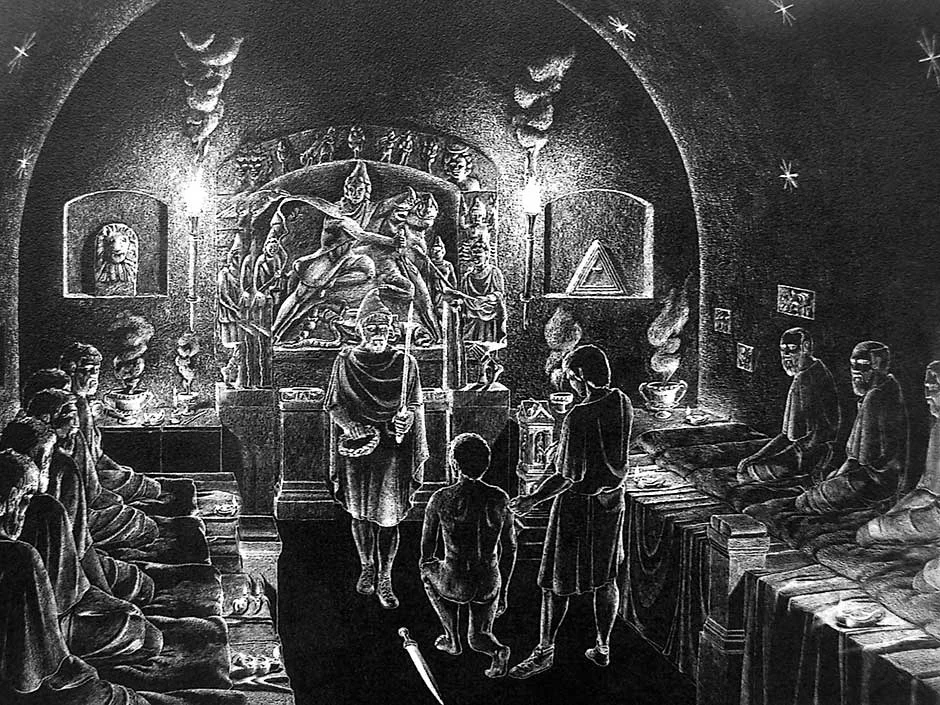
The same function was served by the “trials” to which candidates for discipleship in the ancient Schools were subjected — they were meant to weed out, and thus to protect the unprepared from suffering serious harm caused by misunderstood concepts and incomplete practices. Only those who were willing to exert themselves to overcome such artificial “trials” had a chance to cope with real obstacles that Darkness places before them.
Whenever we seek to obtain something without effort, we do not merely avoid development or give in to laziness; we inflict direct harm on our minds. And just as a diet of softened, pulverized food that requires no effort to digest harms bodily health, so feeding on scraps of information, fragments of practices, and echoes of Knowledge — destroys the Way of the mind.
Conversely, forcing our way through the tangle of words and meanings, images and metaphors in Traditional texts, and overcoming laziness, drowsiness and apathy in the performance of Practices, we do not merely discipline our body and mind; we give them a real chance to develop.