Iron: The Magic of Death and the Death of Magic
Modern civilization, with its industrial spirit, emerged when humanity learned to smelt iron.
The metal of Mars, difficult to grasp, fundamentally altered the course of history, raising the technology of killing to an entirely new level.
But iron is not only the metal of machines and swords; it embodies aggression and killing.
The metal of blood — both literally (human blood contains roughly 5 g of iron as part of hemoglobin) and metaphorically (as the embodiment of the force of war and bloodshed) — iron altered not only the history of civilization but the development of the spirit.
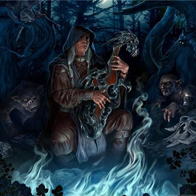
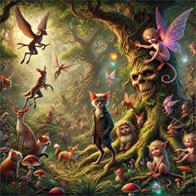
It is well known that Fairies, as well as spirits and ghosts, cannot tolerate iron. Arabs believed that evil spirits, jinns, feared iron, and that simply mentioning it acted as protection against them. In European folk belief, iron was regarded as destroying the spells of elves, fairies, and witches.
Again and again, the ancient ritual fires burned without iron; altars were built without the use of iron or other metals mixed with it.
It is precisely because of this that as soon as humanity gained access to this metal, it simultaneously complicated its relationship with the ‘subtle’ world — the world of fairy tale and unpredictability, the world of freedom — radically more complicated, and shifted to its present, rigidly determined mode of existence.
In Ancient Greece, no iron could be brought into temples. Roman priests were not to be shaved nor ritually purified with iron at sacred times.
Herbs in all cultures were usually gathered with knives not made of iron, because people believed that the power of this metal would disturb the plant’s energy.
The iron sword, as the symbol of the magician’s power, is also intended to cut through and disperse vortices. The same action was attributed to the many swords of heroes in every land.
What, then, is the cause of this effect of the metal of Mars?
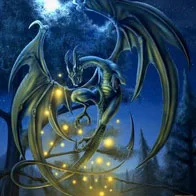
Although the source of iron in antiquity was the sky (the first iron was meteoric), its true birthplace is the blazing depths of the earth. Pyrite — “dragon’s blood” — one of the alchemical prima materiae — fully embodies this principle of the fiery depths.
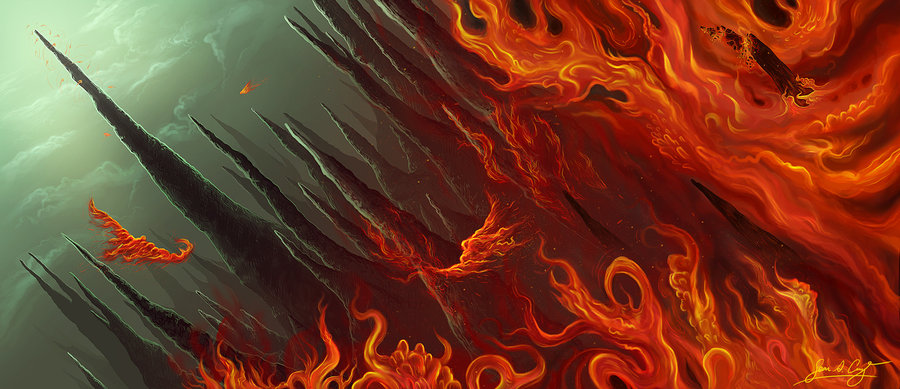
In this sense, iron is an expression of fiery chaos, the Great Dragon of the Earth. Thus the power of iron is a power of destruction, and specifically active, aggressive destruction.
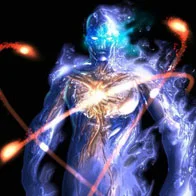
This Dragon is feared by spirits and fairies; it brings them death.
Iron is not simply the metal of battle; it is the metal of killing. Unlike lead (the metal of Saturn, also associated with death), for iron, killing is not merely a means but an end in itself — the point is not simply to end life, but the act of killing gives pleasure.
It is precisely the destructive impulse generated by iron that disperses vortices and drives away ghosts; it is this elemental force of killing that fairies fear. Moreover, even people whose veins run with elven blood feel discomfort upon contact with iron and suffer physical ailments and skin problems.
However, this force can be used for good — to ward off disease and misfortune: iron rings or bracelets are worn to “draw” illness away from the body. In Scotland, iron was used to avert danger when a death occurred in a house. Medieval Catholics drove nails into the walls of their homes to preserve health during plague epidemics.
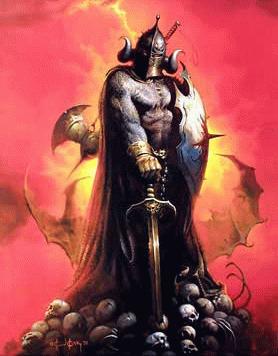
Mastering iron meant not only complete dominion, the maximal dominion over nature, but a shift to its violent exploitation, and also a renunciation of magic, since Magic — the free flow of life — is incompatible with iron. It is no accident that the advice “Hold on to iron so you won’t be jinxed!” still circulates. No unclean power (and, broadly speaking, no pure power either) could approach a person holding iron, much less harm them. Nor could it penetrate doors barred with an iron bolt. Iron armor not only protected a warrior from blows but diverted any sorcery, placing him outside the magical realm.
The smith who worked iron was, on the one hand, the master of its elemental force, but on the other hand, also partook of it; therefore, many peoples believe in the magical power of the forge and that this power — if not openly evil — has a demonic taint.
Having come into contact with the power of iron, humanity had only one way to subdue that power — to respond to violence with violence. Therefore, the entire modern world built on iron is also built on violence, on suppression and oppression.
Even the “benign” use of iron is fraught with the risk of its power running out of control — the cruelty of the fiery depths is simply too great, its thirst for hot blood too strong — blood flowing through iron and from beneath iron.
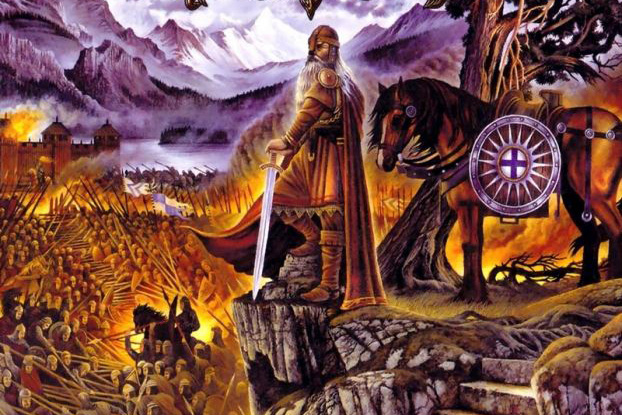

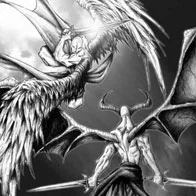
“By coming into contact with the power of iron, mankind had only one way to subjugate this force – to respond with violence to violence. Therefore, the entire modern world, based on iron, is also based on violence, suppression, and oppression.” Before the use of iron, wars took place, there were slaves, blood flowed like a river not only in wars but on altars as well. Yes, with the development of technologies, especially with the development of fast means of transportation, humanity has moved to more mass killings (simply because it is more convenient). I think this is not related to iron, but rather to the nature of people themselves.
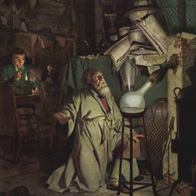
Isn’t working with metals, creating machines – the Magic of Metal (Iron)? If so, it turns out that metal magic is more effective than other magic, and therefore it has become the dominant way of life, interacting with the world.
If something is dominant, it isn’t always because it is more effective. What allows for achieving local effects may not be globally effective at all. Human civilization based on iron brings more harm to both people and their surroundings than good, and its effectiveness is illusory.
Enmerkar, please tell us about people whose veins contain elvish blood. You mentioned this in an article as a factual reality. Or could you suggest where I can read about it, which source can be trusted. I am interested in other signs of these people and how they differ from ordinary people. There is very little information about this. Thank you in advance.
Honestly, until this moment I was absolutely convinced that spiritual entities fear silver more than iron.
Iron walls are unable to contain a thermonuclear reaction, for example.
Iron conducts sound, vibrates; try holding a vibrating sword in your hands…
Iron bolts not only secure the entrance but also the exit. For instance, in the case of a fire in a building…
In the context of the role of iron in history, the Bronze Age catastrophe becomes interesting, which occurred for a whole range of reasons, but one of them was undoubtedly the mass introduction of iron weapons. As a result, most states and major cities of that time were destroyed by armed invaders with iron weapons. After which the dark ages ensued—writing was almost completely lost for a time, cultural traditions and the way of life of people radically changed.
From this arises the question of which gods stood behind this? Who was defeated and forced to leave the stage of history, and who found themselves victorious, taking the place of the defeated, and began to unfold their civilizational processes? After all, something similar is happening now, a change of eras.
Yes, it was then that the Battle of the Courts of the fey occurred, which ultimately led to the Exodus of the Magical people into the Interworld.
https://www.enmerkar.com/en/myth/the-fomorians-and-the-unseelie-court
https://www.enmerkar.com/en/myth/fairies-transformations-in-the-interworld
Thanks!