Shemhamphorash – a Technology of Liberation
We have discussed more than once that the goetic Tradition, describing the psychocosmos and macrocosmos as mutually reflecting infinities, pays special attention to the Force of Separation underlying manifested existence. It is precisely separation, the Threshold opposing the all-unifying influence of Eros, that generates both the manifested “physical” world — separating matter from antimatter — and the world of the mind — separating the “intelligent” manifestations of the psyche from the “mad” chaos.
At the same time, the Threshold is not an absolute barrier, because if there were no exchange between the binary poles there would be no source of energy, no potential difference to sustain manifestation; therefore the whole cosmic process consists precisely in the controlled exchange of energy and information between the various levels of the cosmos.
The goetic Tradition describes the Threshold as a sphere equipped with “Gates” through which the controlled energy exchange that keeps the worlds of being and mind alive occurs. We have already discussed that each such Gate has two properties — the capacity to “let through” and the capacity to “contain” a current of energy. The first power in its “pure” form is known as the Genius of the Gate, the second as the Angel.
Meanwhile, the Genius exists only potentially, as a metaphysical abstraction, the “ideal” form of the Crossing of the Gate. In reality, control over the energy current through a Gate is difficult, and that current is distorted, because a powerful counterforce to the natural basis — the light of Yehida — must manifest for the current to flow. That counterforce is easily twisted, turning individual individuality into separateness, pitting an individual stream against universal oneness.
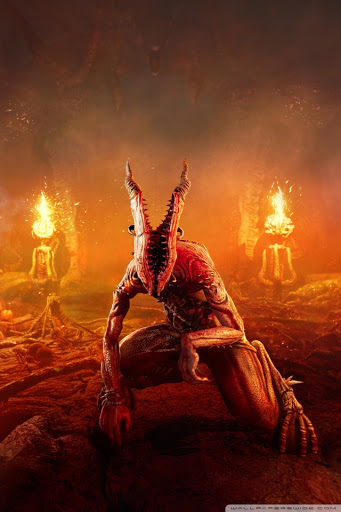
Such distorted forces, which seek to divert the energies of the cosmos — sephiroth — into the Qliphoth, have been called “goetic demons.”
Thus, the force of a Gate’s crossing exists in two aspects — 1) the “correct” one, expressed by the Genius, which seeks to “feed” the cosmos with the creative energies of chaos and to return exhausted structures to chaos, and 2) the distorted one, embodied by the goetic Demon, the Gatekeeper (Shomer), bent on removing everything from the cosmos that contradicts its blind egoism, and for that purpose constantly “draining” surplus energy that could otherwise support the evolution of the macro- and psychocosmos into the Qliphoth.
Because goetic demons are the product of distortion, the perversion of the mind’s natural impulses arising from egoistic blindness, it is clear that at their core lie hidden streams of the Genii, and therefore opposing the demons becomes the search for and activation of the Genii. We have already said that this approach is called “inner goetia” and is a psychotherapeutic method, which originated and was developed centuries before the emergence of all modern schools of psychotherapy.
The earliest mentions of this method are contained in “The Book of the Angel Raziel,” which gave rise to the practical application of the theory of the Divine Names to liberate the mind from destructive tendencies. The method consisted in “replacing” the demon’s name with its corresponding “original” name of the Genius, thereby correcting the very current of energy through the Gate.
Since the kabbalistic worldview characteristically identifies linguistic elements with energetic ones, words and letters with the logoi that create the world, this approach appears quite justified.
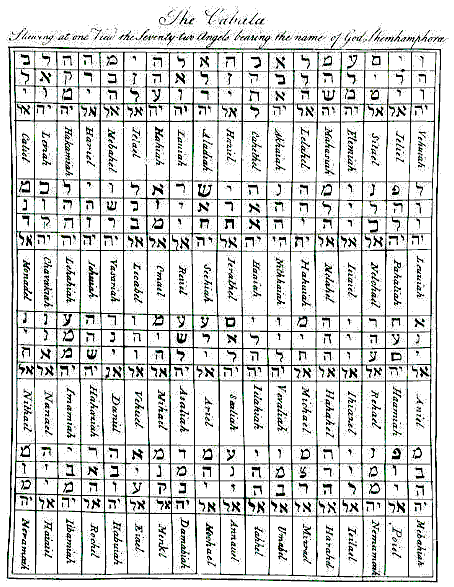
The basis for such a transformation is the Shemhamphorash — the table of names composed from three verses of the biblical Book of Exodus (chapter 14, verses 19–21), each of which contains 72 letters written boustrophedon.
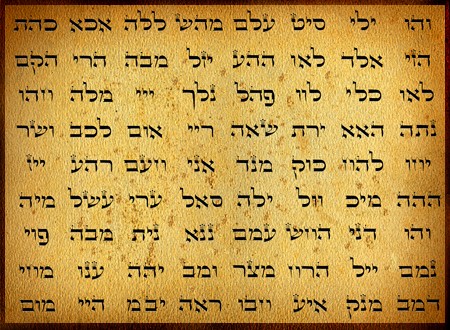
We have already discussed the symbolism of the Gates and the number 72; for practical use note that to each trigram obtained by the mentioned method one appends a “divine” definitive — –yah (יה) or –el (אל).
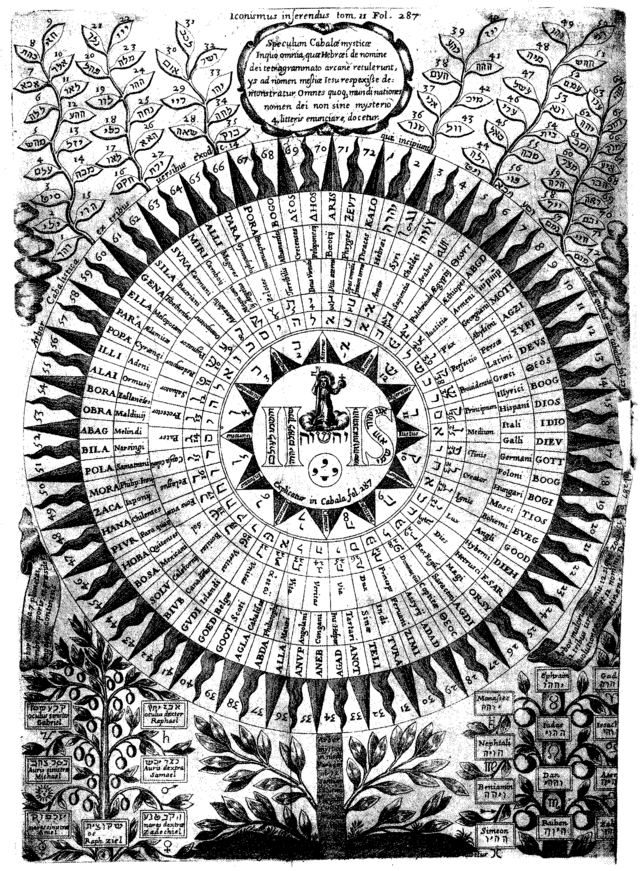
The tradition of appending suffixes to the Shem-ha-Meforash trigrams is first mentioned in the “Sefer ha-Bahir” (סֵפֶר הַבָהִיר, “Sefer ha-Bahir”), and is cited by H. C. Agrippa, A. Kircher, and F. Barrett. Thus a triad of divine power becomes a pentad of manifested will.
There are several interpretations and methods for turning the trigrams into five-letter names.
It is usually held that the choice of suffix depends on whether the force in question exhibits predominantly attractive or expansive qualities. In other words, if a Genius provides an “expansive” current of energy, its name ends in “-el,” and if it is “attractive,” it ends in “-yah.”
Moreover, the definitive “-yah” is associated with the sephirah Chokhmah and manifestations of Divine wisdom, while the definitive “-el” is associated with the sephirah Chesed and Divine mercy.
As is well known, the very word “Shemhamphorash,” more precisely — Shem ha‑Meforash (שם המפורש), means “the Divided Name,” which implies the essential unity of the entire system of Gates it describes. In its essence, this system is a logical continuation, an “unfolding” of the Tetragrammaton יהוה, a form of Its manifestation in the dynamics of the cosmic process.
Using the Divided Name as a method for liberating the mind requires both a clear understanding of the nature of the Genii and the goetic Demons, and knowledge of gematria and other kabbalistic approaches.
As an example of using this method, let us consider the transformation of the energy current of the demon of false hopes — Vassago — into the matrix of the Genius of nobility — Sitael. The name Sitael (סיטאל) has the numerical value (gematria) of 110. The spelling of the demon’s name with the same gematria appears as וצחו. Note that whereas all the names of the Genii consist of five letters (5 — the number of free will), the names of goetic demons in the system of the Divided Name are most often four-letter, which points to their “materializing” character. At the same time, the final letter of the demon’s name usually replaces or distorts the divine suffix. In this case, instead of the Presence אל, there appears the conjunction ו. In other words, Vassago manifests when the activity of an “explicit” manifestation is replaced by an “imagined” action. This is also indicated by the replacement of the letter ס in the Genius’s name by the initial ו of Vassago. Samekh — the letter expressing causal chains — is replaced by the “letter of union” Vav; instead of emphasizing process, there is attachment to results. Further: Yod is replaced by Tsade, creative activity by a “hunt” for chances, and Tet by Het; inner strength becomes power of limitation. Accordingly, to transform “false hopes” into “true nobility” one must, first, be present; second, find within oneself the energy of creative activity; and third, turn one’s potentials into potentiality.
It is clear that this process demands great attentiveness, honesty in self-knowledge, and determination in self-transformation, yet it is precisely the system of the Lemegeton and the Shemhamphorash that provides a powerful instrument for such inner-alchemical work.


Does it make sense to evoke these geniuses? On one hand, it can help activate the non-degenerated matrices, but on the other hand, it is precisely the genius that provides the ground for manifesting the gatekeeper. Would such evocation, due to the imperfection of the operator, contain distortions?
Such ‘Evocation of Geniuses’ is unlikely to be productive, as Geniuses are merely the ‘potential’, ideal core of matrices that are distorted in reality. And yes, in such an evocation, there is a high likelihood of ‘connecting’ with the demon – the actual representation of the relevant matrix, which, of course, will not hesitate to appear in the most benevolent and light-filled form. Therefore, a more successful approach to working with Geniuses is not their evocation but studying them, searching their energies, and gradually restructuring consciousness according to their ‘correct’ matrices.