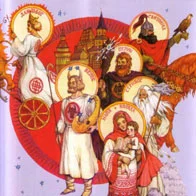
Rod the All-Sustainer
Although, as we have said many times, the notion of a Transcendent Creator of Worlds is derived from immediate religious experience, this notion is, of course, the flip side of every mythologeme, since any idea of Primordial Duality is rooted in the idea of Supramundane Unity.
Slavic pagan philosophy in this respect is no exception. In fact, the sole reality acknowledged was precisely the Most High, who, in the act of creating the world, was conceived in his creative aspect as Rod, the All-Sustainer.
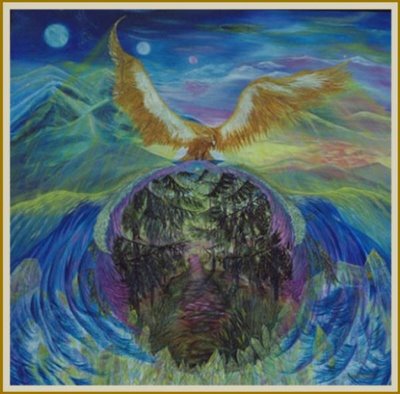
The Most High, who had not even a name — since any name would limit His infinity — by engendering Self-knowledge within Himself, becomes the Source of existence, the “Wellspring” of the Universe.
It is Rod who constitutes the highest point in the synthesis of Being and Mind, for the Most High is beyond comprehension, and one cannot even say that He exists, since Existence is itself a limitation. Rod, however, as the primordial source of Being and Mind, of the Great Mother and Father of the Cosmos, already encompasses these categories, though not in an explicit form, but only as potencies.
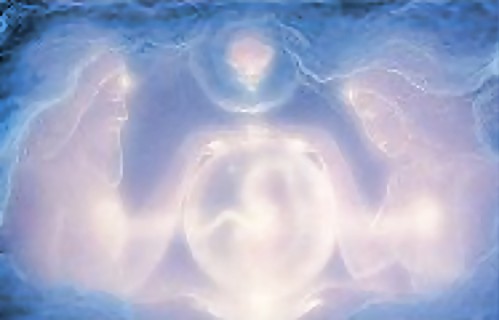
As the Source of the Cosmos, Rod is not yet the Father of the gods; that role belongs to Svarog, who actualizes the potency of Rod’s consciousness. Rod does not “beget” in the strict sense of the word; he is the Primordial Origin from which the generative force of Svarog and Lada emerges.
Rod, the Great Spirit filling the Cosmos, is the source of existence for gods and for nature, for humans and for ministering spirits, since all forms of Being and Mind are rooted in Rod. Rod manifests the possibility of Being and the possibility of Mind, and these possibilities are then realized in the cosmic process.
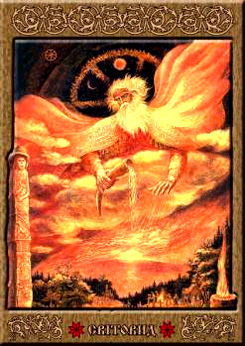
The Western Slavs called him Sviatovit, “God of gods”, and it is likely that the famous Zbruch Idol depicted Sviatovit. It was probably him whom the chronicler Helmold, writing about Bishop Gerold in 1156, reported: “Among the many deities to whom they dedicate fields, forests, sorrows and joys, they (the Slavs) also acknowledge a single God who rules over them in the heavens; they recognize that he is almighty, he concerns himself only with the affairs of the heavens, the other gods obey him and carry out the duties assigned to them, and that they descend from his blood — and that each of them is the more important the nearer he stands to this god of gods“.