Masters, Gods and Sources of Power
Since the aim and the content of the Magus’s Way is self-realization — the expansion of the mind — the accumulation of Power (these three terms are synonymous within the Myth; from the Myth’s point of view, saying that a magus “has much Power,” or that he has a “developed mind,” or that he is “highly realized” — is to speak of the same thing.) The search for sources and methods of such accumulation is therefore a key task on this Way.
Because by “Power” we mean the mind’s capacity for “self-directed activity,” for autonomous activity, it is clear that it comprises two aspects: 1) the mind’s own independence and 2) its engagement with being. From this observation, the Magi discovered that there are two principal approaches to accumulating Power: “from within the mind” and “from external sources.” This distinction only concerns where the accumulation begins, since the process itself must in any case pass through both stages — the “inner” and the “outer,” that is, the study of the mind in its interaction with itself and with “external” objects. Accordingly, both methods are, of course, used by Magi to an equal degree.
The first method amounts to self-study, self-analysis and self-reflection of the mind, which generate Power not merely when they discover certain qualities or properties of the mind, but when, based on those observations, they find new ways for the mind to interact effectively with reality and, accordingly, to study itself in that interaction.
The second method, by contrast, consists in studying being’s “influence” on the mind — the processes that initiate awareness of the influence of the “environment,” and the mind’s reactions to those influences.
So the real question is simply which system is regarded as the “source of interaction” — awareness itself or “being.” In the actual life of a Magus, the first ability — the mind’s capacity to “provoke” being into certain manifestations, to seek new opportunities for self-knowledge through the induction of new interactions — usually does not appear immediately, but only after a stage of development and accumulation of Power. These two stages correspond to the two phases of a Magus’s formation — the seeker, or apprenticeship, and the adept, or independent practice: in the first phase the student uses “external” stimuli for self-development, and in the second learns to independently “provoke” the environment into the interactions he requires.
Because the accumulation of Power occurs by induction, at the first (and often at the second) stage of the mind’s development a need arises for special sources, interactions with which induce Power in a being. In other words, a student always needs such inductors, and even for an adept or a Master interaction with them can be very valuable.
Clearly, only an object that possesses a high degree of inner harmony, stable identity and a coherent inner flow can induce Power, and it must also have a considerable degree of resonance, an inner affinity, with the one in whom this induction is to occur.
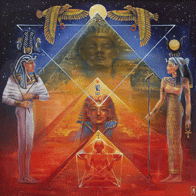
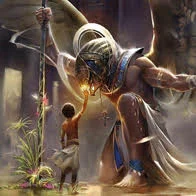
Most often such inductors are three categories of agents: Masters, guardian deities and higher matrices of mind. In other words, it is easiest for the mind to accumulate Power either by entering into interaction with one who possesses that Power, or by internalizing those states in which that Power is accessible.
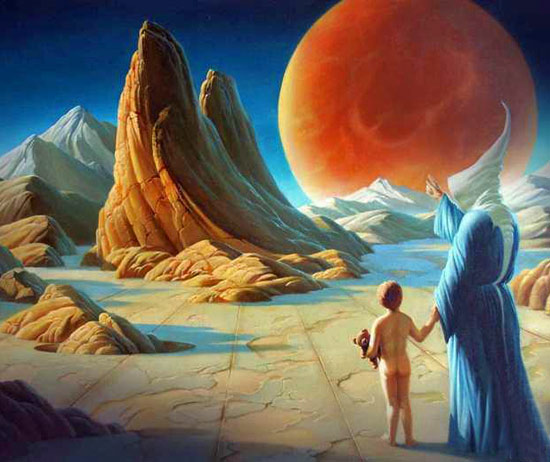
The search for and interaction with a highly realized Master who is resonant with the student is the first and most effective means of inducing Power. Much has been said and written about Guru-yoga. It should be noted merely that if a student is fortunate enough to find a suitable Master, then no other special conditions are required for the success of his Way.
In this sense it is important to remember that the Master, from the perspective of the development of the mind, is a “spiritual parent,” for this title in the Tradition is applied not to the one who simply teaches or even to the one who leads, but to the one who initiates the Way — who, in effect, gives birth to the developing person (or, in Buddhist terms, gives birth to the traveler’s dharmakaya). So one way or another, a traveler may have many tutors and guides, but the root Master is always one. No matter how many doctrines, schools, or Traditions the Wayfarer later samples, he must not forget the one who initiated his Way; a student may try to discard many teachings, but by leaving the Master he must understand that he thereby leaves the Way entirely.
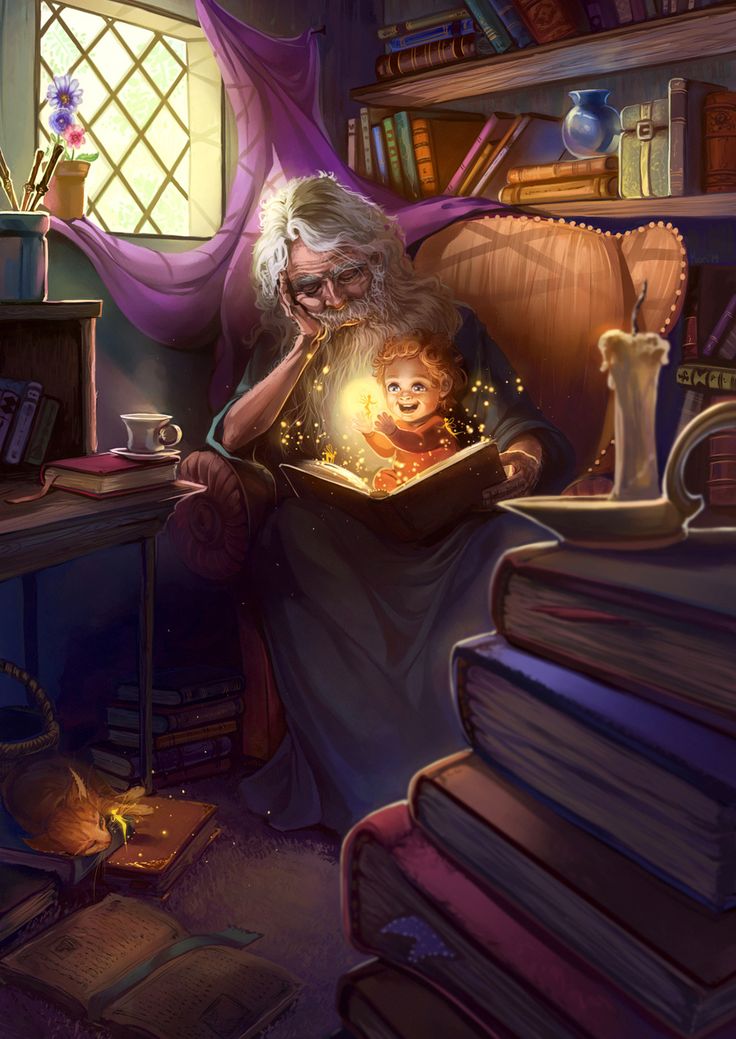
Deity yoga, theurgy — these are aimed at establishing contact with streams of energy capable of harmonizing the mind, increasing its efficiency and orienting it.
The search for an “idam,” an “inner tutelary deity,” shamanic vision quests and the like are most often aimed precisely at activating the higher matrices of mind and establishing a connection between the “actual” layers of the psychocosmos and those upper inhabitants.
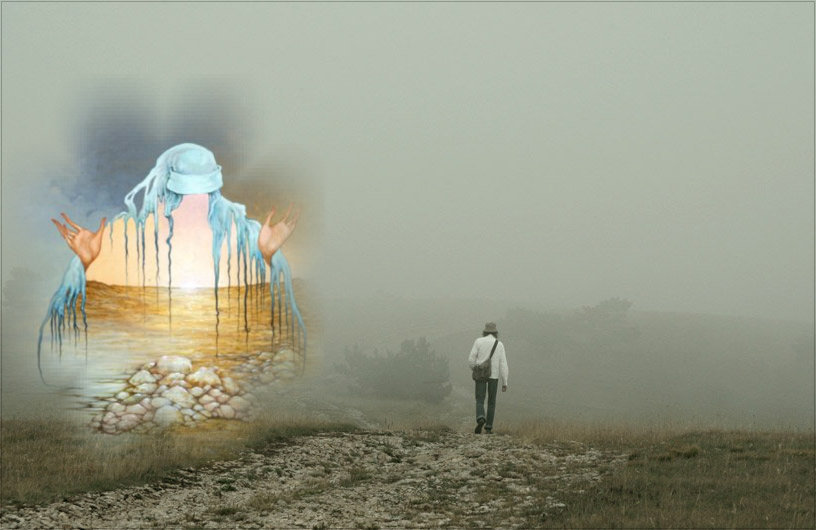
The well-known evolutionary effect of love operates on the same principle: with a sufficient degree of mutual correspondence and tuning, a partner acts as an inducer of Power. And, as is well known, love causes one to see in the beloved his “higher,” “divine” image; it is precisely that image which induces Power in the lover. As an expression of the Power of original unity, love (when it is truly love) transports the mind into that state of “primeval purity,” of uncloudedness, in which it dwelt (metaphysically, not temporally) before its immersion in matter. For this reason the transformative, consciousness-altering action of love can be no less — and often is even more — effective as an inductor of the mind’s realization than all other methods of activating the Higher matrices of mind.
Note that deities of the “Western” pantheon may be regarded both as Living Streams of energy, as independent agents with whom the mind can enter into contact in a theurgic ritual of appeal, and as active matrices of mind (or, as Jungian-oriented travelers now say, “archetypes”); and the Living Deity and the “Archetype” of that deity — its “representation” within the mind — are not necessarily analogous or exert the same influence. Therefore the effects of different forms of interaction with, ostensibly, the same “deity” can be entirely distinct, and this must be taken into account.
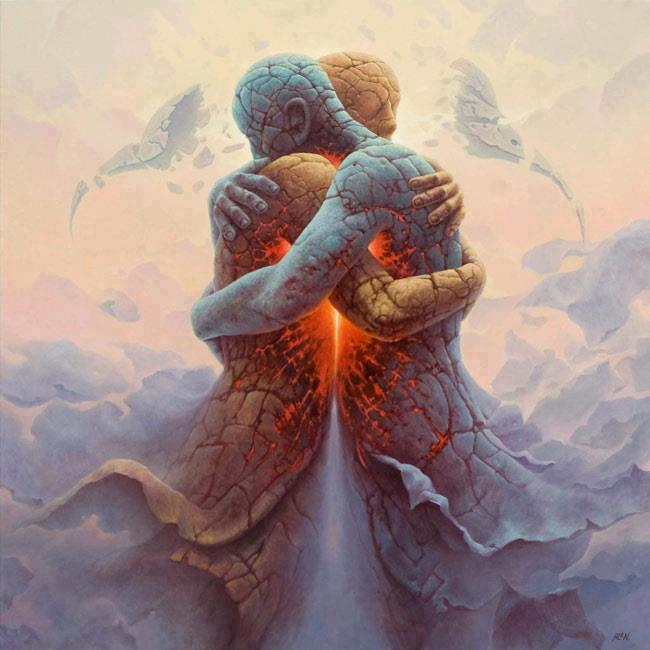
On the other hand, many deities of the Buddhist pantheon (the so-called “transcendent deities”) pertain exclusively to mental realms, designating various “enlightened” activities of the mind itself, and are not directly connected with any “incarnate” entities; therefore interaction with such matrices is a form of self-reflection: the mind seeks within itself, as if in an infinite space, these enlightened states, and, perceiving them first as objects of meditation and then — by identifying with them — transforms itself into a more harmonious and realized condition.
In any case, the mind’s interaction with inducers of Power represents a highly effective path of its perfection. And regardless of where the mind finds these inductors, it must approach, first, the assessment of its degree of correspondence with them with utmost seriousness, and, if a significant correspondence is found — second, the establishment of the most productive contact with them.

Enmerkar, a separate thank you for the Tibetan and shamanic parallels, which are much closer and clearer to me.
It turns out that “The Living Deity and the ‘Archetype’ in consciousness” may not be analogous. What does “Living” mean in your understanding? Are these Deities not made of living cells?
If we say that they are “living” in the sense that they are independent of individual consciousness, well, Archetypes are also collective elements, not the product of a single person. Or if, theoretically speaking, humanity were to disappear, would the Deities remain? Archetypes, of course, would not remain (maybe they would only exist in the form of their reshimas).
And I also make an important practical conclusion for myself. Is it correct? If Deities may not correspond to their representatives in Consciousness, then can demons not correspond either?
I mean that in the Tibetan “feeding demons” ritual, it is more accurate to understand “demons” as what you call distractors, not as “real (living)” entities (of Goetia, for example)… (Although again, what is reality?) That is, in the “feeding demons” ritual, we are more likely transforming distractors?
Living Gods are gods as beings, “Free Spirits” (https://en.enmerkar.com/myth/zhivy-li-bogi). They are alive in the same sense that you and I are – since their manifestation is independent of any specific consciousness, although, of course, like any beings, can be considered manifestations of universal consciousness (and, at the same time – of Universal Being).
Of course, demons as beings can also differ from their images in manifested consciousness (individual or collective). However, since for us, when describing gods, their influence on “being,” on the Macrocosm and the energy flows in it is more important, and when describing demons – their influence on the Psycho-Cosmos and the flows of consciousness within it, then, when it comes to gods, it is more correct to view them from the perspective of their “self-existence,” and when it comes to demons (as well as angels or genies) – it is more productive to view them in their interaction with their “nutritional base” – our consciousness.
How alive are the gods from the perspective of a scientist – a doctor, a biologist? How can they be researched and written about in a dissertation?
How humanoid are they, and do they live in the sky?
But no one knows the answers, and the Gods have been and remain objects of Faith..
Hardly anyone will deny man’s desire to reunite with the Higher, that very Religare, the manifestation of which in the form of cult structures, temples can even be found in the worst village.
People built temples to Christ in those places where for decades they worshiped the gods of the pagans not because Jesus defeated them in battle in heaven, but because “Christians,” as elements of the state, were much more convenient than free-loving pagans. They imposed Christian holidays on pagan ones and provided churches with dismembered, sweet-smelling bones of the dead, although this custom has nothing to do with Jesus at all.
Somewhere in the origins of the collective consciousness of both today’s and past civilizations, the Fear of Death, the desire for an afterlife, and the desire to Conform to the Right Rules (which, of course, were established by a higher power) gives rise to a desire to draw closer to God, to the Gods.
Although in no way are we capable of perceiving them as they are.
We are capable of perceiving the Gods only as we are – humans.
……and then before us remains the Unknown Man living in the Mysterious World……
“they provide churches with dismembered, sweet-smelling bones of the dead”
What does this refer to?
As for the desire to “Conform to the Right Rules (which, of course, were established by a higher power)” – this is often not a desire but a fear of retribution for breaking the Rules. At the same time, as you know, ignorance of the laws does not free one from responsibility. Personally, I have absolutely no concern for either the Gods or the Demons, nor for their rules. But, unfortunately, my desire not to contact them may not be mutual. Therefore, demons must be eradicated along with their distractors (starting with the distractors). And with the Gods, it is more complicated. And it is still unclear what to do. However, there is an idea that if there are many Gods – one can choose whom to be with and whom not to be with. If this also concerns post-mortem matters – then this is quite a prospective topic…
We are talking about Holy Relics with the Gift of Healing.
“…..How alive are the gods from the perspective of a scientist – a doctor, a biologist? How can they be researched and written about in a dissertation?….”
My favorite dialogue on this subject:
– Imagine a deep-sea fish without sight and hearing. Can it have an idea of the sun, of you, of your activities?
– No.
– Right, you have two senses more. Now imagine beings who have two more senses than you. Can you have an idea of their world and their activities?
– A colleague told me about such beings, but I don’t believe in their existence.
– What prevents you?
– If they existed, we would see traces of their activities.
– We see them.
– Where are they?
– For example, the movement of continents.
– I thought the continents moved for natural reasons.
– If you go to chop wood, the rabbits will run away. When they return, they won’t be able to connect the stumps with your activity. To them, it will be “for natural reasons.”
– Are these super-beings – Spirits?
– No, just beings.
– Are they aliens?
– Call them whatever you want…
– Are there many of them on Earth?
– There are many on their Earth, but not on ours, just as we are not on the Earth of the Deep-Sea Fish.
What is a ceiling (God) for us, can be a floor for someone else. Beyond the aquarium with fish, there is a whole world, but the fish hardly suspect this (the evolution of leaving the ocean does not concern them))) Stones and minerals are alive in their own way. Although with physical eyes we may not observe their activity. Perhaps, it is difficult for us to accept the fact that the WORLD can exist, rather, not depend on us, while we depend on it and our perception.
I have an image where a person apologizes to Mother Nature for harm and self-lovingly; she hugs him and says, “Oh, you my ego-centric ones. Nature has the property of adapting and accepting new forms. Nature has survived even more complex periods. Your actions lead to the fact that you are altering the earth and cannot live on it. You are destroying not nature, you are destroying yourselves. That is why I called you egocentric. You think that since you cannot live, then no one can. You will come to complete disaster and no one will miss you”) – says Nature, smiling carelessly. The person is in shock.
The fear of death in human nature borders on the striving for it, for self-destruction. Previously, pagans wished to die in battle and rushed into the arms of death; now Christians pray for the dead and worship bones. Religion is from people (or those who control them), the name God – is just another I. What exists beyond the I and evokes a feeling of the unknown is the way out.
What if all esoteric striving, the continuation of the lineage – is just the problem that we cannot accept the fact that the world can exist without us?
Not long ago, I helped restore the line of bright gods. I transferred the Goddess of Life from one world to the temple. A lovely bright long-haired woman.
I wonder how she would react if I told her that she is an illusion or something abstract))
To make it clearer:
Beings are classified by levels of consciousness; by connections.
Spirits, ghosts;
elements of the elements;
animals, humans, mages;
hunters;
readers; oracles;
gods, etc.
The more influence consciousness has on the universe, the more complex it is and has more connections.
“We” no longer cry from pain
And “we” are not afraid of the Void
And grief, of any strength,
Has separated us from “us”
“We” know no more passion
Forgotten love and need
And “our” yesterday’s parts
Have long since burned out in hell
“We” – ashes – a particle of the planet
“We” have shed decay and vice
“We” – children of freedom sung
And this – our new lesson.
Love is Ending. The Gods are Illusory. Despite the accessibility of Knowledge – real Transformation is achieved by only a few. A possessor of Knowledge is not always a Teacher.
There is a difference between a Doer and a Teacher. A Doer has no need to Structure Knowledge, no need to transmit it. Knowledge remains in the state understandable only to him…
Another topic for discussion in dark tones.
I think it is no secret to you that quite a few “left” traditions work in a similar key with demonic entities. More precisely, with those whom other traditions consider to be such, including you, judging by some notes.
Purely from the logical standpoint, the higher “demons” are more than strong, knowledgeable, and developed.
Do you think these traditions are mistaken, and those demons do not induce development? Or do they indeed induce it, but such development on the part of these travelers is harmful to the world?
Your opinion is very interesting. Because there is much to discuss with dark gods, but there are traditions that directly work with demons, which you described as destructive.
Well, perhaps someone knows ways to induce power using predators. But my experience makes me very skeptical about such possibilities.
Purely my opinion. Any tool is needed for something. If we consider “black methods” in Magic, I cannot understand how they can lead to development. They have a completely different agenda. I perceive methods of forceful and damaging impact on enemies quite calmly, but solely as a System of Protection for my Path, and especially for the Path of the Magical Family. Although martial arts masters may disagree with me, but I do not understand viewing Protection as a separate Path of development. But on the other hand, if a Mage or Family decided to live in society – unfortunately, Protection becomes an inevitable necessity. And, alas, there are precedents when the Happiness of a Family, which directly did not touch anyone, was invaded by the forces of society due to envy and xenophobia, and courts tore them apart. And it was necessary to simply take and beat the teeth out of all aggressors by any means. When the Family is under threat – absolutely all the darkest methods are good and are measured solely by effectiveness.
What is the role and place in this process of Castaneda’s “minor tyrants” and other “black” teachers? As far as I understand, they themselves do not induce power, but create conditions for reflection and understanding obstacles for subsequent contact with the sources of power.
I was reflecting on desacralization, and as a consequence – the Loss of the Center – (during its loss), and came to the conclusion that if the Center – God or ‘God knows who’ – is established outside of ourselves, we make ourselves dependent on external rules of God or ‘God knows who’, and a beautiful illustration of this is the phenomenon of social religiosity and blind submission to political leaders. But it is precisely the Center (a ball of rules without verbal description), discovered Within oneself and not embodied by faces on icons, sacred writings, idols, or other idols, that helps us not to crumble to dust in the face of Chaos, in the presence of unknown forces whose nature you do not understand, but which influence you and try to replace your rules with theirs. That is, all the ‘external crutches’ are powerless, but only what is inside has strength. Something ‘inside’ that is capable of self-regulation at different levels and concordance with the external – that is, for example, instantly changing internally so that contact with the unknown and frightening stops being traumatic and disempowering, something inside initiates the flow into the most suitable state of oneself, and thus it is possible to ‘go to your own fear’. I think, on the path of consciousness development, desacralization is inevitable, as a consequence of reevaluation of values and restructuring of the system. That is, there is a desacralization of the alien and imposed – loss of the external center – search for the internal center – sacralization of what resonates with one’s nature (for me it is – Nature; Harmony of ecosystems with all their components and humans; Beauty as an inner feeling).
I wanted to write something like that there are subjective rules (coming from the center of individuality ideally) and objective rules (with which the child encounters from its very first days, getting burned and bumping their head). And then I just flipped through this Blog to the first pages, recalled at least this https://www.enmerkar.com/en/way/pagan-myth and realized that it is time to start everything from the beginning…
Before finding, you must lose, To avoid the desire for power – “Everything you find – to conquer”. Cunningly hiding under the mask “I am God, if I am strong” Striving upward from illusions, Not shedding its chains. And somewhere at the mountain peak, Sits a person in silence, He sees the illusion of the world, Like a river flowing in the distance. Is it a river? Or maybe time? Or maybe the river of death? Skillfully changing forms – Sometimes time, sometimes death, sometimes water. Not touching the strings of the world, Not trying to play his song, Sits a person and knows The world has freedom. Sitting, becoming silence, The whole world fits in a silhouette. Or maybe the illusion of the world, In which he has long been absent.
I am devouring your articles!! Huge gratitude!!!
What does it mean to leave a teacher? If the teacher initiated the student into the Gaudiya Vaishnavism tradition, and the student left this practice, does that mean he left both the teacher and the entire path?
The bond between the Teacher and the Student is akin to that between a parent and a child, and leaving means ‘transitioning to another family’, so the question is not about some specific practice, but about the very spirit, about the Path itself.
Hello, thank you for your answer. Do you give initiations?
Forgive me this straightforward brevity; sometimes it is out of place.