Interweaving of Fates
We have said that the meeting and union of “kindred souls” brings a significant gain in Power and represents a major leap forward on the Way of self-realization.
At the same time, it is obvious that not everyone a magus meets on his Way, and with whom he travels for a longer or shorter stretch of that Way, is his “monadic kin.”
Nevertheless, it is equally obvious that this shared journey inevitably affects both participants, and the bond remains even after their paths diverge.
Therefore, among magi, two approaches prevail, two modes of interaction with those they encounter on the Way.
These two approaches reflect the social strategies of magi we have already discussed – an orientation toward solitary or shared Way.
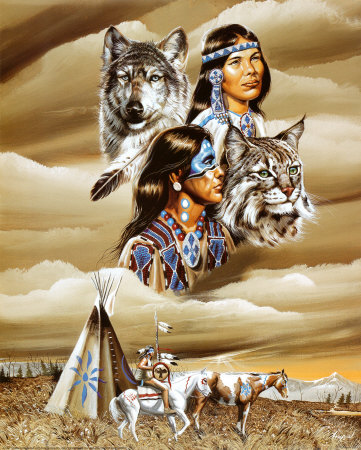
The first approach consists of avoiding close interaction with anyone – the «cat» Way. Its essence is captured by the phrase “I am by myself, you are by yourself; Don’t interfere with me; I won’t interfere.” Such a tactic avoids forming binding ties and responsibilities, but also deprives one of the advantages of mutual aid.
The second approach is an orientation toward responsible ties honestly maintained over a stretch of the Way, and with responsibility that endures. This mode of conduct, the «dog» Way, on the one hand provides the help of the pack, family, the clan, but on the other imposes a heavy burden.
But, as usual, maximal effectiveness lies only in the interpenetration of the two poles. Both approaches in their «pure» form fail the requirement of impeccability: in the first case independence hardens into indifference – and is therefore harmful to the realm of feelings; in the second, the will is constrained, losing its edge and direction.
Be that as it may, for a magus engaged in an honest and full-scale fight against the falsehood and lies of a mutually devouring world, it is impossible to completely avoid forming ties with those to whom he was not originally bound. However, the magus’s most important skill in this area is the ability to see when such ties can be avoided and when they are necessary.
It turns out that, alongside the impulse to accumulate Power, the magus must also be able to give Power when his Honor, the logic of his Way, demands it.
It is very important to walk a fine line between the poles: on the one hand — not to become a cold, and therefore lost, hoarder of Power, but on the other — not to fall into profligacy and dissipation of Power. Both of these states are difficult to reverse, so maintaining equilibrium is essential for effective progress on the Way.
In other words, when Honor and the Way require giving someone a boost of Power, the magus is obliged to do so, understanding that by doing so he takes on certain obligations and responsibility for the use of this loan.
However, there are also situations of another kind – it happens that a magus must accept responsibility for events that took place in other lives and for ties formed by other individuals. Perceiving such “debts” is an important part of the strategy under consideration. Fulfilling accepted obligations — even when they were undertaken by other incarnations in other lifetimes — is also a matter of the magus’s Honor.
Thus, the situations in which an effective magus cannot avoid forming ties reduce to three cases – 1) monadic kinship; 2) the need to close the Chain; and 3) debt obligations.
In all other cases the magus must make every effort to avoid ties, energy currents and vortices.
Such a strategy makes it possible to achieve the harmonious development of the principles of the psychocosm — feelings and will — and moreover cultivates the magus’s intellect.


Enmerkar, please tell me – are there specific signs of Monad kinship? With the 2nd and 3rd points, everything is generally clear; however, I think past debts are not only a matter of Honor but also of Power.
Yes, members of one family of Monads have close Paths, similar energy, and a common character of development.
Are incompatible Monads even possible? I do not mean at the level of embodiment… but as Archetypes, Monads are the Analogues of the Absolute, and in essence, they are its parts (though their sum is not He Himself). How can two parts of the One be incompatible?
Each monad expresses the Absolute in its aspect. And these differential aspects can be more or less close to each other.
how can two parts of the One be incompatible?
there are no 3 identical souls; only 2 can be unique and the closest to each other. one is the 2nd part of the same soul, lost in certain cases, and the other is the flame.
but even 2 twin flames (‘monads’) are not identical due to their ‘contents’; hence the essence of one can represent one race while the essence of the other can be radically different and have completely different levels of powers and practices, but they will be flames suitably suited to each other, partners understanding every gesture, glance, and emotion without words, i.e. they will be (‘related monads’) souls created of one type, as souls are created in pairs (‘biner’).
so it can’t be said that ‘we are all brothers who came from the light and compatible, and all souls are related’; souls can be related by the origin of their races and creation. As for the mass kinship of souls, any souls will be compatible if they melt together in one alchemical furnace – then please, but few would desire such kinship.
Family – clan – kin – people… Someone may manage to walk the ‘cat’s path’ without going to the ‘dark side’… But yes… a sense of measure in a mage must be filigree… and intuition, naturally…
Only he who has achieved self-assertion can approach the state of impeccability.
How about the Path of the Wolf? 🙂 A wolf is a loner by nature. But to achieve specific goals, wolves come together in packs…
I think it is worth alternating stages of solitude and togetherness on the endless Path, if only for diversity and harmonious development.
Great explanation. Thank you.