Archons and Goetia

Whatever we may think about the reality of the Archons and their influence on the currents of energy in our world, we cannot ignore two important trends in the development of modern society: its virtualization against the background of ever-growing concern for bodily health and needs. In other words, it is impossible to argue with the fact that, as a whole, humanity is increasingly becoming a mass that generates a large number of diverse, imbalanced attentional impulses, merging into a “noise” stream and resting upon a well-fed (and often overweight) body. People generate an enormous number of inclinations and (rudimentary) desires, without fulfilling them and quickly switching attention from one bright lure to another. It is shortsighted to deny that, in this process, psychic energy is dissipated in huge quantities, to replenish which an entire high-calorie food industry has emerged. And any person who believes in the law of conservation of energy must ask: “Where exactly does this energy go?”. But it is precisely such a pathology, this set of destructive drives, the Tradition calls the influence of the Archons, and therefore we must acknowledge that, at least within this terminology, this influence is real and evident.

Nevertheless, if for other destructive forces — kidemons, which are destructors, pathologies of the realization of desires — clear classifications, diagnostic methods, and countermeasures have been developed, for the Archons all these methods of prevention and treatment remain severely underdeveloped.
There are several reasons for this. One of them is that the entire world around us has evolved under the strong influence of the Archons, and the very laws of nature are, in fact, largely limited by these forces. As we mentioned, the Tradition calls this state of affairs “heimarmene”, the “enslaving” nature of materiality, and it was precisely this corruption of reality that prompted the Gnostics toward radical methods of transcending manifestation.
The second reason is that interaction with the Archons, their study, and direct inquiry are greatly impeded. If kidemons (as well as many other destructive forces) by their nature are so-called “service” vortices, accessible to “coercion” by human free will, and therefore “convenient” for study, then the Archons are “free” beings, who surpass even most gods in wisdom. In other words, if a demon (whatever we may consider it to be) can be summoned into the Triangle, and thus objectified — made an object of study (and counteraction) — then hypothetical ways of objectifying the Archons are much closer to theurgy than goetia.
Nevertheless, such objectification, as we noted, has a whole range of important therapeutic potential that greatly facilitates resistance to destructors. Even if we regard the image appearing above the altar or in the Triangle as merely a “projection” of our mind, a visualization, or even a hallucination, we can study this image, notice its properties, and also analyze its interaction with our “daytime” mind, and note our mind’s reactions — to its manifestations. If, however, we accept (at least as a working hypothesis) the idea of independent volition of this image, then interaction with it becomes even more complex and varied, and therefore makes it possible to discover in it properties and attributes that are not obvious at first glance — and thus to find new ways of neutralizing them, as well as to outline paths for healing those mental hooks to which “external” destructuring forces cling.
Accordingly, for Magi who wish to increase the effectiveness of such therapy, it will be necessary to develop methods of “protected theurgy” suitable for interaction with archontic forces, enabling one to map resistance paths to their influences. And therefore, the very study of both theurgy and goetia becomes all the more important, since “archontic” theurgy “takes over” part of the “goetic” tasks — paths for purifying the mind.
Until such a system is built and verified, the search for and eradication of destructors in the mind — that render it vulnerable — remains the most important individual task for each wayfarer. At the same time, it is not necessary to consider the Archons (as well as demons) as separate entities, spirits, or personalities; it is enough to acknowledge the obvious inefficiency of individual and collective mind, and to seek ways to correct this inefficiency.

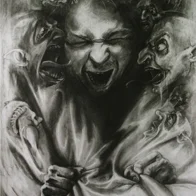
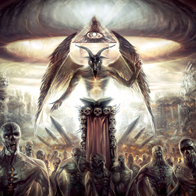

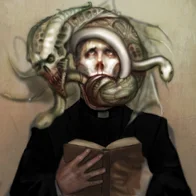
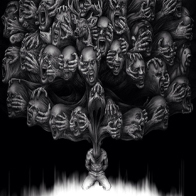

If Archons are not vortices, nor minds (intelligent actors like Devas), then what are they? Stars, from the perspective, for example, of Mandeism?
There are various opinions on this matter; most often, the Archons are related to the first descendants of the Primordial Gods – the Jotuns, Chthonic deities, and similar beings – in other words, they are the ‘first foam’ on the surface of the ocean of the Abyss. They appeared when the worlds of reality and dream were not yet clearly separated, and it is through their efforts that this separation was made (and continues to this day).
I am curious about your opinion on the ‘unclouded state of the Archons.’
Let me clarify right away, I am not very familiar with the coordinate system of ‘fall’ and ‘clouding’ that you use. Therefore, I may make mistakes in my formulations. But I hope the idea will be clear.
In almost all other cases, when you speak of hostile consciousness processes/entities, there is a logic of correction and illumination. Or in my interpretation, that this phenomenon is not destructive (predatory) in its essence, but becomes so for most human consciousness in a particular world. In other words, behind many ‘destructive’ forces, one can discern the image of necessary processes for the cosmos. Let’s skip the discussion on whether there is an aspect of fall and imperfection or not.
However, when you describe the Archons, as well as the Jotuns, the activities of these forces, as I understand from your description, do not reveal any ‘beneficial’ functions for the cosmos. You have essentially stated somewhere that part of these entities is hostile to Creation itself.
Could you comment on this aspect, as well as how processes hostile to creation (emphasizing, hostile to creation and not destructive) can be created within Creation? The very logic of the existence of entities that deny existence (in any form) is incomprehensible to me.
The second question, although indirectly related: you allowed the association of Archons and Jotuns – although it seems that Archons are very active and ‘sophisticated,’ which seems to poorly align with the primacy of Jotuns. What do you think about this consideration? Or am I mistakenly attributing ‘sophistication’ to the Archons or ‘simplicity’ to the Jotuns (in terms of complex structuring of methods)? And if the Archons are indeed hostile to creation, what happens to the energy they extract.
From the Traditional perspective, the Archons are not hostile to creation as such; on the contrary, they are demiurgic forces; however, being deprived of a vision of evolutionary perspective, they resist the specifically evolutionary, liberating, pleromatizing direction of development of the manifested world. In other words, for the Archons, the cyclical concept of time is ‘understood’; they support (and maintain) the gilgul, the cycle of lives and deaths. As the sources say, the Archons consider themselves the only authors of reality, and therefore are confident in the legitimacy of precisely such ‘eternal repetition’, where the Manifested world and the Interworld are two sides of one system: in Reality, energy is generated, in the Interworld it is consumed. When a being strives to grow, to realize itself and thereby to leave the kenoma, to leave the material world — this then causes resistance from the Archons. Thus, from their perspective, the Archons maintain the ‘natural order,’ gemarmen, which is quite essential but denies freedom. The same story applies to the Jotuns: for them, the existence of the ‘Dream world,’ Utgard, that is — the polivariant basis of the world, is quite sufficient as a level of manifestation, and they do not understand the evolutionary perspective of the ‘day world’; they resist not creation as such but the emergence in Elivagar (the stream of probabilities) of certain individual worlds or paths.
Neither the Archons nor the Jotuns are predators in themselves; they stand above the food chains, but they also ensure that the role of humans does not exceed their function of generating energy, which is to be food for the ‘hungry spirits’ — the inhabitants of the Interworld.
-A powerful response. If, in honor of the cyclical concept of time, what is its alternative? Spiral time of Evolution?
– If we analyze the concept of the world spirit (or Hegelian world spirit), the whirling of being, DAO (I may be wrong here, making such comparisons), then two flows of involution and evolution coexist there, and as you wrote, the whirling of these potentials/possibilities will never exhaust itself.
– Perhaps the Archons, in fact, prevent complete realization, and
if everything is realized, then there will be no sense in it?
– Where does a person go when they exit the influence of the Archons, into the pleroma? I’ve never understood how one can exist in the pleroma??
– And as I understand it, the pleroma contains some ‘REALIZED’ possibility in the form of aeons, that is, it is a universal possibility in its pure form (or idea, although I suspect these are slightly different things since ideas have the potential for realization, while possibilities do not), while the kenoma limits the possibility, so this can be compared to the collapse of the wave function?
– The collapse is managed by the Archons, but they are the inhabitants of the kenoma, and the kenoma and pleroma are separated by Chorus (Horizon, if we remember Crowley). Something does not add up here.
– Then how to understand ‘realize’ in the context of the pleroma? Realization in the context of the kenoma is the collapse of the wave function (the isolation of the omni-potent medium)?
– And regarding the possibilities, I still do not fully understand what it is? And I also think that there are negative possibilities of NON-BEING, but people do not see this at all. If it is a possibility, then it is always positive. But there should be an inversion that there is a possibility of this and non-being))
– If it were not so, then there would be no whirling or dialectical replacement of ‘Being’/’not.’
– And regarding the fall of Sophia (if we consider her as formless and non-visible matter/boiling singularity/shakti or closer to the kenoma than the pleroma?), did she fall of her own accord (without the spirit’s involvement), wishing to see her semblance (but she is formless) or the image of Bitos? To see, vision is essentially to know. Well, pictorially speaking, she fell into herself and the kenoma appeared (’empty silence’) since she wished to see Bitos. Bitos, as I understand it, is the unknowable, that which is not. Well, basically, I’ve tracked a general theme here, that if it were not for a particular sin/error/paradox, any movement or plot would not have begun. For example, the myth of Adam or the fall of Lucifer, who did not bow down.
The Archons are the inhabitants of the Limit, Chorus, not the kenoma. The Chorus is Sophia Ahamot, the soil as such, from which anything can grow, but in it, there are no seeds. The Archons create such seeds, but these seeds grow ‘down,’ toward the kenoma, and cannot overcome it by themselves. Sophia, on the other hand, is the same soil, but containing the seeds that grow upwards, and this ‘forest’ above is the Pleroma – realized possibilities.
Thank you for your response. I speak metaphorically. The Archons gaze into the abyss of the kenoma, the boiling singularity of possibilities, and highlight (collapse the wave function) from this omnipotent bubbling abyss, certain possibilities out of which seeds/embryos/potentials/ideas form. Which in turn go for further ‘polishing’ within the limits of Chorus, so to speak. The ideas that have reached purification and ideality are sent for further evolution (unfolding/realization) into the Pleroma, that is, as you say, they grow upwards. OR, into the pleroma, only fully realized ideas come, then what do these ideas do there (what is the point)? Is Chorus, the limit, Ahamot an interworld and intermediate world, or, to put it in mundane terms, the Astral (am I understanding correctly)? If we break down the Enochian magic, the Tablet of Elements, then this very black cross in the center becomes the Kenoma? Can the Kenoma be compared with Akasha (the 5th element) in Indian metaphysics? And ethers/ethyres are stable areas, or rather ‘sections’ of the swirling environment (Telesma) of the interworld? And in principle, appealing to a given Ethyr/ether, is there a chance to meet the ‘mind’ of an Archon or are these ethers themselves Archons? Have you had an experience of encountering an Archon, what is it like and how does it differ from that of demonic mind?? Can a person become an Archon? And suppose they are responsible for some area in the interworld, as I understand this theme often appears in left-hand tantra, anti-cosmists, and all of this has to do with ancient ones, type of becoming gods and creating their world, their Lokka? That famous scheme with the Aeons has nothing to do with ethers and ethyres introduced by Crowley? If one overcomes Chronzon (he is also the Chorus), then it turns out you come to the Pleroma? Can the pleroma be imagined as clusters of Fractal trees that, speaking metaphorically, float in the night and are endlessly directed (growing) upwards, towards some limit? YES, and in general, Being at its core is polarized into higher and lower. If we use the interpretation of the Gnostics, then this leads to Pleroma and Kenoma. The brunt of the Pleroma is pure realization, possibilities in perfect and pure form? Can the pleroma be compared to the world of pure ideas in Plato? By ideas, I mean, for example, the same numbers (Fibonacci, golden ratio, etc.) outlined in sacred geometry? Kenoma are the same possibilities, but not realized — like, or how should this be understood? Those who follow left-hand tantra descend and strive to the farthest limits of the Chorus, layers of the interworld, down to the Kenoma, where they annihilate or what happens there, what is the profit, you said there’s liberation (moksha, freedom from desires)??
The meaning for a person is like his will to be, which is based on his own awareness of the possibility of not being (non-being).
– The will/aspiration for meaning is an instinct that arises naturally from a person’s awareness of their mortality. Only a person reflects on the subject of life and death. Being and non-being. That is, logically, he moves beyond both, yet in reality, he is conditioned by them. ‘Simply put,’ where is there more meaning, in life or in death?
Irreversibility of movement. From death (non-being) to life (Being).
Gradient. Arrow of time.
The will to Be, based on his awareness of the possibility of NON-BEING.
The will to Be is born out of the impossibility of Non-being.
About the possibility of Non-being as about the possibility of any subject/object being another or not being at all.
It is the same as a positive possibility. This is inside being. This is not an alternative to being.
– An animal carries a predetermined instinct of that it can be or may not be.
About any specific object, we can say that it is, apply this predicate; being is the condition that any thing exists.
– Why do we know that it exists? Because the very possibility of breaking it resides within it. At the moment of breaking, it will turn out that this was a unique teapot. At the moment of breaking, it does truly exist, but that moment is enclosed in it now. This is a shimmering thing, which ‘is/not’ in binary. ‘Not’ founds in ‘is’ and vice versa.
– Life/the sphere of becoming is the actualization of this duality. In the living, there is a constant dialectical process of replacing ‘is’/’not’.
And in the teapot, this process is divided (separated in time). Right now it exists, but then when we break it, only then will we understand that it was. In the living, this process occurs constantly. Inner psychological tonus, dialectical replacement exists/not. It will avoid danger. It strives to compensate the constant displacement of ‘NOT’ into ‘is’ through the logic of the behavior of its body in space.