Runes: Magic and Divination
As we have said repeatedly before, any action, any manifestation of desire/will/manifestational energy can be considered from two perspectives: as a vortex and as a vector. Accordingly, since ancient times the Magi have used two fundamental approaches that allow directing and controlling creative processes: the vortex-based, where sigils function as support systems, and the vectoral, where Runes serve as supports. The Vortex Magus acts on the Environment “from the outside,” like a potter or molder shaping a vortex to the desired parameters, while the Vector Magus acts “from within” the current of creative energy, immersing himself in it like a diver shaping the riverbed from its bottom, swimming in the flow of creative realization.
In turn, each approach includes two domains of application: the “magical“, aimed at the “formation” of the Environment and the conditions for realization, and the “mantic“, intended to recognize already existing premises and nascent realizations in order to use their possibilities. Each of the systems has developed toolkits for each mode of operation: in Vortex Magic this is, above all, the Ceremonial system and Tarot, while in the Vectoral — Galdr and Sejt.
From the Vector-based perspective it is important to distinguish Runes as energies and Runes as symbols.
- Runic energy is any clearly distinguishable flow, a vector, with a direction of realization.
- A Runic symbol is any sign of realization upon which a vector can anchor. We have said that the number of such Runic signs is considerable, and it is by no means exhausted by Futhark sets.
In other words, whenever we speak of a directed flow of will, we are, in fact, referring to a Runic vector; whenever we speak of a symbol capable of affecting such a flow, we speak of a Runic symbol; and whenever we attempt to “read” the “disposition” of already formed creative currents, we use Runic divination.
Historically, what has reached us in a more or less intact form are primarily the Norse Runic Traditions, and the term itself comes from the North, yet there are good reasons to believe that similar approaches were once widespread.
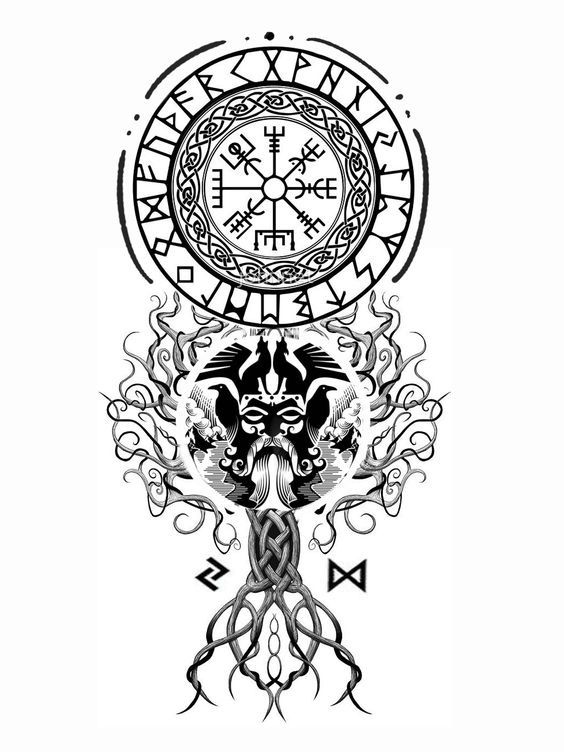
As we said, to be able to operate the currents of energy according to the Runic principle requires two conditions: 1) Power and 2) Inspiration; and to “read” those currents — 1) Receptivity and 2) Inspiration. It is precisely vodic energy that is the key to Runic Magic in the same way that baraka is the key to Vortex Magic.
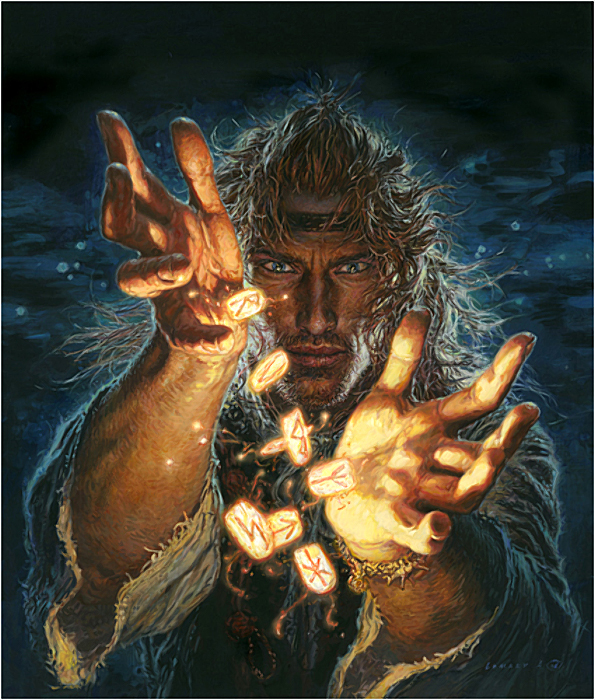
As symbols of realization, Runes are the graphic expression of vectors of will by which the creative mind forms reality. In other words, whenever a Magus carves a rune, he simultaneously and inevitably creates or reinforces the corresponding vector, pouring his energy into it. Yet whenever a Magus reads a Rune, he also mirrors and activates it in his mind, and therefore reinforces the corresponding vector with his energy. Thus, Runic divination is also Runic Magic, where, analogous to the well-known “uncertainty principle,” the very fact of observation is already an act of creation.
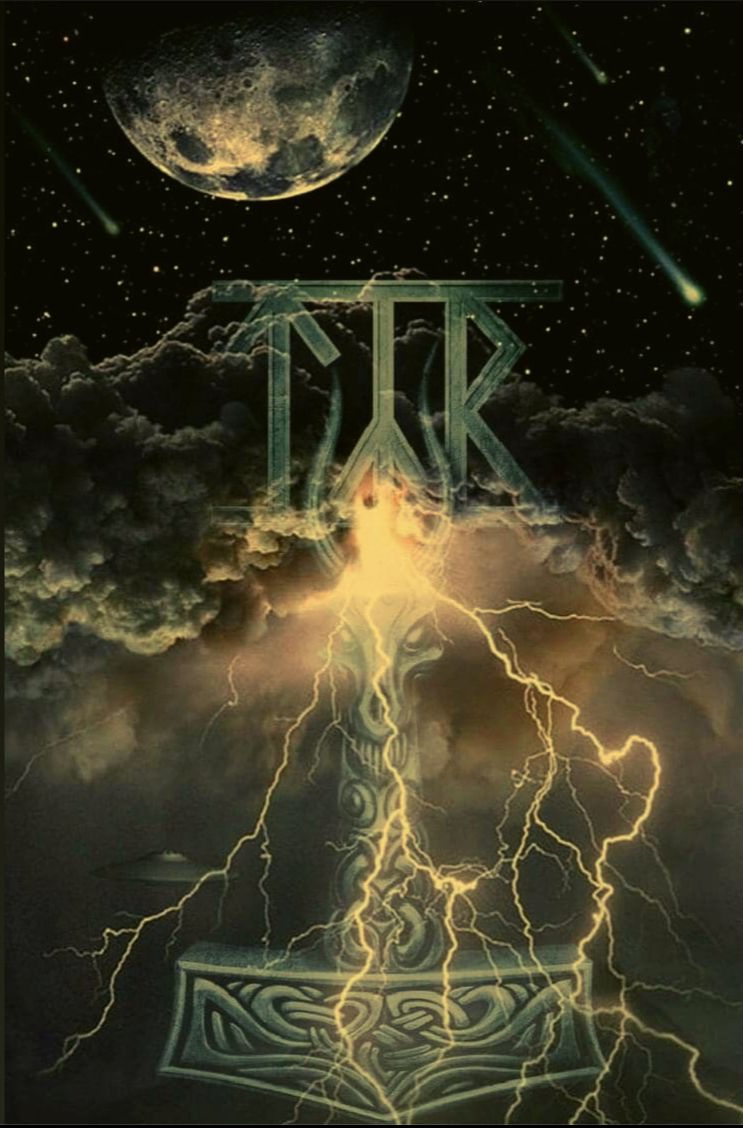
Let us recall that the mechanism of action of any realizational symbol (“sickle“) works by inducing in the mind of the corresponding energetic current, with its subsequent “reflection” into being — that is, “manifestation,” realization.
If the Tarot oracle, in its “ordinary” application, is relatively passive — that is, the cards drawn in a reading arrange themselves according to tied “knots” of energy, reflecting an already established order, like a pattern of iron filings making visible already existing magnetic lines, while minimally altering it — then the Runic oracle is always active. It is like an additional magnet that allows one to detect what is given by attraction or repulsion, while actively influencing the overall structure of the field.
Many practitioners often overlook this feature, treating Runic divination as “ordinary” fortune-telling and failing to take into account that “casting” the Runes is a creative act, with all its consequences, including personal responsibility. This, of course, does not mean that the method cannot be used, but it is important to understand that the purpose of the Runes is to create and build, and therefore it is impossible to “just look” with their help; Runes in any form are instruments for the strong and the brave, which is precisely why the Norse spirit suits them so well. Anyone who is not ready to engage with powerful vodic energies may harm themselves and others by “playing” with Odin’s Instruments.

Thank you, Master! You couldn’t state more clearly, concisely, and succinctly the meaning of the Runic sections of Magic and Divination.