The Magus, step by step, frees himself from the destructors that enslave his mind and gains the ability to reduce losses of Power.



Other Magic
Пишите мне
Enmerkar's Blog contains over 1200 original articles of an esoteric nature.
Enter your search query and you will find the material you need
The Magus, step by step, frees himself from the destructors that enslave his mind and gains the ability to reduce losses of Power.

The postmortem disembodiment of a person must be accompanied by the departing entity’s withdrawal not only from our world but also from the Elements.
If this, for some reason, does not occur, not-fully-disembodied souls, lacking a guide and having lost connection with the monad, turn into demons.


It is hard to find anyone who, as a child, did not at least once take part in—or at least hear of—the summoning of the “Queen of Spades”, the “red, blue, or ‘pencil’ gnome”, and so on.
What happens in such cases?
Are the “appearances” described by children merely products of their imagination?


In the modern world, ideas about the dreaming body, the “astral” body and the “etheric double” regrettably remain at the level of the century before last, with its vulgar mediumism à la Cagliostro, muddled and lacking clarity.
One can only hope that dedicated groups seriously studying and applying this phenomenon will bring some order to the confusion.

All ancient cultures of the world, in the fragments of knowledge that have reached us, speak of astonishing beings that come to people’s aid and often save their lives. Animal Powers were regarded as extremely useful to people, who greatly need that direct, unmediated, absolute connection with the Universality of Life that animals possess.

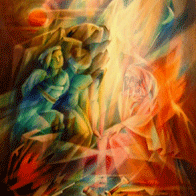
The sagas mention three fundamental features that characterize seiðr: 1) a high seat, or platform, on which the practitioner sits; 2) the use of special songs to induce trance or to secure assistance from spirits; 3) an association with sexual “indecency” (ergi).
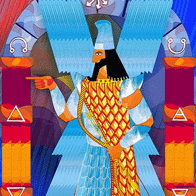
Thousands of years before the Vikings, at the far end of the earth people worshipped a god who, like the Great Aesir, was associated with storm and inspiration.

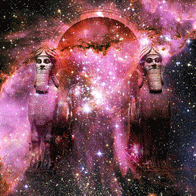
We have already spoken of artifacts that have affected (at least on the psychological level) the course of human history — the Spear of Destiny and the Holy Grail.
Yet these artifacts, though the best known, are not the only objects shrouded in mystery and legend.
Another such Item is the great Sword of Nergal.
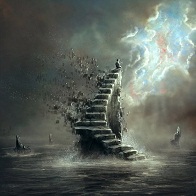
The fundamental difference between the early and later attitudes toward the world’s duality is evident: over time the polarization acquires a strongly felt emotional coloring — a positive attitude toward Light and a negative one toward Darkness. Apparently this shift reflects processes that took place in humanity’s awareness of the world-process, its origins and purposes.
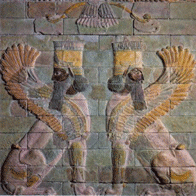
Always and everywhere, the Gnostics were anathematized, tortured, and burned. Yet the enchantment of these views proved stronger than the pyre; in the form of countless schools and movements, they have survived into our own day.
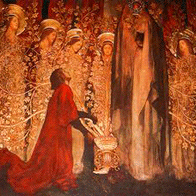
The ideal of Galahad — the pure man — charted a course in the age of monastic knighthood to new heights of spirit and insight.
It was precisely this ideal that was embraced both by the Albigensians (the Cathars) and, later, by the Templars.
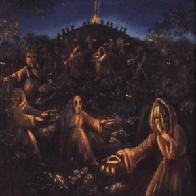
Although the picture of the world is fairly stable, from time to time fluctuations arise in it, and it trembles and thins. It is at those moments that its provisional nature is revealed and another reality peers through the attenuated veil.
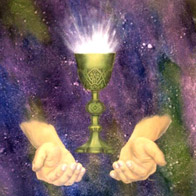
The role of cauldrons and sacred vessels was very great in ancient culture, from the Celtic cauldron of Gundestrup to the cup of the Holy Grail.