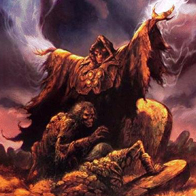
Among the various directions and currents of Magic, perhaps none is so difficult for a sober mind to understand as necromancy.

Other Magic
Пишите мне
Enmerkar's Blog contains over 1200 original articles of an esoteric nature.
Enter your search query and you will find the material you need
Among the various directions and currents of Magic, perhaps none is so difficult for a sober mind to understand as necromancy.
Throughout the entire existence of this blog I have been asked the same questions over and over — “Who taught you?”, “Where does your knowledge come from?”, and so on.

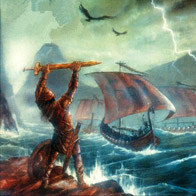
The Western pagan myth does not portray fate as “doom” or “fatum,” an irresistible force, but rather as a challenge issued by the cosmic order to the Magus, which he may accept and fight, or refuse and blindly drift with the current.
Risking the appearance of an uneducated retrograde, I will nevertheless repeat that, from the traditional point of view, there are currently no prospects for a synthesis of worldviews and none are in sight.
The Judeo-Christian tradition regards Ariel as an Angel ruling Jerusalem, thereby emphasizing his special mediatorial position between the Higher and Lower worlds.
Various traditions — from shamanism to psychoanalysis — have noted the dense population of the Psychocosmos. Some regarded its inhabitants as independent agents, others as merely psychic constructs; yet regardless, they acknowledged their active influence on life and on the balance of forces in the psychic universe.
It is precisely doubt that should distinguish the Magus from a religious fanatic; it is precisely doubt that transforms an “occultist” into a Magus.

The Third Att describes the formation of connections on the Magus’s Way with the beings that surround him and the influence of those bonds on his further advancement.
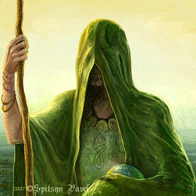
A Magus who has achieved certain successes in his advancement sooner or later notices his solitude. Indeed, on the earlier stages he stood face to face with the Power that guided him, sometimes opposing him, but always faceless and undifferentiated.
At the level of the Second Att the laws of the Magus’s existence on his Way are forged; these are the result of establishing a hierarchy of values within the Way and finding that Way’s place in the world’s economy.
It is well understood that Yav traditionally denotes manifested existence, the world-process in its continuation. The concept of Prav is more difficult to grasp.
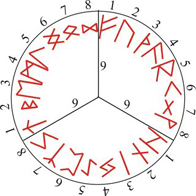
The runic order can be viewed both as a description of the stages of the World’s formation as a whole, and as the Powers operating in the concrete life of a particular person.
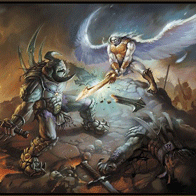
The original concept of the Qliphoth is closely connected with ideas about the Tree of the Sefirot. It is held that each Sefira has its reflection — a qlippa. However, contrary to common belief, the Qliphoth are not “anti-Sefirot”.