
Ogham and the Flow of Life
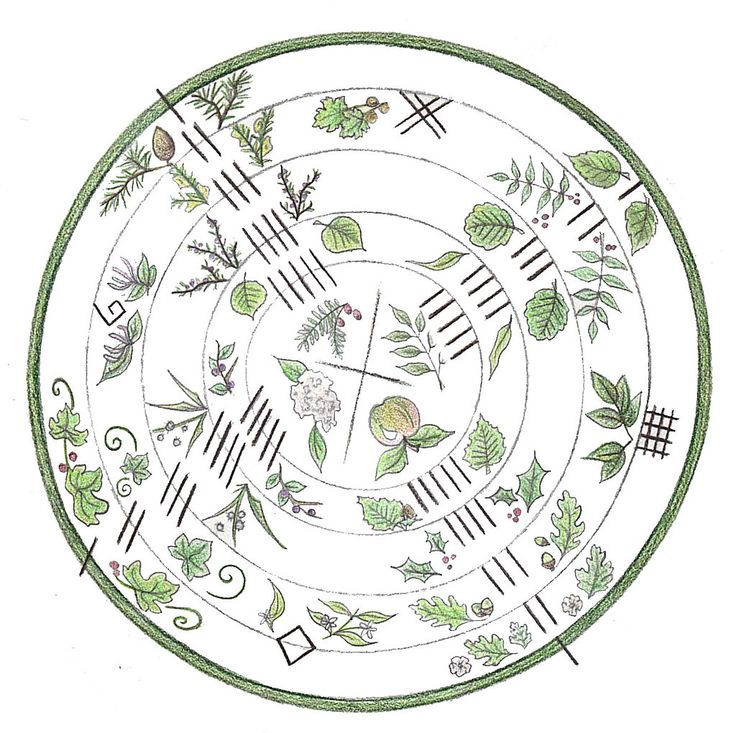
The system of ogham is unique in that, unlike other sacred alphabets, in which the shapes of the letters (or syllables) themselves give them realizational activity, in this system the images are stylized and simple, and the logoi’s energetic content comes from semantic associations, the correlation of symbols with arboreal energies and life patterns. In other words, ogham is a system that acquired realizational activity as a consequence of a meaningful semantic pairing, and in this sense it resembles “places of Power of the second kind” — which acquired their inducing activity as the imprint of “Actions of Power” — certain Magical events.
As the “Auraicept” (“Primer” — an Old Irish text on language and grammar, dated to the 7th century) says — it is one of the main sources of the manuscript tradition on ogham:
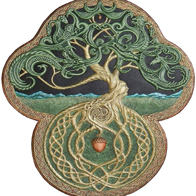
“Here is their number: five oghamic groups, i.e., five in each group and ranging from one to five each, so that their signs could be distinguished. Here are their signs: to the right of the trunk, to the left of the trunk, across the trunk, through the trunk, beside the trunk. Thus one climbs the tree, that is, steps on the tree’s root first with the right hand and then with the left. Then along the trunk, against it, through it, and beside it.”
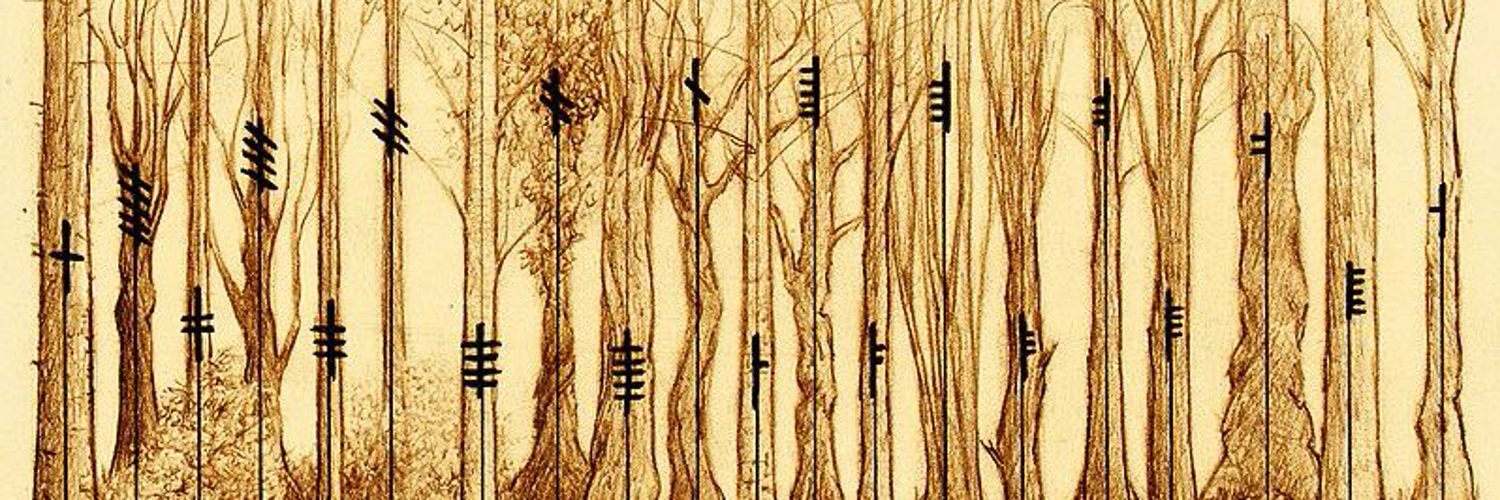
In other words, the ogham system is an expression of the process of “ascending” the tree, represents development and elevation, passing through 20 sections organized into four groups reflecting the main stages of the process. We have already said that the oghamic description of such a process refers, chiefly, to the stages of development of life itself, the awakening and manifestation of life force, although with certain reservations it can also be used to describe the stages of development of consciousness.
The “Battle of the Trees” (Cad Goddeu, a medieval Welsh poem preserved in a 14th-century manuscript known as the Book of Taliesin) describes the order of the ogham trees as a “battle formation”, implying the flow of life overcoming barriers and inertia that hinder the birth and flow of life force.
28 trees and shrubs took part in the “battle”, not all of which entered the “classical” ogham formation:
Alder, willow, rowan, the majestic blackthorn,
Blackberry, wild rose, raspberry, and passionate elder.
Ivy and cherry, birch, gorse, spruce and yew took part,
Elm, hazel, privet, wild apple fought.
Holly, hawthorn, vine, fern danced in battle,
Osier, goldenrod, heather, oak, ash, pear, chestnut flared up.
They hid magic and power within each.
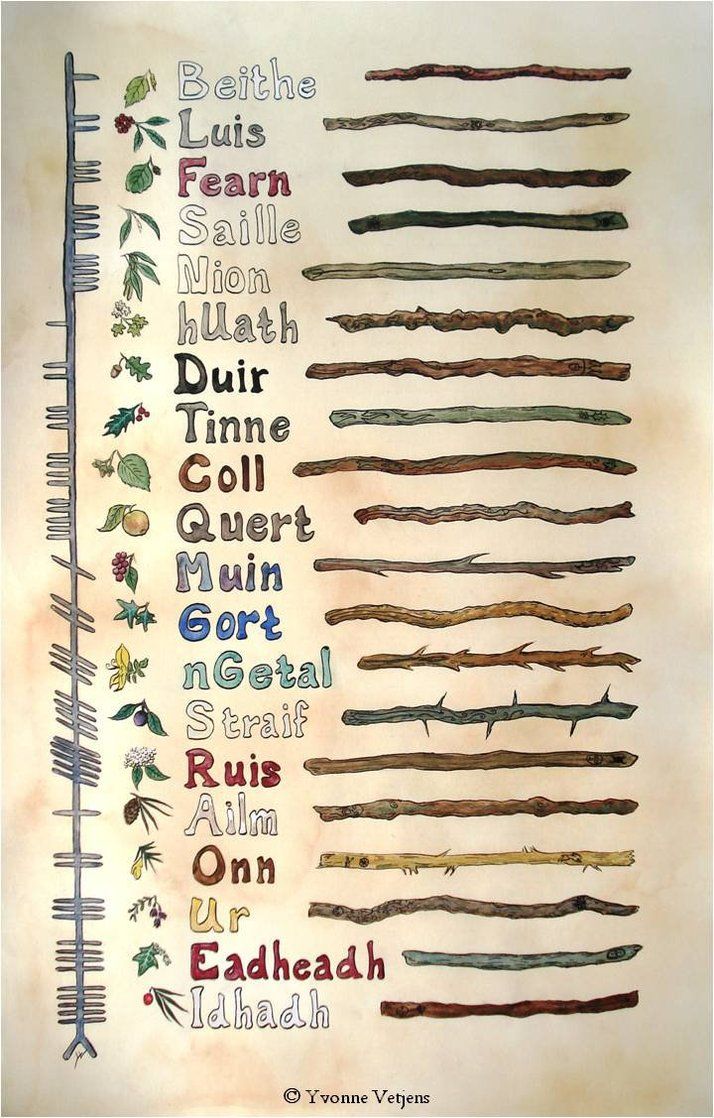
Each of these trees possessed its own special magical properties, distinct character and social role, which reflected the features of their energies. Regardless of which order we adopt, both the Ogham “Beith-luis-nuin” and “Cad Goddeu” can provide an excellent map of the birth and manifestation of Zhiva.
We have already examined the order according to the “Auraicept” in detail; now note that the unique druidic skills that made it possible to create an effective magico-linguistic ogham system involved identifying and activating the “essential” properties of trees — the features of the manifestation of life energy in each of their varieties.
Indeed, many cultures noted the protective power of birch, the warrior spirit of oak, or the world-connecting energy of ash. However, only the druids were able to find the characteristic features of most energetically active plants, learned to awaken their powers and use these energies not only for “everyday” needs — healing, crafting household items, etc., but also as a means of bringing into harmony their own manifestations, “fields” and “bodies” — with the energetic dispositions of those places and worlds in which they happened to be.
According to legend, the druids were taught these skills by gods or sidhe, but regardless of origin, the magic of trees and ogham as a form of imprinting and a means of support are a unique means of harmonizing the world and the beings within it.
Thus, birch was perceived not just as protection, but also as a source of especially smooth, feminine, flowing, yet indestructible energy, and oak — not merely as a warrior, but as the bearer of a “pacifying” activity (which, by the way, fully corresponds to its Jupiterian nature). Also noteworthy is the highly revered “border”, “priestly” energy of beech and the tradition-keeping “royal” power of yew.
Let us conclude the story with our translation of part of the “Battle of the Trees”, from which a curious reader can glean some information about the characteristics of the plant energies discovered by the druids:
“The tops of beeches, dried, once weak and puny,
Now send out shoots, change and are reborn.
When beeches flourish, by the power of spells and prayers,
They call the tops of oaks, awakening hope in the trees.
Having renounced happiness, inspired by joy,
They form into figures, boldly and at ease.
Forming the main letters, the secrets of ogham,
In harmony and order, filled with wisdom.
Travelers marvel, looking upon mysterious wonders,
Warriors are horrified, fear flares up in their hearts.
The agitation of the clash, wrought by ancient Gwydion,
Fulfills the will of fate, will remain forever in history.
To the battle the alder moved first, the eldest in its kind,
The young willow and rowan boldly brought up the procession’s rear.
The prickly blackthorn, drunk on blood, marched in the ranks fearlessly,
Blackberry pressed on, ready for battle, tireless on the march.
Roses in anger thrust their thorns at the enemy boldly,
Raspberry bushes came from the forest thicket to the battle fiercely.
Honeysuckle for the sake of battle scorned its own fence,
And ivy and cherry, laughing, moved to battle together.
Wise birch went last, driven not by fear,
But preserving its pride, it marched to battle.
Blooming goldenrod strongly guarded the formation along the sides,
Spruce went in front, vaunting itself the commander among the trees.
Yew was the king, first to rule in Britain long ago,
Moss-grown elm could not shift its roots, trailing at the tail.
Hazel sharpened weapons, preparing for the terrible battle,
Privet, like a bull, rushed after the slender spruce.
Green holly did not lag behind, repeating in the battle formation,
Wondrous hawthorn, healing wounds, arrived for the battle.
Vine, twisting, crawled to the fight, following the trees in the ranks,
Fern was destroyed; there is no joy for cowardly fighters.
Broom was felled and uprooted, gorse was being defeated,
But honeyed heather, though small, fought bravely, valorously.
Under the mighty oak the earth and heavens trembled, as it fought in rage,
Trampling enemies into the ground, achieving countless victories.
Regal ash with difficulty repelled the enemies’ attacks,
Like waves upon the seashore, they advanced upon it.
Pear fought, shedding much blood, not retreating,
Chestnut competed with spruce in feats of arms, bold and valiant.
White is snow, and black are ink, and green are trees,
Calm are the depths of waters since the time I heard the cry;
Since then birches grow in this land without fear,
And oaks stretch upward by the word of Gwarhan-Melderw.
Thus they fought, trees and bushes in a stubborn battle,
Their strength, passion, and courage are glorified to this day.”

Hello! How and for what can Ogham be used, in a simple everyday example? Can you give me an example?
I have tried runes, sigils using chaos magic methods. I can say that I saw results within 7 days. How can I try Ogham? I’m curious.
Hello.
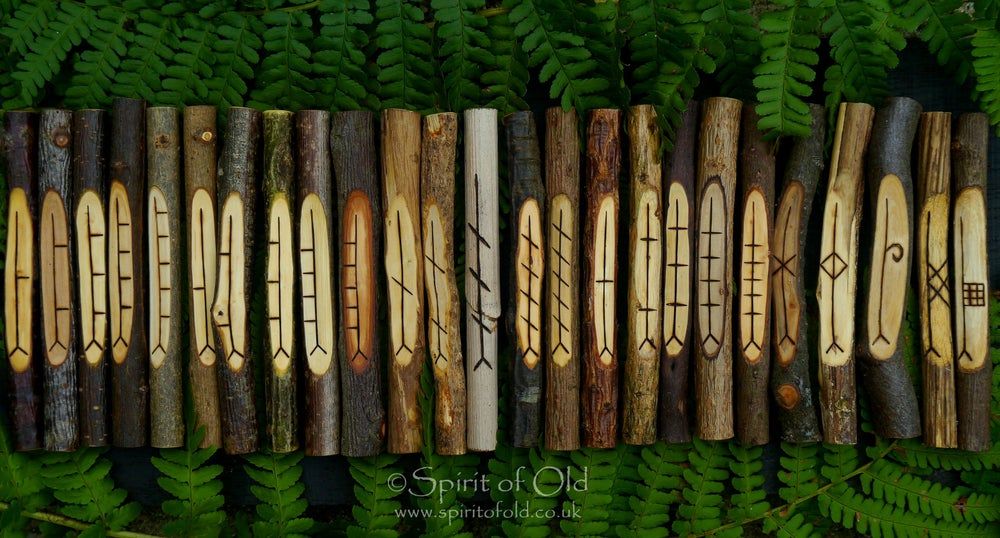
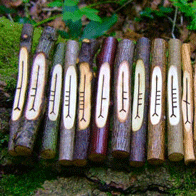
Exactly as any realization symbols. Inscriptions in Ogham can serve as amulets and talismans, while sticks with cut Ogham signs can be a divinatory tool.