Spirituality and Madness
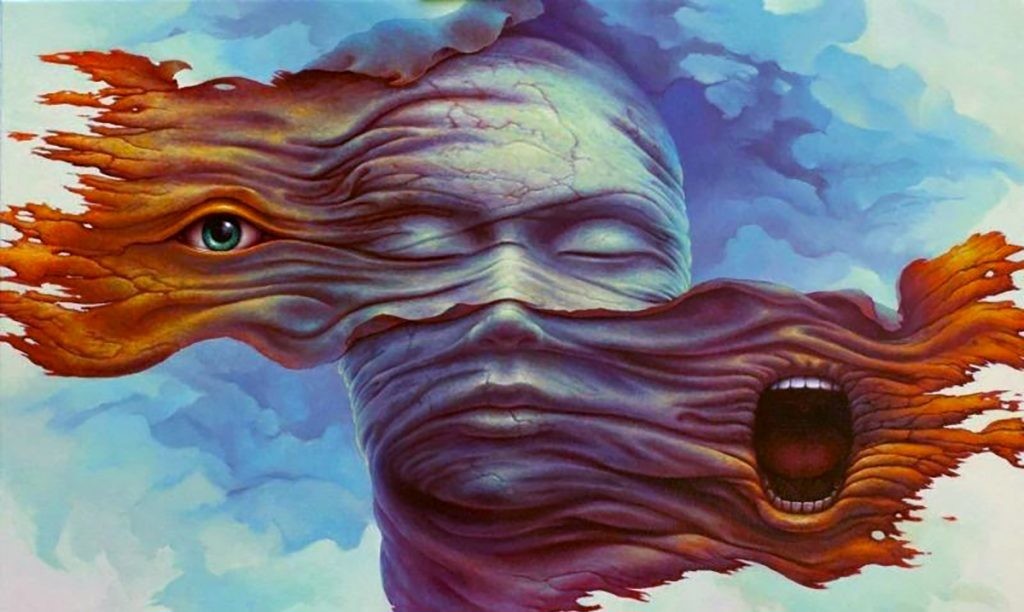
When entering the path of mental development, one quickly notices that the habitual rationality, that had served one well in the “ordinary” world, has its limits and sometimes even hampers us in the domain of the unconscious, the potential, in the world of sources and causes of manifested existence.
Indeed, intelligence, tasked with studying patterns and facilitating action in the world of certainties, stalls in the multivariant space of probabilities, turning from a reliable support into binding shackles.

Of course, anyone who has encountered this “shadow” side of reason sees and understands its limits; yet some strive to declare intelligence the “enemy” and call to “discard” it altogether. This tendency is especially characteristic of immature mystics and dreamers, for whom forays into the irrational are a habitual part of existence.
Because poorly educated teachers and low-skilled guides predominate in society, the esoteric culture fills with literature and teachings that preach that reason is harmful. Hearing or reading such ideas, many novice seekers or those merely curious about “development” find them attractive and begin to “discard intelligence”, to “lose their minds”, and the like — an impulse further reinforced by laziness and the lack of habit of sustained, coherent thinking. As a result, the esoteric community is overflowing with people of varying degrees of madness, inadequacy, and irrationality.

Note that the Traditions know, describe, and often exalt the so-called “sacred madness” — a supreme irrationality arising from direct contact between the mind and its causal field, with the multipotent depths. However, such “madness” does not arise from “discarding” rationality but from surpassing it, since the mind observing the multivariant space of probabilities perceives in it phenomena that for others are “incarnate”, “realized“. Therefore, such a “mad sage” can act rationally and even supra-rationally, finding routes and loopholes in the fabric of reality — toward liberation from its fetters.

Unfortunately, the madness of most “esotericists” and homegrown mystics has nothing to do with the sacred or with wisdom. Thus “spiritual growth” often proves to be spiritual degradation in practice: the ability to exist and act adequately within it diminishes, and in the mind not only are its potentials not actualized, but even already established connections atrophy. Of course, the mind justifies such destruction (after all, it is easier to be lazy) and even exalts it, declaring its own degradation an “escape beyond the limits”. But a mind that has truly “gone beyond” still orients itself well within those “limits”, knows how to work with them, and, when necessary, attain higher successes within them. Therefore, until rationality is genuinely transcended, until a determinacy is truly perceived as merely one option in an ocean of potentials, it is premature to discard intelligence. Only when all regularities are made conscious, identified, and classified is it possible to rise above them and go beyond them. While the mind remains limited, while its capacities are insignificant, it requires development, not “discarding”; otherwise, the mind will still have to return to this work in other, most likely less favorable, incarnations.

The first and fundamental rule of any “discarding” on the path of development is that only what has been exhausted, fully worked through, and transcended may be discarded.
While we still exist in a world of determinacy, we should study its laws, trace causal chains, and predict future developments. Without such a fully developed Apollonian component, the psychocosm cannot balance, and its Dionysian principle will remain only a source of histrionic manifestations and capricious weakness.