Signs of Guidance
We have already mentioned more than once that many magical schools and teachings clearly distinguish between two kinds of knowledge — “higher” (gnosis, jnana) and “lower” (eidein, vijnana). The first relates to integral, synthetic knowledge, while the second relates to dual and analytical knowledge.
Each of the kinds of knowledge has its own aims and tasks: empirical cognition is necessary for existence in the manifested world, whereas guidance is for the transcendence of this world. As long as a being feels comfortable in the manifest world, its success there directly depends on cognitive abilities and the accumulation of information; however, as soon as it intends to go beyond manifested existence, knowledge proves useless and must yield its place to guidance.

Two kinds of knowledge also correspond to two kinds of light, modes of existence of consciousness: conceptual knowledge corresponds to the “Serpent of wisdom” — Nakhash — the light of individuality Yechidah, “distorted” by the manifested world, whereas guidance is the manifestation of the Shekhinah, a glimmer of the wisdom of the Light of Life, Chayah.
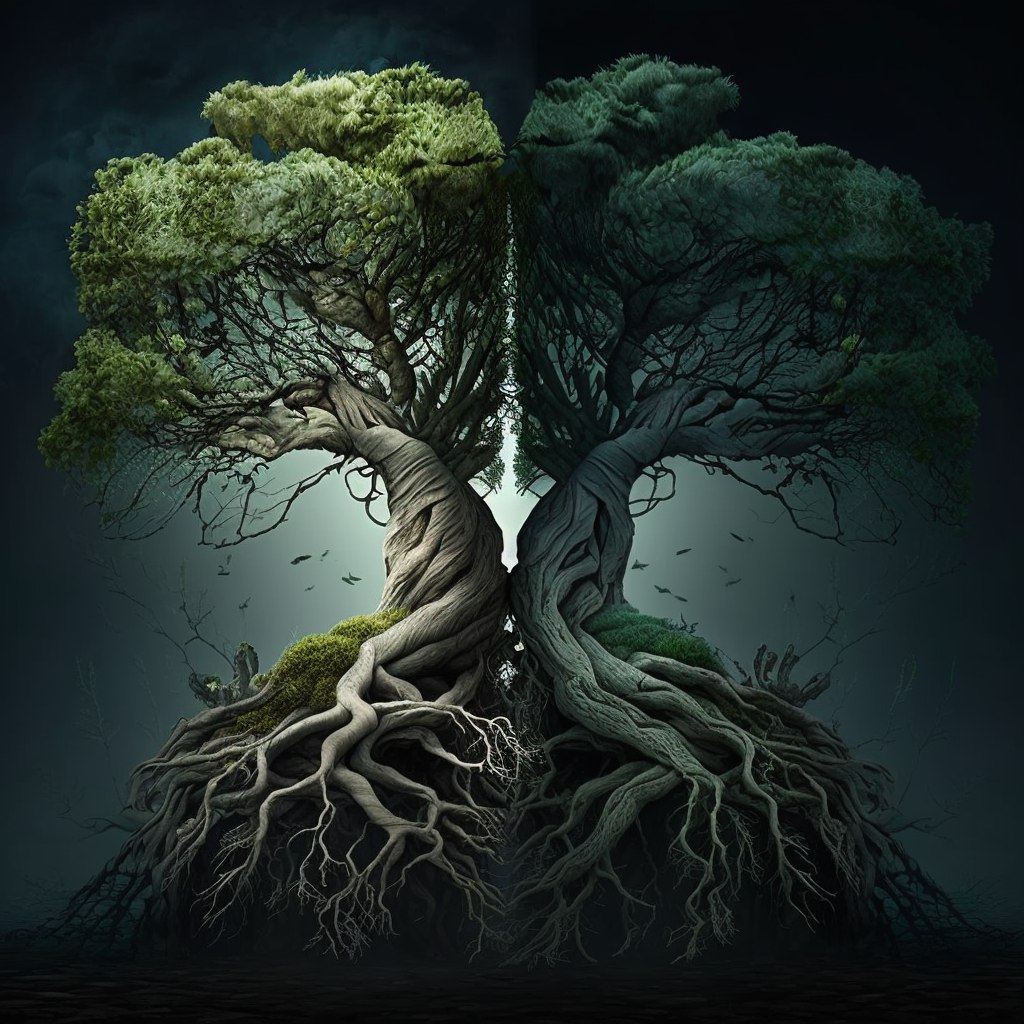
In other words, one can correlate these two kinds of knowledge with the fruits of two Trees of Paradise — the Tree of Knowledge (Heb. עֵץ הַדַּעַת טוֹב וָרָע, Etz ha-Da’at Tov va Ra) and the Tree of Life (Heb. עֵץ הַחַיִּים, Etz ha-Chayim), and the fruits of the Tree of Knowledge, as is known, enslaved the mind in the “fallen” worlds, while the fruits of the Tree of Life must impart to it divinity.
On the everyday level, the manifestations of the two kinds of cognition are two fundamentally different ways of transmitting information: conceptual and symbolic. The first is verbal and near-verbal kinds of communication, implying mastery of “differential” elements of meaning — simple logoi — operating with which, with varying degrees of clarity, creates the world as a picture. The second operates with symbols that carry synthetic, extra-conceptual information and are a reflection of logoi of a much higher order.
From a physical point of view, one can say that these two kinds of cognition are two modes of description (observation) by which the mind “collapses” potential reality, creating in it islands of certainty — worlds. The activity of eidein is observation that creates a world of objects, whereas gnosis is an instrument for building the Pleroma.
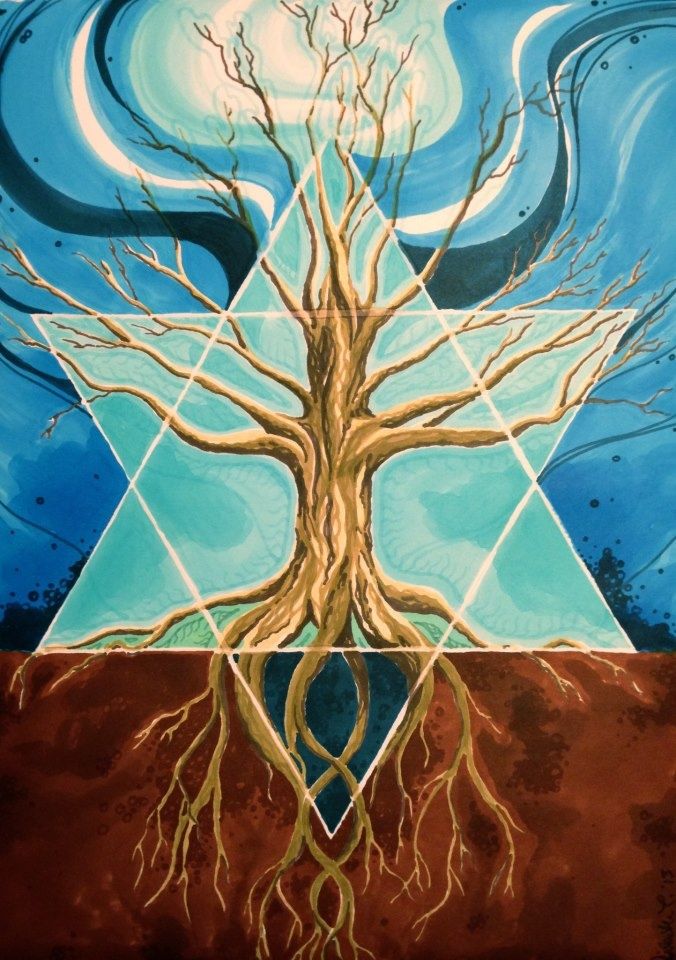
It is clear that in order to create the Great Perfection, one must first reveal its aspects, the actualization of which leads to the Great Unification. Therefore eidein is a necessary first stage of the manifestation of consciousness, which, however, must be followed by gnosis, and it is the violation of this sequence that leads to the emergence of the vicious cycle of gilgul.
In turn, the two main kinds of symbols — vortical and vector — correspond to two ways of “binding” the fabric of reality — through creating within it axes and guidelines of meaning.
Thus, one can say that the “simple” notions and concepts of eidein create the very possibility of the existence of reality, make it definable, perceivable, and therefore lawful, while the symbols of gnosis create “nodes” in this reality that support its integrity and simultaneously serve as channels of communication with probability spaces.
While the mind perceives worlds from the position of Nakhash, as a set of separate objects and differentiated processes, it uses conceptual knowledge and “profane” symbols; but when it moves to perception from the position of Chayah, it sees the world as a single flow of being-mind, for the description of which one should use the Signs of Power.
Thus, magical symbols can be regarded as ways of non-verbal description (and, consequently, creation) of reality, operating with logoi of high orders and serving for direct penetration into the nature of the flow of being-mind.

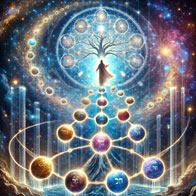
Good time of day. Question: if there is a vision of consciousness as a Tree and a flow of symbols filling the matrix, but not constantly. How to apply this correctly?
Yes, there are parts-worlds on the tree that one can indeed enter. I see them in bright colors. In one of them, I communicated with a local, he explained that a symbol is a structure of thought. The basis is emptiness. Honestly, I didn’t think to write this, but your post is right on point.
The Tree is always a symbol of growth and development.
Looking at the structure of consciousness, I have the impression of a closed system. That is, the matrix of construction is one, while elements are distributed individually. Moreover,
some elements are taken from someone’s flow, others are generated by the consciousness itself, etc. What do you think, isn’t this the root of misunderstanding others? I think, for consciousness to grow, it needs to operate with commonly accepted symbols. In principle, I understood, thank you.
The topic of symbols also intrigues me. But I do not fully understand the technology of working with them. As I understand it, they need to be kept in constant focus (internal gaze), then move on to contemplation (feeling – tuning into resonance), and thirdly, mentally (not verbally) ask the questions you are interested in? For now, meditation on the symbol is going well when you read various interpretations and its translations. But is it possible to gain knowledge directly that you can express directly, without prior reading related literature?
A symbol is not just an object of contemplation; it is a special way of transmitting information and, in the case of a realizational symbol, also energy. Therefore, working with symbols is a kind of reading information and transforming energy.
Hello. Is this related to all symbols or just some? For example, I read the book by Faidish E.A. ‘Altered States of Consciousness’, on page 38, there is an example quote: ‘One of the goddesses of the tantric pantheon, Bhagamukhi, is depicted holding her own head in her hand. A stream of blood gushing from her neck goes into her mouth. The first thing that comes to mind is the image of some horrific vampire monster (which I absolutely agree with). In reality, the image symbolizes the denial of the bodily, animal nature in the name of the spiritual; the blood gushing from the neck signifies the sublimation of animal energy through higher mental functions.’ The question is how will my subconscious perceive this symbol, as described or as a horrific monster? If we assume that I do not know this symbol’s description and see it for the first time. Or the same symbol of the snake, it symbolizes wisdom and the depths of the subconscious, but mostly the mind reacts to it as a danger. Is there a difference for our subconscious, for example, when working with Voodoo symbols?
There is a difference between a symbol as such and a symbolic representation. The examples you provided are exactly symbolic representations; symbols are abstract graphemes, they can only resemble something real but not copy it. Symbolic representations are meaningful signs, that is, their perception often depends on culture and context.
Listen to your subconscious and trust it. Snakes are enemies of humans. And despite the fact that the history of the war between snakes and humans has been carefully erased, the information about it has remained. And the monument in Red Square, where a snake is pierced by a spear, stands there for a reason.
For a huge number of sages and schools, snakes primarily represent Wisdom. And they are definitely not ‘enemies of humans.’ That is some kind of prejudice.