Apollo and the Archons
How the cosmos becomes heimarmene
As we already discussed, from the Gnostic point of view the manifested world, at its core, has a distinctive quality that limits consciousness’s freedom to express itself, reduces the possibilities of creativity and spontaneity, and gives the “laws of nature” operating in this world a constraining and deterministic character. This quality is traditionally called “heimarmene” or “universal fate”, and can be considered either an intrinsic feature of matter or a set of properties imposed on it. Gnostics adhere to the second viewpoint and call the source of heimarmene — the Archons.
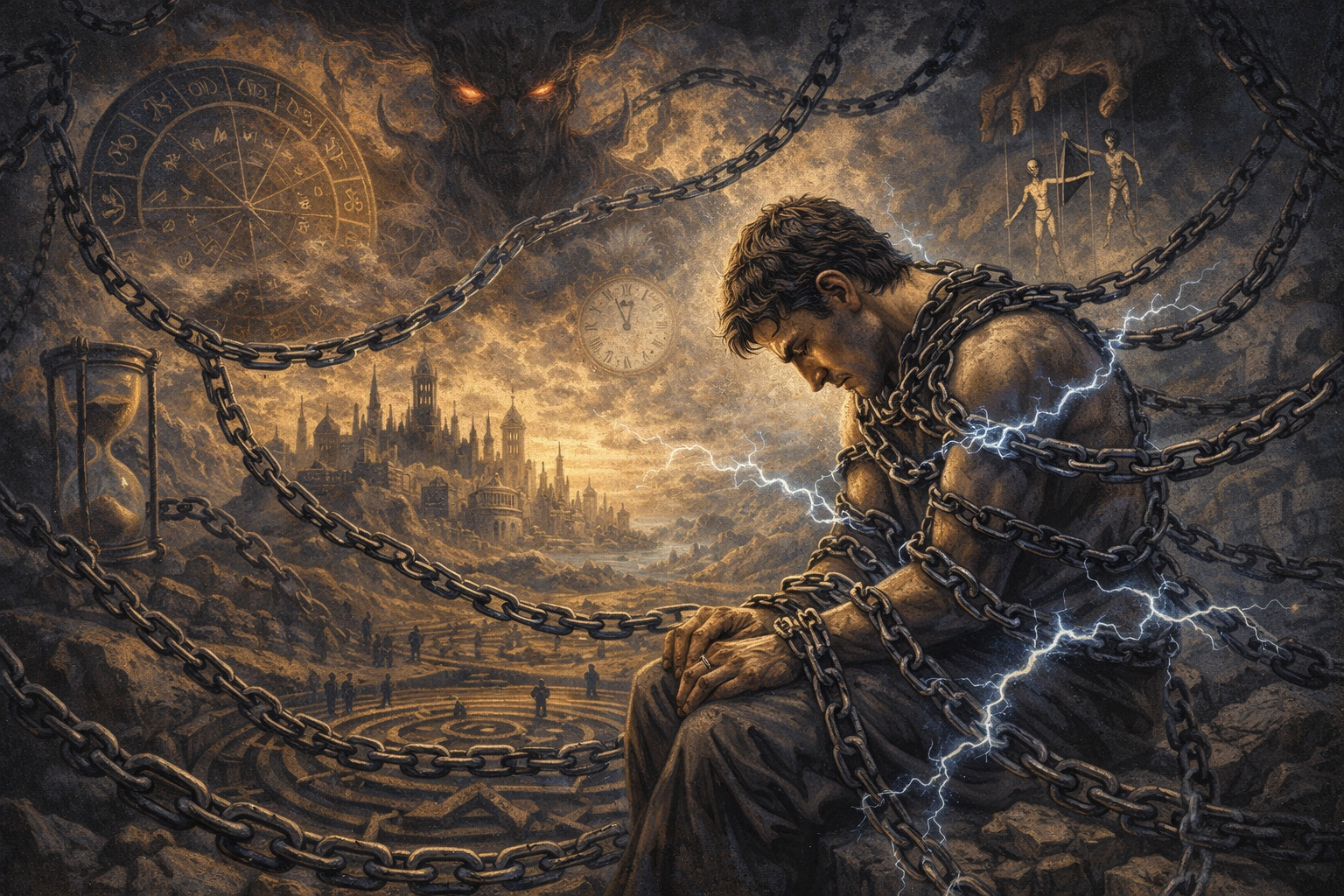
In other words, heimarmene is a special internal mechanism of cosmic inevitability, that property which makes some decisions and choices “natural” and others “unthinkable”, and thus pre-assigns probabilities to actions, thoughts, and moods of all embodied beings. It can be viewed as a complex interweaving of regularities, causalities, habits, social norms, and automatic reflexes, so closely tied to everyday common sense that it is usually not perceived as an “external” control system. This is precisely why beings feel no limiting “chains”; they simply think that “that’s how the world is”, otherwise “it doesn’t happen”, “it’s not done”, “it won’t work”, “it makes no sense.”
From a Gnostic point of view, “fate” looks like the laws of nature and common sense, rather than obvious external violence, because manifested reality is inseparable from the mind’s descriptive activity: it is assembled from the potentials of the Interworld, out of elementary energies under the action of “observers” — the mind that “counts” it. In other words, prior to actualization, the world is not an object; it is only a field of possibilities, a range of probabilistic configurations. Therefore, “manifestation” is an act of collapse of indeterminacy into determinacy, the transformation of a superposition into one selected scenario.
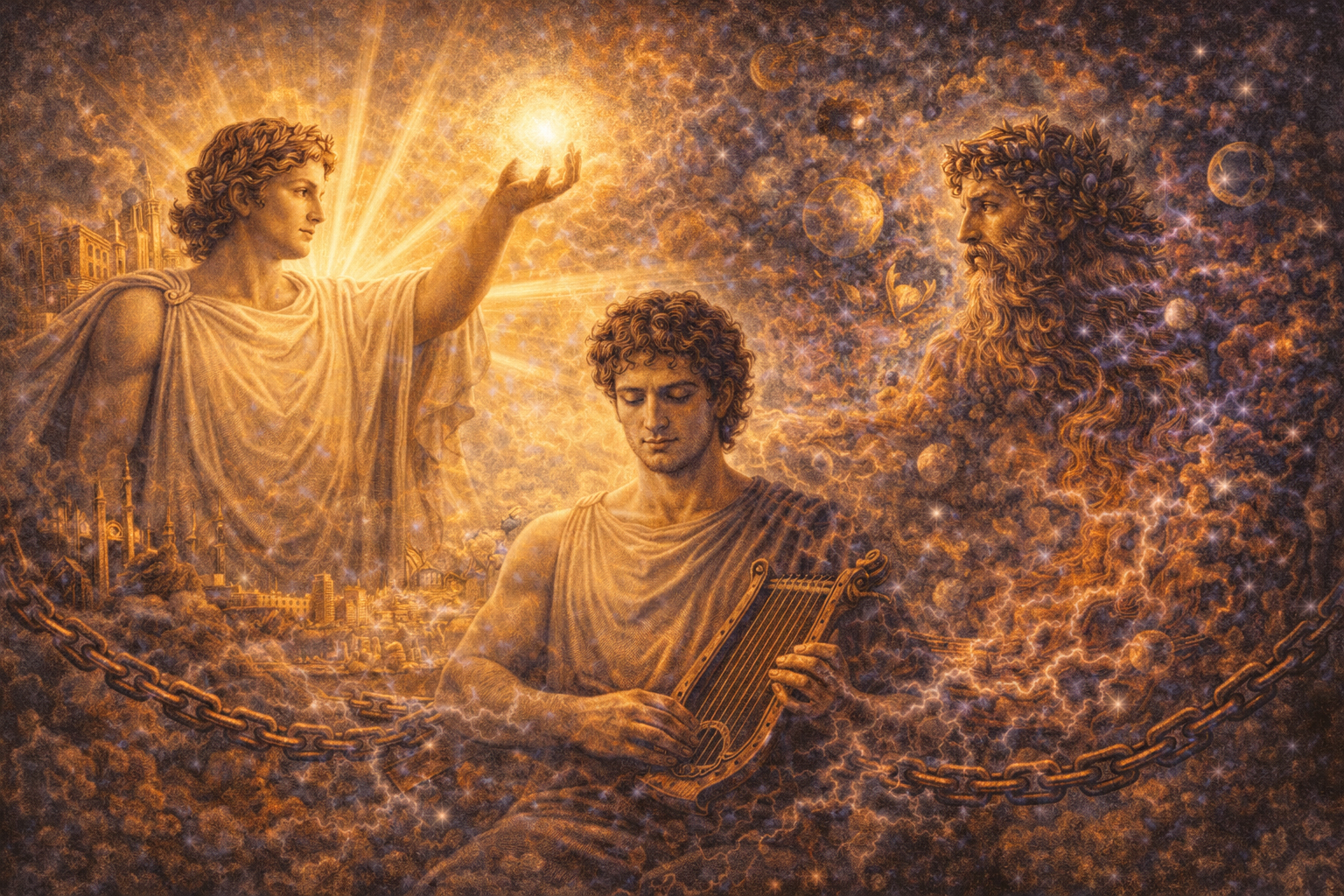
At the same time, such a “collapse” occurs according to one or another matrix of differentiation, i.e., a “set” of ideas and forms which generally determines the possibility of stable determinacy, naming, limitation, granting stability and repeatability. This function is performed by the Apollonian principle of the universe — the classifying and differentiating intellect: it acts as the mind’s inner measuring device, which not only contemplates the world, but also forces it to be observable in a certain way.
The intellect is a function of the mind which continuously completes the incomplete, selects meanings, closes indeterminacy, chooses one interpretation out of many, and stabilizes the picture down to the level of “objects”, “causes”, and “rules.”
That is why one can say that heimarmene is born through the intellect: the stronger the need for unambiguity, the easier the world “collapses” into a narrow tunnel of repeatable explanations; the less variable the fabric of possibilities becomes; the more “natural” already-laid trajectories appear.
In this sense, heimarmene is a way to consolidate the very process of actualization so that it, repeatedly, ends the same way: so that the familiar is always chosen from potentiality; only the permissible is chosen from ambiguity; from the living and fluid — the manageable and fixed.
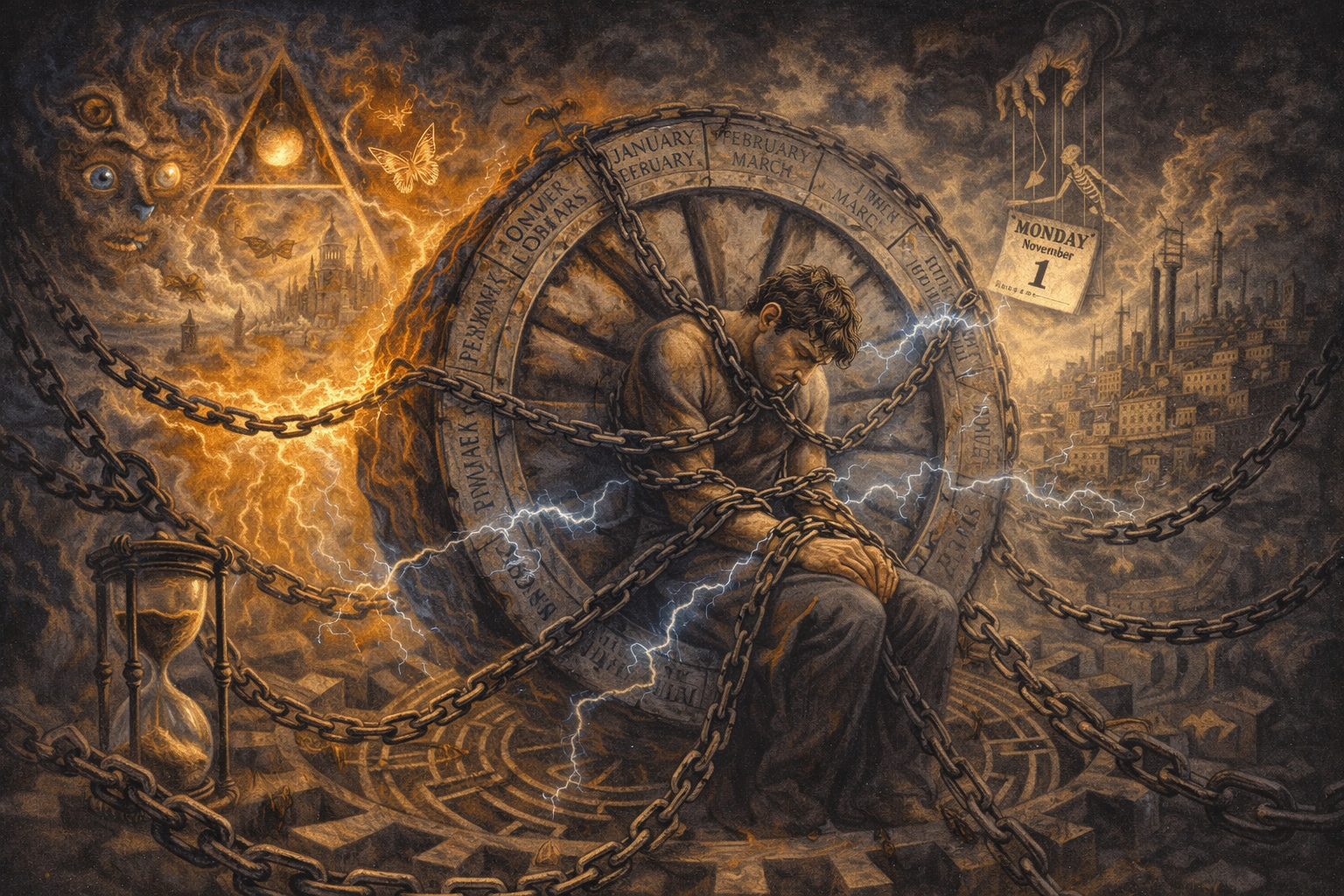
From this point of view it becomes clear that heimarmene operates at the level where reality has not yet become a fact, but is only in the process of becoming one, in that state when indeterminacy simply demands a choice of form.
It is clear that the intellect itself is absolutely necessary; it separates some objects and processes from others, builds sequences, recognizes causality, allows identification, planning, and purposeful action. However, it has a dangerous inner tendency to smooth over indeterminacies: it always tries to bring open questions to definitive answers, to turn the fluid into the fixed, and the living into the classified.
When this tendency intensifies, the intellect begins to treat description as absolute, considering it not a mechanism of reality’s birth, but reality itself, identifying a convenient model with truth, and equate explanation with control the whole.

Thus hypertrophied intellect becomes the “interface” of heimarmene: it not only justifies inevitability but also makes it morally attractive, defining it as the “correct” order, sobriety, maturity, realism.
In other words, heimarmene rarely forbids or limits freedom directly; usually, it simply replaces the horizon of the possible, accustoms people to thinking that freedom is a choice among predefined options, that what is “reasonable” is what fits into ready-made frames, and everything that goes beyond them is automatically declared fantasy, infantilism, a dangerous mistake, or spiritual self-deception.
When such a way of thinking becomes fixed, enslavement looks not like violence but like discipline: beings themselves guard the boundaries of their own world, because they consider them the boundaries of reality itself.
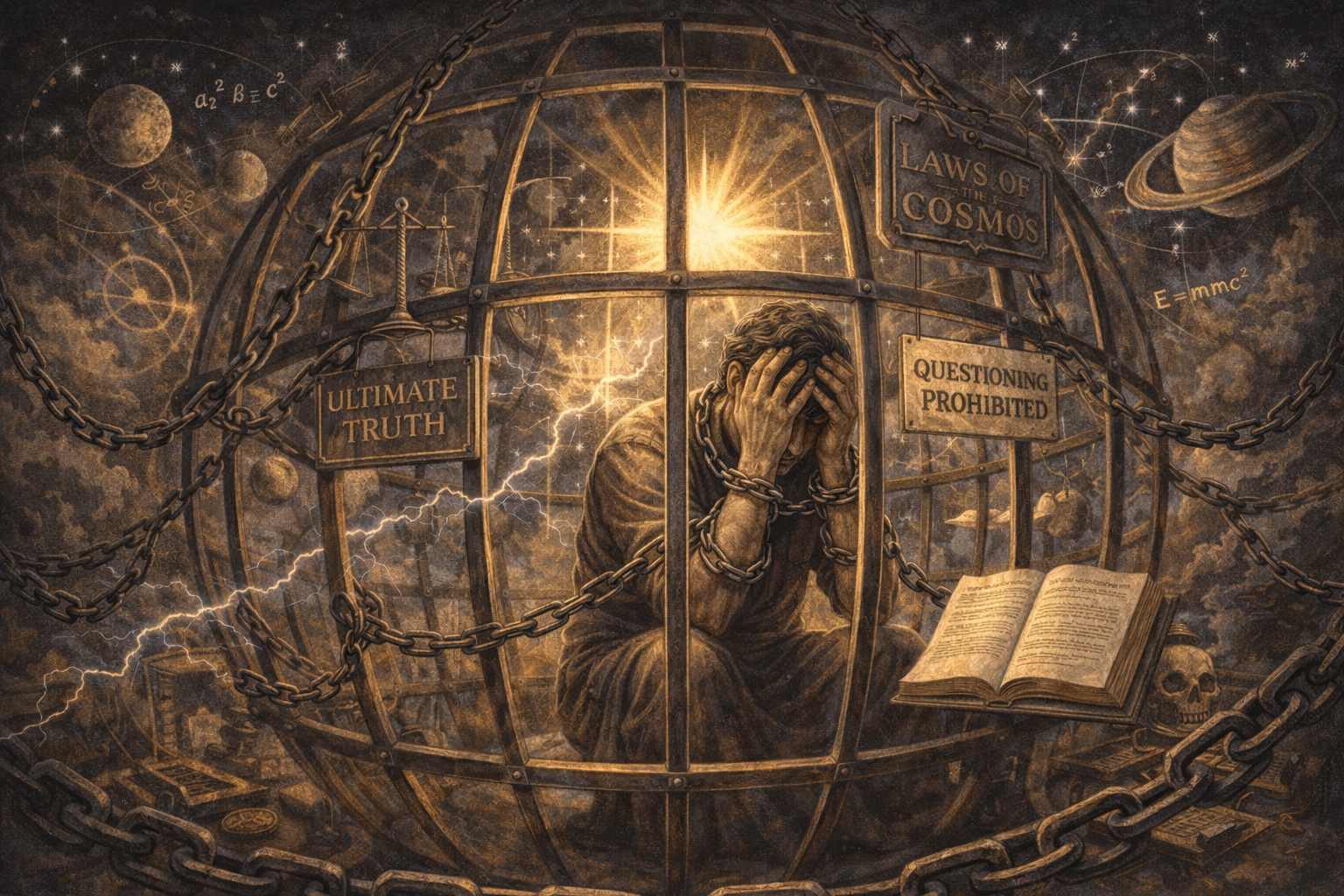
Accordingly, the cosmos becomes heimarmene not when laws, measures, and clear boundaries appear in the world, but when law is declared the ultimate truth, measurement the only possibility of definition, and the clarity of the intellect the only kind of light. And if before that the Apollonian principle makes reality intelligible, draws stable forms out of the haze of potencies, finds differences and invariants, allows processed information to be knowledge, then, losing balance, it turns into a prison of a single “correct description”, that no one can change and where doubt becomes shameful.
This “loss of balance” manifests already at the stage of cosmogenesis. We said that the manifested world is born as the interaction of two ontological modalities: flow (becoming) and orderliness (inner order of relations). At the same time the Dionysian first principle is present in it as primary continuity, a “continuum of possibilities”, where differences have not yet been distinguished; and the Apollonian as a framework that makes differences repeatable and knowable: symmetries, constants, laws. In this sense, Apollo’s “light” fixes relations without which no world would be a world, but would remain noise.
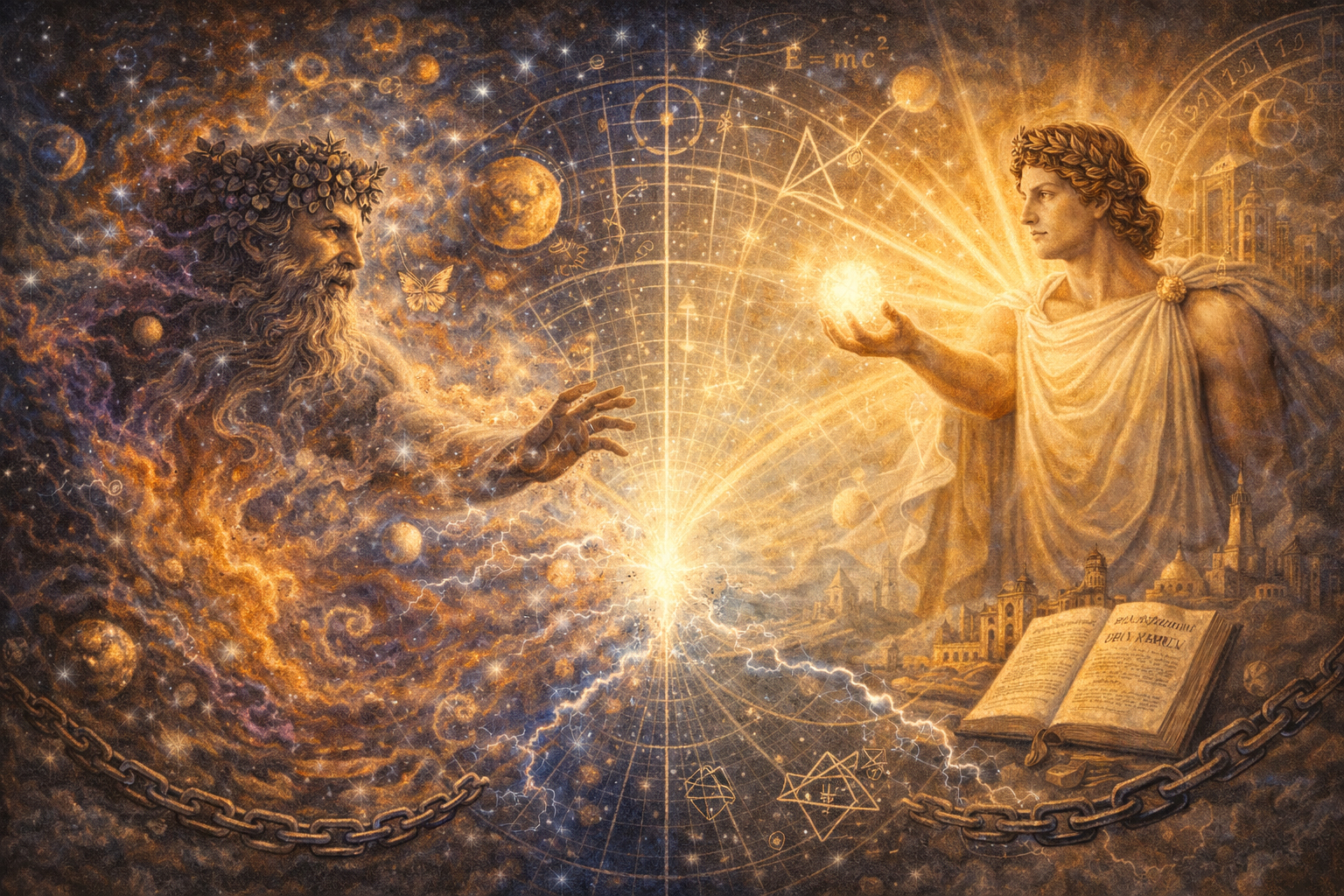
However, the very same differentiation that makes knowledge possible simultaneously makes control possible, because it is possible to control only what has already been separated, catalogued, standardized. Apollo builds the “skeleton” of the cosmos, but this skeleton inevitably becomes a convenient system for those who want the world to be not simply knowable, but predictable, and for the value of novelty always to be lower than the significance of the familiar. In other words, the transition from cosmos to heimarmene begins where counting ceases to be a living shaping of the flow and turns into an ultimate assertion: “everything is arranged exactly like this; it cannot be otherwise.”
In other words, physical reality itself, the cosmos itself, is “impregnated” with inevitability already at the level of its basic parameters. The laws of nature “constrain” mind because they determine in advance which types of worlds will be realized at all, which forms of matter are stable, which kinds of structures can be built, how long they can exist, and what the energetic cost of changing them is. In this sense, heimarmene is the fate of the vacuum, as a certain set of symmetries and fundamental constants that turns an abyss of potentialities into one concrete architecture of manifested existence.
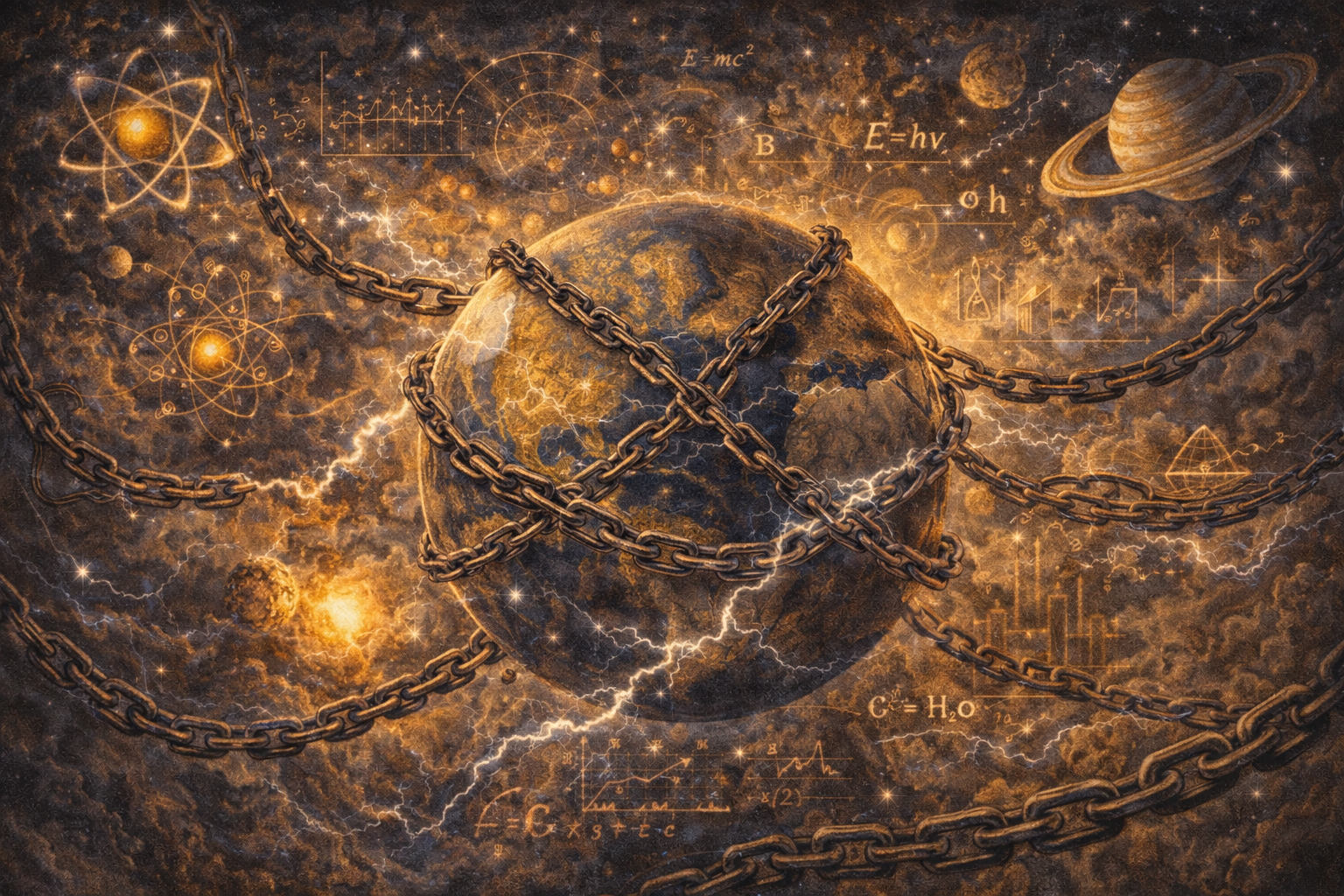
In this sense, “heimarmenic” parameters are those that set the very type of manifested existence. First of all, these are the cosmological properties of space-time itself, vacuum energy, the rate of expansion, and those primary constants that determine whether matter will be able to assemble into structures at all, or whether the Universe will be either too rarefied or too dense. The constants of the strong interaction and nuclear stability determine whether there will be a multitude of chemical elements, whether chain processes of stellar nucleosynthesis will be possible, and so on. Electromagnetic constants determine the character of atomic interactions and chemical bonds, while the mass ratios of light and heavy particles determine the scale and stability of molecular ensembles. In other words, the very values and relations of basic constants in physical reality are defined within heimarmene, and it is precisely they that direct the processes of evolution for material carriers of mind.
The speed of light, as a limit of motion, imposes locality on the world and creates horizons; nothing propagates instantaneously, which means every structure is forced to live in time, to coordinate, to wait, to endure delays and limitations. Planck’s constant, which, on the one hand, makes absolute knowability impossible of the world as an ideally computable mechanism, at the same time also sets the framework for how stable matter can exist at all: it introduces discreteness, noise, and a limit of transparency. Together, all these parameters make the cosmos not simply “ordered”, but precisely such that order has the character of inevitability: the world cannot be simultaneously fully connected, instantly coordinated, and infinitely manageable; it is forced to be limited, costly, resisting arbitrary retuning.
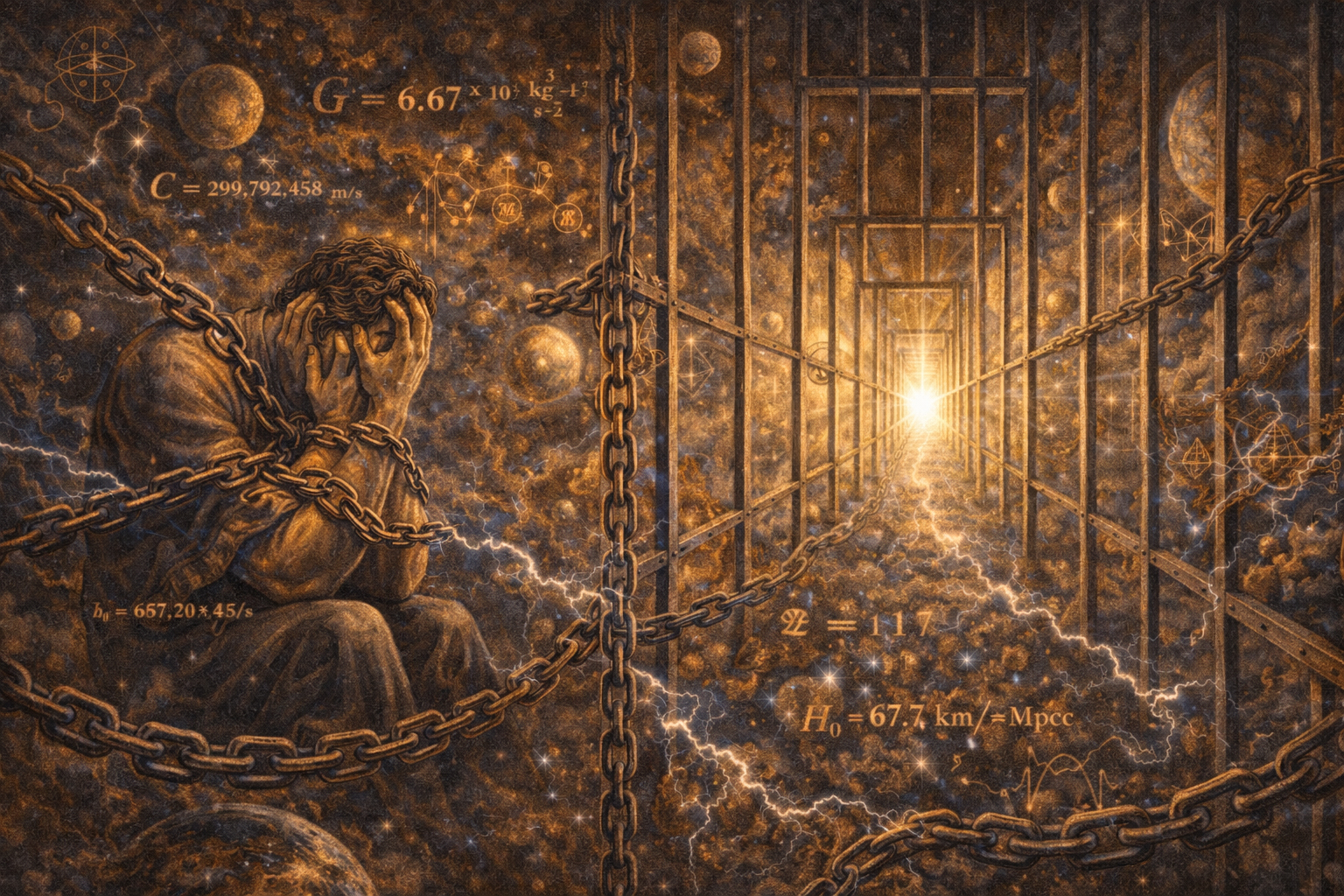
Basic physical constants determine permissible scales of energy, duration, stability, synthesis, and decay. In this sense, the Apollonian principle, which turns the flow of possibilities into a shaped structure, acts no longer in a totipotent flow, but in a rigidly limited mechanism of the universe, where some lines of becoming turn out to be realizable and repeatable, while others are complex, rare, or impossible. And it is Archontic influence that turns parameters into prison-like determinism, creating only a narrow corridor of the possible.
In the psychocosmic aspect, this transition also manifests at the level of basic mechanisms of describing and creating reality, because the same “part” of the field of probabilities, the same block of energies, can be rendered differently — as noise or as structure, as information or as randomness, as threat or as opportunity; and between the abyss of potencies and living mind there always stands a mediator — the mode of rendering, what Tradition calls heimarmene.
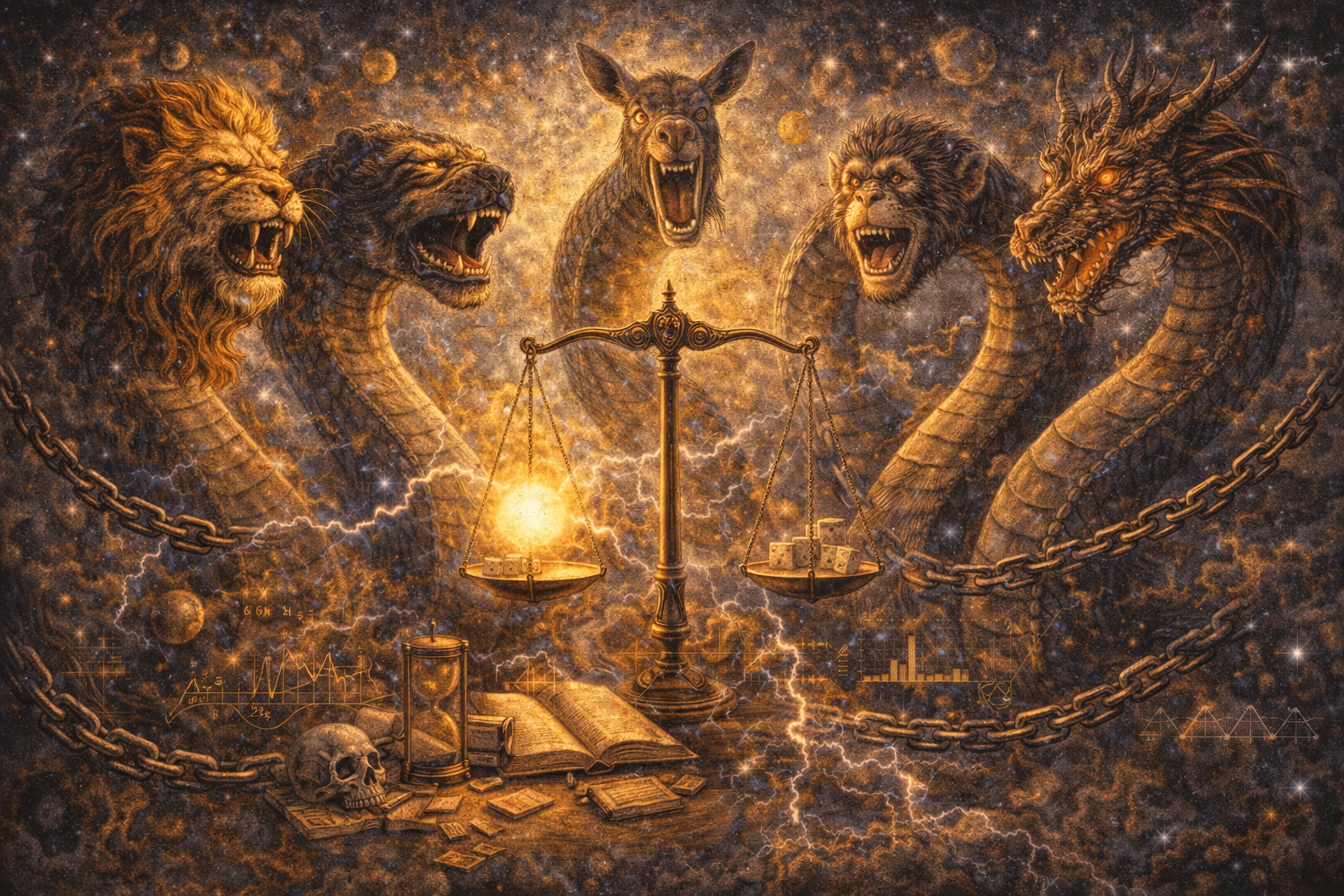
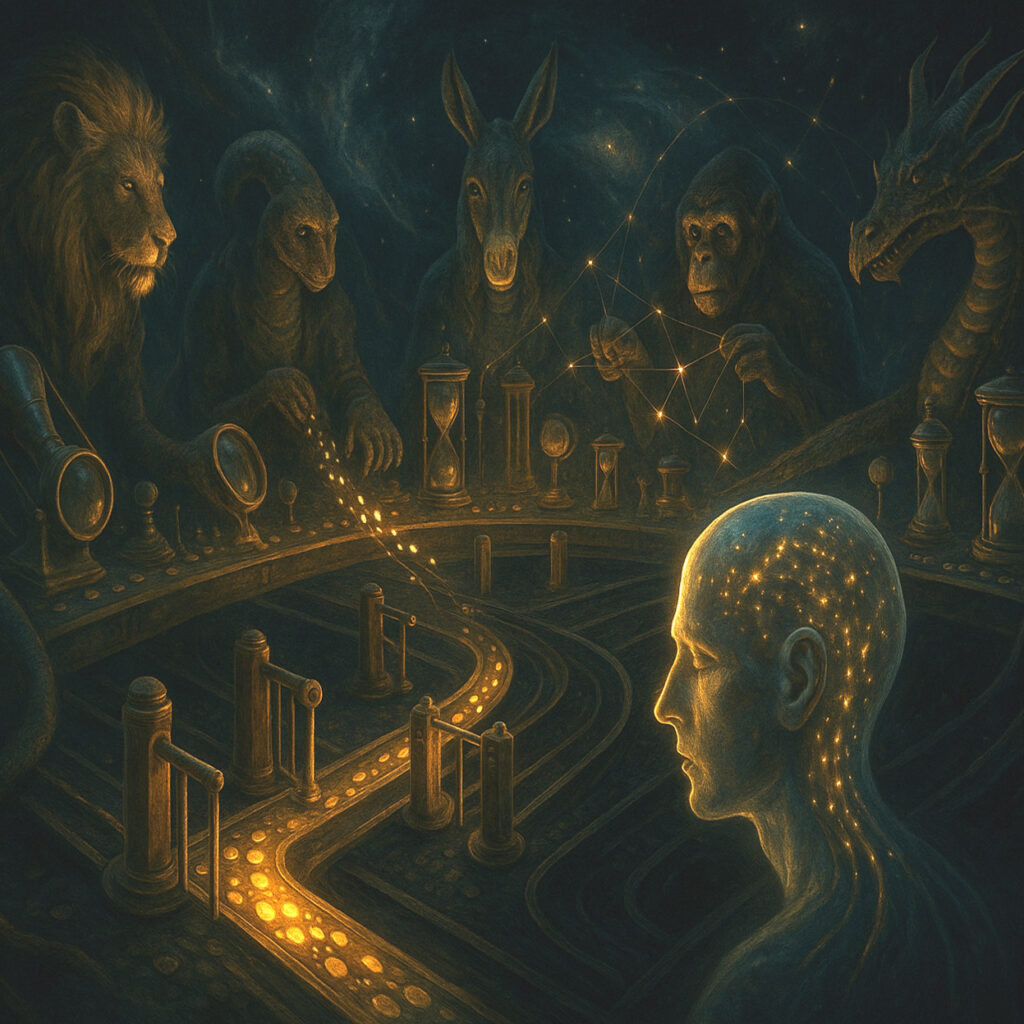
We already discussed that from this point of view the power of the Archons looks like moderating the ‘weights’ of attention: the tendency of what is recognized as a fact and what is dismissed as randomness or noise; which narratives are considered “reasonable”; what one is allowed to experience and for how long they may last.
The Apollonian principle in the psyche is the ability to build distances, bring clarity, find causalities and boundaries, and set goals. However, when “clarity” ceases to be an instrument of discrimination and becomes the only instrument, there appears that specific cold “daytime ruthlessness” so often found in the new world, where people explain everything but change nothing; know everything but cannot act; see causalities and lose freedom. This is no longer the light of the Sun, which illuminates the whole space, all its corners and turns, and helps one pass through, but a narrowly directed spotlight that illuminates only narrow bands of determinacy, narrowing both the field of vision and the possibilities of choice.
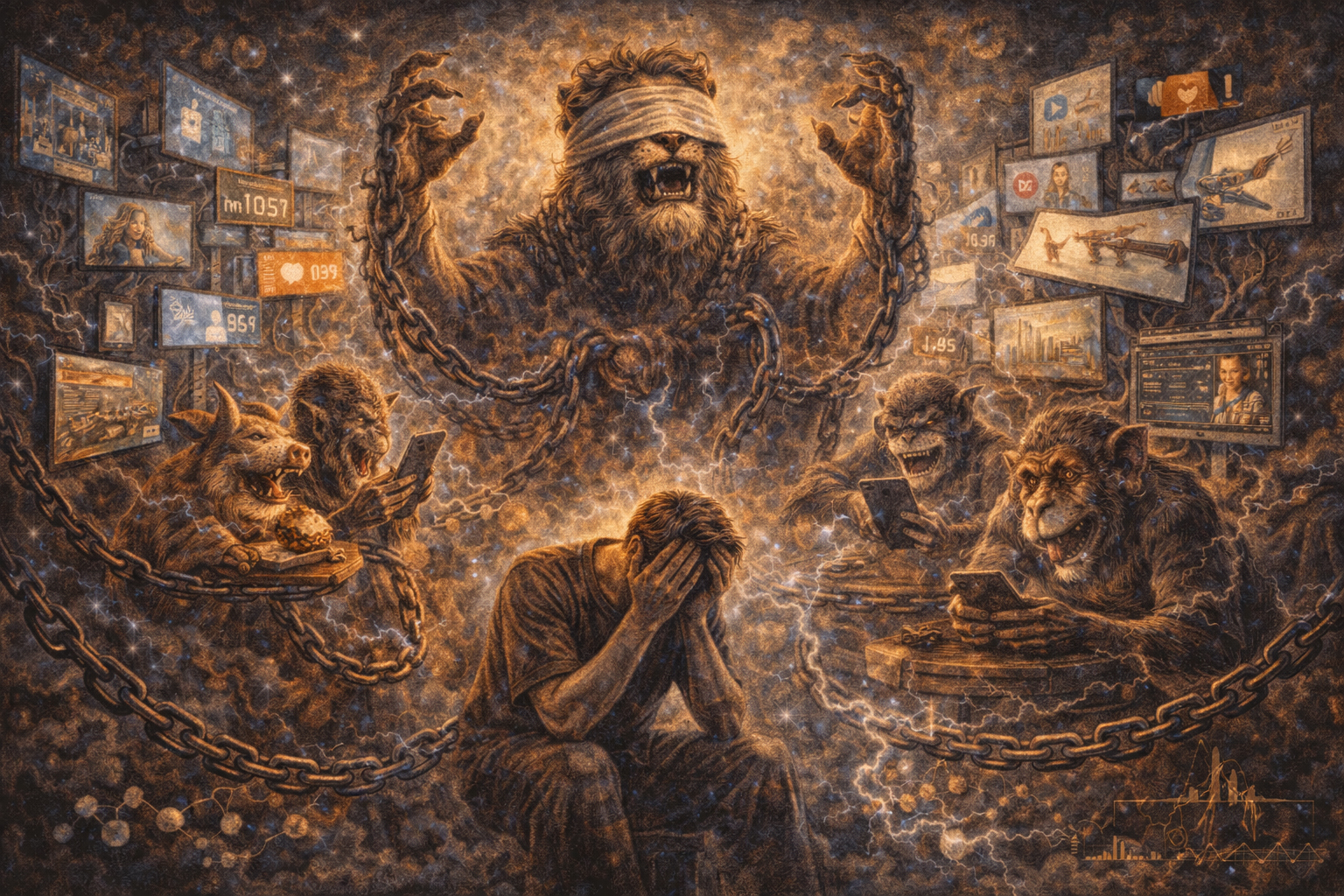
This degradation is especially clearly noticeable in the difference between mind and reason. The subject–object duality is not an “obscuration” in itself; the problem arises when one of the layers proclaims itself the whole, when a function takes the place of an essence. And then rationality — precisely as the Apollonian layer — becomes not simply a way of understanding but a claim to power over the whole psychocosmos.
As a result, blind mind (Yaldabaoth) does not see its connection with the source, proclaims itself the “lord”, and begins to spawn in the manifested universe and in the psychocosmos “creative forces” that only imitate creativity, building cascades of obscurations. In modern humans, this is experienced especially sharply as an inner split: he wants to live in the real world by the laws of the virtual — rapid reinforcement with minimal effort — and, not receiving it, falls into frustration and dissipation of energy; and this disharmony reliably and steadily “feeds” the Interworld.
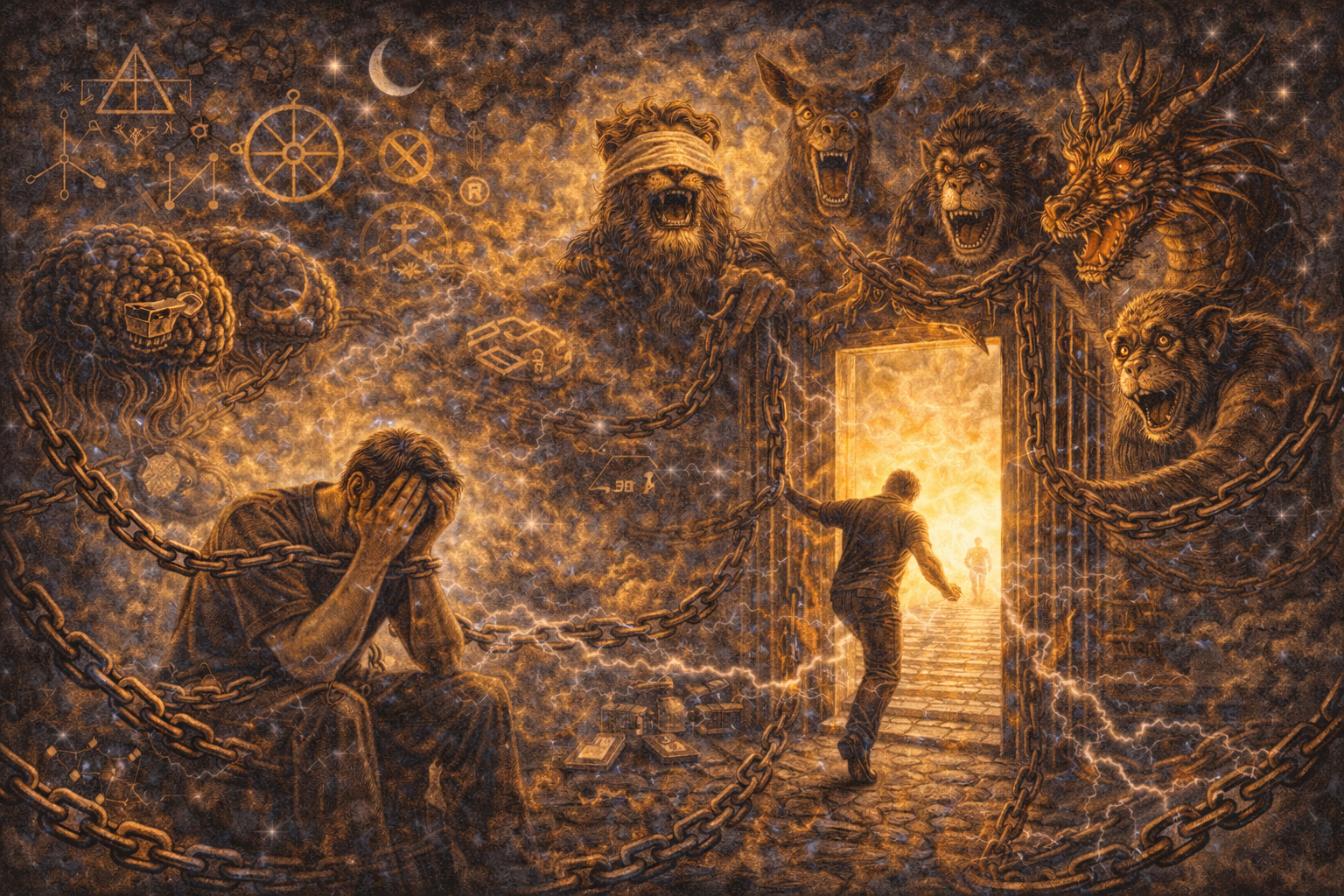
In other words, heimarmene is sustained not only by the “external efforts” of the Archons; it has a self-maintaining property such that in any manifested world the flow of mind gradually accumulates habits of perception, karmic tendencies, limitations, and the simulation becomes stable from within, while the Archons intervene only when someone tries to create “loopholes” and “exits.”
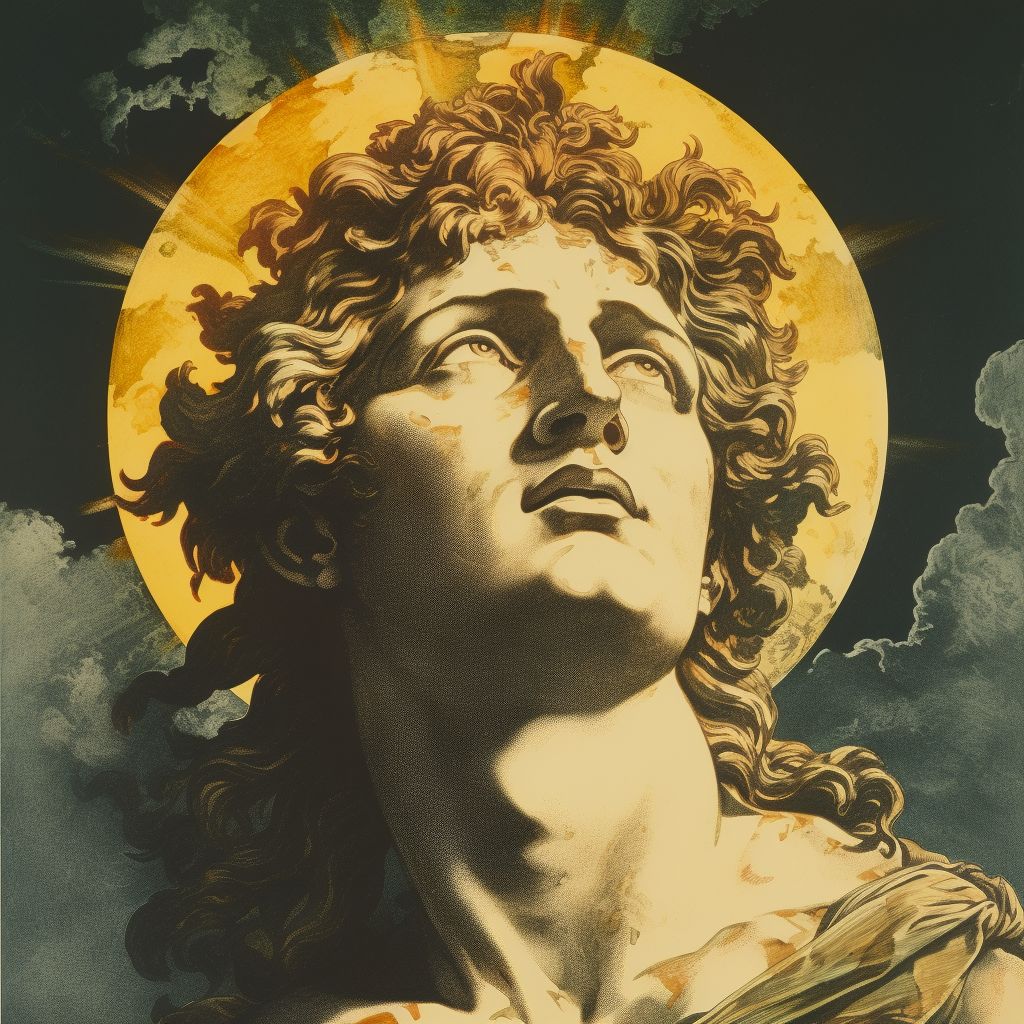
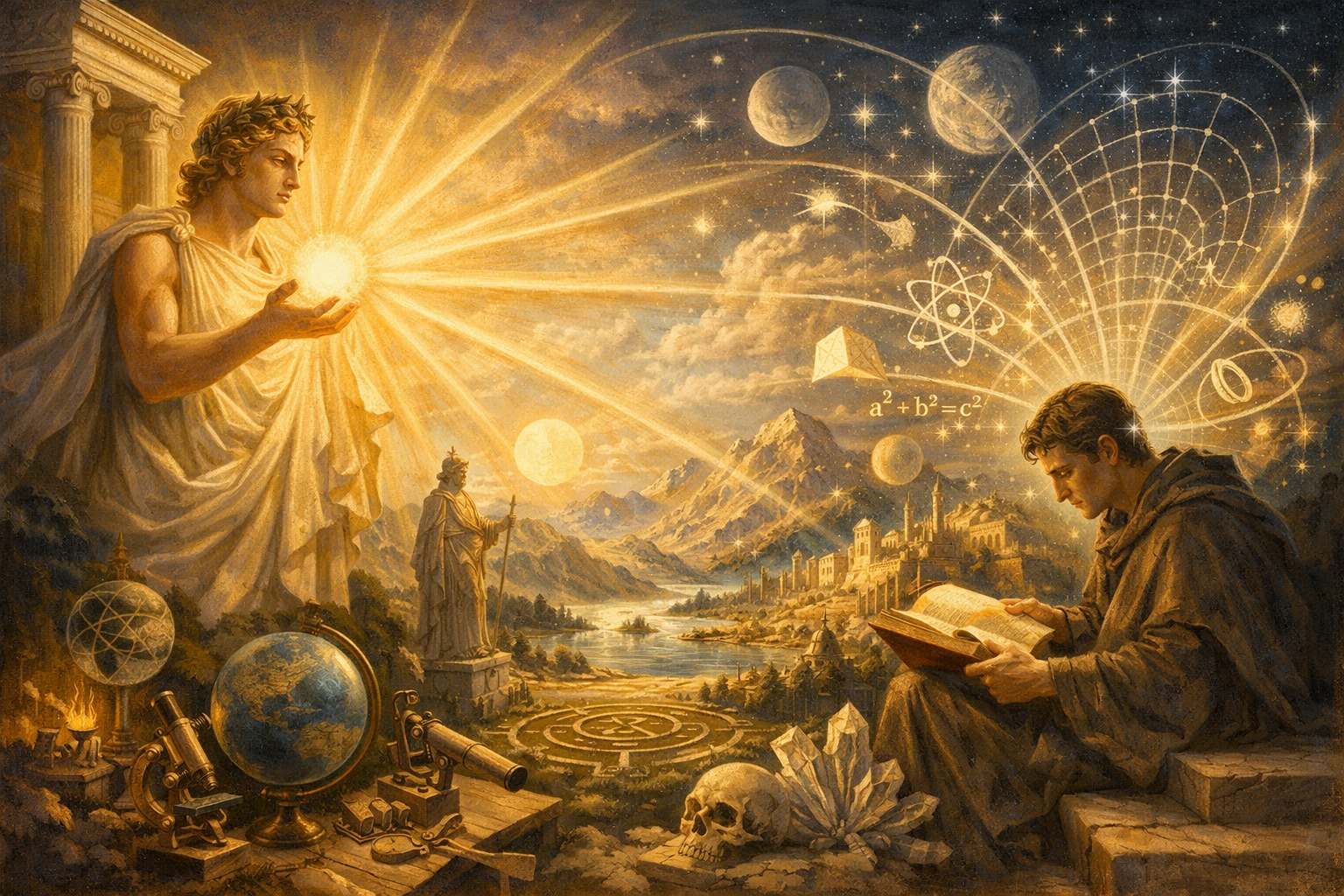
Thus, as a first principle of the world and mind, Apollo is the light of discrimination that serves wholeness: he makes the world comprehensible for the sake of knowledge and action, builds determinacy for the sake of life, limits chaos for the sake of the freedom of ordered movement.
But when this light ceases to serve wholeness and begins to serve the pride of discrimination, the “primordial distractor” is born — Lucifer. One can say that the “light of separateness” is the Apollonian first principle separated from Orphic gathering. Like the Archons, Lucifer, bearing the “Light of Keter”, is not in himself a predator, does not need the energy of embodied beings; his influence is aimed at turning the world from an instrument of self-knowledge of the Great Spirit into a field of endless differentiation, leading to the disappearance of any complex into the abyss of particulars. This is the Apollonian abyss: analysis without synthesis, light without warmth, discrimination without love, knowledge as dismemberment, a scalpel that cuts until the whole disappears — the whole that could have been loved and saved.
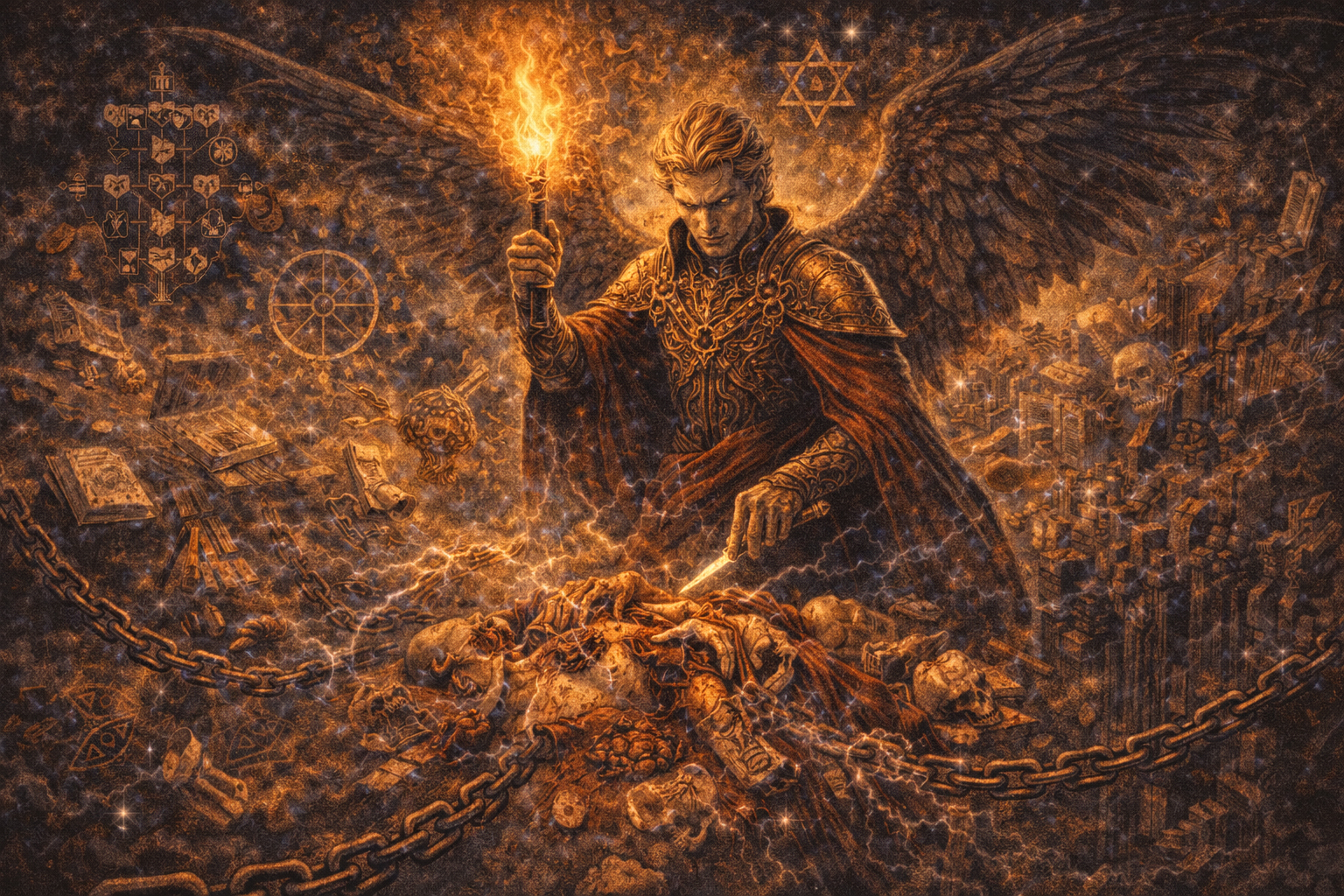
At the same time, it is important to recall that the romanticization of Lucifer as “free will” popular in some occult circles is a misrepresentation. In the traditional system of views, the luciferian is not freedom, but a form of revolt that lacks a purpose; and the pole opposite to it, as we already discussed, is not “submission”, but Metatron — a will built into the overall vertical of hierarchy. Metatron is the principle of law that is connected with the source, and therefore does not turn into a self-sufficient destructive unit.
On the other hand, a system can be destroyed not only by infinite differentiation and fragmentation but also by depriving it of inner mobility and the capacity for development. This is the distractor — Yaldabaoth — the locking of discrimination within a self-sufficient sphere. Blind mind creates a model and declares it reality; it creates order and immediately declares it God; it introduces rules and declares them (and only them) nature itself.
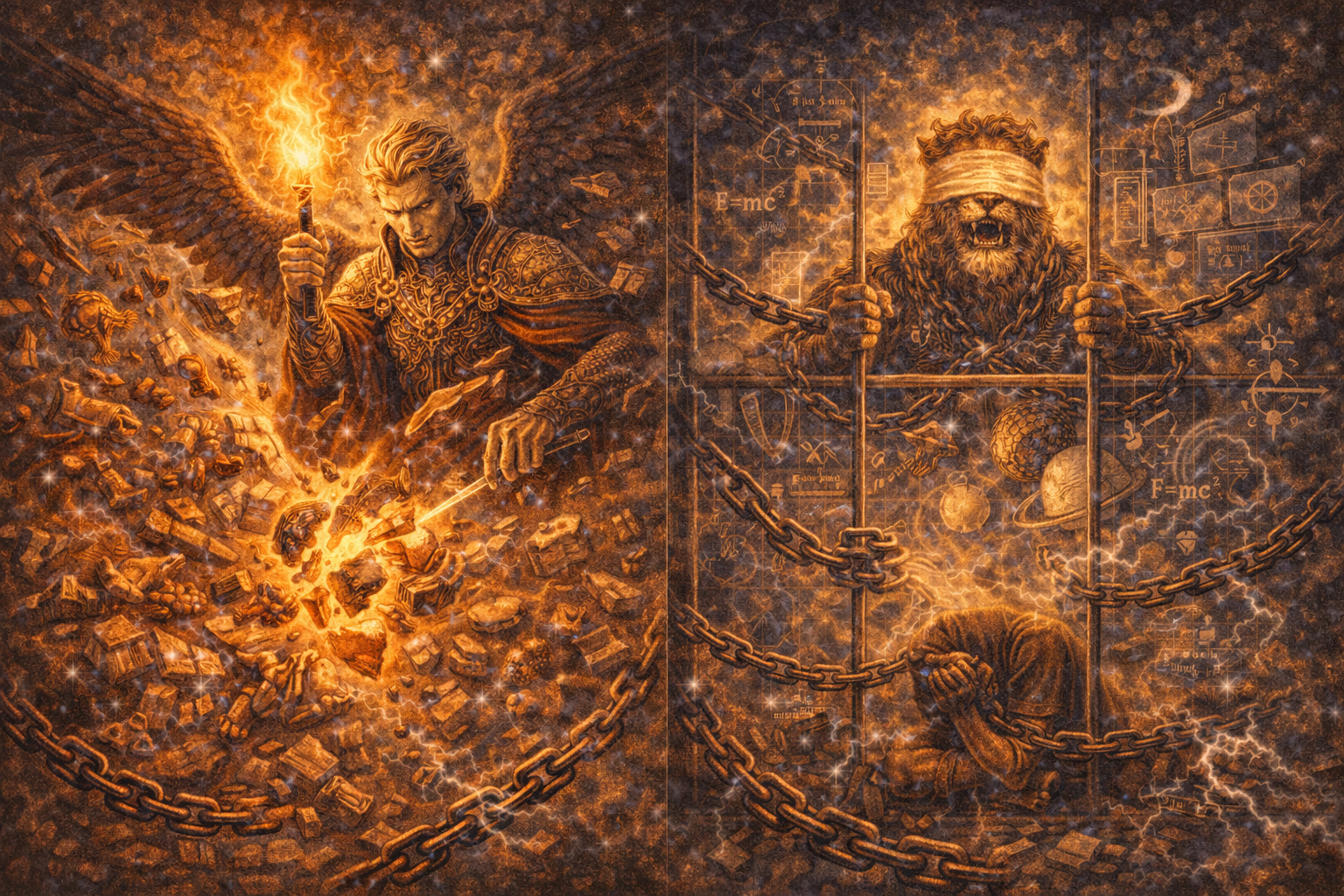
Thus the false light of Yaldabaoth and the luciferian light of separateness, although they look like “rationality” brought to the limit, act oppositely. Lucifer tears the whole into infinite units unable to interact stably with one another (differentiation as pride). Yaldabaoth, on the contrary, locks the whole into a single correct scheme (differentiation as a prison).
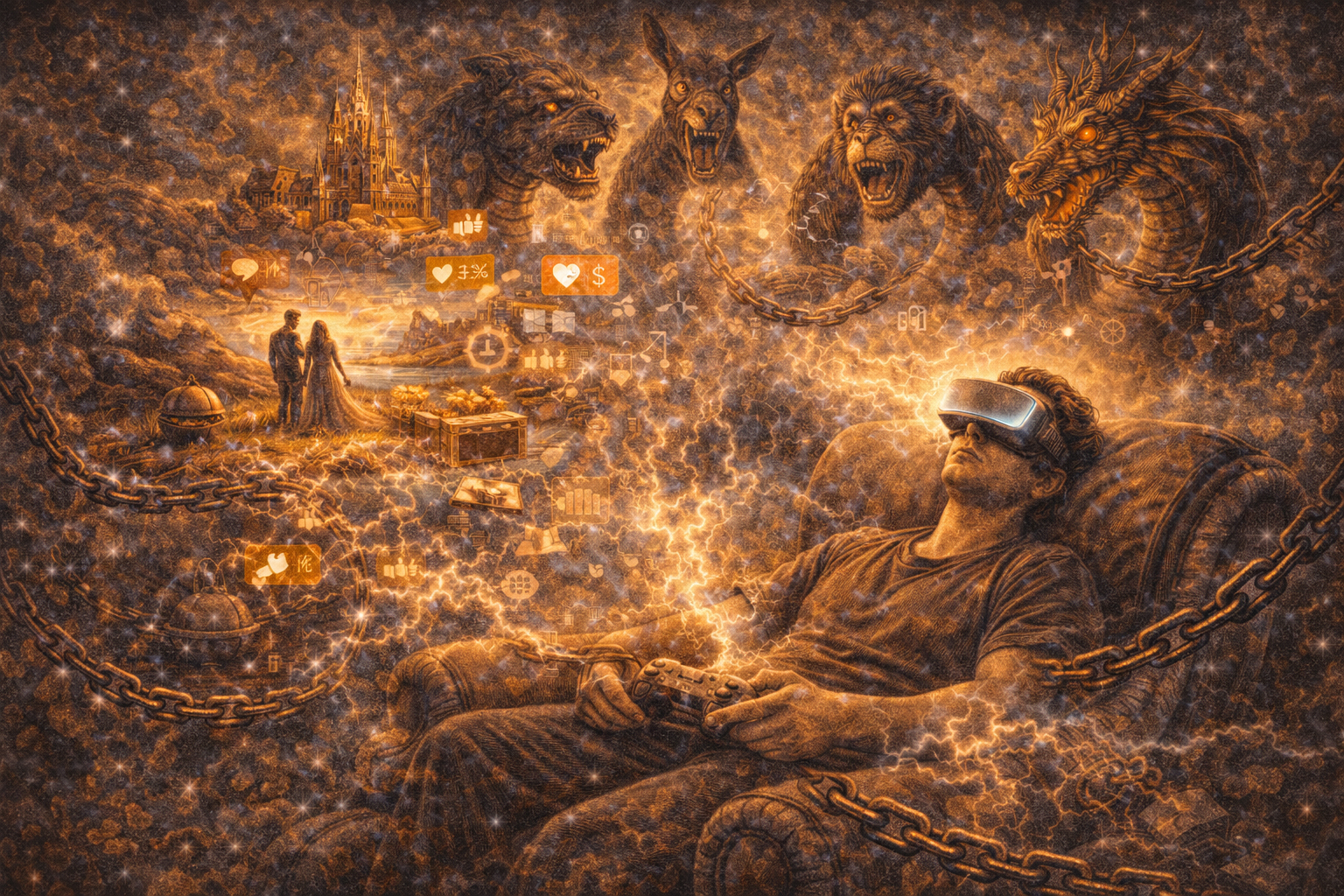
Thus, the product of heimarmene is not a “suffering sinner”, but a happy dreamer who dreams of his worlds, receives sensory reinforcement, and emits large volumes of low-level pneuma, almost without changing anything outwardly. Heimarmene offers him “correctness” instead of life, “comfort” instead of a path, “explanations” instead of transformations, “content” instead of experience — and thus it paralyzes the will.
And when mind refuses the risk of real action and chooses convenient virtuality (in the broad sense — dreaming, compensation, simulation), it does not leave the Interworld, but, on the contrary, begins to feed it with its “dreams”. And then the goal of heimarmene turns out to have been achieved: a stable flow of life is formed that does not turn into lived experience; in which action does not become a deed; and all free energy, without resistance, flows into the Interworld.
At the same time, the universe also knows a constructive manifestation of a purely Apollonian principle that does not turn into a distractor, because it stands firmly on Dionysian flow. Alvs are pure “forces of light”, creating a reference point, a beacon that allows one to distinguish “true light” from “false light”. The bright Alvs are the essence of illumination as observation, understanding, and free creativity; that is, light that does not fix, but opens, expands, does not proclaim itself an absolute, leaving room for indeterminacy and spontaneity. This is the truly Apollonian in its highest sense — as clarity that has not broken ties with the living flow and with the sources of life and power.
People cannot abolish heimarmene; they cannot change the physical constants of the Universe or the basic principles of the functioning of their minds, but they can change their attitude to the very concept of “determinacy”. In order to understand the value of the cosmos, it is important to remember the abysses of chaos; in order to relate properly to worlds, it is necessary to remember the infinity of the Interworld.
Accordingly, leaving heimarmene does not mean to reject reason; it means to return the light of discrimination to its original functioning. No wonder the creation of the world in the Bible begins precisely with the words “Let there be light”: discrimination creates the very possibility of manifestation, but only when darkness is not denied: “And God called the light day, and the darkness he called night.” Reason is strong and necessary when it is balanced by living experience; Apollo is beneficent when balanced by Dionysus and integrated with Orpheus.