The Tree Amid the Garden: the “Minor” Arcana of the Tarot
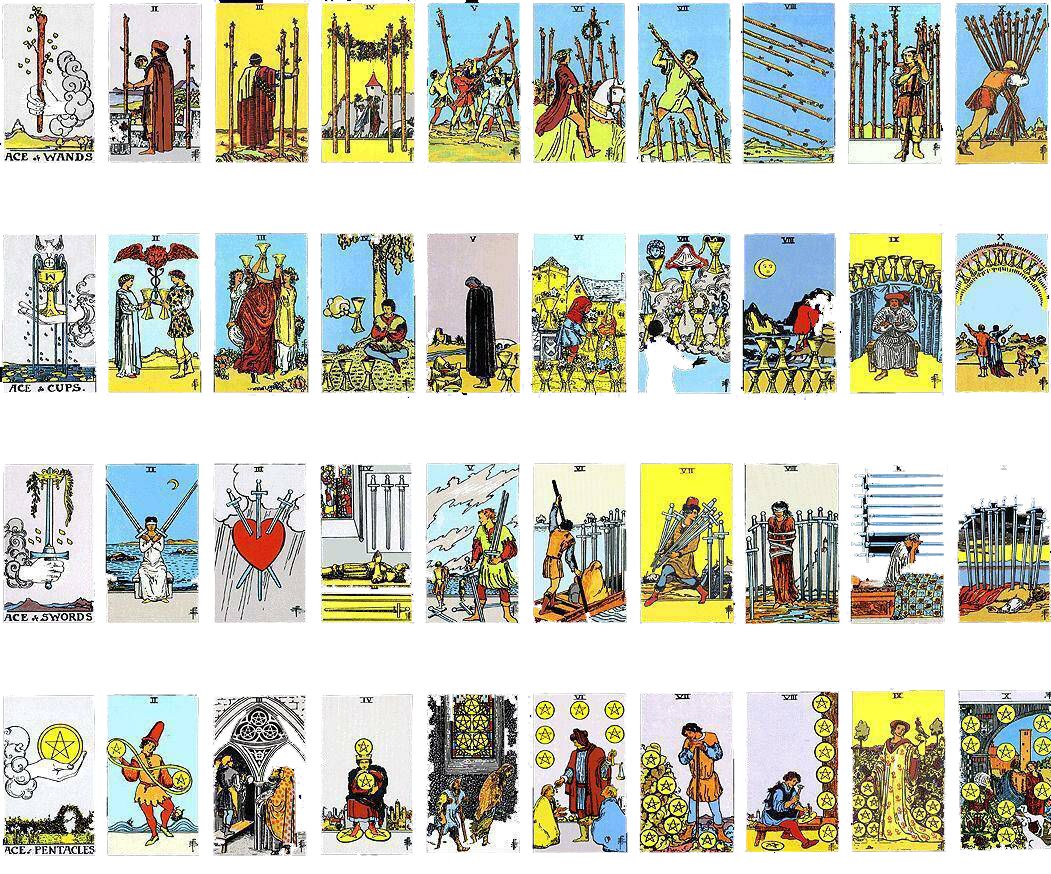
The Tarot system— designed to map the passage of the mind through stages of development, through the degrees of Initiation— is divided into two distinct “maps.” They describe (1) the “ideal,” perfected state of a fully realized system: the “Major” Arcana; and (2) the becoming of this system on the way toward such perfection: the “Minor” Arcana.
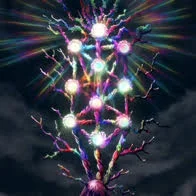
We have already said that the “Major” Arcanum includes two analogous Sephirothic Trees, conventionally corresponding to the “Affirming” and the “Affirmed” states of the system — the Macro- or Psychocosmos. It is precisely this “ideal,” “skeletal” structure of the “Major” Arcanum that is most often regarded as the source of the “universal knowledge” embedded in the Tarot.
Nevertheless, the dynamic aspect of the system — the processes that unfold within it and through it — is also of extraordinary importance, both theoretically and practically.
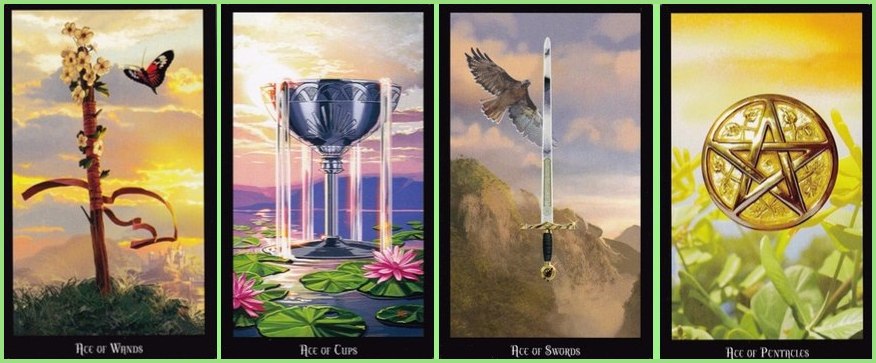
If the “Major” Arcanum considers the system in an abstract “metaphysical space,” in its fullness and perfection, then the “Minor” Arcana describe cross-sections of the system within the real, concrete, manifested world, as set forth by the Tetractys and the system of First Elements. Accordingly, the “Major Arcana” form a binary-decimal system, whereas the “Minor” form a quaternary-decimal one.
Thus, the “Minor” Arcanum is represented by four Sephirothic Trees — one in each “section” of being, each “element”: Air, Water, Fire, and Earth— plus the aggregate of the “reflections” of all First Elements within any given one.
Alongside this “horizontal,” element-oriented description of the “Minor” Arcanum, a “vertical” interpretation is also used, relating the suits to the Kabbalistic “layers” of reality — and thus to the worlds of Emanation, Creation, Formation, and Manifestation.
Both interpretations are useful, and may be applied to describe two kinds of motion — “vertical” and “horizontal” — that occur within the system and in the system’s unfolding.
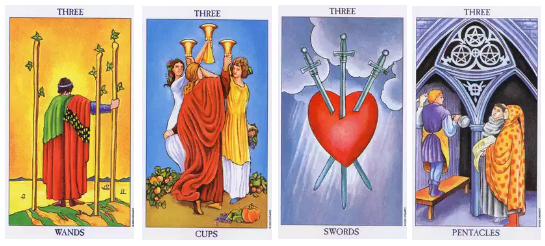
Note that in “horizontal” readings, the correlation of suits with elements is not univocal. While “Cups” are more or less universally correlated with Water, and “Sickles” with Earth, for “Wands” and “Swords” one finds, respectively, either Air and Fire, or Fire and Air.
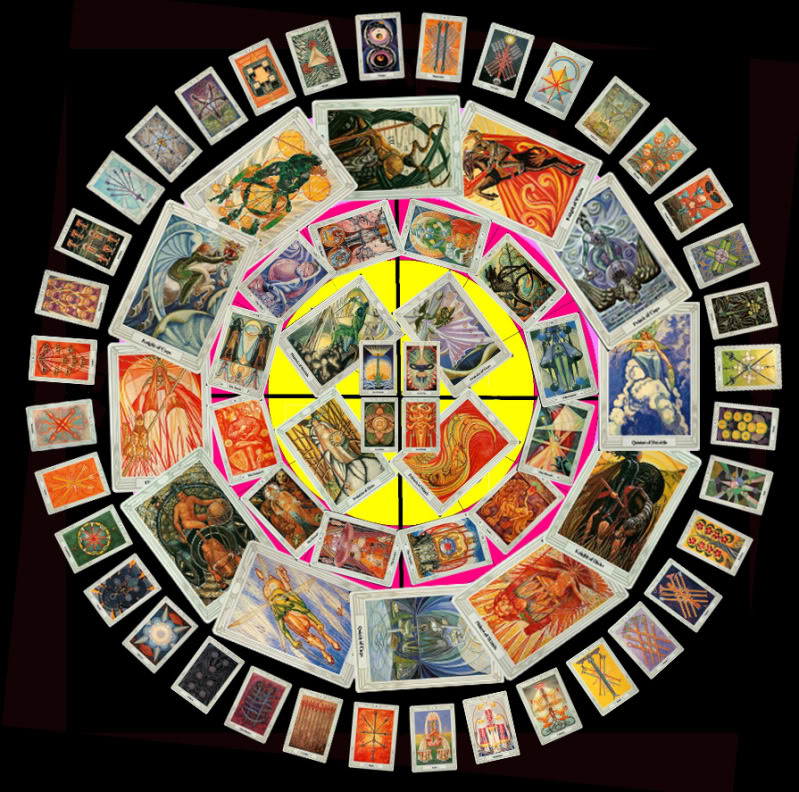
The reason for this ambiguity lies in differing conceptions of the Masculine principle. Some Schools and Lineages emphasize its expansiveness, while for others its “active” aspect comes to the fore. If one takes the primordial impulse — the Yod of the Tetragrammaton — to be an activity that “divides” primordial homogeneity, an erected phallic act piercing the depths of the “proto-kteis,” then it is natural to correlate this principle with Fire, to associate Wands with that element, and correspondingly to leave Swords — and the letter Vav — to Air. If, however, one accepts as primal activity the Spirit that “blows where it wills,” that “moves upon the waters,” then Yod and the Wands correspond to Air, while fiery destruction falls to the Swords.
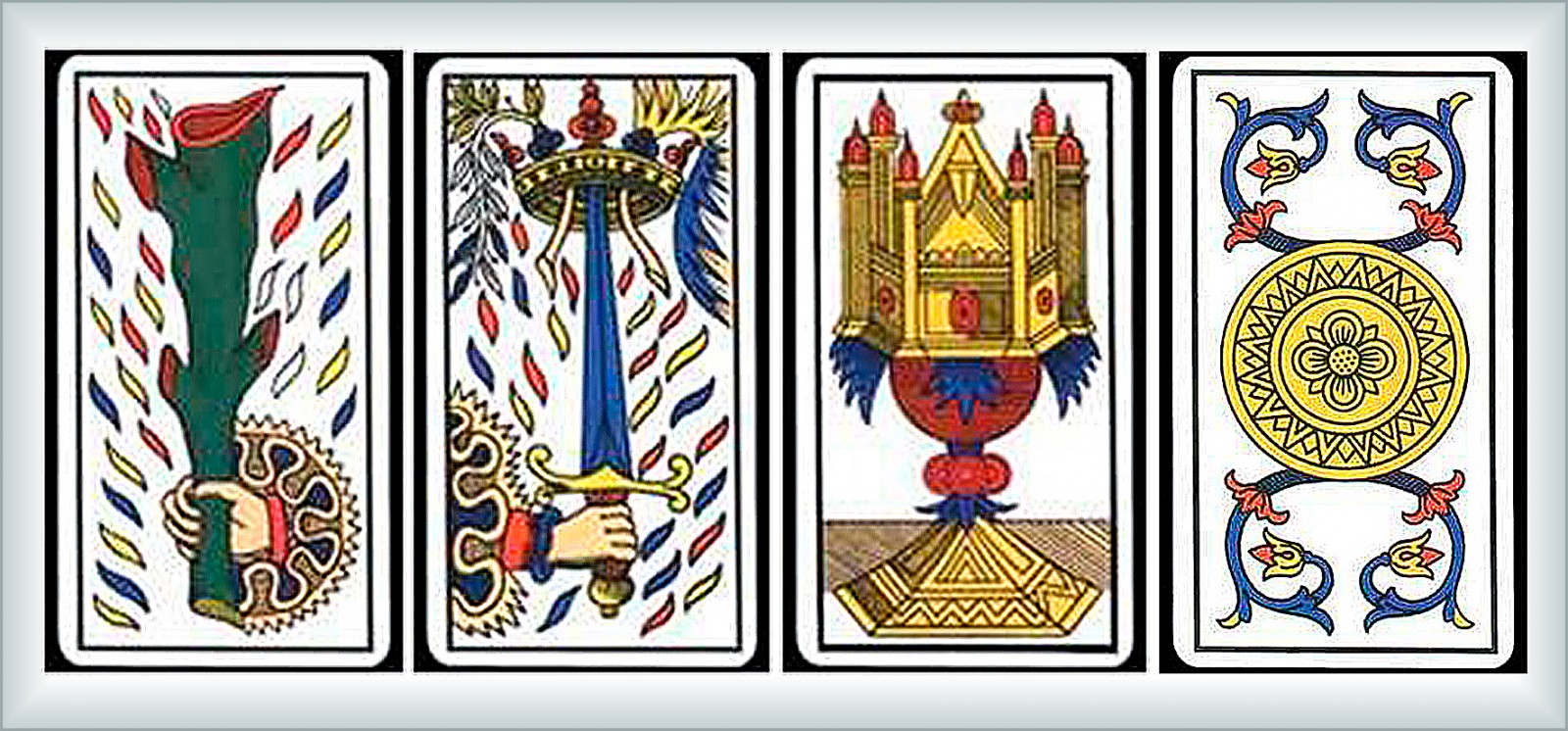
In the “vertical” reading, such ambiguities usually do not arise. Wands are confidently attributed to the Power of the world of Atziluth; Cups, to the Divine Will of the world of Briah; Swords, to the Struggle of the world of Yetzirah; and Sickles, to the Affirmation of the world of Assiah.
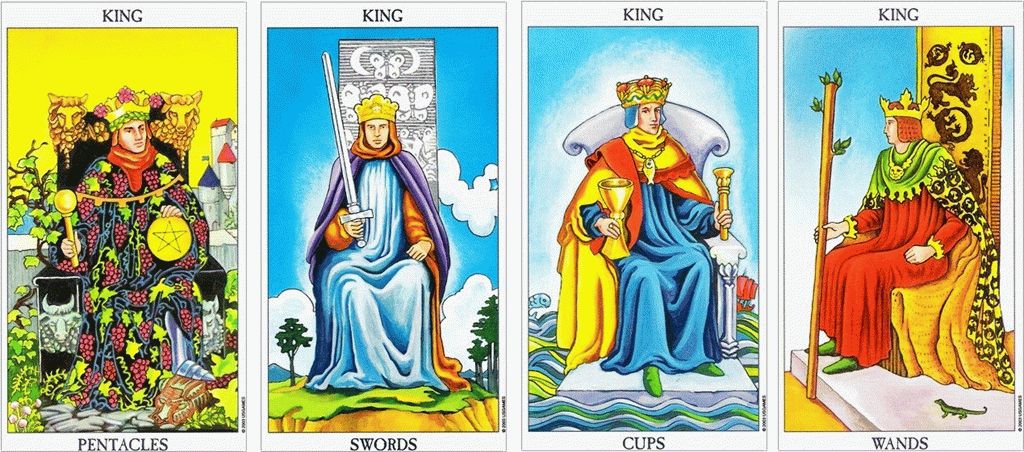
In the same way, mutual correspondences are established among the court “representatives” across the suits: Kings correspond to Wands; Queens, to Cups; Knights, to Swords; and Pages, to Sickles. In other words, the King is, as it were, the Wand of each suit; the Queen, its Cup; and, analogously, the Knight most fully expresses the principle of Swords, and the Page that of Sickles within each suit. It is clear that each suit is most fully expressed in its corresponding court card: the principle of Wands is most essentially expressed by the King of Wands; the Queen of Cups is the very essence of that suit; and so forth.
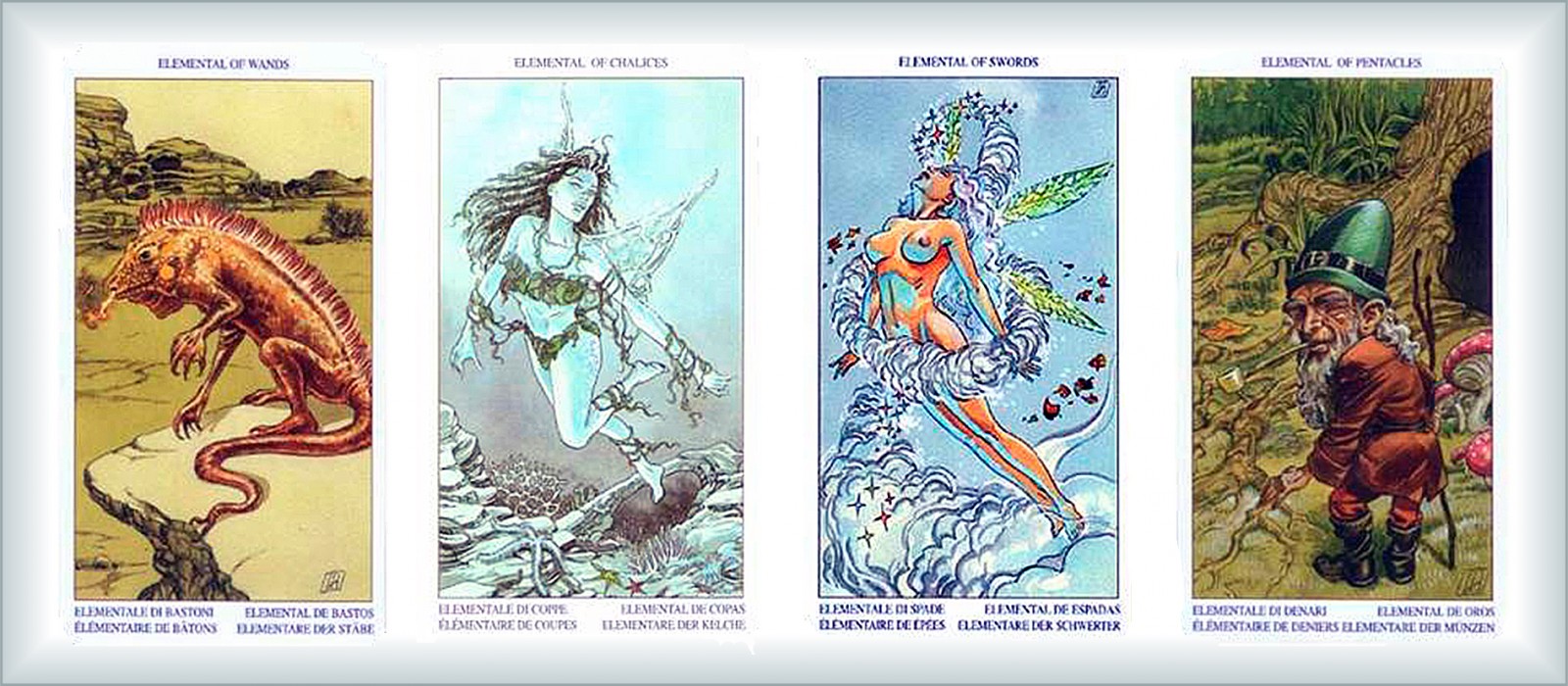
Let us note that in newer decks, the Page is sometimes replaced by the “Princess.” In the authors’ view, this makes it possible to balance the dualities in the courtly segment: two “male” cards emerge — King and Knight — and two “female” — Queen and Princess. Nevertheless, the traditional figure of the Page — devoid of any gendered character — reflects secondary passivity: an accepting field in its own particular, neutral key. In our view, this more precisely corresponds to the Tetragrammatic process.
In addition to the figured (court) cards — which express the essence of a given suit “in itself,” and also the reflections of other suits within it — the “Minor” Arcanum includes numbered cards, corresponding to Sephirothic manifestations within the register of a given element / a given world. At the same time, the “lower” Arcana correspond to planetary forces — “secondary causalities” — whereas the three highest correspond to the primary ternary.
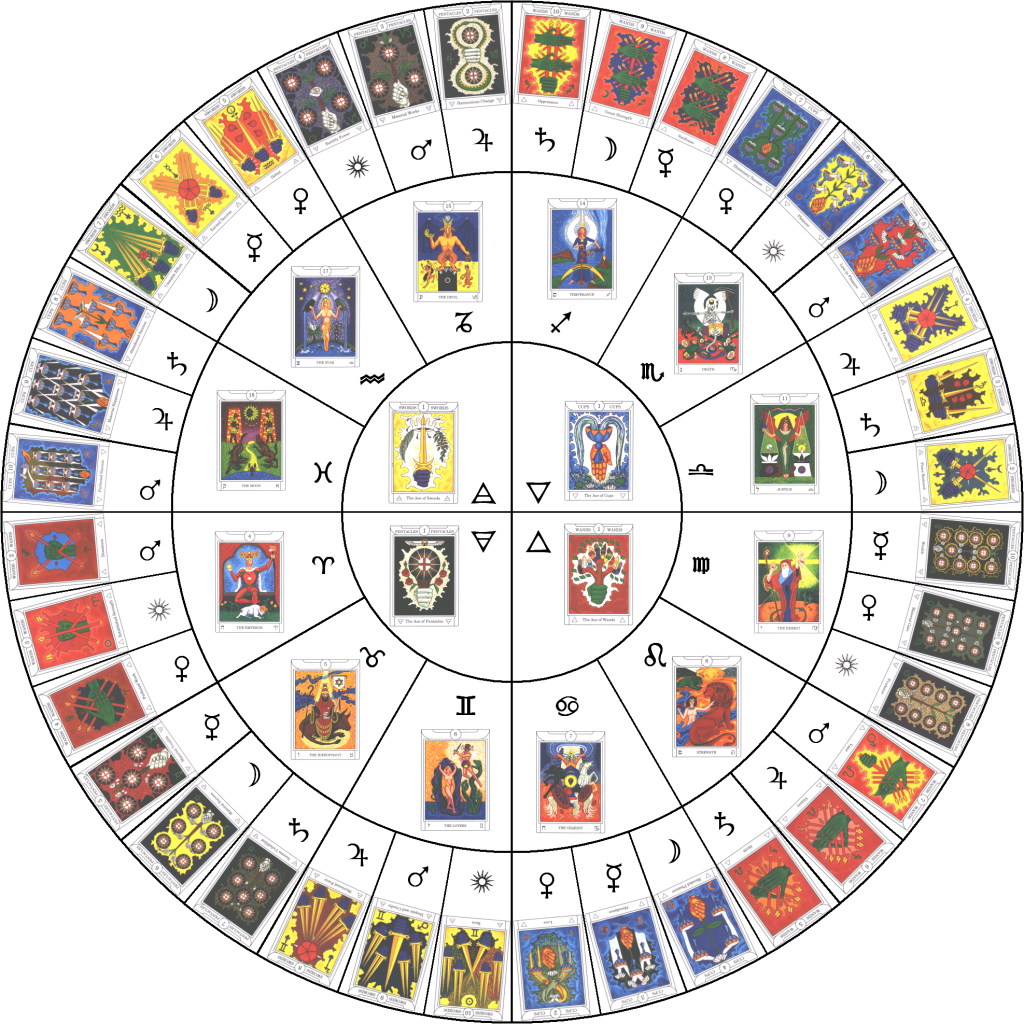
Here the Ace expresses Kether, the synthesis of each suit; the Two, the introduction of polarity into it; the Three, neutralization through outward manifestation; the Four, the principle of Power (Jupiter); the Five, that of Affirmation (Mars); the Six, Harmony (the Sun); the Seven, Victory (Mercury); the Eight, Manifestation (Venus); the Nine, Form (the Moon); and the Ten, inner inertia (Earth). At the stage of the Ace, the potential of the given Tree is revealed; at the Two, the possibility of its development; at the Three, the purposiveness of this development; at the Four, the possibility of its self-affirmation as such. At the Five, it asserts itself in opposition to others; at the Six, it discovers inner equilibrium; at the Seven, it gains the capacity to act outwardly; at the Eight, the capacity to receive influences; at the Nine, the Tree reaches its maximum degree of manifestedness; at the Ten, it confronts the necessity of an “external” environment for its manifestation.
In order to traverse the entire Way of Initiation — whose facilitation and formalization is precisely what the system of Arcana serves — the student must first grasp the system’s “static” aspect: the “Major” Arcanum. Only after mastering it can one proceed to the study of the system’s dynamics: the “Minor” Arcanum. And only by passing through these two doors — contemplating the Tree in its “ideal” form, in its projection through the Worlds, and in its unfolding within the Elements — can one attain that fullness of understanding for the sake of which the Great Chariot was created.

Lady, King, Knight, Page. Imho, they represent the active + passive principle and the result of their interaction (which is androgynous, hence the two cards of the Knight and the Page, and the concept of the Princess fits in here as well). In my opinion, everything looks confusing, but in a deck of 36 cards, this misunderstanding has been removed.
Regarding swords and wands, although your theory has merit, I would classify swords with fire on the grounds that they correspond to the suit of spades and are manifestations of Need – the very fire that drives an object to action. This Need is the seed-Yod that compels the first He to produce the sprout-Vav – the active principle and the Son of his Father (note that the sprout grows not from seed but from the earth). By the way, it is on this basis that in the divination system, spades are associated with various misfortunes.
According to Tetragrammatical logic, firstly, although the first “neutral” component is formally androgenous, it nevertheless carries within it the activity inherited from the Father (Yod), meaning it is a “boy”; secondly, for its expression, it requires an “external” field where this “younger” activity can spread, hence the need for the fourth element – the “page” (in the sense of one being educated) or the “princess” (“bride,” meaning the “potential wife” of this “boy”). Regarding the Swords and Wands – the question boils down to understanding the nature of the male principle.
Yes, the tetragrammaton clearly demonstrates this, which is why JHVH has two Ns, and the Son in some mysteries holds the title “Husband of His Mother.” But that is what I’ve written about. Nonetheless, there are only three letters.
Secondly, it is worth noting that Vav is initially a child and, like all children, does not have a “gender identity.” It is only at the next stage that Vav becomes the active principle. And this stage will not occur until the Son “sees” his bride. Because active (triangle pointing up) and passive (triangle pointing down) forces have significance relative to each other and not otherwise (after all, if there are only men around, how can one know that there are women?).
Thirdly, the name of the creator is Elohim (7 days and 7 nights), not Yahweh.
The problem with swords and staffs arises from the ambiguity in the interpretation of symbols. However, I personally believe that wood is “softer” than iron.
No object exists separately from its environment, and the letter He paired with Yod is not at all the same letter as He paired with Vav.