
Sigils and Galdrastaves
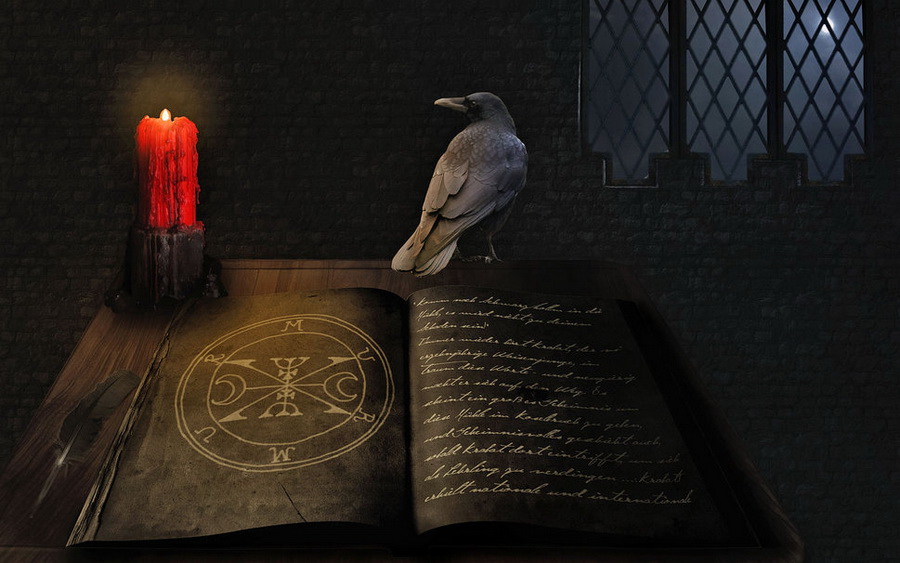
Graphic Sickles are actualizing symbols that concentrate, direct, and call Power. They are as ancient as the mind that actively transforms reality. From the earliest drawings on cave walls and symbols carved in bone or wood to today’s corporate logos and product trademarks, humanity has long made use of the magical possibilities inherent in graphic form.
By now, several key currents of graphic Magic have taken shape. Among them, an important place belongs to the traditions of Galdr—galdrastaves, galdramunds, ægishjálmar, and band-runes— as well as Kabbalistic approaches to the creation and use of sigils and seals. Despite the many shared principles involved in composing and applying these two groups of Sickles, each has distinctive features — and those distinctions are not always understood clearly today.
Any Sickle, like any magical object, may be regarded as an element active both macrocosmically and psychocosmically. On the one hand, the interaction between the perceiving (and creating) mind and the symbol produces definite, predictable, and controllable changes in that mind — redirecting its flow in a correspondingly definite way. In this sense, any Sickle is an instrument for transforming mind. On the other hand, a Sickle is an energetically active structure of the macrocosm, producing changes within it “independently” (that is, outside the conscious processes of the mind that perceives/creates the symbol — since, in the Magical description of the world, being and mind cannot in principle be separated). In this sense, a Sickle acts even when no one sees it, or when the one who sees it has no notion of its nature and purpose.
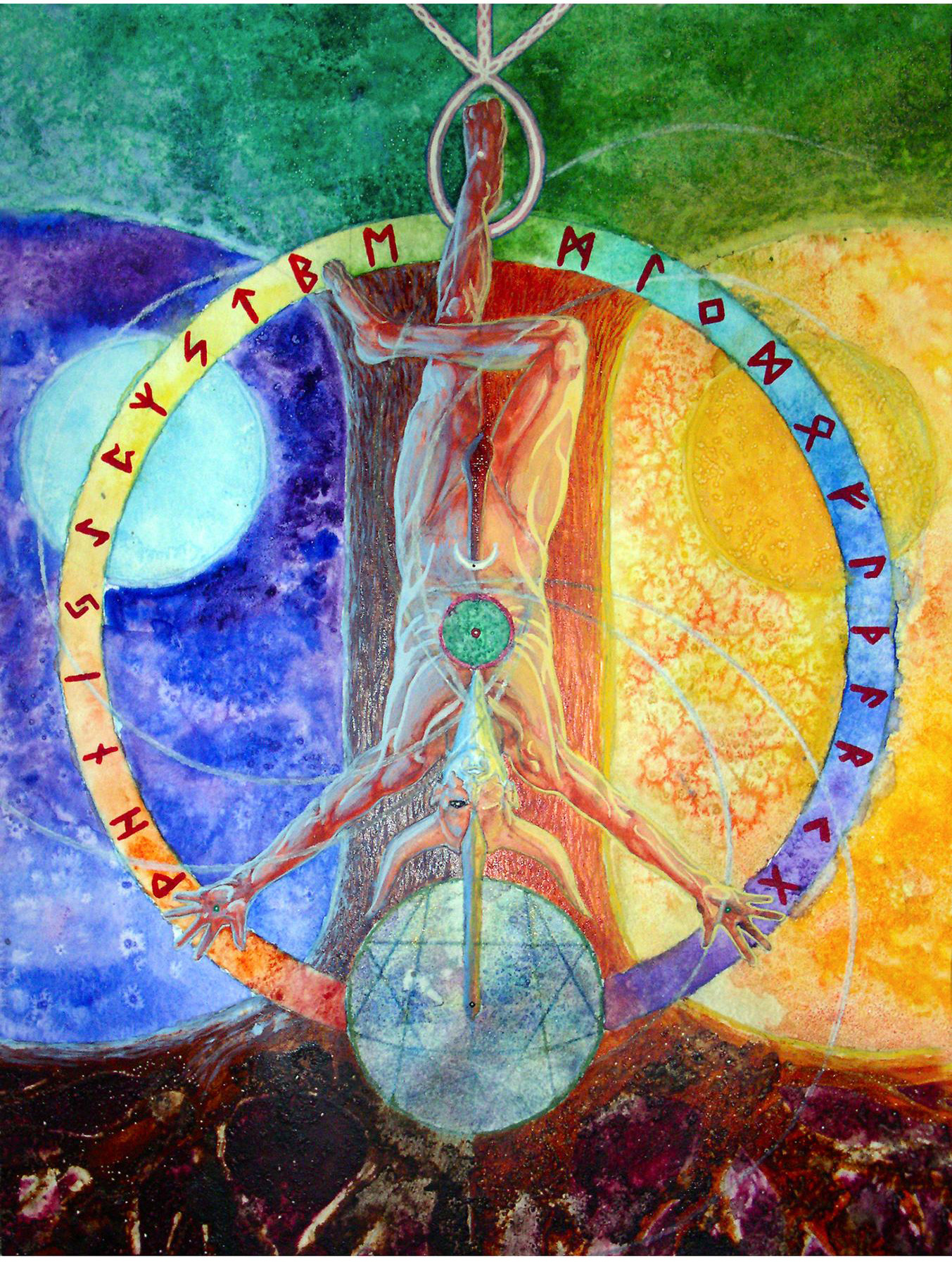
From these premises, people since antiquity understood that reality can be altered in two ways: by influencing its processes and by influencing its agents. Historically, Northern culture was more oriented toward working with flows, whereas the traditions of the Near East tended to operate with beings. Thus two related — yet not identical — methodologies arose: the art of creating galdrastaves and the art of creating sigils.
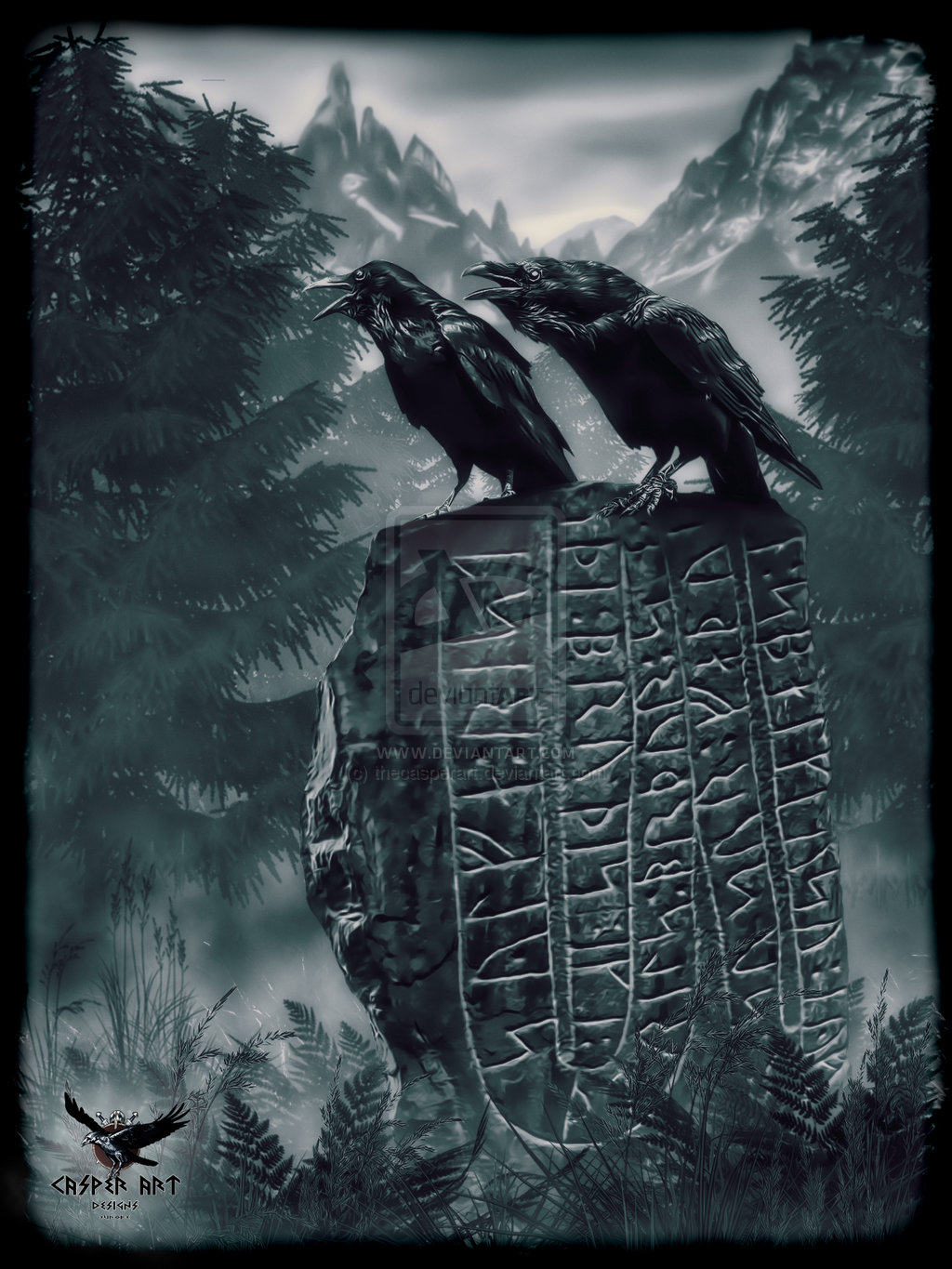
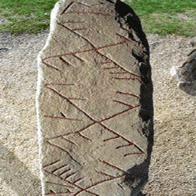
It is well known that a galdrastave is a stylized bound rune in which separate vector components are summed, and the whole symbol operates as a unified resultant of all the forces entering into it. The stylization —the smoothing and sharpening of angles— used in creating a galdrastave, on the one hand, gives it wholeness of action; on the other, it harmonizes the vectors within it and imparts a common orientation. As a result, a galdrastave acts less sharply, but more fundamentally, than a runescript or a band-rune. In effect, a galdrastave is a graphic depiction of the summed vector of a process, intended to ensure that this process unfolds in a given direction and with the required efficacy. Accordingly, in creating a galdrastave, the eril invests his Power and will into steering a worldly process one way or another, relying on the actualizing graphics of symbols.
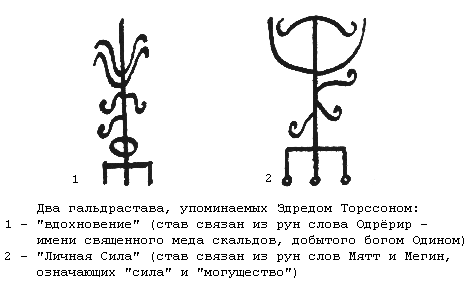
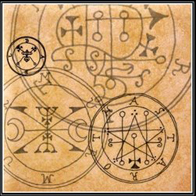
Traditionally, a sigil is a graphic expression of the nature of a particular agent— a vortex functioning in the Medium and structuring it. Over the course of history, three approaches to composing and reading sigils developed. All of them treat the sigil as a stylized text, a “signature,” differing only in the method of composition and reading.
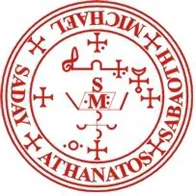
Historically, the first method consisted of stylizing a “linear” inscription. The Name (or epithet) of the agent (spirit, god) was written in one of the “sacred alphabets” and then stylized. To this were added known actualizing symbols — energy transformers — crosses, circles, pentagrams, and the like — intended to affirm the Magus’ authority over the given Power. If the sigil was additionally enclosed in a circle or cartouche — further restraining the named Power — then it became a Seal. To this same approach one may also assign the stylization of an image that describes features of the agent’s nature: such stylized birds, animals, and implements are widely found on the Seals of spirits.
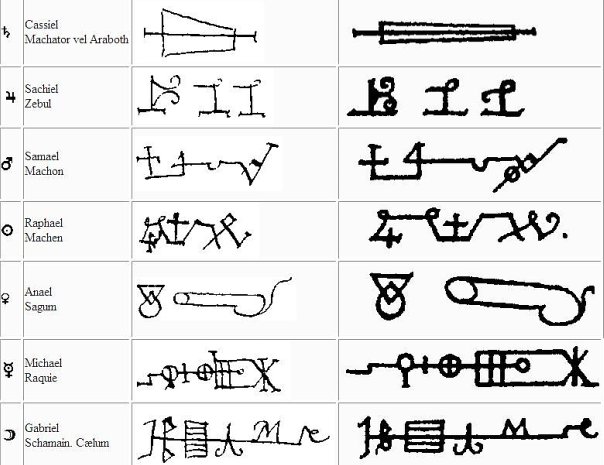
The other two methods arose much later and reduce to composing a sigil by connecting letters or numbers on special actualizing matrices — magical squares or the Rose of Sefer Yetzirah. Sometimes additional marks are appended to sigils composed in this manner.
In any case, historically, sigils were intended to activate or attract the Power of a particular agent, who would then carry out the required changes.
In other words, in working with a galdrastave the Magus, above all, engages his Power, whereas in the Magic of sigils his Authority is more important. Thus, for example, for a young and ardent Magus who relies primarily on the fire of his desires and inspiration, the processual Magic of galdrastaves will be more congenial; while for a wizard seasoned by experience yet wearied by life, the summoning Magic of sigils may prove easier. Nevertheless, an effective Magus must know both approaches and apply them according to the situation in which he finds himself.
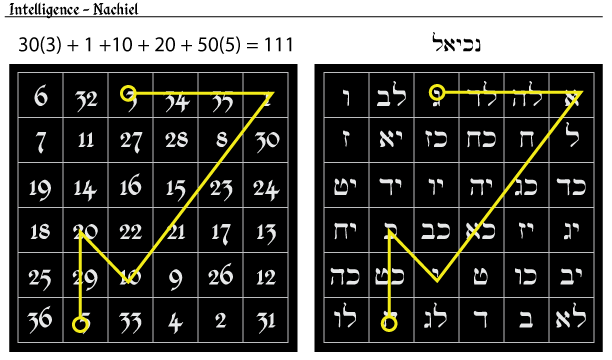
These two differences — source of Power and the demands placed upon the operator — produce the methodological divergence within these directions of Graphic Magic. Unfortunately, a certain confusion of methods exists today, and much of what is widely known as contemporary “sigil Magic” is, in essence, galdrastave Magic: it creates a graphic depiction of a process rather than calling an agent. Accordingly, it demands significant vector effort from the operator — effort that is often neglected.
An effective Magus strives for a precise understanding of the processes with which he is working, since this determines what is required of him, of the Ritual scheme, and of the sources of energy. A lack of understanding does not merely reduce the effectiveness of actualization; it diminishes the impeccability of the Magus himself — and can lead to significant losses of Power and to falls that can and should be avoided.

“The Wanderer of Free Paths”
We wander under the sky of holidays,
Not dividing worlds into pieces.
We stand and wonder, dreaming once more to set out,
To the point from the source and the rainbow flowers.
Poems ring out about wisdom
And the song – the beauty of nature.
In agreement, those who have called, the significance of the deed
And the purity of desire.
The abyss cries in every direction,
That the essence of truth is simple, like the song of a flute.
Inscribed on the root, on the side of the emerald.
And writings have been inscribed in lines and covered with codes,
Purposely substituting, the only knowledge under the cloud of snow.
And we speak in vain, trying to reach not even our neighbor, to our own, at our own doors.
I do not wish to open the door with my foot, open voluntarily,
With light, bread, salt
I ask you to take me in,
Also come in as long as you wish;
Welcome.
On the petal of reason, laid down, inscribed;
Out of dust we were created, into it we shall return, nothing to take with us.
Dignity and honesty, and infinite power,
Freely, gently – gently love and be healthy.
I fly away as dust, not radioactive
And not even diamond – cosmic, free.
I inherit to you powers and money, a lot, in gold,
Take for yourself from the lines, not slender, lonely,
The fragrance of apple trees and petals of roses.
On the petal of reason, there are golden letters:
“Thank you for the cooperation”
My dear, I will not come again.
PS. I am very sorry – I do not heal illnesses,
Long ago I was sick myself – I am humanity.
The pain quiets, moments of those dreams that flickered away go far.
The blurred trace is not worth regret,
Spring will come when the blizzards howl again.
Direct your path forward, find the road,
Where joys will wash the depths of wounds.
Do not forget what was, but what will be,
Depends not on those who look behind.
Let the wilted leaves lie on the ground.
Let the sprouts break through to the white light.
Nothing in the world can be as it was before.
Allow yourself to be reborn from the ashes.
It seems to me that you are not completely right regarding modern sigils. I read several books dedicated to this technique, and at least half of what I read leans more towards vortex formations.
I think there are both, but in my feelings, a noticeable part of sigilization techniques is akin to the creation of tulpa and servitors, rather than targeted impacts.
In my humble opinion, of course.
Alright, you’ve convinced me – I stay in Life.
(Bin ich doch – unkompliziert)
And I take off my hat in gratitude to you.
I will remain a scourge,
But let the horses go – let them rush to the skies.