
Names, Epithets, and Mottos
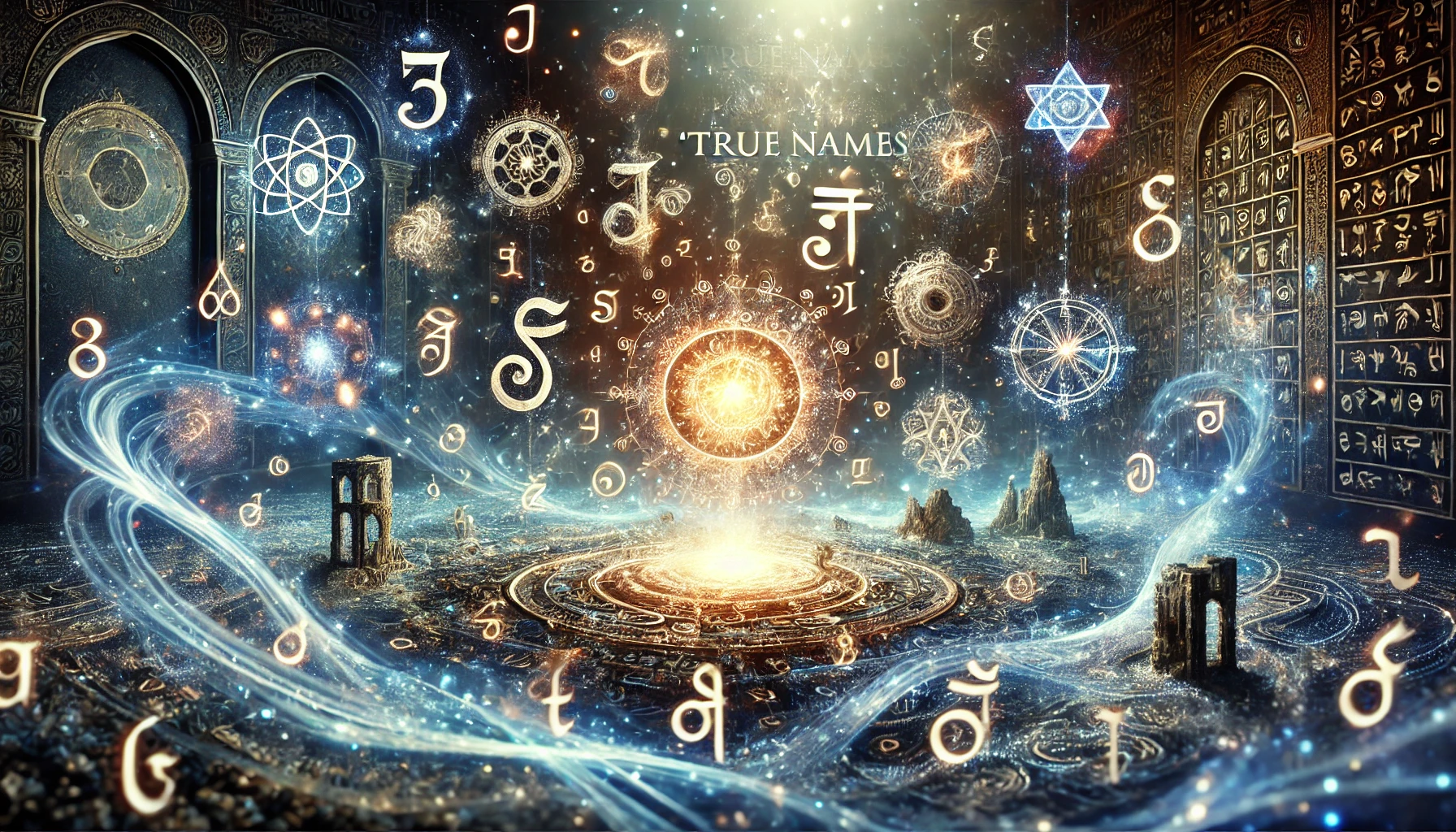
The idea that a Name, understood as a bearer of the Logos, a form of semantic manifestation of a being or an object, is the aspect most accessible to magical influence, is common and widely known.
In other words, the being itself and its name (in the most sacred sense of this word) are not separate entities, but forms of manifestation of a single principle, the Logos, respectively on the “physical” and “semantic” levels.

We have already said that the notion that a name is the same “full-fledged” mode of manifestation of the integral spirit as the body, vitality, awareness, or receptivity, was already formulated by the ancient Egyptians. To “know the Name” of a being meant approximately the same as having full access to its body or energy; therefore, for example, Isis, to whom alone the names of all gods and beings were known, was the bearer of both absolute wisdom and unlimited power.
At the same time, it is clear that manipulating a name is much safer than trying to influence the body of a particular being, its vortex, or the stream of vital energy.

That is precisely why nominative Magic has always been not merely “mainstream” in the Art, but also the foundation of all other paths and methods of manipulating reality.
And for the same reason the “true names” of the Magi themselves, as well as those of gods, spirits, demons, cities, or whole worlds, have always been secret and carefully guarded.
However, “to know a name” is not merely an intellectual or informational act; it is a special ability, a special wisdom, a special energy. It is not enough simply to pronounce a word, not enough simply to write down a name; one must attune oneself to it; it must be pronounced with Power and from Power, and only then does manipulation of the word become an operation upon the Logos. Thus, the first “level of protection” of names is contained within them, in the necessity of applying that “creative speech” which is, in itself, not a simple act.

Thus, the “true” name is not always available for manipulation; nominative Magic more often deals not with the names themselves, not with manifested Logos, but with their more “lower” cross-sections, situated on the same axis of analogy, but not requiring breaching secret energetic veils that conceal the name.
Two groups of such “external names” can be distinguished: epithets, descriptions, associative names of how this or that power appears to the observer, and mottos (sisms), part of “semantic energy” which the being itself wishes to manifest in its interaction with the observer.

Thus, for example, the well-known name “Zeus” was an epithet meaning “Shining,” and referring to that “heavenly” hypostasis of the Great God, whose “secret,” initiatory name was “Iao,” while on Earth, the God manifested as Zagreus, the “Hunter of Game,” whose initiatory name was “Evokhe.” In the same way, the names of other ancient gods were kept in the strictest secrecy, and the known and used namings were usually precisely epithets. Likewise, for example, the name Apollo — an epithet of the great god Paean — meant “Hunter,” and referred to the manifestations of this god both in society (where “hunting” meant the “gathering” of people) and in nature.
Another interesting example of the use of epithets in Magic is attempts at “suppressive” naming of demons: for many of the Dark Ones, epithets were used that asserted their “weakened” state. Thus, the name “Belial” was read as “Beli ya’al” (בלי יעלה), “May he not rise,” while the demon himself interprets this word as “Beli ol” (בְּלֹ אעֹל), “Unyoked,” that is, “free.” Likewise, for example, the epithet “Asmodeus” Magi tried to read as “Accursed” (אשמדאי), while the demon himself prefers the interpretation “He whose Name Disturbs” (חַשְמְ דאג).

In Scandinavian galdr, the use of epithets — kennings and heiti — is generally one of the basic magical and poetic devices, which has proven its effectiveness repeatedly.
The use of such epithets in both theurgical and goetic operations was always considered safer than attempts to operate using Names, since the slightest mistake in pronouncing or writing the latter could lead to harmful or even fatal consequences for the operator.
However, even more effective ritually, though much less common than the use of epithets, is the use of mottos of gods, spirits, and demons. We have already mentioned that a “motto” is a verbal reflection of the structure of the vortex of a given entity, a verbal record of what a sigil represents in graphic form.

Thus, a well-known motto of Apollo was “He who strikes from afar” (Apellai), an expression establishing the god’s “own” source of energy; and, for example, in Belial’s sigil the word “Independently” (בלא) is written twice and joined with the word “umbilical cord” (חבל), which as a whole can be read as “Rejection of the bond,” and understood as the power of a connection built on alienation, which is the essence of the influence of this demon. Accordingly, the epithet “He who rejects the bond with the womb” combines signs of external observation of the demon’s power and its own activity, which provides an effective instrument for addressing the corresponding energy in the Ritual.
Thus, when using names, epithets, and mottos, it is important for the Magus, on the one hand, to understand what kind of naming he is using and, accordingly, to build a spell or design a ritual. The use of a name centers the ritual on the “own” nature of the invoked or enchanted power; the application of an epithet expresses this power’s unfolding toward the periphery and its influence on fields receptive to it; and the use of a motto reflects the “inner vectors” of this spreading, the mechanism of vortex construction and activity.
On the other hand, safety parameters differ: the Magus communicates either with the “core of power,” or with its manifested aspect, or with its inner activity; therefore names require the greatest caution, while epithets are the safest.







Thank you.
Each new article of yours confirms what I am going through in my life. Thank you very much!
Another treasure chest rather than just an article. Thank you.