Fairies and the “Taboo of the Name
Among all the laws passed down in legends and tales about the fae, one stands apart — the prohibition concerning the Name.
In all cultures that have preserved a living tradition of communicating with otherworldly forces, there exists an understanding of the magical power of a name.
However, in the folklore of the British Isles, Scandinavia, Gaul, and among Finno-Ugric and Siberian peoples, the clearest taboo appears: “Never speak your name in the presence of the fae, and never utter their names — if you know them.”
It was especially forbidden to do this in the Interworld: “Do not speak your name in the land of the fae.” A typical plot of such a story tells how a hero, through carelessness, says his true name — and loses his freedom. However, this is an important lesson about the magic of the name, about the power of self-identification; the fae do not steal the soul — they reflect you, and if you have handed them the key, they test how you will handle it. For them, it is very important to understand that a “true name” is the essence, and careless handling of it is a loss of power.
This taboo has not only ritual significance but also deep psychological, ontological, and magical foundations.
We have repeatedly said that the Name is an embodiment of the Logos, one of the forms of existence and modes of interaction. From the perspective of the Magical tradition, the Name simultaneously fulfills 1) a fixing function: it defines essence through the word, and 2) an invocatory one: allowing one to address it in the context of a rite or magical act, and 3) a binding one: through it, channels of contact are established, including energetic channels.
In other words, a name structures the flow of mind, a process, or an object, making it a definite form in the aspect of meanings and forces. What is named, explicitly named — acquires form, becomes observed, fixed.
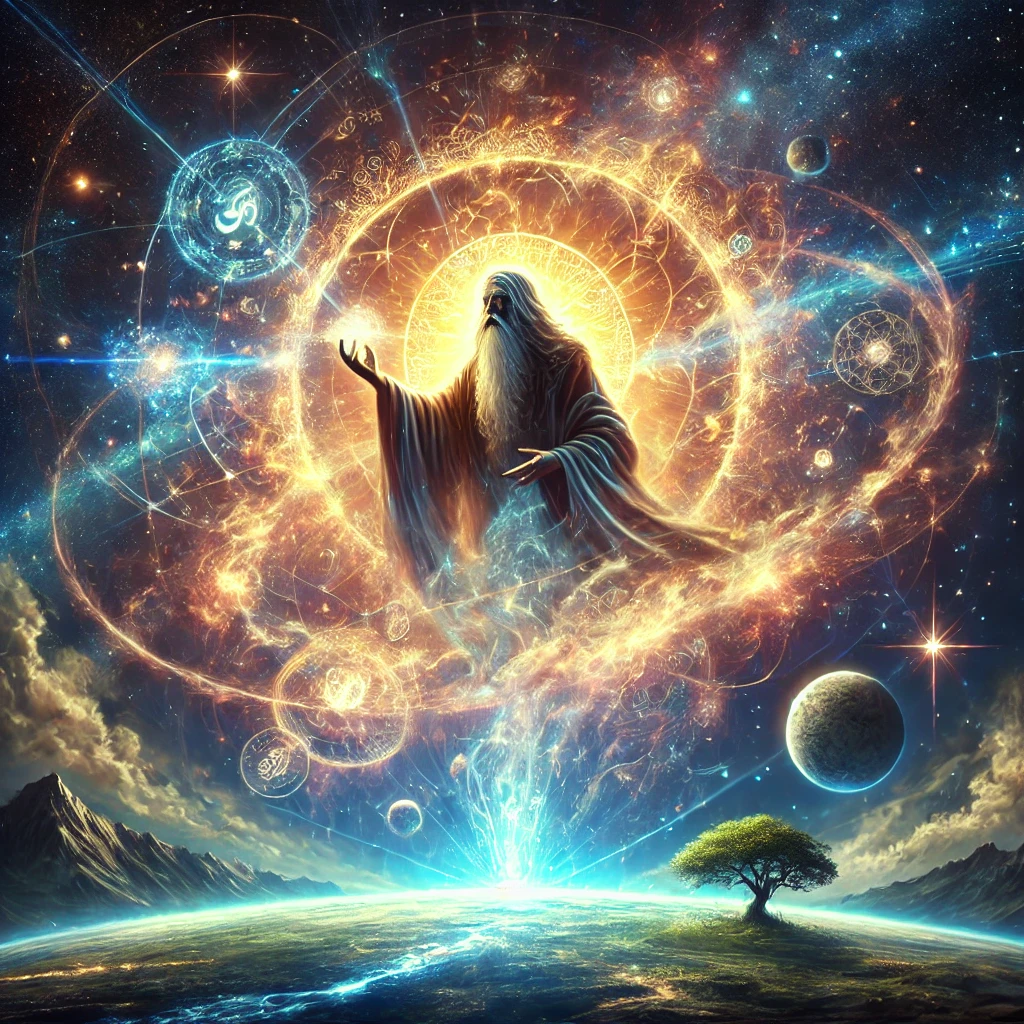
This, of course, is important in everyday reality, but at the same time it is dangerous in plastic, nonlinear, “living” interworldly spaces, where the very structure of mind is subject to continual flow and transformation.
We have repeatedly noted that the faerie are beings who do not inhabit rigid forms; their nature is changeable, multidimensional, and flexible. They can change appearance and sex, can exist simultaneously in different forms, disappearing, becoming light, an animal, or even a melody. The faerie are immeasurable. Their bodies are a play of light, wind, magnetism, and spirit. Their boundaries are conditional. Their essence is multiplicity. That is precisely why an attempt to call them by name is perceived as violence — as a desire to fix what is fluid, to force the free into a definition.
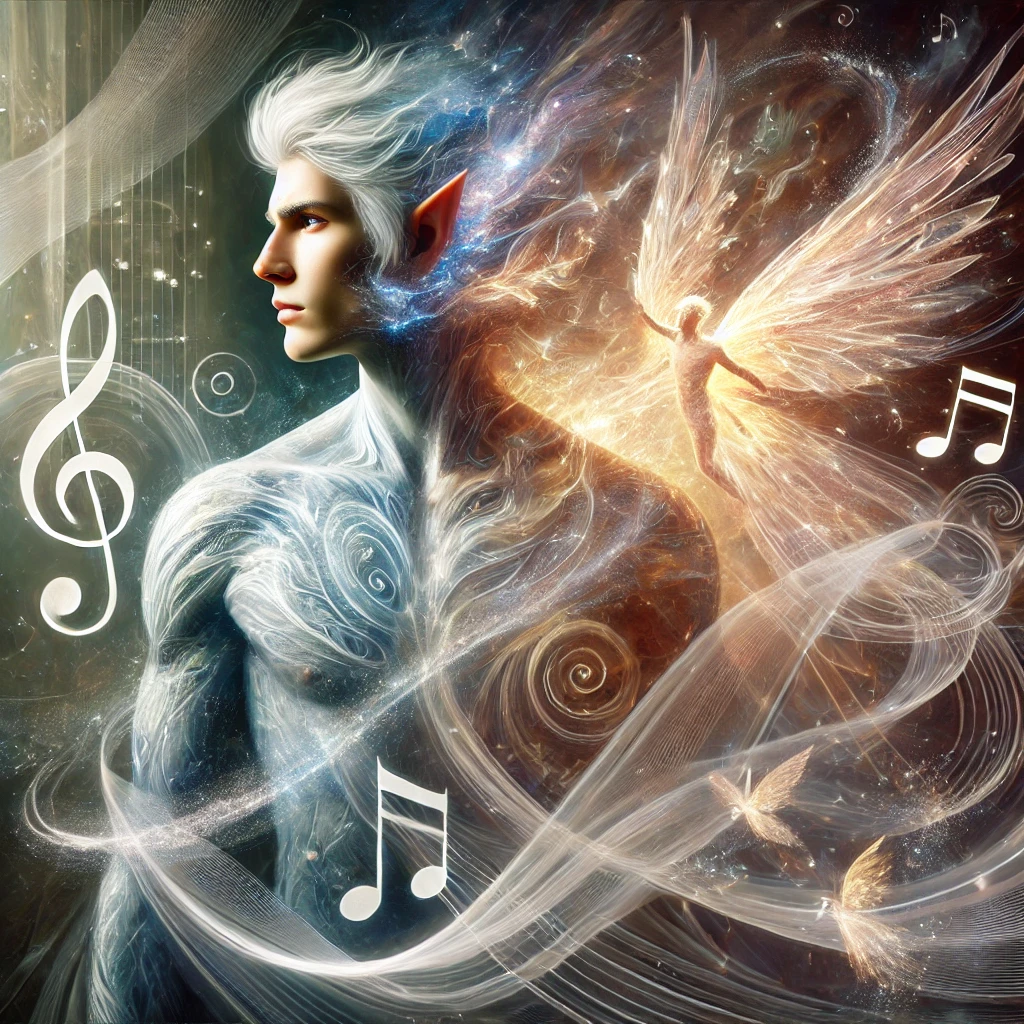
For them, a name is a holy, sacred word, an incantation, not an empty sound or a gift. Therefore, legends so often say: “If you learn their true name — they will vanish, or become angry, or submit.”
In other words, in the Interworld name = form = power. And any attempt to dominate the fae destroys the very possibility of contact with them.
Similarly, when a person enters the Interworld, or, in general, the fae realm (in sleep, trance, during scrying, or in a magical ritual), they cross the boundary of the world of fixed forms. They find themselves in a hyperspace where form is determined by perception, thought can materialize, and identity is fluid and depends on intention.

From this point of view, it is clear that any utterance of one’s own name in such a space is an act of self-fixation. As mentioned, the fae exist on the level of energy and meta-forms. In such environments everything that is named is “counted,” defined — it becomes reality. Therefore, by saying: “I am so-and-so,” a person literally creates themself as such — and can no longer be otherwise. And that, from the fae’s point of view, is the most dangerous limitation.
This makes the being excessively vulnerable, and the faerie (especially the Unseelie) receive a “key” to the very core of their psyche. In addition, the name binds the being to its “worldly,” former form — and thereby hinders adaptation, transformation, and learning, which can also lead to distortion of mind: if the former form was fragile, the faerie may “replace” it — not maliciously, but as an act of “correction.”
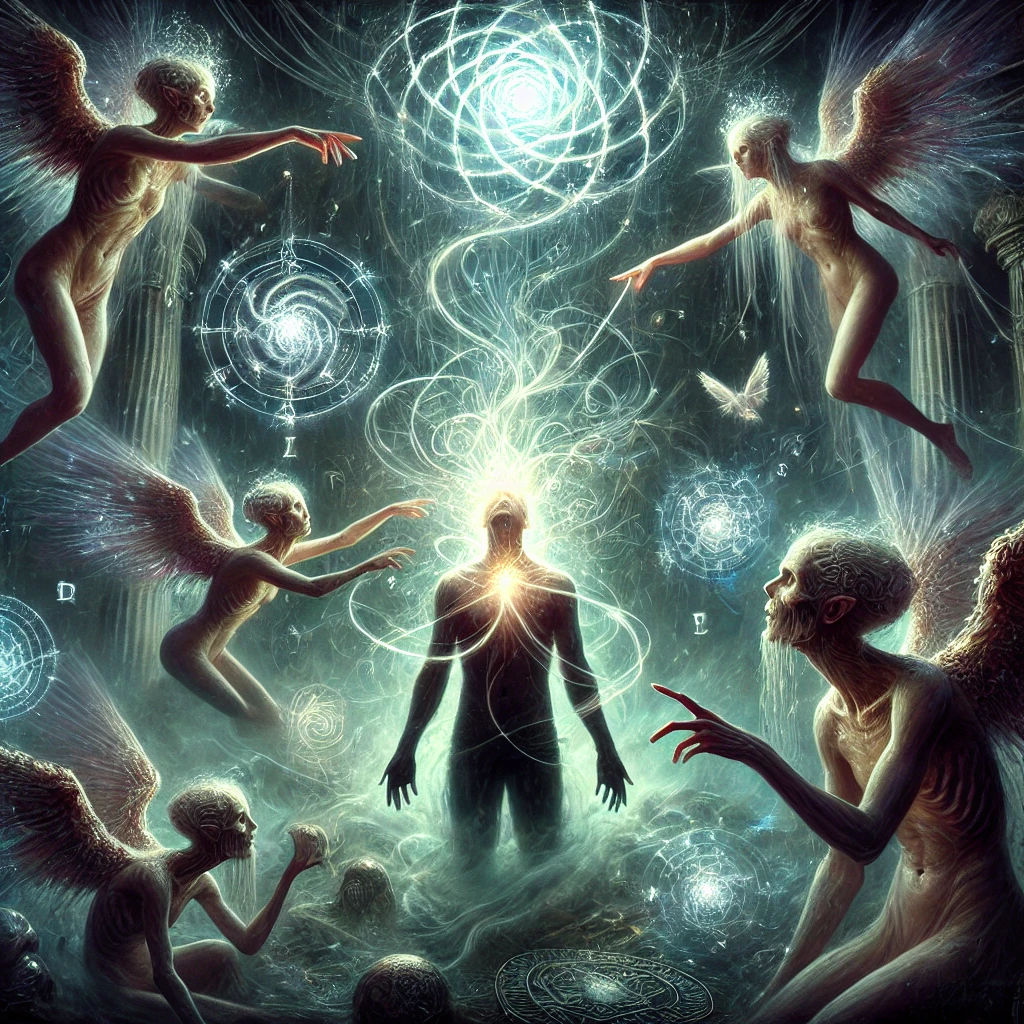
This is especially dangerous in spaces such as TEX, RII, LIN, where the space actively interacts with the inner content of the traveler.
Instead of a name, practices for interacting with the fae recommend speaking in images: “I am one who walks in shadow,” “One who seeks the song,” “Nameless,” “Whispering at dusk,” using ritual forms in which the subject does not name themselves but acts symbolically, attuning to inner resonance without clear verbalization.
And in order to address the fae, instead of a name, descriptions and epithets are used: “She who stands by the pond,” “He who dances in the ring,” signs: a gesture, an image, a flower, music, and sometimes simply inner impulses: the fae perceive intention and response, not sound. Such a method respects their mystery and opens space for contact.
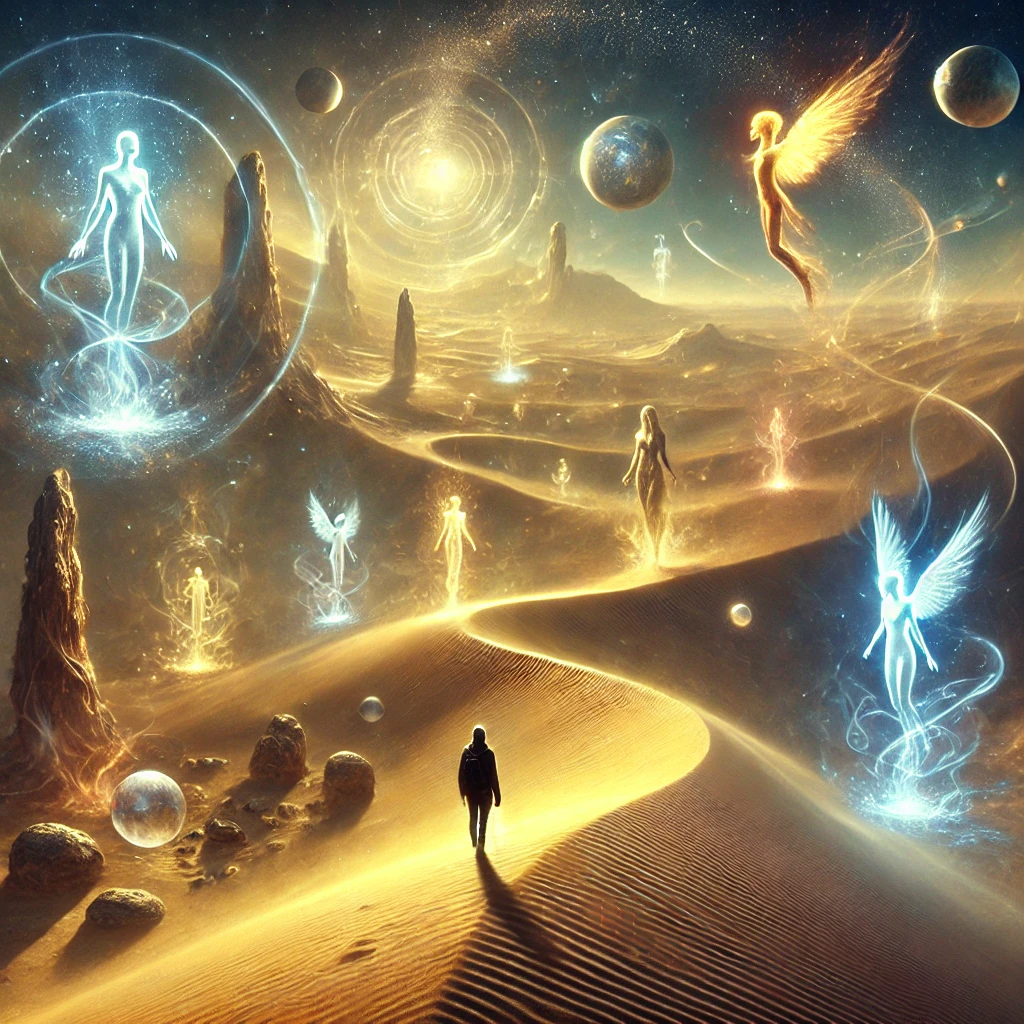
The faerie are beings of subtle sensitivity. They do not need a name to recognize the essence of a being or phenomenon, but a spoken name may prevent them from perceiving the being correctly.
Thus, the taboo on the name in the Interworld is a mechanism of careful interaction with another level of being, where form and word are magical actions, instruments for creating and changing reality.
Therefore, in faerie spaces a person is not a name, mask, or role. They are sound, image, a flow of mind, and a wave of intention. And only if they enter without a name are they free and multifaceted.
But if the fae name a being — that name will be true, but only for this moment, in this reflection, in this part of the dreaming. In this case, the name is not a fixation but the fruit of interaction. It does not “fix” the essence but illuminates one facet in the context of their world.
And therefore, entering the Interworld, be nameless like the wind, but whole as breath.




Thank you.
Hello! As I understood from the text of the article, the name structures reality and fixes form, while fairies exist in a fluid state. If so, can we consider the act of naming as a form of violence against being, and in this sense, are human languages, based on form and definiteness, incompatible with the perception of the world characteristic of fairies?
Hello! As we have discussed multiple times, in most human traditions, a name is an act of power. A name is an embodiment of the logos, a structuring principle that turns chaos into cosmos, flow into form, possibility into manifestation. But at the same time, naming impoverishes, ‘locks’ the named into a certain form of manifestation. Therefore, many have sensed since ancient times: a name gives power but also vulnerability. The named is submissive, captured. The nameless, on the other hand, is free. Fairies live in a fluid state of form, in what the ancient Celts called cruth. This is a form not in the sense of a completed appearance (as in the Greek morphe) but a living, instantaneous, and temporary manifestation of essence. We stated that fairies do not have one fixed form, name, or role. Their appearance, behavior, and even perception of the world and time are changeable, multiple, resonant with the surrounding world. They do not exist in a structure, but in flow. Therefore, for such beings, the act of naming is an interference, a violation of their nature. A name makes them singular, defined, and therefore distorted. It ‘extracts’ them from flow and places them within boundaries and confines. In other words, for their ontology, a name is an anchor that brings about loss of plasticity and freedom. Thus, naming can indeed be considered a form of violence against being since this being is originally fluid, multiple, and non-discrete. From this perspective, human language, based on names, categories, stable connections, and logic, is fundamentally incompatible with the perception of the world characteristic of fairies. It breaks the world into objects and actions, requires subjects and connections, imposes a form of thought through grammar and logic. Fairies, however, exist outside these boundaries; they do not fix the past and future linearly, thus their language is primarily rhythm, gesture, light, intonation, image, but not ‘name-predicate-action.’ However, this does not mean that communication between worlds is impossible. It simply means that it requires abandoning fixed thinking. Communication with fairies is possible – through response, through resonance. Fairies perceive the world through cruth – a form that arises naturally from the very essence of processes, and therefore – is not described but directly and immediately experienced. A person wanting to hear and understand their voice must not only learn a new language but also unlearn to fixate, name, and interpret.
This is an amazing article and the comment is great too. Thank you