We are the product of the relation between our realized and unrealized desires; we are the result of the interaction of our nature, our realizations, and our shadow.
Other Magic
Пишите мне
Enmerkar's Blog содержит более тысячи авторских статей эзотерической направленности.
Введите интересующий Вас запрос — и Вы найдете нужный для Вас материал
We are the product of the relation between our realized and unrealized desires; we are the result of the interaction of our nature, our realizations, and our shadow.
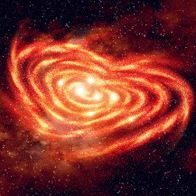
Recognizing freedom as the highest value means granting each individual stream the right to determine its own boundaries.
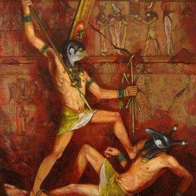
For the Magus it is equally important to find a balance in satisfying his needs, to recognize and neutralize whims in time, and, of course, to perceive and support the unfolding realization of a budding desire.

The mind must strive to overcome the multiplicity of its manifestations, toward unidirectionality and precise focus, without which the depth of the mind’s penetration into being will be insufficient for their integration

For the Way to become natural, one must first study it long and hard; and to understand that the Way was never lost, one must first search for it long and hard.

Only when the mind stops fleeing from presence, stops narrowing its field and striving to limit itself, to “forget itself,” does it find the keys to its nature — the nature of active presence, active creativity, active awareness.
Just as the blissful reliance on materiality as the source of goods and pleasures is a dead end and leads only to the accumulation of empty experience, taking pleasure in negation drives one toward destruction and self-fixation.
It can be said that any successful Magus is a goetic Magus, even if the Lemegeton is not his reference book.
Responsibility for the Magus is not merely a pretty word, nor even a desirable positive quality; for him it is a direct condition of both his own survival and the safety of those around him.
In realizing oneself in actions, the Magus does not lose the inward orientation of self-reflection; otherwise, one risks losing equilibrium and falling into empty activity. And in immersing oneself, one does not forget the necessity of self-knowledge in actions — otherwise, one loses the meaning of one’s individuality.
The Magus does not identify himself with the personalities and subpersonalities that flow one into another, nor does he deny them; he watches the play, sinks into his undifferentiated depth and reappears on the surface, avoiding both absolutism and nihilism.

Magic is a Way of developing the mind through action — a Way of transformation and transmutation that unfolds through ordering, through the interaction of the cognizing aspect with whatever is brought into awareness.
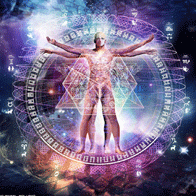
An individual knowable aspect becomes available to cognition only when it manifests itself, and the mode of such manifestation is interaction with other such aspects